Arrow left icon
Explore Products
Best Sellers
New Releases
Books
Videos
Audiobooks
Learning Hub
Newsletter Hub
Free Learning
Arrow right icon
timer SALE ENDS IN
0 Days
:
00 Hours
:
00 Minutes
:
00 Seconds

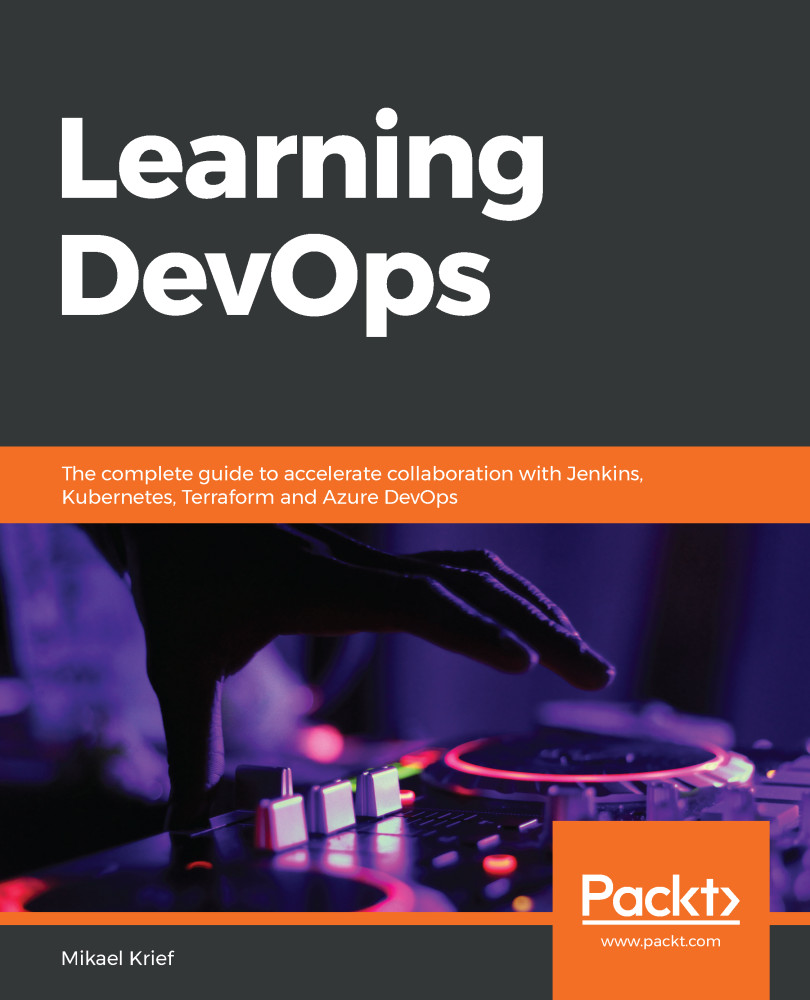
Free eBook - Learning DevOps

4 (4 reviews total)
By Mikael Krief
  • A new free eBook every day on the latest in tech
  • 30 permanently free eBooks from our core tech library
  1. Section 1: DevOps and Infrastructure as Code
About this book
The implementation of DevOps processes requires the efficient use of various tools, and the choice of these tools is crucial for the sustainability of projects and collaboration between development (Dev) and operations (Ops). This book presents the different patterns and tools that you can use to provision and configure an infrastructure in the cloud. You'll begin by understanding DevOps culture, the application of DevOps in cloud infrastructure, provisioning with Terraform, configuration with Ansible, and image building with Packer. You'll then be taken through source code versioning with Git and the construction of a DevOps CI/CD pipeline using Jenkins, GitLab CI, and Azure Pipelines. This DevOps handbook will also guide you in containerizing and deploying your applications with Docker and Kubernetes. You'll learn how to reduce deployment downtime with blue-green deployment and the feature flags technique, and study DevOps practices for open source projects. Finally, you'll grasp some best practices for reducing the overall application lead time to ensure faster time to market. By the end of this book, you'll have built a solid foundation in DevOps, and developed the skills necessary to enhance a traditional software delivery process using modern software delivery tools and techniques
Publication date:
October 2019
Publisher
Packt
Pages
504
ISBN
9781838642730


Section 1: DevOps and Infrastructure as Code

The objectives of the first section are to present the DevOps culture and to provide all of the keys for the best Infrastructure as Code practices. This section explains the DevOps application on cloud infrastructure, showing provisioning using Terraform and configuration with Ansible. Then, we improve this by templating this infrastructure with Packer.

We will have the following chapters in this section:

  • Chapter 1, DevOps Culture and Practices
  • Chapter 2, Provisioning Cloud Infrastructure with Terraform
  • Chapter 3, Using Ansible for Configuring IaaS Infrastructure
  • Chapter 4, Optimizing Infrastructure Deployment with Packer
About the Author
  • Mikael Krief

    Mikael Krief is a DevOps engineer who lives in France. He believes that Infrastructure as Code is a fundamental practice in DevOps culture. He is therefore interested in HashiCorp products and specializes in the use of Terraform. Mikael loves to share his passion through various communities, such as the HashiCorp User Groups. Over the years, he has contributed to many public projects, written various blog posts, published several books, and spoken at leading conferences. For his contributions and passion, he was nominated and selected as a HashiCorp Ambassador since 2019, and he has been awarded the Microsoft Most Valuable Professional (MVP) award for 7 years.

    Browse publications by this author
Latest Reviews (4 reviews total)
The problem with books about DevOps is that they typically deep dive in the trenches of DevOps technology right from the start. But, DevOps in the first place is about culture, it’s a mindshift. A mindshift to the left, granting teams to take more responsibility on how they develop and operate products. That comes with trust and trust is a matter of culture.In all honesty, reading the subtitel of this book, made me worry a bit. Reading words such as Terraform, Kubernetes, Jenkins and Azure DevOps does give the impression that is very much a tech-book for developers - although culture adoption is mentioned as well in the title. Mikael Krief rightfully starts with this: the cultural aspects of DevOps. But let there be no mistake: this is a tech-book, going through every aspect of Infrastructure as Code, configuration as code, CI/CD pipelines, containers and container orchestration with Kubernetes.The first three sections is a deep dive in the industry leading tooling, starting with Terraform to deploy infrastructure to Azure. (Be aware that this book focuses on the usage in Azure.) Next, we get into Ansible to configure the infrastructure and Packer to optimize the infra. The second section is about setting up the CI/CD pipelines, using Git, Jenkins and Azure DevOps. Logically, this section is followed by an extensive guide on how to work with Docker containers and Kubernetes container orchestration. Since the book focuses on Azure, obviously there's quite some detailing on using Helm charts with ACR and AKS.Again, the author gets me worried a bit at this stage. DevOps is a shift-left movement, so where's the security and specially the testing of the code? Test-driven development is likely one of the most important aspects in DevOps and luckily the whole of section 4 is about testing the application, security and performance tests. In the final chapter, best practices are listed, including the shift-left in security.In short: this is probably one of the most complete books on DevOps targeting the Azure cloud. In well over 500 pages every aspect of DevOps is discussed. The only 'downside' is that by trying to be as complete as the author, topics tend to just start scratching the surface. But overall: this is a very good, yet technical introduction to learn about DevOps.
Very nice product covering all the concepts
This book would get five starts, except that for some reason, the text is gray when you make the background black. You cannot change the font color, either. Why? This is terrible. The contrast is horrid.
Recommended For You
Solutions Architect's Handbook

From fundamentals and design patterns to the different strategies for creating secure and reliable architectures in AWS cloud, learn everything you need to become a successful solutions architect

By Saurabh Shrivastava and 1 more
Kubernetes and Docker - An Enterprise Guide

Apply Kubernetes beyond the basics of Kubernetes clusters by implementing IAM using OIDC and Active Directory, Layer 4 load balancing using MetalLB, advanced service integration, security, auditing, and CI/CD

By Scott Surovich and 1 more
Mastering Kubernetes - Third Edition

Go beyond simply learning Kubernetes fundamentals and its deployment, and explore more advanced concepts, including serverless computing and service meshes with the latest updates

By Gigi Sayfan
The Docker Workshop

Get started with Docker on your local machine and progress towards deploying useful applications in production with this simplified, practical guide

By Vincent Sesto and 4 more