Search icon CANCEL
Subscription
0
Cart icon
Your Cart (0 item)
Close icon
You have no products in your basket yet
Save more on your purchases! discount-offer-chevron-icon
Savings automatically calculated. No voucher code required.
Arrow left icon
Explore Products
Best Sellers
New Releases
Books
Videos
Audiobooks
Learning Hub
Newsletter Hub
Free Learning
Arrow right icon
timer SALE ENDS IN
0 Days
:
00 Hours
:
00 Minutes
:
00 Seconds
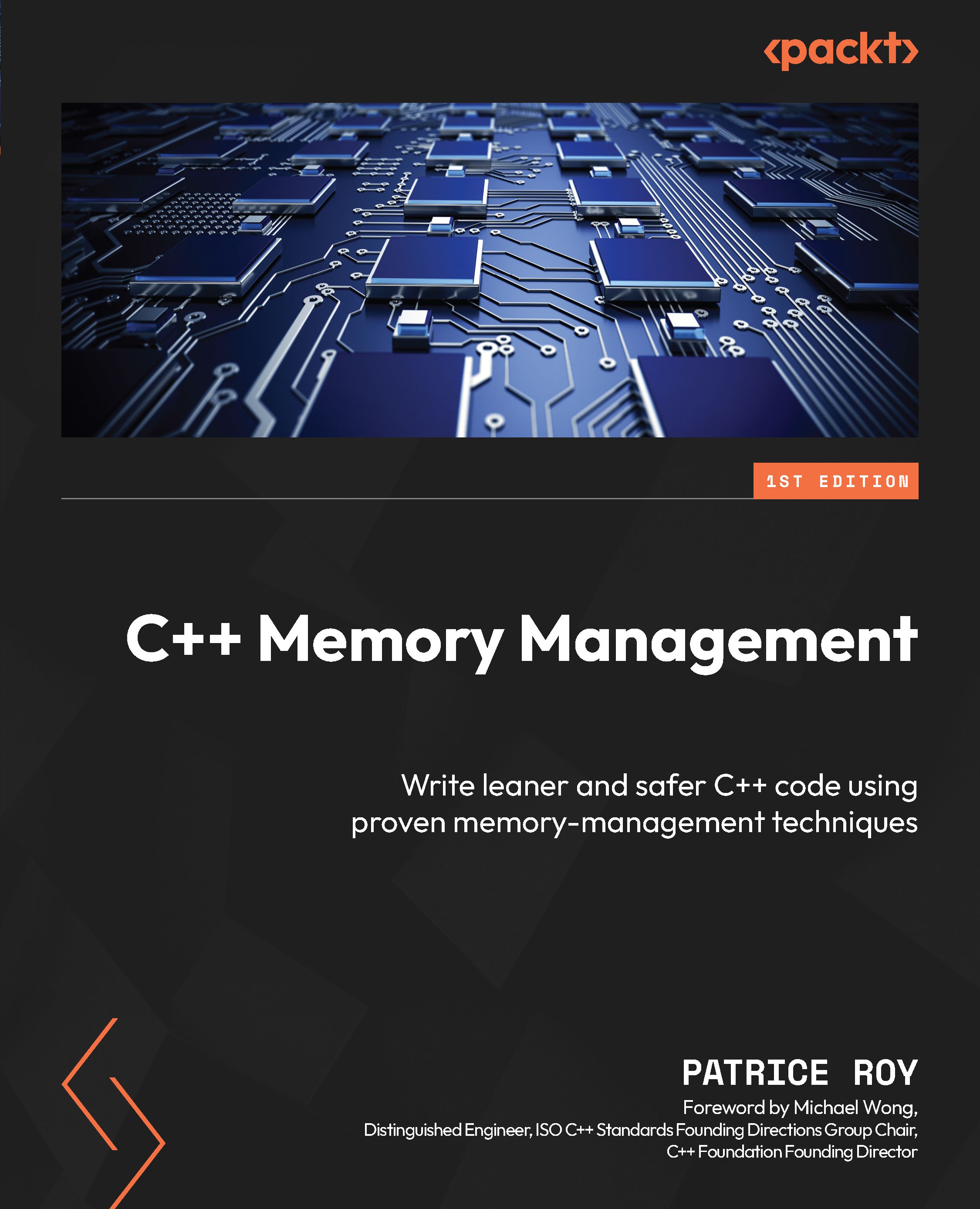
C++ Memory Management

C++ Memory Management: Write leaner and safer C++ code using proven memory-management techniques

Arrow left icon
Profile Icon Patrice Roy
Arrow right icon
Free Trial
Full star icon Full star icon Full star icon Half star icon Empty star icon 3.7 (3 Ratings)
Paperback Mar 2025 442 pages 1st Edition
eBook
$9.99 $33.99
Paperback
$41.99
Subscription
Free Trial
Arrow left icon
Profile Icon Patrice Roy
Arrow right icon
Free Trial
Full star icon Full star icon Full star icon Half star icon Empty star icon 3.7 (3 Ratings)
Paperback Mar 2025 442 pages 1st Edition
eBook
$9.99 $33.99
Paperback
$41.99
Subscription
Free Trial
eBook
$9.99 $33.99
Paperback
$41.99
Subscription
Free Trial

What do you get with a Packt Subscription?

Free for first 7 days. $19.99 p/m after that. Cancel any time!
Product feature icon Unlimited ad-free access to the largest independent learning library in tech. Access this title and thousands more!
Product feature icon 50+ new titles added per month, including many first-to-market concepts and exclusive early access to books as they are being written.
Product feature icon Innovative learning tools, including AI book assistants, code context explainers, and text-to-speech.
Product feature icon Thousands of reference materials covering every tech concept you need to stay up to date.
Subscribe now
View plans & pricing
Table of content icon View table of contents Preview book icon Preview Book

C++ Memory Management

Objects, Pointers, and References

Before we start discussing memory management in C++, let’s make sure we understand each other and agree on a common vocabulary. If you’re a long-time C++ programmer, you probably have your own ideas about what pointers, objects, and references are. Your ideas will stem from a wealth of experience. If you are coming to this book from another language, you might also have your own ideas as to what these terms mean in C++ and how they relate to memory and memory management.

In this chapter, we are going to make sure we have a common understanding of some basic (but profound) ideas so that we can build on this shared understanding for the rest of our adventure together. Specifically, we will explore questions such as the following:

  • How is memory represented in C++? What exactly is that thing we call memory, at least in the context of the C++ language?
  • What are objects, pointers, and references? What do we mean by those terms...

Getting the most out of this book – get to know your free benefits

Unlock exclusive free benefits that come with your purchase, thoughtfully crafted to supercharge your learning journey and help you learn without limits.

Here’s a quick overview of what you get with this book:

Next-gen reader

Figure 1.1: Illustration of the next-gen Packt Reader’s features

Our web-based reader, designed to help you learn effectively, comes with the following features:

Multi-device progress sync: Learn from any device with seamless progress sync.

Highlighting and notetaking: Turn your reading into lasting knowledge.

Bookmarking: Revisit your most important learnings anytime.

Dark mode: Focus with minimal eye strain by switching to dark or sepia mode.

Interactive...

Technical requirements

This book assumes that readers have some basic knowledge of C++ or of syntactically similar languages such as C, Java, C#, or JavaScript. For this reason, we will not explain the basics of variable declarations, loops, if statements, or functions.

We will, however, use some aspects of the C++ language in this chapter that some readers might be less comfortable with. Please refer to Annexure: Things You Should Know, before reading this book.

Some of the examples use C++20 or C++23, so make sure that your compiler supports this version of the standard to get the most out of them.

The code for this chapter can be found here: https://github.com/PacktPublishing/C-Plus-Plus-Memory-Management/tree/main/chapter1.

Representation of memory in C++

This is a book on memory management. You, readers, are trying to figure out what it means, and I, as the author, am trying to convey what it means.

The way in which the standard describes memory can be seen in [wg21.link/basic.memobj]. Essentially, memory in C++ is expressed as one or more sequences of contiguous bytes. This opens up the possibility of memory expressed as a set of discontinuous blocks of contiguous memory because, historically, C++ has supported memories made of various distinct segments. Every byte in a C++ program has a unique address.

Memory in a C++ program is populated with various entities such as objects, functions, references, and so on. Managing memory efficiently requires grasping what these entities mean and how programs can make use of them.

The meaning of the word byte is important in C++. As detailed in [wg21.link/intro.memory], bytes are the fundamental storage unit in C++. The number of bits in a byte is implementation...

Understanding the fundamental properties of objects

We saw earlier that in C++, an object has a type and an address. It also occupies a region of storage from the beginning of its construction to the end of its destruction. We will now examine these fundamental properties in more detail in order to understand how these properties affect the ways in which we write programs.

Object lifetime

One of C++’s strengths, but also one reason for its relative complexity, arises from the control one has over the lifetime of objects. In C++, generally speaking, automatic objects are destructed at the end of their scope in a well-defined order. Static (global) objects are destructed on program termination in a somewhat well-defined order (in a given file, the order of destruction is clear, but it’s more complicated for static objects in different files). Dynamically allocated objects are destructed “when your program says so” (there are many nuances to this).

...

Arrays

We have used arrays in our preceding examples, but we have not really provided a formal definition for that useful-yet-low-level construct. Note that in this section, the term “array” refers to raw, built-in arrays, not to other very useful but higher-level constructs such as std::vector<T> or std::array<T,N>.

Quite simply, in C++, an array is a contiguous sequence of elements of the same type. Thus, in the following excerpt, the a0 object occupies 10*sizeof(int) bytes in memory, whereas the a1 object occupies 20*sizeof(std::string) bytes:

int a0[10];
std::string a1[20];

The number of bytes between elements at indices i and i+1 in an array of some type T is precisely equal to sizeof(T).

Consider the following expression, which would be used in C++, as in C, for some array arr:

arr[i]

It evaluates to the same address as the following:

*(arr + i)

Since pointer arithmetic is typed, the + i part in this expression means “plus...

Summary

In this chapter, we took a look at fundamental ideas of the C++ language such as: what is an object? What are pointers and references? What do we mean when we talk about the size and alignment of an object or of a type? Why are there no zero-size objects in C++? What are the special members of a class and when do we need to write them explicitly? This non-exhaustive list of topics gave us a common vocabulary from which to build what you, dear reader, will find in the chapters to come.

With this, we are ready to get our hands dirty, so to speak. We have given ourselves a set of low-level tools and ideas from which to build higher-level abstractions, but we have to give ourselves some measure of discipline.

The next chapter will discuss some things we need to avoid. Those include undefined behavior, implementation-defined behavior (to a lesser extent), ill-formed no-diagnostic-required code, buffer overflows, and other unrecommendable behaviors.

Then, we will follow...

Left arrow icon Right arrow icon
Download code icon Download Code

Key benefits

  • Use contemporary C++ features to enhance code safety and reliability
  • Develop a deeper understanding of memory management mechanisms in C++
  • Write programs that adapt to the constraints of your chosen architecture or platform

Description

Memory management in C++ isn't one-size-fits-all; real-time systems, games, and embedded applications each present unique memory constraints. This book delivers targeted solutions for each domain. Written by ISO C++ Standards Committee member, Patrice Roy, this guide covers fundamental concepts of object lifetime and memory organization to help you write simpler and safer programs. You’ll learn how to control memory allocation mechanisms, create custom containers and allocators, and adapt allocation operators to suit your specific requirements, making your programs smaller, faster, safer, and more predictable. From core principles to modern facilities that simplify your work, you’ll master memory management mechanics, build tailored memory solutions for your application needs, and measure their impact on your program’s behavior. By the end of this book, you’ll be able to write secure programs that handle memory optimally for your application domain. You will also have a strong grasp of both high-level abstractions for safer programs and low-level abstractions that allow detailed customization.

Who is this book for?

This book is for programmers who find C++ memory management challenging yet want to master it. It’s ideal for those seeking greater control over memory allocation to make their programs smaller, faster, and safer. Whether you're a seasoned C++ developer or transitioning from other languages, you'll gain insights into how C++ can enhance your programming. It’s especially valuable if you’re working in constrained environments, like embedded systems or game development. Prior experience with programming concepts, such as generic and concurrent programming, is helpful.

What you will learn

  • Master the C++ object model to write more efficient and maintainable code
  • Automate resource management to reduce manual errors and improve safety
  • Customize memory allocation operators to optimize performance for specific applications
  • Develop your own smart pointers to manage dynamic memory with greater control
  • Adapt allocation behavior to meet the unique needs of different data types
  • Create safe and fast containers to ensure optimal data handling in your programs
  • Utilize standard allocators to streamline memory management in your containers

Product Details

Country selected
Publication date, Length, Edition, Language, ISBN-13
Publication date : Mar 25, 2025
Length: 442 pages
Edition : 1st
Language : English
ISBN-13 : 9781805129806
Category :
Languages :

What do you get with a Packt Subscription?

Free for first 7 days. $19.99 p/m after that. Cancel any time!
Product feature icon Unlimited ad-free access to the largest independent learning library in tech. Access this title and thousands more!
Product feature icon 50+ new titles added per month, including many first-to-market concepts and exclusive early access to books as they are being written.
Product feature icon Innovative learning tools, including AI book assistants, code context explainers, and text-to-speech.
Product feature icon Thousands of reference materials covering every tech concept you need to stay up to date.
Subscribe now
View plans & pricing

Product Details

Publication date : Mar 25, 2025
Length: 442 pages
Edition : 1st
Language : English
ISBN-13 : 9781805129806
Category :
Languages :

Packt Subscriptions

See our plans and pricing
Modal Close icon
$19.99 billed monthly
Feature tick icon Unlimited access to Packt's library of 7,000+ practical books and videos
Feature tick icon Constantly refreshed with 50+ new titles a month
Feature tick icon Exclusive Early access to books as they're written
Feature tick icon Solve problems while you work with advanced search and reference features
Feature tick icon Offline reading on the mobile app
Feature tick icon Simple pricing, no contract
$199.99 billed annually
Feature tick icon Unlimited access to Packt's library of 7,000+ practical books and videos
Feature tick icon Constantly refreshed with 50+ new titles a month
Feature tick icon Exclusive Early access to books as they're written
Feature tick icon Solve problems while you work with advanced search and reference features
Feature tick icon Offline reading on the mobile app
Feature tick icon Choose a DRM-free eBook or Video every month to keep
Feature tick icon PLUS own as many other DRM-free eBooks or Videos as you like for just Mex$85 each
Feature tick icon Exclusive print discounts
$279.99 billed in 18 months
Feature tick icon Unlimited access to Packt's library of 7,000+ practical books and videos
Feature tick icon Constantly refreshed with 50+ new titles a month
Feature tick icon Exclusive Early access to books as they're written
Feature tick icon Solve problems while you work with advanced search and reference features
Feature tick icon Offline reading on the mobile app
Feature tick icon Choose a DRM-free eBook or Video every month to keep
Feature tick icon PLUS own as many other DRM-free eBooks or Videos as you like for just Mex$85 each
Feature tick icon Exclusive print discounts

Table of Contents

22 Chapters
Part 1: Memory in C++ Chevron down icon Chevron up icon
Chapter 1: Objects, Pointers, and References Chevron down icon Chevron up icon
Chapter 2: Things to Be Careful With Chevron down icon Chevron up icon
Chapter 3: Casts and cv-qualifications Chevron down icon Chevron up icon
Part 2: Implicit Memory Management Techniques Chevron down icon Chevron up icon
Chapter 4: Using Destructors Chevron down icon Chevron up icon
Chapter 5: Using Standard Smart Pointers Chevron down icon Chevron up icon
Chapter 6: Writing Smart Pointers Chevron down icon Chevron up icon
Part 3: Taking Control (of Memory Management Mechanisms) Chevron down icon Chevron up icon
Chapter 7: Overloading Memory Allocation Operators Chevron down icon Chevron up icon
Chapter 8: Writing a Naïve Leak Detector Chevron down icon Chevron up icon
Chapter 9: Atypical Allocation Mechanisms Chevron down icon Chevron up icon
Chapter 10: Arena-Based Memory Management and Other Optimizations Chevron down icon Chevron up icon
Chapter 11: Deferred Reclamation Chevron down icon Chevron up icon
Part 4: Writing Generic Containers (and a Bit More) Chevron down icon Chevron up icon
Chapter 12: Writing Generic Containers with Explicit Memory Management Chevron down icon Chevron up icon
Chapter 13: Writing Generic Containers with Implicit Memory Management Chevron down icon Chevron up icon
Chapter 14: Writing Generic Containers with Allocator Support Chevron down icon Chevron up icon
Chapter 15: Contemporary Issues Chevron down icon Chevron up icon
Chapter 16: Unlock Your Book’s Exclusive Benefits Chevron down icon Chevron up icon
Annexure: Things You Should Know Chevron down icon Chevron up icon
Index Chevron down icon Chevron up icon

Customer reviews

Rating distribution
Full star icon Full star icon Full star icon Half star icon Empty star icon 3.7
(3 Ratings)
5 star 66.7%
4 star 0%
3 star 0%
2 star 0%
1 star 33.3%
Jason Curl Apr 18, 2025
Full star icon Full star icon Full star icon Full star icon Full star icon 5
Finally, a book that covers the world of memory management in C++. From all the books and internet searches, this is by far one of the most important books I’ve come across on lifetime management and memory usage as per the standard to avoid undefined behaviour. I haven’t spent much time on iterators yet, but while everyone trivialises it, there are for people new to C++ many details not explained. I’ve been programming for 35 years in assembly, C99, C# on Windows, embedded OSes and Linux. I know about memory, just not C++ model, and very few engineers actually do when I ask.
Feefo Verified review Feefo
Mahamadou Diakite May 14, 2025
Full star icon Full star icon Full star icon Full star icon Full star icon 5
This book is an essential resource for anyone who prioritizes memory management to enhance software performance.
Feefo Verified review Feefo
Jaykumar Nov 01, 2025
Full star icon Empty star icon Empty star icon Empty star icon Empty star icon 1
navigation broken
Subscriber review Packt
Get free access to Packt library with over 7500+ books and video courses for 7 days!
Start Free Trial

FAQs

What is included in a Packt subscription? Chevron down icon Chevron up icon

A subscription provides you with full access to view all Packt and licnesed content online, this includes exclusive access to Early Access titles. Depending on the tier chosen you can also earn credits and discounts to use for owning content

How can I cancel my subscription? Chevron down icon Chevron up icon

To cancel your subscription with us simply go to the account page - found in the top right of the page or at https://subscription.packtpub.com/my-account/subscription - From here you will see the ‘cancel subscription’ button in the grey box with your subscription information in.

What are credits? Chevron down icon Chevron up icon

Credits can be earned from reading 40 section of any title within the payment cycle - a month starting from the day of subscription payment. You also earn a Credit every month if you subscribe to our annual or 18 month plans. Credits can be used to buy books DRM free, the same way that you would pay for a book. Your credits can be found in the subscription homepage - subscription.packtpub.com - clicking on ‘the my’ library dropdown and selecting ‘credits’.

What happens if an Early Access Course is cancelled? Chevron down icon Chevron up icon

Projects are rarely cancelled, but sometimes it's unavoidable. If an Early Access course is cancelled or excessively delayed, you can exchange your purchase for another course. For further details, please contact us here.

Where can I send feedback about an Early Access title? Chevron down icon Chevron up icon

If you have any feedback about the product you're reading, or Early Access in general, then please fill out a contact form here and we'll make sure the feedback gets to the right team. 

Can I download the code files for Early Access titles? Chevron down icon Chevron up icon

We try to ensure that all books in Early Access have code available to use, download, and fork on GitHub. This helps us be more agile in the development of the book, and helps keep the often changing code base of new versions and new technologies as up to date as possible. Unfortunately, however, there will be rare cases when it is not possible for us to have downloadable code samples available until publication.

When we publish the book, the code files will also be available to download from the Packt website.

How accurate is the publication date? Chevron down icon Chevron up icon

The publication date is as accurate as we can be at any point in the project. Unfortunately, delays can happen. Often those delays are out of our control, such as changes to the technology code base or delays in the tech release. We do our best to give you an accurate estimate of the publication date at any given time, and as more chapters are delivered, the more accurate the delivery date will become.

How will I know when new chapters are ready? Chevron down icon Chevron up icon

We'll let you know every time there has been an update to a course that you've bought in Early Access. You'll get an email to let you know there has been a new chapter, or a change to a previous chapter. The new chapters are automatically added to your account, so you can also check back there any time you're ready and download or read them online.

I am a Packt subscriber, do I get Early Access? Chevron down icon Chevron up icon

Yes, all Early Access content is fully available through your subscription. You will need to have a paid for or active trial subscription in order to access all titles.

How is Early Access delivered? Chevron down icon Chevron up icon

Early Access is currently only available as a PDF or through our online reader. As we make changes or add new chapters, the files in your Packt account will be updated so you can download them again or view them online immediately.

How do I buy Early Access content? Chevron down icon Chevron up icon

Early Access is a way of us getting our content to you quicker, but the method of buying the Early Access course is still the same. Just find the course you want to buy, go through the check-out steps, and you’ll get a confirmation email from us with information and a link to the relevant Early Access courses.

What is Early Access? Chevron down icon Chevron up icon

Keeping up to date with the latest technology is difficult; new versions, new frameworks, new techniques. This feature gives you a head-start to our content, as it's being created. With Early Access you'll receive each chapter as it's written, and get regular updates throughout the product's development, as well as the final course as soon as it's ready.We created Early Access as a means of giving you the information you need, as soon as it's available. As we go through the process of developing a course, 99% of it can be ready but we can't publish until that last 1% falls in to place. Early Access helps to unlock the potential of our content early, to help you start your learning when you need it most. You not only get access to every chapter as it's delivered, edited, and updated, but you'll also get the finalized, DRM-free product to download in any format you want when it's published. As a member of Packt, you'll also be eligible for our exclusive offers, including a free course every day, and discounts on new and popular titles.

Modal Close icon
Modal Close icon