Search icon CANCEL
Subscription
0
Cart icon
Your Cart (0 item)
Close icon
You have no products in your basket yet
Save more on your purchases! discount-offer-chevron-icon
Savings automatically calculated. No voucher code required.
Arrow left icon
Explore Products
Best Sellers
New Releases
Books
Videos
Audiobooks
Learning Hub
Newsletter Hub
Free Learning
Arrow right icon
timer SALE ENDS IN
0 Days
:
00 Hours
:
00 Minutes
:
00 Seconds
Arrow up icon
GO TO TOP
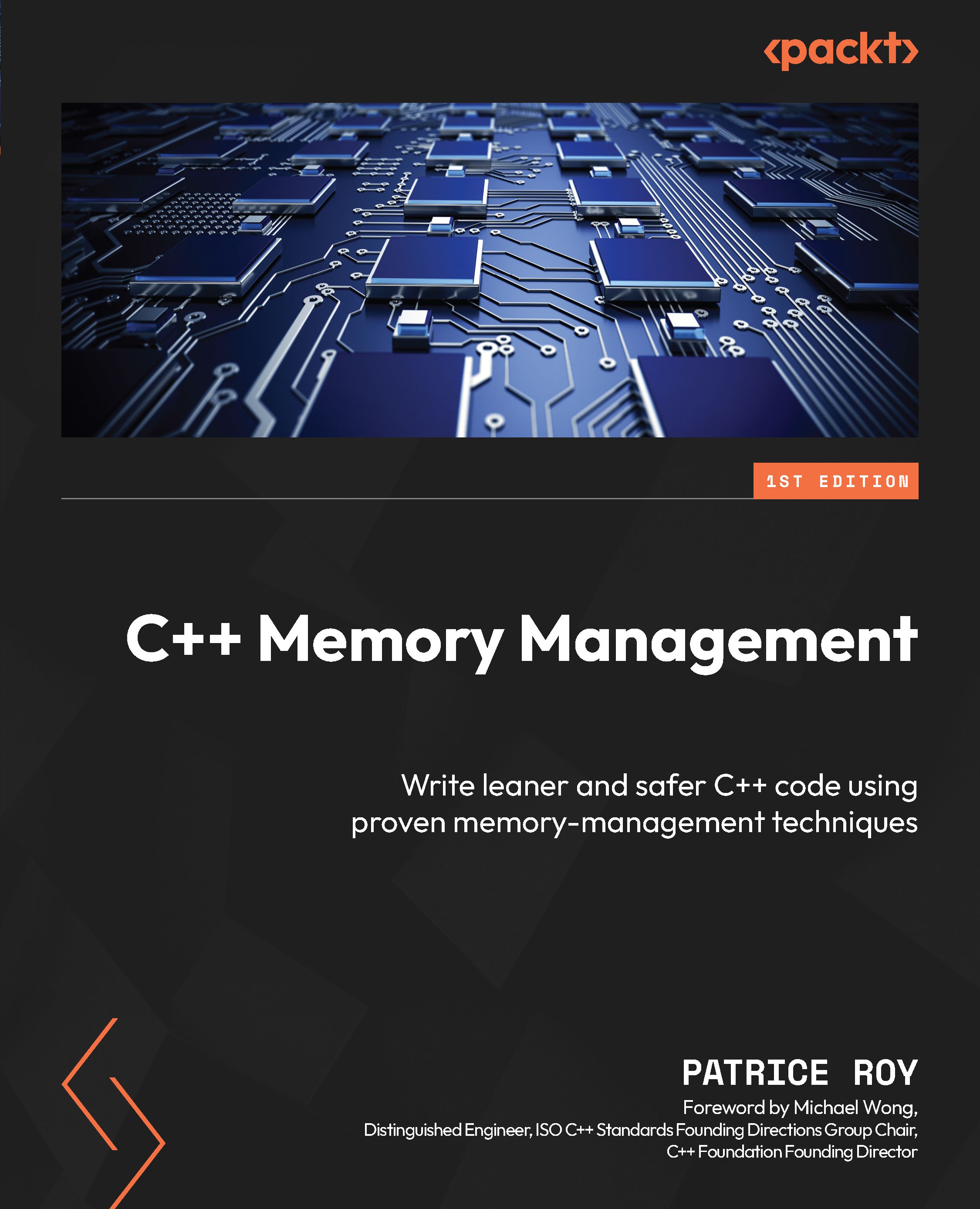
C++ Memory Management

You're reading from   C++ Memory Management Write leaner and safer C++ code using proven memory-management techniques

Arrow left icon
Product type Paperback
Published in Mar 2025
Publisher Packt
ISBN-13 9781805129806
Length 442 pages
Edition 1st Edition
Languages
Arrow right icon
Author (1):
Arrow left icon
Patrice Roy Patrice Roy
Author Profile Icon Patrice Roy
Patrice Roy
Arrow right icon
View More author details
Toc

Table of Contents (23) Chapters Close

Preface 1. Part 1: Memory in C++
2. Chapter 1: Objects, Pointers, and References FREE CHAPTER 3. Chapter 2: Things to Be Careful With 4. Chapter 3: Casts and cv-qualifications 5. Part 2: Implicit Memory Management Techniques
6. Chapter 4: Using Destructors 7. Chapter 5: Using Standard Smart Pointers 8. Chapter 6: Writing Smart Pointers 9. Part 3: Taking Control (of Memory Management Mechanisms)
10. Chapter 7: Overloading Memory Allocation Operators 11. Chapter 8: Writing a Naïve Leak Detector 12. Chapter 9: Atypical Allocation Mechanisms 13. Chapter 10: Arena-Based Memory Management and Other Optimizations 14. Chapter 11: Deferred Reclamation 15. Part 4: Writing Generic Containers (and a Bit More)
16. Chapter 12: Writing Generic Containers with Explicit Memory Management 17. Chapter 13: Writing Generic Containers with Implicit Memory Management 18. Chapter 14: Writing Generic Containers with Allocator Support 19. Chapter 15: Contemporary Issues 20. Chapter 16: Unlock Your Book’s Exclusive Benefits 21. Annexure: Things You Should Know 22. Index

Brief overview of the C language allocation functions

Before we get to the memory allocation mechanisms of C++, let’s first take a brief look at the C family of memory allocation functions through its most distinguished representatives: malloc() and free(). There are, of course, many other memory-allocation-related functions such as calloc(), realloc(), and aligned_alloc(), not counting operating-system-specific services that perform similar tasks for specialized use cases, but these will serve our discussion well.

Note that since this is a book on memory management with C++, I will use the C++ version of these functions (from <cstdlib> instead of <stdlib.h>), which really changes nothing to the code we will write except for the fact that in C++, these functions are located in the std namespace.

The signatures for these two functions are as follows:

void* malloc(size_t n);
void free(void *p);

Quick tip: Enhance your coding experience with the AI Code...

lock icon The rest of the chapter is locked
Visually different images
CONTINUE READING
83
Tech Concepts
36
Programming languages
73
Tech Tools
Icon Unlimited access to the largest independent learning library in tech of over 8,000 expert-authored tech books and videos.
Icon Innovative learning tools, including AI book assistants, code context explainers, and text-to-speech.
Icon 50+ new titles added per month and exclusive early access to books as they are being written.
C++ Memory Management
Register for a free Packt account to unlock a world of extra content!
A free Packt account unlocks extra newsletters, articles, discounted offers, and much more. Start advancing your knowledge today.
Unlock this book and the full library FREE for 7 days
Get unlimited access to 7000+ expert-authored eBooks and videos courses covering every tech area you can think of
Renews at $19.99/month. Cancel anytime
Modal Close icon
Modal Close icon