Search icon CANCEL
Subscription
0
Cart icon
Your Cart (0 item)
Close icon
You have no products in your basket yet
Save more on your purchases! discount-offer-chevron-icon
Savings automatically calculated. No voucher code required.
Arrow left icon
Explore Products
Best Sellers
New Releases
Books
Videos
Audiobooks
Learning Hub
Newsletter Hub
Free Learning
Arrow right icon
timer SALE ENDS IN
0 Days
:
00 Hours
:
00 Minutes
:
00 Seconds
Arrow up icon
GO TO TOP
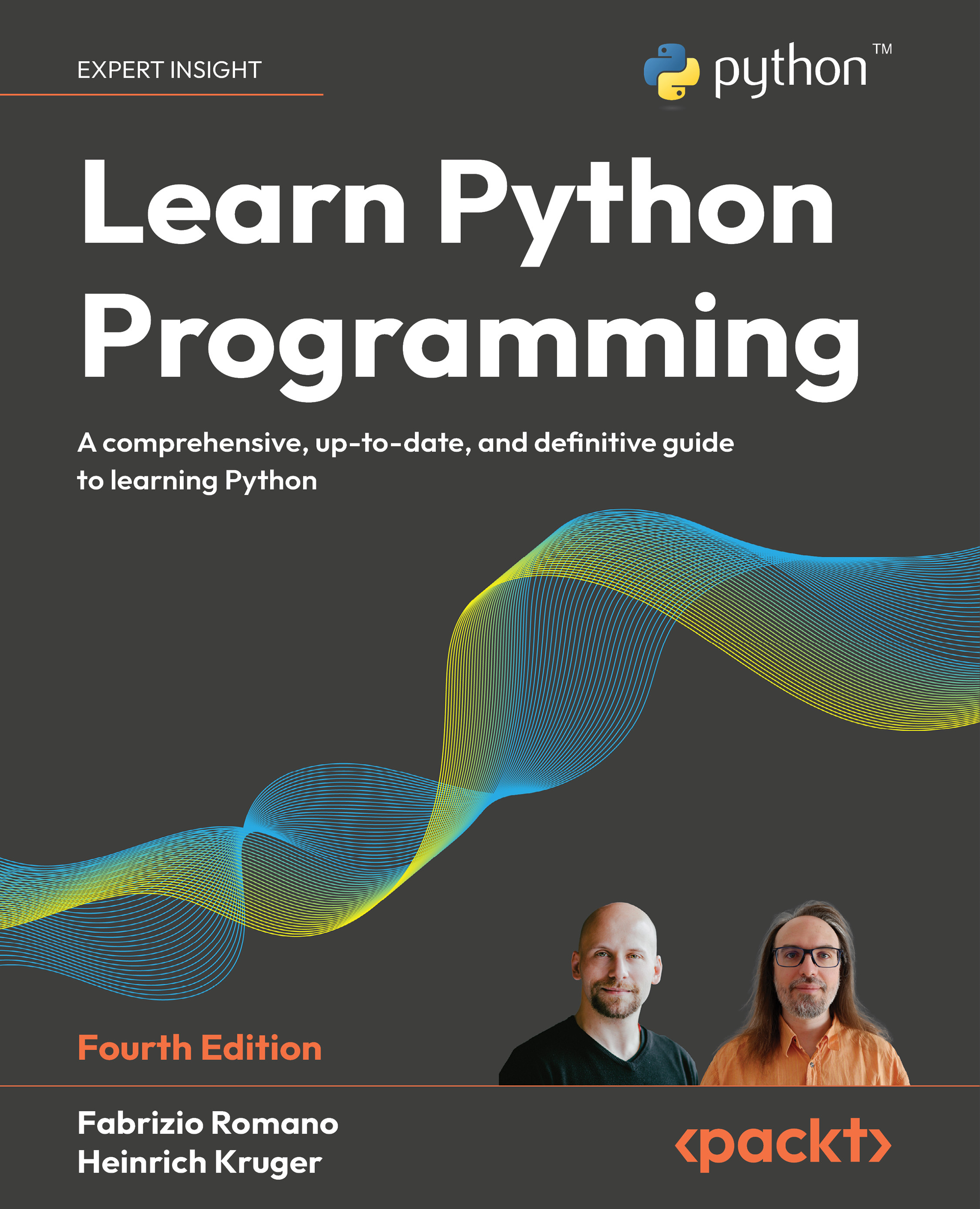
Learn Python Programming

You're reading from   Learn Python Programming A comprehensive, up-to-date, and definitive guide to learning Python

Arrow left icon
Product type Paperback
Published in Nov 2024
Publisher Packt
ISBN-13 9781835882948
Length 620 pages
Edition 4th Edition
Languages
Arrow right icon
Authors (2):
Arrow left icon
Fabrizio Romano Fabrizio Romano
Author Profile Icon Fabrizio Romano
Fabrizio Romano
Heinrich Kruger Heinrich Kruger
Author Profile Icon Heinrich Kruger
Heinrich Kruger
Arrow right icon
View More author details
Toc

Table of Contents (21) Chapters Close

Preface
A Gentle Introduction to Python FREE CHAPTER Built-In Data Types Conditionals and Iteration Functions, the Building Blocks of Code Comprehensions and Generators OOP, Decorators, and Iterators Exceptions and Context Managers Files and Data Persistence Cryptography and Tokens Testing Debugging and Profiling Introduction to Type Hinting Data Science in Brief Introduction to API Development CLI Applications Packaging Python Applications Programming Challenges Unlock Your Exclusive Benefits
Other Books You May Enjoy
Index

Debugging techniques

In this part, we will introduce you to some of the techniques we use most often. This is not an exhaustive list, but it should give you some useful ideas for where to start when debugging your own Python code.

Debugging with print

The key to understanding any bug is to understand what your code is doing at the point where the bug occurs. For this reason, we will be looking at a few different techniques for inspecting the state of a program while it is running.

The easiest technique of all is to add print() calls at various points in your code. This allows you to easily see which parts of your code are executed, and what the values of key variables are at different points during execution. For example, if you are developing a Django website and what happens on a page is not what you would expect, you can fill the view with prints and keep an eye on the console while you reload the page.

There are several drawbacks and limitations to using print...

lock icon The rest of the chapter is locked
CONTINUE READING
83
Tech Concepts
36
Programming languages
73
Tech Tools
Icon Unlimited access to the largest independent learning library in tech of over 8,000 expert-authored tech books and videos.
Icon Innovative learning tools, including AI book assistants, code context explainers, and text-to-speech.
Icon 50+ new titles added per month and exclusive early access to books as they are being written.
Learn Python Programming
Register for a free Packt account to unlock a world of extra content!
A free Packt account unlocks extra newsletters, articles, discounted offers, and much more. Start advancing your knowledge today.
Unlock this book and the full library FREE for 7 days
Get unlimited access to 7000+ expert-authored eBooks and videos courses covering every tech area you can think of
Renews at $19.99/month. Cancel anytime
Modal Close icon
Modal Close icon