Search icon CANCEL
Subscription
0
Cart icon
Your Cart (0 item)
Close icon
You have no products in your basket yet
Save more on your purchases! discount-offer-chevron-icon
Savings automatically calculated. No voucher code required.
Arrow left icon
Explore Products
Best Sellers
New Releases
Books
Videos
Audiobooks
Learning Hub
Newsletter Hub
Free Learning
Arrow right icon
timer SALE ENDS IN
0 Days
:
00 Hours
:
00 Minutes
:
00 Seconds
Julia High Performance

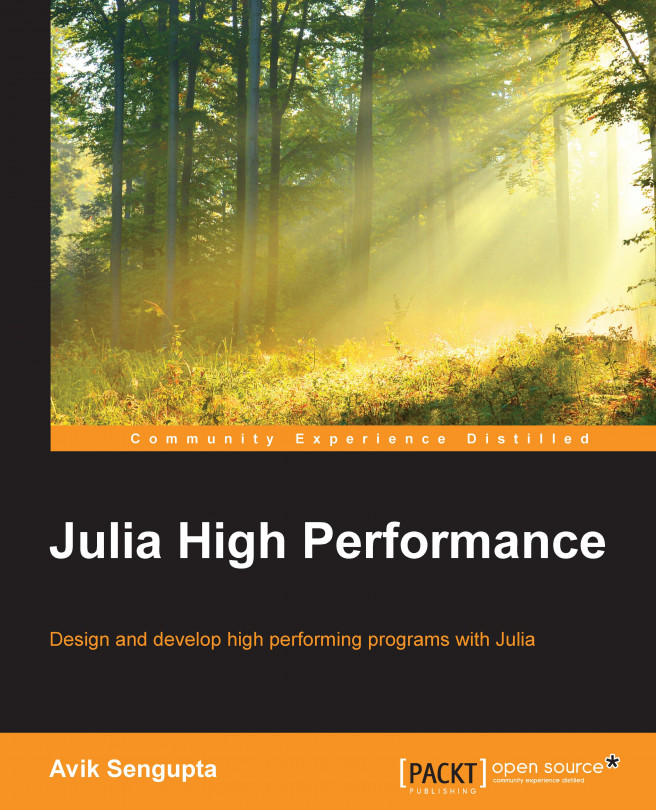
Julia High Performance: Design and develop high performing programs with Julia

eBook
$26.99 $29.99
Paperback
$38.99
Hardcover
$32.99
Subscription
Free Trial
Renews at $19.99p/m

What do you get with Print?

Product feature icon Instant access to your digital copy whilst your Print order is Shipped
Product feature icon Paperback book shipped to your preferred address
Product feature icon Redeem a companion digital copy on all Print orders
Product feature icon Access this title in our online reader with advanced features
Product feature icon DRM FREE - Read whenever, wherever and however you want
Product feature icon AI Assistant (beta) to help accelerate your learning
Modal Close icon
Payment Processing...
tick Completed

Shipping Address

Billing Address

Shipping Methods
Table of content icon View table of contents Preview book icon Preview Book

Julia High Performance

Chapter 1. Julia is Fast

In many ways, the history of programming languages has often been driven by, and certainly intertwined, with the needs of numerical and scientific computing. The first high-level programming language, Fortran, was created with scientific computing in mind, and continues to be important in the field even to this day. In recent years, the rise of data science as a specialty has brought additional focus to scientific computing, particularly for statistical uses. In this area, somewhat counterintuitively, both specialized languages such as R and general-purpose languages such as Python are in widespread use. The rise of Hadoop and Spark has spread the use of Java and Scala respectively among this community. In the midst of all this, Matlab has had a strong niche within engineering and communities, while Mathematica remains unparalleled for symbolic operations.

A new language for scientific computing therefore has a very high barrier to overcome. It's been only a few short years since the Julia language was introduced into the world. In this time, it's innovative features, which make it a dynamic language, based on multiple dispatch as its defining paradigm, has created growing niche within the numerical computing world. However, it's the claim of high performance that excited its early adopters the most.

This, then, is a book that celebrates writing high-performance programs. With Julia, this is not only possible, but also reasonably straightforward, within a low-overhead, dynamic language.

As a reader of this book, you have likely already written your first few Julia programs. We will assume that you have successfully installed Julia, and have a working programming environment available. We expect you are familiar with very basic Julia syntax, but we will discuss and review many of those concepts throughout the book as we introduce them.

  • Julia – fast and dynamic
  • Designed for speed
  • How fast can Julia be?

Julia – fast and dynamic

It is a widely believed myth in programming language communities that high-performance languages and dynamic languages are completely disjoint sets. The perceived wisdom is that, if you want programmer productivity, you should use a dynamic language, such as Ruby, Python or R. On the other hand, if you want fast code execution, you should use a statically typed language such as C or Java.

There are always exceptions to this rule. However, for most mainstream programmers, this is a strongly held belief.

This usually manifests itself in what is known as the "two language" problem. This is something that is especially prominent in scientific computing. This is the situation where the performance-critical inner kernel is written in C, but is then wrapped and used from a dynamic, higher-level language. Code written in traditional, scientific computing environments such as R, Matlab or NumPy follows this paradigm.

Code written in this fashion is not without its drawbacks however. Even though it looks like this gets you the best of both worlds — fast computation, while allowing the programmer to use a high-level language — this is a path full of hidden dangers. For one, someone will have to write the low-level kernel. So, you need two different skillsets. If you are lucky to find the low level code in C for your project, you are fine. However, if you are doing anything new or original, or even slightly different from the norm, you will find yourself writing both C and a high-level language. This severely limits the number of contributors that your projects or research will get: to be really productive, they have to be familiar with two languages.

Secondly, when running code routinely written in two languages, there can be severe and unforeseen performance pitfalls. When you can drop down to C code quickly, everything is fine. However, if, for whatever reason, your code cannot call into a C routine, you'll find your program taking hundreds or even thousands of times more longer than you expected.

Julia is the first modern language to make a reasonable effort to solve the "two language" problem. It is a high-level, dynamic, language with powerful features that make for a very productive programmer. At the same time, code written in Julia usually runs very fast, almost as fast as code written in statically typed languages.

The rest of this chapter describes some of the underlying design decisions that make Julia such a fast language. We also see some evidence of the performance claims for Julia.

The rest of the book shows you how to write your Julia programs in a way that optimizes its time and memory usage to the maximum. We will discuss how to measure and reason performance in Julia, and how to avoid potential performance pitfalls.

For all the content in this book, we will illustrate our point individually with small and simple programs. We hope that this will enable you grasp the crux of the issue, without getting distracted by unnecessary elements of a larger program. We expect that this methodology will therefore provide you with an instinctive intuition about Julia's performance profile.

Julia has a refreshingly simple performance model – and thus writing fast Julia code is a matter of understanding a few key elements of computer architecture, and how the Julia compiler interacts with it. We hope that, by the end of this book, your instincts are well developed to design and write your own Julia code with the fastest possible performance.

Tip

Versions of Julia

Julia is a fast moving project, with an open development process. All the code and examples in this book are targeted at version 0.4 of the language, which is the currently released version at the time of publication. Check Packt's website for changes and errata for future versions of Julia.


Designed for speed

When the creators of Julia launched the language into the world, they said the following in a blog post entitled Why We Created Julia, which was published in early 2012:

"We want a language that's open source, with a liberal license. We want the speed of C with the dynamism of Ruby. We want a language that's homoiconic, with true macros like Lisp, but with obvious, familiar mathematical notation like Matlab. We want something as usable for general programming as Python, as easy for statistics as R, as natural for string processing as Perl, as powerful for linear algebra as Matlab, as good at gluing programs together as the shell. Something that is dirt simple to learn, yet keeps the most serious hackers happy. We want it interactive and we want it compiled.

(Did we mention it should be as fast as C?)"

High performance, indeed nearly C-level performance, has therefore been one of the founding principles of the language. It's built from the ground up to enable a fast execution of code.

In addition to being a core design principle, it has also been a necessity from the early stages of its development. A very large part of Julia's standard library, including very basic low-level operations, is written in Julia itself. For example, the + operation to add two integers is defined in Julia itself. (Refer to: https://github.com/JuliaLang/julia/blob/1986c5024db36b4c921130351597f5b4f9f81691/base/int.jl#L8). Similarly, the basic for loop uses the standard iteration mechanism available to all user-defined types. This means that the implementation had to be very fast from the very beginning to create a usable language. The creators of Julia did not have the luxury of escaping to C for even the core elements of the library.

We will note throughout the book many design decisions that have been made with an eye to high performance. But there are three main elements that create the basis for Julia's speed.

JIT and LLVM

Julia is a Just In Time (JIT) compiled language, rather than an interpreted one. This allows Julia to be dynamic, without having the overhead of interpretation. This compilation infrastructure is build on top of Low Level Virtual Machine (LLVM) (http://llvm.org).

JIT and LLVM

The LLVM compiler without infrastructure project originated at University of Illinois. It now has contributions from a very large number of corporate as well as independent developers. As a result of all this work, it is now a very high-quality, yet modular, system for many different compilation and code generation activities.

Julia uses LLVM for its JIT compilation needs. The Julia runtime generates LLVM Intermediate Representation (IR) and hands it over to LLVM's JIT compiler, which in turn generates machine code that is executed on the CPU. As a result, sophisticated compilation techniques that are built into LLVM are ready and available to Julia, from the simple (such as Loop Unrolling or Loop Deletion) to state-of-the-art (such as SIMD Vectorization) ones. These compiler optimizations form a very large body of work, and in this sense, the existence is of LLVM is very much a pre-requisite to the existence of Julia. It would have been an almost impossible task for a small team of developers to build this infrastructure from scratch.

Tip

Just-In-Time compilation

Just-in-Time compilation is a technique in which the code in a high-level language is converted to machine code for execution on the CPU at runtime. This is in contrast to interpreted languages, whose runtime executes the source language directly. This usually has a significantly higher overhead. On the other hand, Ahead of Time (AOT) compilation refers to the technique of converting source language into machine code as a separate step prior to running the code. In this case, the converted machine code can usually be saved to disk as an executable file.

Types

We will have much more to say about types in Julia throughout this book. At this stage, suffice it to say that Julia's concept of types is a key ingredient in its performance.

The Julia compiler tries to infer the type of all data used in a program, and compiles different versions of functions specialized to particular types of its arguments. To take a simple example, consider the sqrt function. This function can be called with integer or floating-point arguments. Julia will compile two versions of the code, one for integer arguments, and one for floating point arguments. This means that, at runtime, fast, straight-line code without any type checks will be executed on the CPU.

The ability of the compiler to reason about types is due to the combination of a sophisticated dataflow-based algorithm, and careful language design that allows this information to be inferred from most programs before execution begins. Put in another way, the language is designed to make it easy to statically analyze.

If there is a single reason for Julia is being such a high-performance language, this is it. This is why Julia is able to run at C-like speeds while still being a dynamic language. Type inference and code specialization are as close to a secret sauce as Julia gets. It is notable that, outside this type inference mechanism, the Julia compiler is quite simple. It does not include many advanced Just in Time optimizations that Java and JavaScript compilers are known to use. When the compiler has enough information about the types within the code, it can generate optimized, straight-line, code without many of these advanced techniques.

It is useful to note here that unlike some other optionally typed dynamic languages, simply adding type annotations to your code does not usually make Julia go any faster. Type inference means that the compiler is, in most cases, able to figure out the types of variables when necessary. Hence you can usually write high-level code without fighting with the compiler about types, and still achieve superior performance.

How fast can Julia be?

The best evidence of Julia's performance claims is when you write your own code. However, we can provide an indication of how fast Julia can be by comparing a similar algorithm over multiple languages.

As an example, let's consider a very simple routine to calculate the power sum for a series, as follows:

How fast can Julia be?

The following code runs this computation in Julia 500 times:

function pisum()
    sum = 0.0
    for j = 1:500
        sum = 0.0
        for k = 1:10000
            sum += 1.0/(k*k)
        end
    end
    sum
end

You will notice that this code contains no type annotations. It should look quite familiar to any modern dynamic language. The same algorithm implemented in C would look something similar to this:

double pisum() {
    double sum = 0.0;
    for (int j=0; j<500; ++j) {
        sum = 0.0;
        for (int k=1; k<=10000; ++k) {
            sum += 1.0/(k*k);
        }
    }
    return sum;
}

Tip

Downloading the example code

You can download the example code files for this book from your account at http://www.packtpub.com. If you purchased this book elsewhere, you can visit http://www.packtpub.com/support and register to have the files e-mailed directly to you.

You can download the code files by following these steps:

  • Log in or register to our website using your e-mail address and password
  • Let the mouse pointer hover on the SUPPORT tab at the top
  • Click on Code Downloads & Errata
  • Enter the name of the book in the Search box
  • Select the book for which you're looking to download the code files
  • Choose from the drop-down menu where you purchased this book from
  • Click on Code Download

You can also download the code files by clicking on the Code Files button on the book's webpage at the Packt Publishing website. This page can be accessed by entering the book's name in the Search box. Please note that you need to be logged in to your Packt account.

Once the file is downloaded, please make sure that you unzip or extract the folder using the latest version of:

  • WinRAR/7-Zip for Windows
  • Zipeg/iZip/UnRarX for Mac
  • 7-Zip/PeaZip for Linux

By timing this code, and its re-implementation in many other languages (all of which are available at https://github.com/JuliaLang/julia/tree/master/test/perf/micro), we can note that Julia's performance claims are certainly borne out in this limited test. Julia can perform at a level similar to C and other statically typed and compiled languages.

This is of course a micro benchmark, and should therefore not be extrapolated too much. However, I hope you will agree that it is possible to achieve excellent performance in Julia. The rest of the book will attempt to show how you can achieve performance close to this standard in your code.

How fast can Julia be?

Summary

In this chapter, you noted that Julia is a language that is built from the ground up for high performance. Its design and implementation have always been focused on providing the highest possible performance on the modern CPU.

The rest of the book will show you how to use the power of Julia to the maximum, to write the fastest possible code in this language. In the next chapter, we will discuss how to measure the speed of Julia code, and identify performance bottlenecks. You will learn some of the tools that are built into Julia for this purpose.

Left arrow icon Right arrow icon
Download code icon Download Code

Key benefits

  • Learn to code high reliability and high performance programs
  • Stand out from the crowd by developing code that runs faster than your peers’ codes
  • This book is intended for developers who are interested in high performance technical programming.

Description

Julia is a high performance, high-level dynamic language designed to address the requirements of high-level numerical and scientific computing. Julia brings solutions to the complexities faced by developers while developing elegant and high performing code. Julia High Performance will take you on a journey to understand the performance characteristics of your Julia programs, and enables you to utilize the promise of near C levels of performance in Julia. You will learn to analyze and measure the performance of Julia code, understand how to avoid bottlenecks, and design your program for the highest possible performance. In this book, you will also see how Julia uses type information to achieve its performance goals, and how to use multuple dispatch to help the compiler to emit high performance machine code. Numbers and their arrays are obviously the key structures in scientific computing – you will see how Julia’s design makes them fast. The last chapter will give you a taste of Julia’s distributed computing capabilities.

Who is this book for?

This book is for beginner and intermediate Julia programmers who are interested in high performance technical computing. You will have a basic familiarity with Julia syntax, and have written some small programs in the language.

What you will learn

  • * Discover the secrets behind Julia's speed
  • * Get a sense of the possibilities and limitations of Julia's performance
  • * Analyze the performance of Julia programs
  • * Measure the time and memory taken by Julia programs
  • * Create fast machine code using Julia's type information
  • * Define and call functions without compromising Julia's performance
  • * Understand number types in Julia
  • * Use Julia arrays to write high performance code
  • * Get an overview of Julia's distributed computing capabilities
Estimated delivery fee Deliver to United States

Economy delivery 10 - 13 business days

Free $6.95

Premium delivery 6 - 9 business days

$21.95
(Includes tracking information)

Product Details

Country selected
Publication date, Length, Edition, Language, ISBN-13
Publication date : Apr 26, 2016
Length: 132 pages
Edition : 1st
Language : English
ISBN-13 : 9781785880919
Category :
Languages :

What do you get with Print?

Product feature icon Instant access to your digital copy whilst your Print order is Shipped
Product feature icon Paperback book shipped to your preferred address
Product feature icon Redeem a companion digital copy on all Print orders
Product feature icon Access this title in our online reader with advanced features
Product feature icon DRM FREE - Read whenever, wherever and however you want
Product feature icon AI Assistant (beta) to help accelerate your learning
Modal Close icon
Payment Processing...
tick Completed

Shipping Address

Billing Address

Shipping Methods
Estimated delivery fee Deliver to United States

Economy delivery 10 - 13 business days

Free $6.95

Premium delivery 6 - 9 business days

$21.95
(Includes tracking information)

Product Details

Publication date : Apr 26, 2016
Length: 132 pages
Edition : 1st
Language : English
ISBN-13 : 9781785880919
Category :
Languages :

Packt Subscriptions

See our plans and pricing
Modal Close icon
$19.99 billed monthly
Feature tick icon Unlimited access to Packt's library of 7,000+ practical books and videos
Feature tick icon Constantly refreshed with 50+ new titles a month
Feature tick icon Exclusive Early access to books as they're written
Feature tick icon Solve problems while you work with advanced search and reference features
Feature tick icon Offline reading on the mobile app
Feature tick icon Simple pricing, no contract
$199.99 billed annually
Feature tick icon Unlimited access to Packt's library of 7,000+ practical books and videos
Feature tick icon Constantly refreshed with 50+ new titles a month
Feature tick icon Exclusive Early access to books as they're written
Feature tick icon Solve problems while you work with advanced search and reference features
Feature tick icon Offline reading on the mobile app
Feature tick icon Choose a DRM-free eBook or Video every month to keep
Feature tick icon PLUS own as many other DRM-free eBooks or Videos as you like for just $5 each
Feature tick icon Exclusive print discounts
$279.99 billed in 18 months
Feature tick icon Unlimited access to Packt's library of 7,000+ practical books and videos
Feature tick icon Constantly refreshed with 50+ new titles a month
Feature tick icon Exclusive Early access to books as they're written
Feature tick icon Solve problems while you work with advanced search and reference features
Feature tick icon Offline reading on the mobile app
Feature tick icon Choose a DRM-free eBook or Video every month to keep
Feature tick icon PLUS own as many other DRM-free eBooks or Videos as you like for just $5 each
Feature tick icon Exclusive print discounts

Frequently bought together


Stars icon
Total $ 143.97
Julia High Performance
$38.99
Getting started with Julia Programming Language
$43.99
Mastering Julia
$60.99
Total $ 143.97 Stars icon

Table of Contents

8 Chapters
1. Julia is Fast Chevron down icon Chevron up icon
2. Analyzing Julia Performance Chevron down icon Chevron up icon
3. Types in Julia Chevron down icon Chevron up icon
4. Functions and Macros – Structuring Julia Code for High Performance Chevron down icon Chevron up icon
5. Fast Numbers Chevron down icon Chevron up icon
6. Fast Arrays Chevron down icon Chevron up icon
7. Beyond the Single Processor Chevron down icon Chevron up icon
Index Chevron down icon Chevron up icon

Customer reviews

Rating distribution
Full star icon Full star icon Full star icon Full star icon Empty star icon 4
(4 Ratings)
5 star 50%
4 star 0%
3 star 50%
2 star 0%
1 star 0%
Amazon Customer Nov 01, 2016
Full star icon Full star icon Full star icon Full star icon Full star icon 5
Bom para quem já conhece a linguagem, nível entre intermediário e avançado. Apresenta boa estrutura e didática, pena que é só em inglês.
Amazon Verified review Amazon
Amazon Customer Dec 11, 2016
Full star icon Full star icon Full star icon Full star icon Full star icon 5
A brief (115 pages) but effective exploration of Julia's high performance capabilities, including parallelism.
Amazon Verified review Amazon
Andrew Jul 20, 2016
Full star icon Full star icon Full star icon Empty star icon Empty star icon 3
Very thin book for its price. The book describes itself as being aimed at novice & intermediate level Julia programmers -- I consider myself in that range, however only maybe 7-10 pages of the 115 in the book were useful/new to me.If you are an absolute novice, this book will be useful to you. But you should just go read the online documentation on the Julia website and get a significant percentage of the same information.Well written and very readable. Went through the whole thing quite comfortably in a couple of hours.
Amazon Verified review Amazon
J. DEHAAN Jun 16, 2016
Full star icon Full star icon Full star icon Empty star icon Empty star icon 3
At 111 pages this is a fairly thin book. Taking out all the partially and fully blank pages and the many unnecessary full listings of Julia REPL output would reduce it to about 60 to 70 pages. I read it cover to cover in about two hours, which left me with the feeling "is this it?". This is partially because I wished the author would have fleshed out more of the topics and partially because I already knew about half the topics from reading the very good Julia documentation online. Now, the proverbial story is that it costs five thousand dollar and fifty cents to fix a generator; a quarter for each kick and $5000 for knowing where to kick. And this is where this book succeeds. It tells you where to kick. That justified the price of the book for me. Your mileage may vary.
Amazon Verified review Amazon
Get free access to Packt library with over 7500+ books and video courses for 7 days!
Start Free Trial

FAQs

What is the digital copy I get with my Print order? Chevron down icon Chevron up icon

When you buy any Print edition of our Books, you can redeem (for free) the eBook edition of the Print Book you’ve purchased. This gives you instant access to your book when you make an order via PDF, EPUB or our online Reader experience.

What is the delivery time and cost of print book? Chevron down icon Chevron up icon

Shipping Details

USA:

'

Economy: Delivery to most addresses in the US within 10-15 business days

Premium: Trackable Delivery to most addresses in the US within 3-8 business days

UK:

Economy: Delivery to most addresses in the U.K. within 7-9 business days.
Shipments are not trackable

Premium: Trackable delivery to most addresses in the U.K. within 3-4 business days!
Add one extra business day for deliveries to Northern Ireland and Scottish Highlands and islands

EU:

Premium: Trackable delivery to most EU destinations within 4-9 business days.

Australia:

Economy: Can deliver to P. O. Boxes and private residences.
Trackable service with delivery to addresses in Australia only.
Delivery time ranges from 7-9 business days for VIC and 8-10 business days for Interstate metro
Delivery time is up to 15 business days for remote areas of WA, NT & QLD.

Premium: Delivery to addresses in Australia only
Trackable delivery to most P. O. Boxes and private residences in Australia within 4-5 days based on the distance to a destination following dispatch.

India:

Premium: Delivery to most Indian addresses within 5-6 business days

Rest of the World:

Premium: Countries in the American continent: Trackable delivery to most countries within 4-7 business days

Asia:

Premium: Delivery to most Asian addresses within 5-9 business days

Disclaimer:
All orders received before 5 PM U.K time would start printing from the next business day. So the estimated delivery times start from the next day as well. Orders received after 5 PM U.K time (in our internal systems) on a business day or anytime on the weekend will begin printing the second to next business day. For example, an order placed at 11 AM today will begin printing tomorrow, whereas an order placed at 9 PM tonight will begin printing the day after tomorrow.


Unfortunately, due to several restrictions, we are unable to ship to the following countries:

  1. Afghanistan
  2. American Samoa
  3. Belarus
  4. Brunei Darussalam
  5. Central African Republic
  6. The Democratic Republic of Congo
  7. Eritrea
  8. Guinea-bissau
  9. Iran
  10. Lebanon
  11. Libiya Arab Jamahriya
  12. Somalia
  13. Sudan
  14. Russian Federation
  15. Syrian Arab Republic
  16. Ukraine
  17. Venezuela
What is custom duty/charge? Chevron down icon Chevron up icon

Customs duty are charges levied on goods when they cross international borders. It is a tax that is imposed on imported goods. These duties are charged by special authorities and bodies created by local governments and are meant to protect local industries, economies, and businesses.

Do I have to pay customs charges for the print book order? Chevron down icon Chevron up icon

The orders shipped to the countries that are listed under EU27 will not bear custom charges. They are paid by Packt as part of the order.

List of EU27 countries: www.gov.uk/eu-eea:

A custom duty or localized taxes may be applicable on the shipment and would be charged by the recipient country outside of the EU27 which should be paid by the customer and these duties are not included in the shipping charges been charged on the order.

How do I know my custom duty charges? Chevron down icon Chevron up icon

The amount of duty payable varies greatly depending on the imported goods, the country of origin and several other factors like the total invoice amount or dimensions like weight, and other such criteria applicable in your country.

For example:

  • If you live in Mexico, and the declared value of your ordered items is over $ 50, for you to receive a package, you will have to pay additional import tax of 19% which will be $ 9.50 to the courier service.
  • Whereas if you live in Turkey, and the declared value of your ordered items is over € 22, for you to receive a package, you will have to pay additional import tax of 18% which will be € 3.96 to the courier service.
How can I cancel my order? Chevron down icon Chevron up icon

Cancellation Policy for Published Printed Books:

You can cancel any order within 1 hour of placing the order. Simply contact customercare@packt.com with your order details or payment transaction id. If your order has already started the shipment process, we will do our best to stop it. However, if it is already on the way to you then when you receive it, you can contact us at customercare@packt.com using the returns and refund process.

Please understand that Packt Publishing cannot provide refunds or cancel any order except for the cases described in our Return Policy (i.e. Packt Publishing agrees to replace your printed book because it arrives damaged or material defect in book), Packt Publishing will not accept returns.

What is your returns and refunds policy? Chevron down icon Chevron up icon

Return Policy:

We want you to be happy with your purchase from Packtpub.com. We will not hassle you with returning print books to us. If the print book you receive from us is incorrect, damaged, doesn't work or is unacceptably late, please contact Customer Relations Team on customercare@packt.com with the order number and issue details as explained below:

  1. If you ordered (eBook, Video or Print Book) incorrectly or accidentally, please contact Customer Relations Team on customercare@packt.com within one hour of placing the order and we will replace/refund you the item cost.
  2. Sadly, if your eBook or Video file is faulty or a fault occurs during the eBook or Video being made available to you, i.e. during download then you should contact Customer Relations Team within 14 days of purchase on customercare@packt.com who will be able to resolve this issue for you.
  3. You will have a choice of replacement or refund of the problem items.(damaged, defective or incorrect)
  4. Once Customer Care Team confirms that you will be refunded, you should receive the refund within 10 to 12 working days.
  5. If you are only requesting a refund of one book from a multiple order, then we will refund you the appropriate single item.
  6. Where the items were shipped under a free shipping offer, there will be no shipping costs to refund.

On the off chance your printed book arrives damaged, with book material defect, contact our Customer Relation Team on customercare@packt.com within 14 days of receipt of the book with appropriate evidence of damage and we will work with you to secure a replacement copy, if necessary. Please note that each printed book you order from us is individually made by Packt's professional book-printing partner which is on a print-on-demand basis.

What tax is charged? Chevron down icon Chevron up icon

Currently, no tax is charged on the purchase of any print book (subject to change based on the laws and regulations). A localized VAT fee is charged only to our European and UK customers on eBooks, Video and subscriptions that they buy. GST is charged to Indian customers for eBooks and video purchases.

What payment methods can I use? Chevron down icon Chevron up icon

You can pay with the following card types:

  1. Visa Debit
  2. Visa Credit
  3. MasterCard
  4. PayPal
What is the delivery time and cost of print books? Chevron down icon Chevron up icon

Shipping Details

USA:

'

Economy: Delivery to most addresses in the US within 10-15 business days

Premium: Trackable Delivery to most addresses in the US within 3-8 business days

UK:

Economy: Delivery to most addresses in the U.K. within 7-9 business days.
Shipments are not trackable

Premium: Trackable delivery to most addresses in the U.K. within 3-4 business days!
Add one extra business day for deliveries to Northern Ireland and Scottish Highlands and islands

EU:

Premium: Trackable delivery to most EU destinations within 4-9 business days.

Australia:

Economy: Can deliver to P. O. Boxes and private residences.
Trackable service with delivery to addresses in Australia only.
Delivery time ranges from 7-9 business days for VIC and 8-10 business days for Interstate metro
Delivery time is up to 15 business days for remote areas of WA, NT & QLD.

Premium: Delivery to addresses in Australia only
Trackable delivery to most P. O. Boxes and private residences in Australia within 4-5 days based on the distance to a destination following dispatch.

India:

Premium: Delivery to most Indian addresses within 5-6 business days

Rest of the World:

Premium: Countries in the American continent: Trackable delivery to most countries within 4-7 business days

Asia:

Premium: Delivery to most Asian addresses within 5-9 business days

Disclaimer:
All orders received before 5 PM U.K time would start printing from the next business day. So the estimated delivery times start from the next day as well. Orders received after 5 PM U.K time (in our internal systems) on a business day or anytime on the weekend will begin printing the second to next business day. For example, an order placed at 11 AM today will begin printing tomorrow, whereas an order placed at 9 PM tonight will begin printing the day after tomorrow.


Unfortunately, due to several restrictions, we are unable to ship to the following countries:

  1. Afghanistan
  2. American Samoa
  3. Belarus
  4. Brunei Darussalam
  5. Central African Republic
  6. The Democratic Republic of Congo
  7. Eritrea
  8. Guinea-bissau
  9. Iran
  10. Lebanon
  11. Libiya Arab Jamahriya
  12. Somalia
  13. Sudan
  14. Russian Federation
  15. Syrian Arab Republic
  16. Ukraine
  17. Venezuela
Modal Close icon
Modal Close icon