Search icon CANCEL
Subscription
0
Cart icon
Your Cart (0 item)
Close icon
You have no products in your basket yet
Save more on your purchases! discount-offer-chevron-icon
Savings automatically calculated. No voucher code required.
Arrow left icon
Explore Products
Best Sellers
New Releases
Books
Videos
Audiobooks
Learning Hub
Newsletter Hub
Free Learning
Arrow right icon
timer SALE ENDS IN
0 Days
:
00 Hours
:
00 Minutes
:
00 Seconds
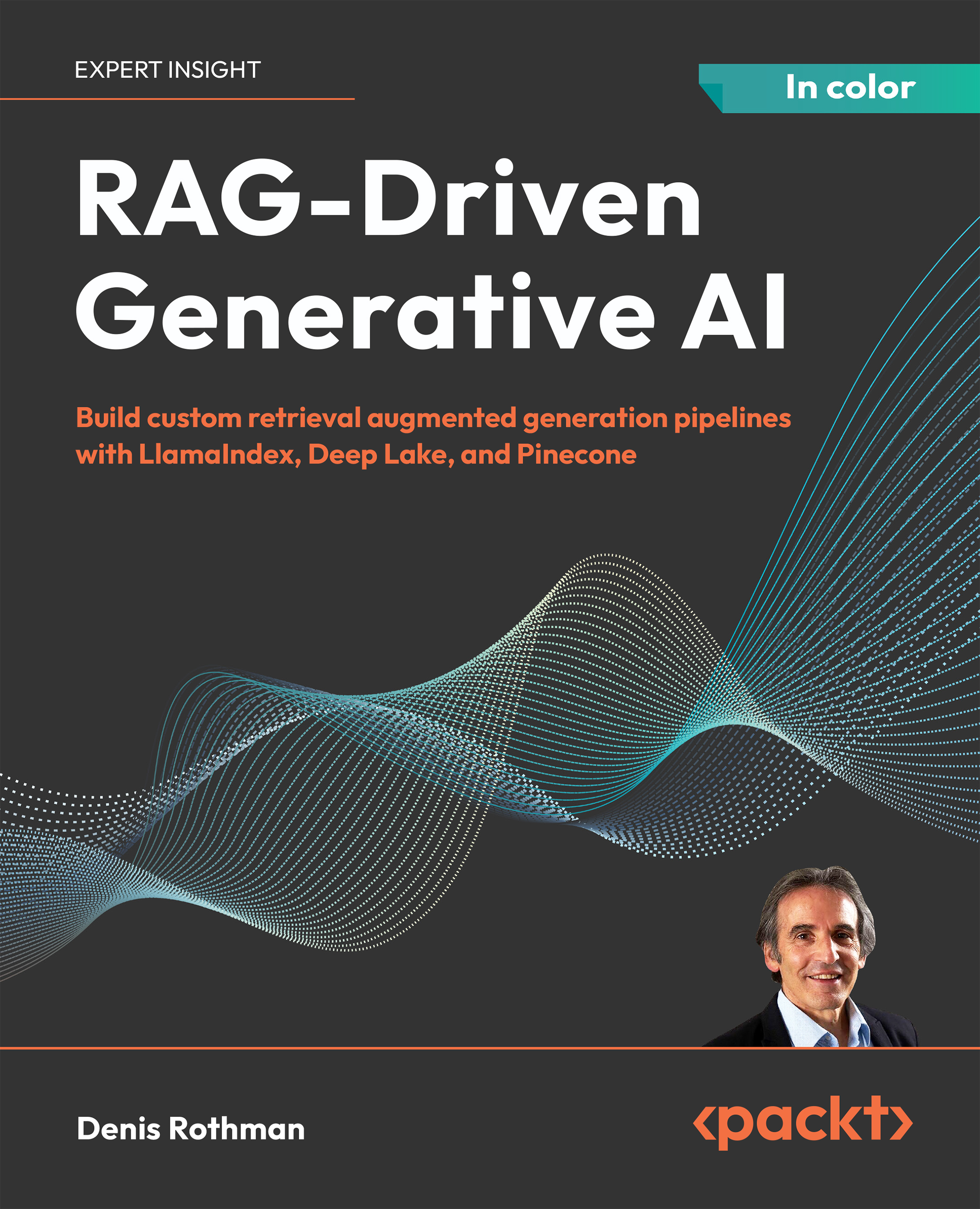
RAG-Driven Generative AI

RAG-Driven Generative AI: Build custom retrieval augmented generation pipelines with LlamaIndex, Deep Lake, and Pinecone

Arrow left icon
Profile Icon Denis Rothman
Arrow right icon
$9.99 $35.99
eBook Sep 2024 338 pages 1st Edition
eBook
$9.99 $35.99
Paperback
$43.99
Subscription
Free Trial
Renews at $19.99p/m
Arrow left icon
Profile Icon Denis Rothman
Arrow right icon
$9.99 $35.99
eBook Sep 2024 338 pages 1st Edition
eBook
$9.99 $35.99
Paperback
$43.99
Subscription
Free Trial
Renews at $19.99p/m
eBook
$9.99 $35.99
Paperback
$43.99
Subscription
Free Trial
Renews at $19.99p/m

What do you get with eBook?

Product feature icon Instant access to your Digital eBook purchase
Product feature icon Download this book in EPUB and PDF formats
Product feature icon Access this title in our online reader with advanced features
Product feature icon DRM FREE - Read whenever, wherever and however you want
Product feature icon AI Assistant (beta) to help accelerate your learning
Modal Close icon
Payment Processing...
tick Completed

Billing Address

Table of content icon View table of contents Preview book icon Preview Book

RAG-Driven Generative AI

RAG Embedding Vector Stores with Deep Lake and OpenAI

There will come a point in the execution of your project where complexity is unavoidable when implementing RAG-driven generative AI. Embeddings transform bulky structured or unstructured texts into compact, high-dimensional vectors that capture their semantic essence, enabling faster and more efficient information retrieval. However, we will inevitably be faced with a storage issue as the creation and storage of document embeddings become necessary when managing increasingly large datasets. You could ask the question at this point, why not use keywords instead of embeddings? And the answer is simple: although embeddings require more storage space, they capture the deeper semantic meanings of texts, with more nuanced and context-aware retrieval compared to the rigid and often-matched keywords. This results in better, more pertinent retrievals. Hence, our option is to turn to vector stores in which embeddings are organized and rapidly...

From raw data to embeddings in vector stores

Embeddings convert any form of data (text, images, or audio) into real numbers. Thus, a document is converted into a vector. These mathematical representations of documents allow us to calculate the distances between documents and retrieve similar data.

The raw data (books, articles, blogs, pictures, or songs) is first collected and cleaned to remove noise. The prepared data is then fed into a model such as OpenAI text-embedding-3-small, which will embed the data. Activeloop Deep Lake, for example, which we will implement in this chapter, will break a text down into pre-defined chunks defined by a certain number of characters. The size of a chunk could be 1,000 characters, for instance. We can let the system optimize these chunks, as we will implement them in the Optimizing chunking section of the next chapter. These chunks of text make it easier to process large amounts of data and provide more detailed embeddings of a document, as...

Organizing RAG in a pipeline

A RAG pipeline will typically collect data and prepare it by cleaning it, for example, chunking the documents, embedding them, and storing them in a vector store dataset. The vector dataset is then queried to augment the user input of a generative AI model to produce an output. However, it is highly recommended not to run this sequence of RAG in one single program when it comes to using a vector store. We should at least separate the process into three components:

  • Data collection and preparation
  • Data embedding and loading into the dataset of a vector store
  • Querying the vectorized dataset to augment the input of a generative AI model to produce a response

Let’s go through the main reasons for this component approach:

  • Specialization, which will allow each member of a team to do what they are best at, either collecting and cleaning data, running embedding models, managing vector stores, or tweaking generative...

A RAG-driven generative AI pipeline

Let’s dive into what a real-life RAG pipeline looks like. Imagine we’re a team that has to deliver a whole system in just a few weeks. Right off the bat, we’re bombarded with questions like:

  • Who’s going to gather and clean up all the data?
  • Who’s going to handle setting up OpenAI’s embedding model?
  • Who’s writing the code to get those embeddings up and running and managing the vector store?
  • Who’s going to take care of implementing GPT-4 and managing what it spits out?

Within a few minutes, everyone starts looking pretty worried. The whole thing feels overwhelming—like, seriously, who would even think about tackling all that alone?

So here’s what we do. We split into three groups, each of us taking on different parts of the pipeline, as shown in Figure 2.3:

Figure 2.3: RAG pipeline components

Each of the three groups has one...

Building a RAG pipeline

We will now build a RAG pipeline by implementing the pipeline described in the previous section and illustrated in Figure 2.3. We will implement three components assuming that three teams (Team #1, Team #2, and Team #3) work in parallel to implement the pipeline:

  • Data collection and preparation by Team #1
  • Data embedding and storage by Team #2
  • Augmented generation by Team #3

The first step is to set up the environment for these components.

Setting up the environment

Let’s face it here and now. Installing cross-platform, cross-library packages with their dependencies can be quite challenging! It is important to take this complexity into account and be prepared to get the environment running correctly. Each package has dependencies that may have conflicting versions. Even if we adapt the versions, an application may not run as expected anymore. So, take your time to install the right versions of the packages and dependencies...

Evaluating the output with cosine similarity

In this section, we will implement cosine similarity to measure the similarity between user input and the generative AI model’s output. We will also measure the augmented user input with the generative AI model’s output. Let’s first define a cosine similarity function:

from sklearn.feature_extraction.text import TfidfVectorizer
from sklearn.metrics.pairwise import cosine_similarity
def calculate_cosine_similarity(text1, text2):
    vectorizer = TfidfVectorizer()
    tfidf = vectorizer.fit_transform([text1, text2])
    similarity = cosine_similarity(tfidf[0:1], tfidf[1:2])
    return similarity[0][0]

Then, let’s calculate a score that measures the similarity between the user prompt and GPT-4’s response:

similarity_score = calculate_cosine_similarity(user_prompt, gpt4_response)
print(f"Cosine Similarity Score: {similarity_score:.3f}")

The score is low, although the output seemed...

Summary

In this chapter, we tackled the complexities of using RAG-driven generative AI, focusing on the essential role of document embeddings when handling large datasets. We saw how to go from raw texts to embeddings and store them in vector stores. Vector stores such as Activeloop, unlike parametric generative AI models, provide API tools and visual interfaces that allow us to see embedded text at any moment.

A RAG pipeline detailed the organizational process of integrating OpenAI embeddings into Activeloop Deep Lake vector stores. The RAG pipeline was broken down into distinct components that can vary from one project to another. This separation allows multiple teams to work simultaneously without dependency, accelerating development and facilitating specialized focus on individual aspects, such as data collection, embedding processing, and query generation for the augmented generation AI process.

We then built a three-component RAG pipeline, beginning by highlighting the...

Questions

Answer the following questions with Yes or No:

  1. Do embeddings convert text into high-dimensional vectors for faster retrieval in RAG?
  2. Are keyword searches more effective than embeddings in retrieving detailed semantic content?
  3. Is it recommended to separate RAG pipelines into independent components?
  4. Does the RAG pipeline consist of only two main components?
  5. Can Activeloop Deep Lake handle both embedding and vector storage?
  6. Is the text-embedding-3-small model from OpenAI used to generate embeddings in this chapter?
  7. Are data embeddings visible and directly traceable in an RAG-driven system?
  8. Can a RAG pipeline run smoothly without splitting into separate components?
  9. Is chunking large texts into smaller parts necessary for embedding and storage?
  10. Are cosine similarity metrics used to evaluate the relevance of retrieved information?

References

Further reading

Join our community on Discord

Join our community’s Discord space for discussions with the author and other readers:

https://www.packt.link/rag

Left arrow icon Right arrow icon
Download code icon Download Code

Key benefits

  • Implement RAG’s traceable outputs, linking each response to its source document to build reliable multimodal conversational agents
  • Deliver accurate generative AI models in pipelines integrating RAG, real-time human feedback improvements, and knowledge graphs
  • Balance cost and performance between dynamic retrieval datasets and fine-tuning static data

Description

RAG-Driven Generative AI provides a roadmap for building effective LLM, computer vision, and generative AI systems that balance performance and costs. This book offers a detailed exploration of RAG and how to design, manage, and control multimodal AI pipelines. By connecting outputs to traceable source documents, RAG improves output accuracy and contextual relevance, offering a dynamic approach to managing large volumes of information. This AI book shows you how to build a RAG framework, providing practical knowledge on vector stores, chunking, indexing, and ranking. You’ll discover techniques to optimize your project’s performance and better understand your data, including using adaptive RAG and human feedback to refine retrieval accuracy, balancing RAG with fine-tuning, implementing dynamic RAG to enhance real-time decision-making, and visualizing complex data with knowledge graphs. You’ll be exposed to a hands-on blend of frameworks like LlamaIndex and Deep Lake, vector databases such as Pinecone and Chroma, and models from Hugging Face and OpenAI. By the end of this book, you will have acquired the skills to implement intelligent solutions, keeping you competitive in fields from production to customer service across any project.

Who is this book for?

This book is ideal for data scientists, AI engineers, machine learning engineers, and MLOps engineers. If you are a solutions architect, software developer, product manager, or project manager looking to enhance the decision-making process of building RAG applications, then you’ll find this book useful.

What you will learn

  • Scale RAG pipelines to handle large datasets efficiently
  • Employ techniques that minimize hallucinations and ensure accurate responses
  • Implement indexing techniques to improve AI accuracy with traceable and transparent outputs
  • Customize and scale RAG-driven generative AI systems across domains
  • Find out how to use Deep Lake and Pinecone for efficient and fast data retrieval
  • Control and build robust generative AI systems grounded in real-world data
  • Combine text and image data for richer, more informative AI responses

Product Details

Country selected
Publication date, Length, Edition, Language, ISBN-13
Publication date : Sep 30, 2024
Length: 338 pages
Edition : 1st
Language : English
ISBN-13 : 9781836200901
Vendor :
Facebook , Docker , OpenAI
Category :
Languages :
Concepts :
Tools :

What do you get with eBook?

Product feature icon Instant access to your Digital eBook purchase
Product feature icon Download this book in EPUB and PDF formats
Product feature icon Access this title in our online reader with advanced features
Product feature icon DRM FREE - Read whenever, wherever and however you want
Product feature icon AI Assistant (beta) to help accelerate your learning
Modal Close icon
Payment Processing...
tick Completed

Billing Address

Product Details

Publication date : Sep 30, 2024
Length: 338 pages
Edition : 1st
Language : English
ISBN-13 : 9781836200901
Vendor :
Facebook , Docker , OpenAI
Category :
Languages :
Concepts :
Tools :

Packt Subscriptions

See our plans and pricing
Modal Close icon
$19.99 billed monthly
Feature tick icon Unlimited access to Packt's library of 7,000+ practical books and videos
Feature tick icon Constantly refreshed with 50+ new titles a month
Feature tick icon Exclusive Early access to books as they're written
Feature tick icon Solve problems while you work with advanced search and reference features
Feature tick icon Offline reading on the mobile app
Feature tick icon Simple pricing, no contract
$199.99 billed annually
Feature tick icon Unlimited access to Packt's library of 7,000+ practical books and videos
Feature tick icon Constantly refreshed with 50+ new titles a month
Feature tick icon Exclusive Early access to books as they're written
Feature tick icon Solve problems while you work with advanced search and reference features
Feature tick icon Offline reading on the mobile app
Feature tick icon Choose a DRM-free eBook or Video every month to keep
Feature tick icon PLUS own as many other DRM-free eBooks or Videos as you like for just $5 each
Feature tick icon Exclusive print discounts
$279.99 billed in 18 months
Feature tick icon Unlimited access to Packt's library of 7,000+ practical books and videos
Feature tick icon Constantly refreshed with 50+ new titles a month
Feature tick icon Exclusive Early access to books as they're written
Feature tick icon Solve problems while you work with advanced search and reference features
Feature tick icon Offline reading on the mobile app
Feature tick icon Choose a DRM-free eBook or Video every month to keep
Feature tick icon PLUS own as many other DRM-free eBooks or Videos as you like for just $5 each
Feature tick icon Exclusive print discounts

Frequently bought together


Stars icon
Total $ 138.97
RAG-Driven Generative AI
$43.99
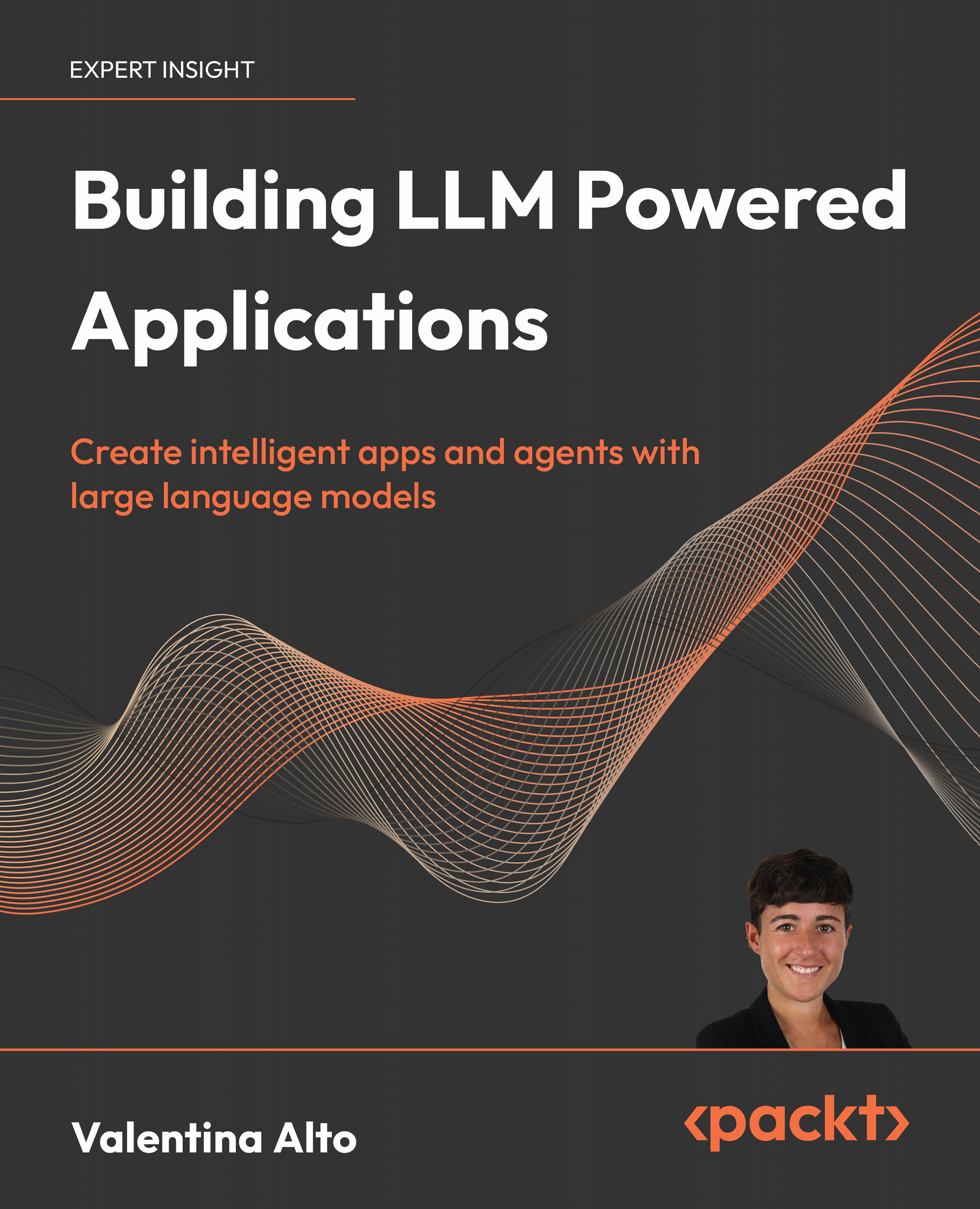
Building LLM Powered Applications
$49.99
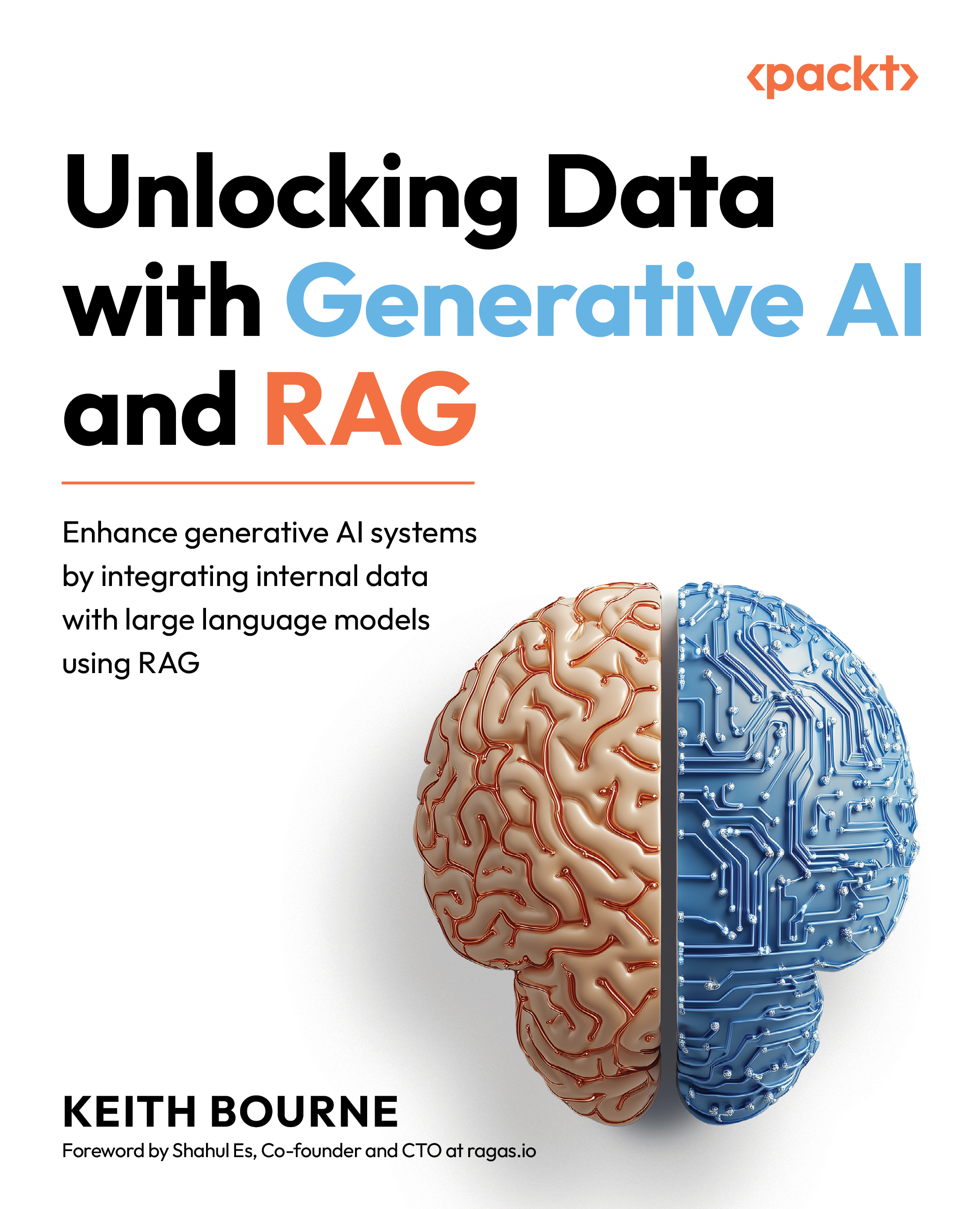
Unlocking Data with Generative AI and RAG
$44.99
Total $ 138.97 Stars icon

Table of Contents

12 Chapters
Why Retrieval Augmented Generation? Chevron down icon Chevron up icon
RAG Embedding Vector Stores with Deep Lake and OpenAI Chevron down icon Chevron up icon
Building Index-Based RAG with LlamaIndex, Deep Lake, and OpenAI Chevron down icon Chevron up icon
Multimodal Modular RAG for Drone Technology Chevron down icon Chevron up icon
Boosting RAG Performance with Expert Human Feedback Chevron down icon Chevron up icon
Scaling RAG Bank Customer Data with Pinecone Chevron down icon Chevron up icon
Building Scalable Knowledge-Graph-Based RAG with Wikipedia API and LlamaIndex Chevron down icon Chevron up icon
Dynamic RAG with Chroma and Hugging Face Llama Chevron down icon Chevron up icon
Empowering AI Models: Fine-Tuning RAG Data and Human Feedback Chevron down icon Chevron up icon
RAG for Video Stock Production with Pinecone and OpenAI Chevron down icon Chevron up icon
Other Books You May Enjoy Chevron down icon Chevron up icon
Index Chevron down icon Chevron up icon
Get free access to Packt library with over 7500+ books and video courses for 7 days!
Start Free Trial

FAQs

How do I buy and download an eBook? Chevron down icon Chevron up icon

Where there is an eBook version of a title available, you can buy it from the book details for that title. Add either the standalone eBook or the eBook and print book bundle to your shopping cart. Your eBook will show in your cart as a product on its own. After completing checkout and payment in the normal way, you will receive your receipt on the screen containing a link to a personalised PDF download file. This link will remain active for 30 days. You can download backup copies of the file by logging in to your account at any time.

If you already have Adobe reader installed, then clicking on the link will download and open the PDF file directly. If you don't, then save the PDF file on your machine and download the Reader to view it.

Please Note: Packt eBooks are non-returnable and non-refundable.

Packt eBook and Licensing When you buy an eBook from Packt Publishing, completing your purchase means you accept the terms of our licence agreement. Please read the full text of the agreement. In it we have tried to balance the need for the ebook to be usable for you the reader with our needs to protect the rights of us as Publishers and of our authors. In summary, the agreement says:

  • You may make copies of your eBook for your own use onto any machine
  • You may not pass copies of the eBook on to anyone else
How can I make a purchase on your website? Chevron down icon Chevron up icon

If you want to purchase a video course, eBook or Bundle (Print+eBook) please follow below steps:

  1. Register on our website using your email address and the password.
  2. Search for the title by name or ISBN using the search option.
  3. Select the title you want to purchase.
  4. Choose the format you wish to purchase the title in; if you order the Print Book, you get a free eBook copy of the same title. 
  5. Proceed with the checkout process (payment to be made using Credit Card, Debit Cart, or PayPal)
Where can I access support around an eBook? Chevron down icon Chevron up icon
  • If you experience a problem with using or installing Adobe Reader, the contact Adobe directly.
  • To view the errata for the book, see www.packtpub.com/support and view the pages for the title you have.
  • To view your account details or to download a new copy of the book go to www.packtpub.com/account
  • To contact us directly if a problem is not resolved, use www.packtpub.com/contact-us
What eBook formats do Packt support? Chevron down icon Chevron up icon

Our eBooks are currently available in a variety of formats such as PDF and ePubs. In the future, this may well change with trends and development in technology, but please note that our PDFs are not Adobe eBook Reader format, which has greater restrictions on security.

You will need to use Adobe Reader v9 or later in order to read Packt's PDF eBooks.

What are the benefits of eBooks? Chevron down icon Chevron up icon
  • You can get the information you need immediately
  • You can easily take them with you on a laptop
  • You can download them an unlimited number of times
  • You can print them out
  • They are copy-paste enabled
  • They are searchable
  • There is no password protection
  • They are lower price than print
  • They save resources and space
What is an eBook? Chevron down icon Chevron up icon

Packt eBooks are a complete electronic version of the print edition, available in PDF and ePub formats. Every piece of content down to the page numbering is the same. Because we save the costs of printing and shipping the book to you, we are able to offer eBooks at a lower cost than print editions.

When you have purchased an eBook, simply login to your account and click on the link in Your Download Area. We recommend you saving the file to your hard drive before opening it.

For optimal viewing of our eBooks, we recommend you download and install the free Adobe Reader version 9.

Modal Close icon
Modal Close icon