Search icon CANCEL
Subscription
0
Cart icon
Your Cart (0 item)
Close icon
You have no products in your basket yet
Arrow left icon
Explore Products
Best Sellers
New Releases
Books
Events
Videos
Audiobooks
Packt Hub
Free Learning
Arrow right icon
timer SALE ENDS IN
0 Days
:
00 Hours
:
00 Minutes
:
00 Seconds
Arrow up icon
GO TO TOP
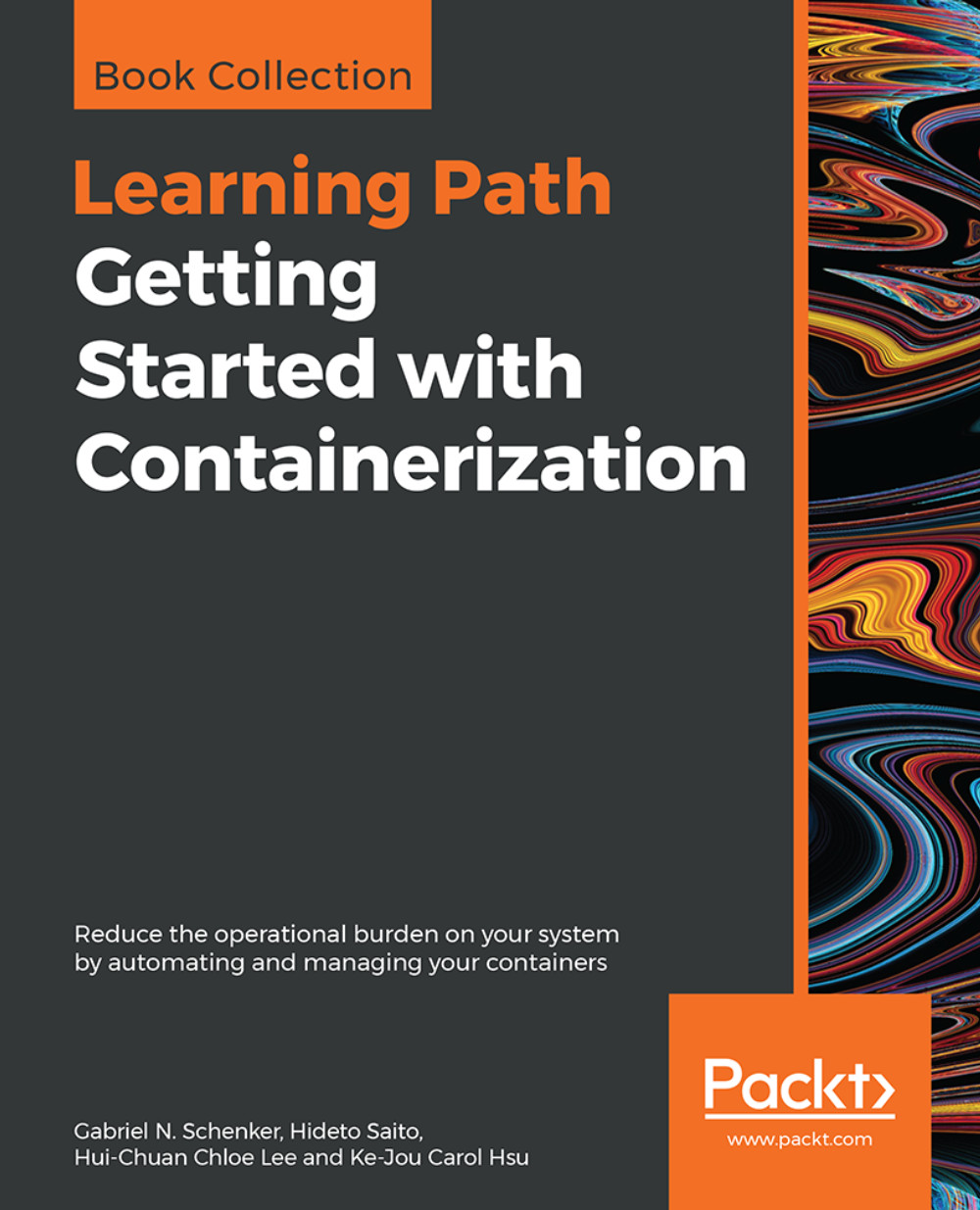
Getting Started with Containerization

You're reading from   Getting Started with Containerization Reduce the operational burden on your system by automating and managing your containers

Arrow left icon
Product type Course
Published in Mar 2019
Publisher Packt
ISBN-13 9781838645700
Length 736 pages
Edition 1st Edition
Tools
Arrow right icon
Authors (4):
Arrow left icon
Dr. Gabriel N. Schenker Dr. Gabriel N. Schenker
Author Profile Icon Dr. Gabriel N. Schenker
Dr. Gabriel N. Schenker
Hideto Saito Hideto Saito
Author Profile Icon Hideto Saito
Hideto Saito
Hui-Chuan Chloe Lee Hui-Chuan Chloe Lee
Author Profile Icon Hui-Chuan Chloe Lee
Hui-Chuan Chloe Lee
Ke-Jou Carol Hsu Ke-Jou Carol Hsu
Author Profile Icon Ke-Jou Carol Hsu
Ke-Jou Carol Hsu
Arrow right icon
View More author details
Toc

Table of Contents (25) Chapters Close

Title Page
Copyright
About Packt
Contributors
Preface
1. What Are Containers and Why Should I Use Them? FREE CHAPTER 2. Setting up a Working Environment 3. Working with Containers 4. Creating and Managing Container Images 5. Data Volumes and System Management 6. Distributed Application Architecture 7. Single-Host Networking 8. Docker Compose 9. Orchestrators 10. Introduction to Docker Swarm 11. Zero Downtime Deployments and Secrets 12. Building Your Own Kubernetes Cluster 13. Walking through Kubernetes Concepts 14. Playing with Containers 15. Building High-Availability Clusters 16. Building Continuous Delivery Pipelines 17. Building Kubernetes on AWS 18. Advanced Cluster Administration 1. Other Books You May Enjoy Index

Chapter 8. Docker Compose

In the previous chapter, we learned a lot about how container networking works on a single Docker host. We introduced the Container Network Model (CNM), which forms the basis of all networking between Docker containers, and then we dove deep into different implementations of the CNM, specifically the bridge network.


This chapter introduces the concept of an application consisting of multiple services, each running in a container, and how Docker Compose allows us to easily build, run, and scale such an application using a declarative approach.

The chapter covers the following topics:

  • Demystifying declarative versus imperative
  • Running a multi-service application
  • Scaling a service
  • Building and pushing an application

After completing this chapter, the reader will be able to do the following:

  • Explain in a few short sentences the main differences between an imperative and declarative approach for defining and running an application
  • Describe in their own words the difference...
lock icon The rest of the chapter is locked
CONTINUE READING
83
Tech Concepts
36
Programming languages
73
Tech Tools
Icon Unlimited access to the largest independent learning library in tech of over 8,000 expert-authored tech books and videos.
Icon Innovative learning tools, including AI book assistants, code context explainers, and text-to-speech.
Icon 50+ new titles added per month and exclusive early access to books as they are being written.
Getting Started with Containerization
Register for a free Packt account to unlock a world of extra content!
A free Packt account unlocks extra newsletters, articles, discounted offers, and much more. Start advancing your knowledge today.
Unlock this book and the full library FREE for 7 days
Get unlimited access to 7000+ expert-authored eBooks and videos courses covering every tech area you can think of
Renews at R$50/month. Cancel anytime
Modal Close icon
Modal Close icon