Over 20+ new recipes, including recognizing music genres and detecting objects in a scene
Create practical examples using TensorFlow Lite for Microcontrollers, Edge Impulse, and more
Explore cutting-edge technologies, such as on-device training for updating models without data leaving the device
Description
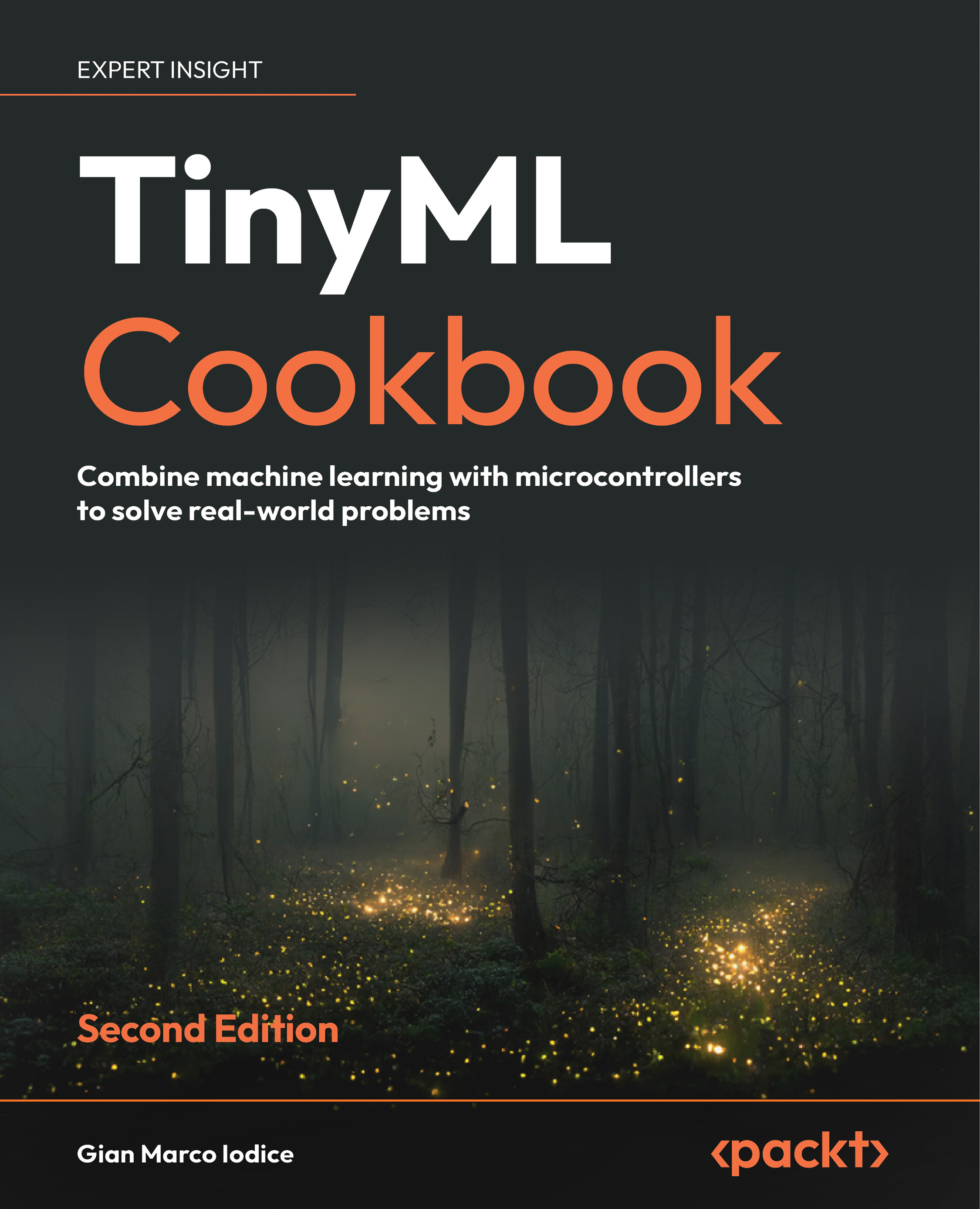
Discover the incredible world of tiny Machine Learning (tinyML) and create smart projects using real-world data sensors with the Arduino Nano 33 BLE Sense, Raspberry Pi Pico, and SparkFun RedBoard Artemis Nano.
TinyML Cookbook, Second Edition, will show you how to build unique end-to-end ML applications using temperature, humidity, vision, audio, and accelerometer sensors in different scenarios. These projects will equip you with the knowledge and skills to bring intelligence to microcontrollers. You'll train custom models from weather prediction to real-time speech recognition using TensorFlow and Edge Impulse.Expert tips will help you squeeze ML models into tight memory budgets and accelerate performance using CMSIS-DSP.
This improved edition includes new recipes featuring an LSTM neural network to recognize music genres and the Faster-Objects-More-Objects (FOMO) algorithm for detecting objects in a scene. Furthermore, you’ll work on scikit-learn model deployment on microcontrollers, implement on-device training, and deploy a model using microTVM, including on a microNPU. This beginner-friendly and comprehensive book will help you stay up to date with the latest developments in the tinyML community and give you the knowledge to build unique projects with microcontrollers!
Who is this book for?
This book is ideal for machine learning engineers or data scientists looking to build embedded/edge ML applications and IoT developers who want to add machine learning capabilities to their devices. If you’re an engineer, student, or hobbyist interested in exploring tinyML, then this book is your perfect companion.
Basic familiarity with C/C++ and Python programming is a prerequisite; however, no prior knowledge of microcontrollers is necessary to get started with this book.
What you will learn
Understand the microcontroller programming fundamentals
Work with real-world sensors, such as the microphone, camera, and accelerometer
Implement an app that responds to human voice or recognizes music genres
Leverage transfer learning with FOMO and Keras
Learn best practices on how to use the CMSIS-DSP library
Create a gesture-recognition app to build a remote control
Design a CIFAR-10 model for memory-constrained microcontrollers
Having read the first edition of this book that I own, I received a pre-release copy of the second edition from <PACKT> to review for this book. I was a co-editor on another <PACKT> book related to RTOS (Real-time Operating Systems) so I get pre-release copies from time to time to review.This book is a great expansion of the first edition and includes more visual diagrams and expanded detail to explain hardware connectivity, MEMS sensors and how they operate, different types of machine learning inference with sensor devices, the Edge Impulse cloud-based no-code machine learning toolkit, and Tensorflow programming using the Arduino IDE.I wouldn't consider this book for absolute beginners but a beginner would need to read it a couple of times first to understand core concepts before trying to do the "How To Do It" sections at the end of each example project. This book is more suited with someone who has some exposure to embedded microcontroller programming with Arduino IDE, Arduino dev boards like the Nano 33 BLE Sense, the Raspberry Pi Pico dev board, and perhaps the ESP32 dev board variants from Espressif Systems.The new Arduino Nano 33 BLE Sense 2 has recently come out and should apply to this book as well for the Edge Impulse and Tensorflow chapters for deploying TinyML machine learning models. If you buy this book now and buy an Arduino Nano 33 BLE Sense dev board and peripherals for Christmas, you can have enough time to read the book and deploy TinyML models over the Christmas holidays after your dev board arrives!I work with embedded machine learning on intelligent wireless IoT devices for my business and can deploy TinyML models to almost any ARM Cortex-M embedded microcontroller out there. I use other machine learning tools to deploy TinyML models directly onto MEMS sensors as well.Gian Marco Iodice is an expert in the field of embedded machine learning due to his work at ARM in the UK and his education experience in researching the field of TinyML on embedded systems or resource-constrained embedded devices for computer vision. The principles of this book cover a wide range of TinyML possibilities with great examples from deploying machine learning models from scratch using the Arduino IDE with C and C++ code and ARM MBED OS to no-code tools like Edge Impulse.For anyone wanting to learn how to deploy machine learning models to an embedded microcontroller development kit like the Arduino Nano 33 Ble Sense or the Raspberry Pi Pico dev kit, you must get this book to learn how to do it easily while learning important concepts at the same time. You can also join the "Embedded Systems Professionals" Discord channel to ask the author of the book, Gian Mardo Iodice, questions about the contents of the book and to get some help on how to deploy TinyML models to your dev board.To conclude, I know you will enjoy the book as much as I did. The second edition is an improvement to the first edition with updated code fixes, more diagrams, expanded explanations of topics, and updated information. Buy an Arduino Nano 33 BLE Sense dev board, buy some peripheral sensors to connect to your Arduino dev board, and start deploying TinyML models with the "TinyML Cookbook: Combine machine learning with microcontrollers to solve real-world problems" today. I highly recommend this book if you want to learn about the future of machine learning on embedded devices and how to actually deploy TinyML models onto embedded systems to make those systems really smart.
Amazon Verified review
Heena ChouhanFeb 07, 2024
5
If you're into microcontrollers and machine learning like I am, this book is an absolute gem. It's the perfect fusion of both worlds, providing valuable insights on how to leverage machine learning to tackle real-world challenges on power and compute-constrained devices.
Amazon Verified review
D. KingDec 08, 2023
5
I’ve spent much of the past 7+ years working with various groups of software developers focused on the problem of 'cramming' AI/ML capabilities into various microcontrollers and microprocessors found in all sorts of resource-constrained devices. These ranged from tail tags on cows, gait monitors for Parkinson patients, engines on large scale mining equipment, and video cameras on mini-drones and low earth orbit satellites, to name just a few. During each of these projects a sizeable percentage of our time was spent gathering and assessing various books, papers, research papers and the like in order to address the problem. This is how I came across Gian Marco Iodice’s ‘TinyML Cookbook – both the the 1st edition (April 2022), and now the 2nd edition (November 2023) . If these editions had been published earlier, then they could have served as a valuable resource, saving us time, reducing our false starts, and introducing much more rigor to our development processes.Like its predecessor, this 2nd edition of the Cookbook has a decidely practical hands-on approach (much like the ‘Make’ books for microcontrollers). Starting with an intro to TinyML, ML, and deep learning (DL), it quickly guides readers through the steps required to setup the microcontroller hardware and software environments used to ‘cook’ the recipes in the remainder of the book. Most recipes in this Cookbook employ the Arduino Nano 33 BLE Sense, the Raspberry Pi Pico, and occasionally the SparkFun Artemis Nano. Likewise, the same dev environment (Arduino IDE or Arduino Web, TensorFlow, Edge Impulse, and TensorFlow Lite) and development procedures are in most of the chapters, taking the reader from initial project statement to prototype completion. Crudely put, for each project the reader starts on the cloud with the goal of building, training and testing the appropriate TensorFlow ML model. Once completed, TensorFlow Lite and quantization are used to create an ML model that can then be deployed on the various microprocessors of interest.What makes this Cookbook enjoyable is the non-trivial nature of its projects. While some may seem basic at first glance, such as predicting snowfall from sensor data or controlling LEDs with voice commands, diving into the details of these, as well as the other projects, reveals their complexity. These projects can serve as building blocks for more intricate applications.In the world of Amazon reviews, we often scrutinize 1s and 2s in deciding whether to purchase the product. For the earlier edition, there were no such ratings, just one 4 and the rest 5s (28 of them), with reviewers praising its practicality, readability, and comprehensive coverage. From my own experience, these accolades extend to the 2nd edition.Who should consider this book? It's not for non-programmers or beginners. Instead, it's ideal for those with ML and programming experience in Python and C/C++ who want to explore tinyML and Edge AI. Conversely, if you're comfortable with microcontrollers and programming but new to ML, this book is an excellent starting point. If you're well-versed in both ML and microcontrollers and seek a deeper understanding of tinyML, this book is a valuable addition to your library. Finally, if you already have the 1st edition, then the upgrade to the new edition is well worth it.
Amazon Verified review
Anuj DuttJan 28, 2024
5
This book is an invaluable resource for both enthusiasts and professionals interested in integrating machine learning with microcontrollers. This practical guide, focusing on tinyML, is perfect for those with a basic understanding of machine learning and an interest in applying it on microcontrollers like Arduino Nano 33 BLE Sense, Raspberry Pi Pico, and SparkFun RedBoard Artemis Nano.This book is a comprehensive journey into tinyML, starting with fundamental concepts and advancing to real-world sensor applications. It covers a wide range of topics including weather prediction, voice-controlled LEDs, music genre recognition, object detection, and gesture-based interfaces for YouTube playback. Practical projects using Edge Impulse, TensorFlow Lite for Microcontrollers, and Apache TVM are included, making it an essential read for those looking to explore tinyML applications.This edition of the book stands out with its hands-on approach and detailed recipes that guide the reader through various tinyML implementations. It's particularly useful for readers looking to apply machine learning in memory-constrained environments, offering insights into model optimization and deployment strategies.Whether you're a beginner or looking to expand your ML knowledge, this book's real-world examples and end-to-end project guidance make it a must-read for anyone venturing into the field of tinyML.
Amazon Verified review
SteveNov 29, 2023
5
TinyML is the set of technologies to enable using Machine Learning (ML) on microcontrollers (MCU’s) for embedded systems. My background is in embedded systems, but I’m a novice at ML.The book is excellent. It’s not a book on theory. Instead, it’s a thorough, practical hands-on guide to applying ML on embedded systems. It assumes no background knowledge in ML or working with MCU’s, providing enough detail to familiarize the reader with the concepts and terminology needed to execute the recipes. It provides a number of links and references for more information.ML is a complex topic, and applying it on MCU’s adds further complexity due to their constraints of limited CPU performance, limited electrical power, limited memory, and lack of floating point hardware. Making it work requires a combination of cloud, local host, and embedded system MCU on-device elements.The book starts with an overview of ML technologies, followed by an excellent brief introduction to working with MCU’s. Readers interested in learning more about MCU’s and the various devices that form embedded systems can use one of the many educational electronics sets for Arduino and Raspberry Pi.The recipes cover using ML on three different MCU development platforms: Arduino Nano 33 BLE Sense, Raspberry Pi Pico, and SparkFun RedBoard Artemis Nano. These provide a variety of on-board sensors and connections for external sensors.The book uses the Arduino and RPi as the primary platforms for detailed recipes, and the Artemis for additional exploration. In addition, it shows how to run ML on the QEMU emulator on your local host, which allows you to experiment with more platforms. This all shows you how to work with a variety of systems.One of the main challenges for the beginner is the bewildering array of software tools that need to be used for tinyML. The real strength of the book is showing how to do that.The recipes provide detailed instructions for setting up and using MCU development environments (Integrated Development Environment (IDE) and Command Line Interface (CLI)), CMSIS-DSP, MbedOS and Zephyr OS, QEMU, and the ML tools TensorFlow Lite, Edge Impulse, Apache TVM, and scikit-learn. They also include custom code snippets in C++ and Python for integrating and adapting items. They impart a wealth of practical knowledge that can be applied beyond the book.The projects covered by the recipes: a weather station that interprets temperature and humidity sensor data to predict snow; controlling LED’s with voice commands received over a microphone; recognizing music genres on the mic; detecting objects in camera images; and interpreting gestures with an Inertial Measurement Unit (IMU, i.e. accelerometer and gyroscope) to control YouTube playback.
Gian Marco Iodice is team and tech lead in the Machine Learning Group at Arm, who co-created the Arm Compute Library in 2017. The Arm Compute Library is currently the most performant library for ML on Arm, and it's deployed on billions of devices worldwide – from servers to smartphones.
Gian Marco holds an MSc degree, with honors, in electronic engineering from the University of Pisa (Italy) and has several years of experience developing ML and computer vision algorithms on edge devices. Now, he's leading the ML performance optimization on Arm Mali GPUs.
In 2020, Gian Marco cofounded the TinyML UK meetup group to encourage knowledge-sharing, educate, and inspire the next generation of ML developers on tiny and power-efficient devices.
Where there is an eBook version of a title available, you can buy it from the book details for that title. Add either the standalone eBook or the eBook and print book bundle to your shopping cart. Your eBook will show in your cart as a product on its own. After completing checkout and payment in the normal way, you will receive your receipt on the screen containing a link to a personalised PDF download file. This link will remain active for 30 days. You can download backup copies of the file by logging in to your account at any time.
If you already have Adobe reader installed, then clicking on the link will download and open the PDF file directly. If you don't, then save the PDF file on your machine and download the Reader to view it.
Please Note: Packt eBooks are non-returnable and non-refundable.
Packt eBook and Licensing When you buy an eBook from Packt Publishing, completing your purchase means you accept the terms of our licence agreement. Please read the full text of the agreement. In it we have tried to balance the need for the ebook to be usable for you the reader with our needs to protect the rights of us as Publishers and of our authors. In summary, the agreement says:
You may make copies of your eBook for your own use onto any machine
You may not pass copies of the eBook on to anyone else
How can I make a purchase on your website?
If you want to purchase a video course, eBook or Bundle (Print+eBook) please follow below steps:
Register on our website using your email address and the password.
Search for the title by name or ISBN using the search option.
Select the title you want to purchase.
Choose the format you wish to purchase the title in; if you order the Print Book, you get a free eBook copy of the same title.
Proceed with the checkout process (payment to be made using Credit Card, Debit Cart, or PayPal)
Where can I access support around an eBook?
If you experience a problem with using or installing Adobe Reader, the contact Adobe directly.
To view the errata for the book, see www.packtpub.com/support and view the pages for the title you have.
To view your account details or to download a new copy of the book go to www.packtpub.com/account
Our eBooks are currently available in a variety of formats such as PDF and ePubs. In the future, this may well change with trends and development in technology, but please note that our PDFs are not Adobe eBook Reader format, which has greater restrictions on security.
You will need to use Adobe Reader v9 or later in order to read Packt's PDF eBooks.
What are the benefits of eBooks?
You can get the information you need immediately
You can easily take them with you on a laptop
You can download them an unlimited number of times
You can print them out
They are copy-paste enabled
They are searchable
There is no password protection
They are lower price than print
They save resources and space
What is an eBook?
Packt eBooks are a complete electronic version of the print edition, available in PDF and ePub formats. Every piece of content down to the page numbering is the same. Because we save the costs of printing and shipping the book to you, we are able to offer eBooks at a lower cost than print editions.
When you have purchased an eBook, simply login to your account and click on the link in Your Download Area. We recommend you saving the file to your hard drive before opening it.
For optimal viewing of our eBooks, we recommend you download and install the free Adobe Reader version 9.


 United States

 Great Britain
 India
India
 Germany
 France
 Canada
 Russia
 Spain
Spain
 Brazil
 Australia
 Singapore
 Canary Islands
 Hungary
 Ukraine
 Luxembourg
 Estonia
 Lithuania
 South Korea
 Turkey
 Switzerland
 Colombia
 Taiwan
 Chile
Chile
 Norway
 Ecuador
 Indonesia
 New Zealand
 Cyprus
 Denmark
 Finland
 Poland
 Malta
Malta
 Czechia
 Austria
 Sweden
 Italy
Italy
 Egypt
Egypt
 Belgium
 Portugal
 Slovenia
 Ireland
 Romania
 Greece
 Argentina
 Netherlands
 Bulgaria
 Latvia
 South Africa
 Malaysia
 Japan
Japan
 Slovakia
 Philippines
 Mexico
 Thailand










 Filter