

Introduction
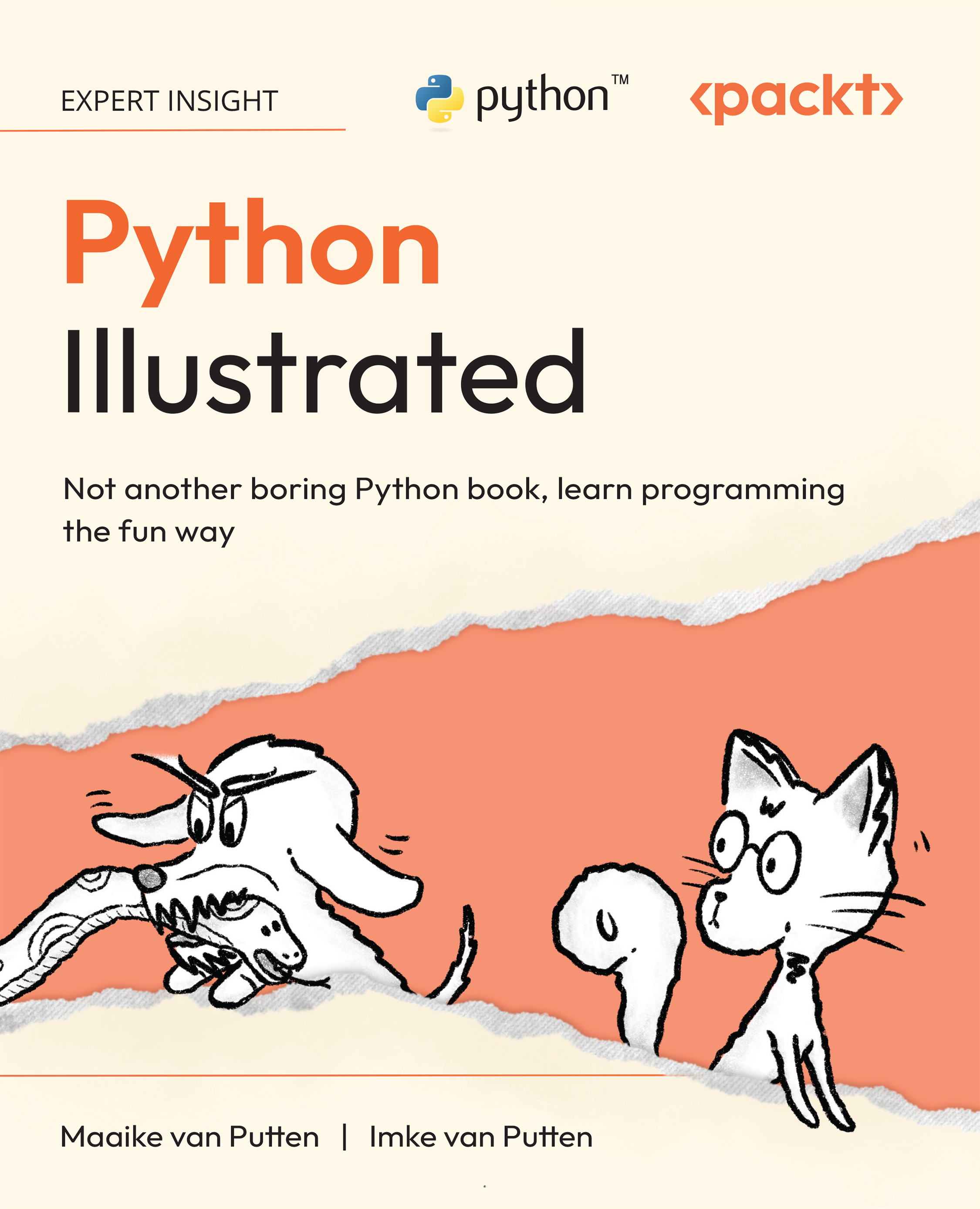
Hi, my name is Zia.

Yes, I’m a cat.
You might think that cats have no business writing books on Python. Well, you’re wrong. If you own a cat, you might know that we love to be on your keyboard. Partly because it’s warm (yes, it feels really good, not going to lie), but also because we love to type all sorts of things.
My human is a teacher in the tech space. She accidentally taught me Python while I was on her lap during her lessons. Fast forward to now, and I’m employed (100% remotely, of course) at a big tech company. I cannot tell you which one because I’ve signed an NDA. Also, I always use my human filter on Zoom and they cannot know I’m a cat. I’ve tested the waters with HR, and exposing that secret would get me fired.

Oh right, one more person I need to introduce.

Wiesje is here too. It’s a Dutch name, you’d pronounce it something like Weesha. She is the cutest dachshund dog, and I’m proud to say that she’s my cousin. Not sure why, but she doesn’t seem to share the joy of us being related and can come across a little grumpy.

Once you get to know her better, you’ll find that she’s actually very sweet. She can’t code Python yet, so she’ll join you in the learning process.
Anyways, Python is easy, and I can teach you. But wait… What even is Python? Python is a programming language. A programming language is a set of instructions that can be used to communicate with computers. Just like how we use English to talk to each other, we use programming languages to tell computers what to do. Python is one of the easiest languages to learn and use, which makes it great for beginners.
To give you some more concrete examples, here are a few things you can do with a programming language:
- Automating repetitive tasks such as renaming files
- Making applications, for example a calculator
- Creating a game, just to name something… a number guessing game
Spoiler alert! We are going to do all of these things in this book (and more of course). Here’s an overview of the things we’re going to do:
- Get your computer ready to code Python
- Understading variables and data types
- Working with conditional statements
- Using lists, tuples, and dictionaries
- Iterating with loops
- Writing functions and using built-in functions
- Handling files and exceptions
- Creating and using classes
- Understanding inheritance
- Debugging our code
- Next steps
Okay, time’s valuable, let’s get started getting your computer ready to code.