Search icon CANCEL
Subscription
0
Cart icon
Your Cart (0 item)
Close icon
You have no products in your basket yet
Save more on your purchases! discount-offer-chevron-icon
Savings automatically calculated. No voucher code required.
Arrow left icon
Explore Products
Best Sellers
New Releases
Books
Events
Videos
Audiobooks
Packt Hub
Free Learning
Arrow right icon
timer SALE ENDS IN
0 Days
:
00 Hours
:
00 Minutes
:
00 Seconds
Arrow up icon
GO TO TOP
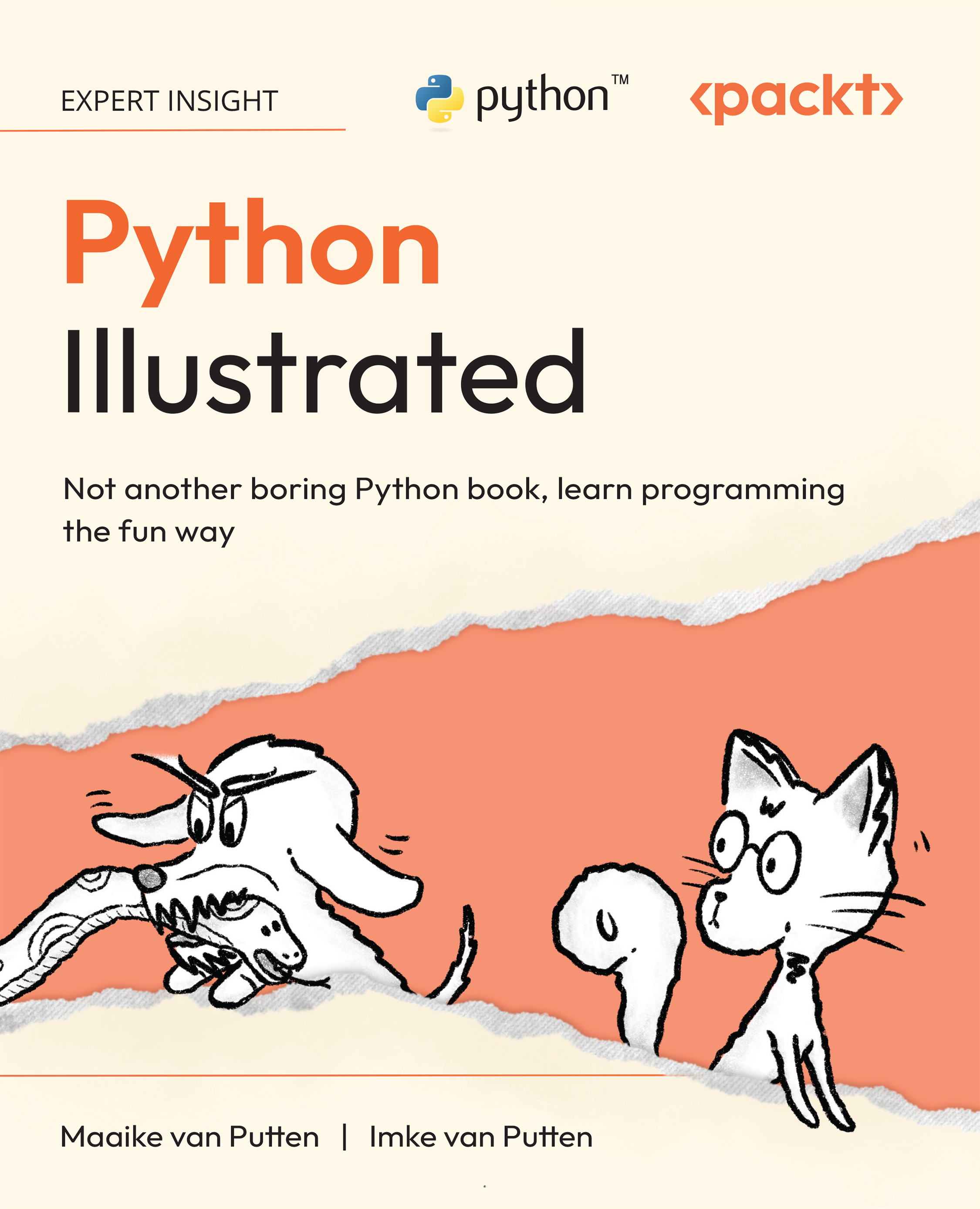
Python Illustrated

You're reading from   Python Illustrated Not another boring Python book, learn programming the fun way

Arrow left icon
Product type Paperback
Published in Feb 2026
Publisher Packt
ISBN-13 9781836646334
Length 432 pages
Edition 1st Edition
Languages
Arrow right icon
Authors (2):
Arrow left icon
Maaike van Putten Maaike van Putten
Author Profile Icon Maaike van Putten
Maaike van Putten
Imke van Putten Imke van Putten
Author Profile Icon Imke van Putten
Imke van Putten
Arrow right icon
View More author details
Toc

Table of Contents (19) Chapters Close

Preface 1. Introduction
2. Get Your Computer Ready to Code Python FREE CHAPTER 3. Understanding Variables and Data Types 4. Working with Conditional Statements 5. Using Lists, Tuples, and Dictionaries 6. Iterating with Loops 7. Writing Functions and Using Built-In Functions 8. Handling Files and Exceptions 9. Creating and Using Classes 10. Understanding Inheritance 11. Debugging Our Code 12. Next Steps 13. Unlock Your Exclusive Benefits 14. Other Books You May Enjoy
15. Index
Appendix A: Exercise Files 1. Appendix B: Quiz Answers 2. Appendix C: Exercise Solutions

Speaking the terminal’s language

The terminal might look like a dark and scary place, but it’s really just a simple conversation with your computer. You type a command, press Enter, and your computer responds. Each command is like a magic word that makes something happen. The terminal is in a certain folder on your computer. This is like when you have File Explorer or the Finder application open; you are in the folder that you see.

On mine, in the image with the command line, we are at the location ~. Which means that I’m currently in my home directory. The home directory is known as the default user folder. If you’re not sure where you are, you can ask the terminal where you are. Here’s how it’s done on macOS/Linux. In the terminal, type the following:

pwd

Then press Enter. This pwd stands for “print working directory.” In my case, you can see I’m in the user’s home directory, the user folder...

CONTINUE READING
83
Tech Concepts
36
Programming languages
73
Tech Tools
Icon Unlimited access to the largest independent learning library in tech of over 8,000 expert-authored tech books and videos.
Icon Innovative learning tools, including AI book assistants, code context explainers, and text-to-speech.
Icon 50+ new titles added per month and exclusive early access to books as they are being written.
Python Illustrated
You have been reading a chapter from
Python Illustrated
Published in: Feb 2026
Publisher: Packt
ISBN-13: 9781836646334
Register for a free Packt account to unlock a world of extra content!
A free Packt account unlocks extra newsletters, articles, discounted offers, and much more. Start advancing your knowledge today.
Unlock this book and the full library FREE for 7 days
Get unlimited access to 7000+ expert-authored eBooks and videos courses covering every tech area you can think of
Renews at $19.99/month. Cancel anytime
Modal Close icon
Modal Close icon