Search icon CANCEL
Subscription
0
Cart icon
Your Cart (0 item)
Close icon
You have no products in your basket yet
Save more on your purchases! discount-offer-chevron-icon
Savings automatically calculated. No voucher code required.
Arrow left icon
Explore Products
Best Sellers
New Releases
Books
Videos
Audiobooks
Learning Hub
Newsletter Hub
Free Learning
Arrow right icon
timer SALE ENDS IN
0 Days
:
00 Hours
:
00 Minutes
:
00 Seconds
Arrow up icon
GO TO TOP
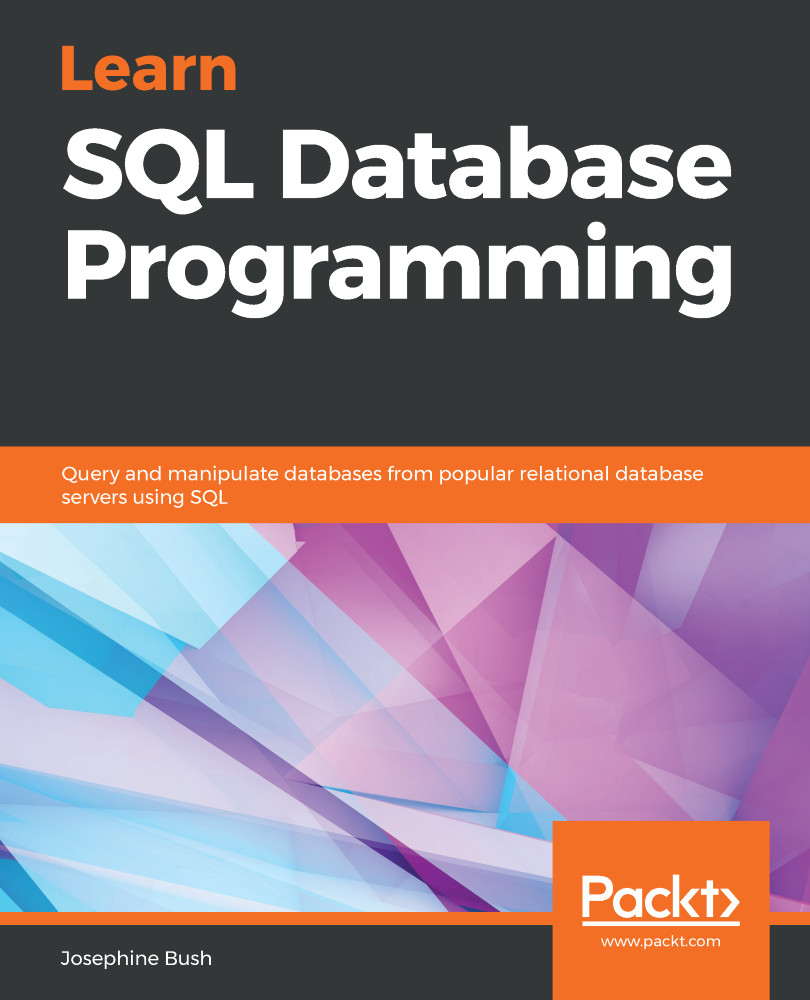
Learn SQL Database Programming

You're reading from   Learn SQL Database Programming Query and manipulate databases from popular relational database servers using SQL

Arrow left icon
Product type Paperback
Published in May 2020
Publisher Packt
ISBN-13 9781838984762
Length 564 pages
Edition 1st Edition
Languages
Tools
Arrow right icon
Author (1):
Arrow left icon
Josephine Bush Josephine Bush
Author Profile Icon Josephine Bush
Josephine Bush
Arrow right icon
View More author details
Toc

Table of Contents (24) Chapters Close

Preface 1. Section 1: Database Fundamentals
2. Introduction to Relational Database Management Systems FREE CHAPTER 3. Installing and Using MySQL Workbench 4. Understanding Data Types 5. Designing and Creating a Database 6. Importing and Exporting Data 7. Section 2: Basic SQL Querying
8. Querying a Single Table 9. Querying Multiple Tables 10. Modifying Data and Table Structures 11. Section 3: Advanced SQL Querying
12. Working with Expressions 13. Grouping and Summarizing Data 14. Advanced Querying Techniques 15. Programmable Objects 16. Section 4: Presenting Your Findings
17. Exploring and Processing Your Data 18. Telling a Story with Your Data 19. Section 5: SQL Best Practices
20. Best Practices for Designing and Querying 21. SQL Appendix 22. Assessments 23. Other Books You May Enjoy

Understanding SQL

Structured Query Language, or SQL (pronounced see-quel), is the language that is used for querying and manipulating data and defining structures in databases. Initially developed at IBM in the early 1970s, SQL became an ANSI and ISO standard in 1986.

SQL is a powerful, yet simple language, and can do many things, such as execute queries, retrieve, insert, update, and delete data, create databases and tables, and much more.

These types of activities can be grouped into different subdivisions of SQL: Data Definition Language (DDL), Data Manipulation Language (DML), and Data Control Language (DCL):

  • Use DDL commands to specify database schema:
  • CREATE: This is used to create a new database or objects in a database.
  • ALTER: This is used to alter a database or objects in a database.
  • DROP: This is used to delete a database or objects in a database.
  • TRUNCATE: This is used to remove all data from a table instantaneously.
  • Use DML commands to query and modify data:
  • SELECT: This is used to retrieve data from a database.
  • INSERT: This is used to insert data into a database.
  • UPDATE: This is used to update data in a database.
  • DELETE: This is used to remove data from a database.
  • Use DCL commands to control permissions and translations:
  • GRANT: This is used to give access to a user.
  • REVOKE: This is used to take access away from a user.
  • COMMIT: This is used to save changes in a transaction.
  • ROLLBACK: This is used to remove the saved changes in a transaction.
You won't learn about GRANT and REVOKE in this book. To get more information on granting and denying permissions, please visit https://dev.mysql.com/doc/refman/8.0/en/grant.html and https://dev.mysql.com/doc/refman/8.0/en/revoke.html.

Elements of SQL

The SQL language comprises several elements that will be explained in more depth in subsequent chapters. These elements include the following:

  • Queries that retrieve data based on specific criteria.
  • Clauses that are components of statements or queries.
  • Predicates that are logical conditions that evaluate to true or false. These help you to narrow down the results of your queries.
  • Expressions that produce either scalar values or tables of columns and rows. Expressions are a part of predicates.
  • Statements that are queries run against a database, comprised of clauses and, optionally, expressions and predicates.
  • White space that is generally ignored in SQL statements and queries, making it easier to format for readability because you don't have to worry so much about particular spacing for the SQL to run correctly.

The following diagram shows you the components of a SQL statement, which is also called a SQL query:

In the preceding diagram, you can see the different elements of a SQL statement. Each line in the preceding statement is considered a clause. Clauses use SQL keywords. Keywords are reserved words that have special significance in the SQL language—SELECT, FROM, and WHERE are just some of the keywords that are used. More information on keywords is provided in Chapter 4, Designing and Creating a Database. The preceding diagram also shows an expression and predicate. A predicate helps you to narrow down your query results. The expression is a piece of a predicate that sets the value. The diagram also helps to illustrate the use of white space. You could write out your entire query on one line, but it's much easier to read when you add carriage returns and spaces. The details of the different elements of queries will be covered more in future chapters of this book.

CONTINUE READING
83
Tech Concepts
36
Programming languages
73
Tech Tools
Icon Unlimited access to the largest independent learning library in tech of over 8,000 expert-authored tech books and videos.
Icon Innovative learning tools, including AI book assistants, code context explainers, and text-to-speech.
Icon 50+ new titles added per month and exclusive early access to books as they are being written.
Learn SQL Database Programming
You have been reading a chapter from
Learn SQL Database Programming
Published in: May 2020
Publisher: Packt
ISBN-13: 9781838984762
Register for a free Packt account to unlock a world of extra content!
A free Packt account unlocks extra newsletters, articles, discounted offers, and much more. Start advancing your knowledge today.
Unlock this book and the full library FREE for 7 days
Get unlimited access to 7000+ expert-authored eBooks and videos courses covering every tech area you can think of
Renews at $19.99/month. Cancel anytime
Modal Close icon
Modal Close icon