

A database is a collection of data. You store databases in a relational database management system (RDMS). The RDMS is the basis for modern database systems like MySQL, SQL Server, Oracle, PostgreSQL, and others. These will be covered in more detail later in this chapter.
Understanding databases
Tables
In an RDMS, objects called tables store data. Tables are a collection of related data stored in columns and rows. The following screenshot is a cross-section of a table that contains data about baseball players' appearances in all-star games:
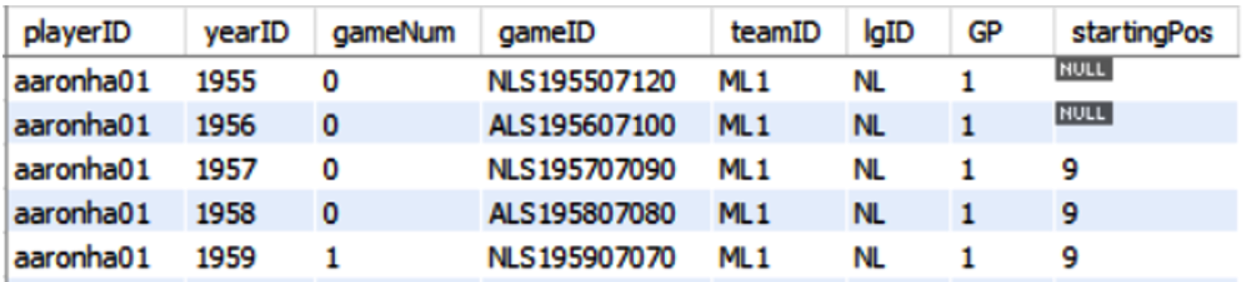
A NULL value in a table is a value that appears to be blank. It doesn't represent a string of blank spaces, zero, or a zero-length character string: it's a missing or unknown value.
The data has been sourced from http://www.seanlahman.com/baseball-archive/statistics/ with a CC BY-SA 3.0 license.
Fields
A field is an intersection of a row and a column. This field could be any type of data, including a yearID, teamID, or a playerID field (using our example). Each red arrow in the following screenshot points to a value in a column that is considered a field:

Records or rows
A row contains values in a horizontal division of data. In this example case, it's a row or record from a table:

Columns
A column contains values in a vertical division of data. In this example case, it's the gameID column from a table:

To ensure that the data in your tables is consistent and accurate, you will need to understand data integrity. You will learn about data integrity in the next section.