Search icon CANCEL
Subscription
0
Cart icon
Your Cart (0 item)
Close icon
You have no products in your basket yet
Save more on your purchases! discount-offer-chevron-icon
Savings automatically calculated. No voucher code required.
Arrow left icon
Explore Products
Best Sellers
New Releases
Books
Videos
Audiobooks
Learning Hub
Newsletter Hub
Free Learning
Arrow right icon
timer SALE ENDS IN
0 Days
:
00 Hours
:
00 Minutes
:
00 Seconds
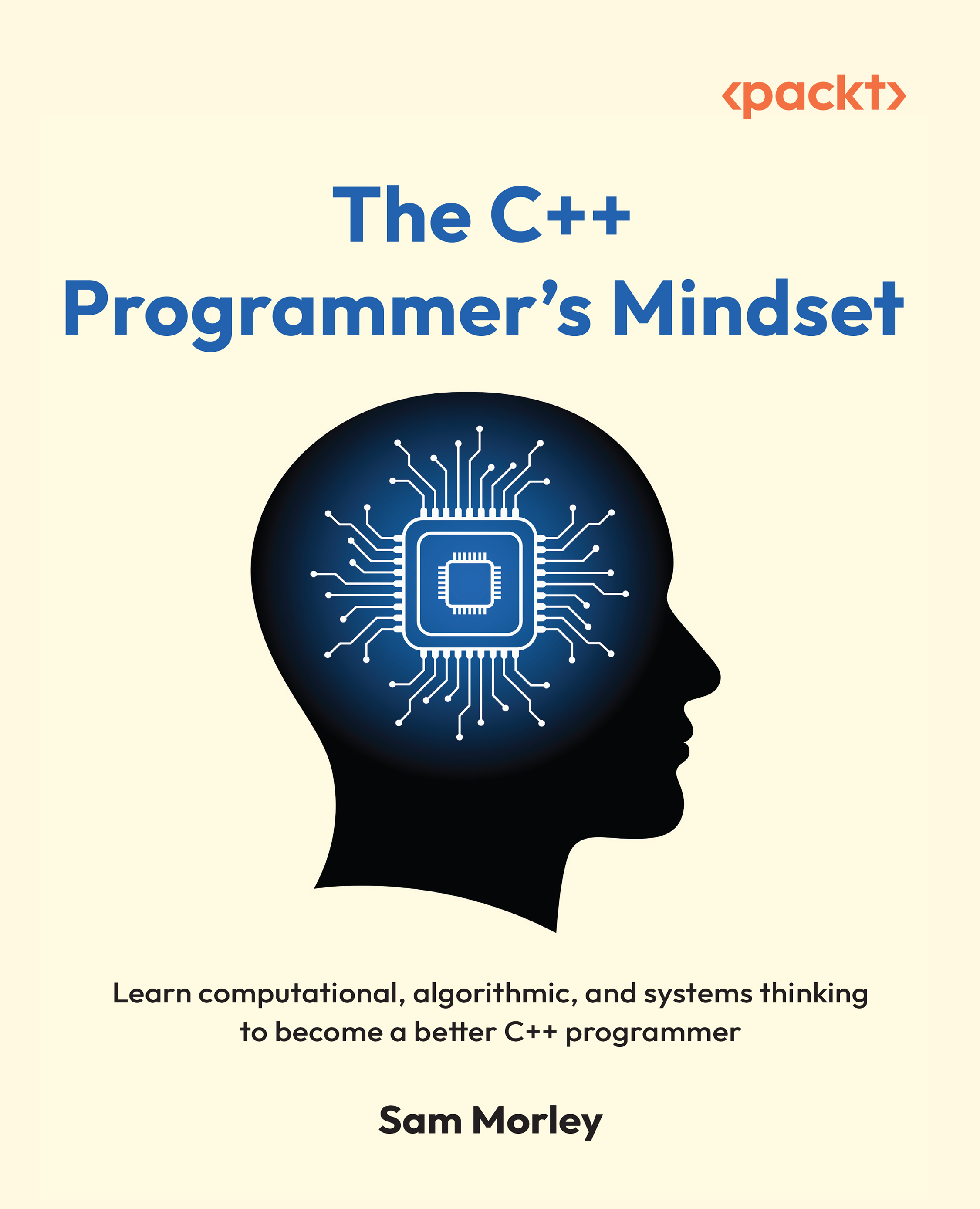
The C++ Programmer's Mindset

The C++ Programmer's Mindset: Learn computational, algorithmic, and systems thinking to become a better C++ programmer

Arrow left icon
Profile Icon Sam Morley
Arrow right icon
€26.99 €29.99
eBook Nov 2025 398 pages 1st Edition
eBook
€26.99 €29.99
Paperback
€37.99
Subscription
Free Trial
Renews at €18.99p/m
Arrow left icon
Profile Icon Sam Morley
Arrow right icon
€26.99 €29.99
eBook Nov 2025 398 pages 1st Edition
eBook
€26.99 €29.99
Paperback
€37.99
Subscription
Free Trial
Renews at €18.99p/m
eBook
€26.99 €29.99
Paperback
€37.99
Subscription
Free Trial
Renews at €18.99p/m

What do you get with eBook?

Product feature icon Instant access to your Digital eBook purchase
Product feature icon Download this book in EPUB and PDF formats
Product feature icon Access this title in our online reader with advanced features
Product feature icon DRM FREE - Read whenever, wherever and however you want
Product feature icon AI Assistant (beta) to help accelerate your learning
OR
Modal Close icon
Payment Processing...
tick Completed

Billing Address

Table of content icon View table of contents Preview book icon Preview Book

The C++ Programmer's Mindset

Abstraction in Detail

Abstraction is a term that is used in many different contexts, even within this book. In Chapter 1, we talked about formulating abstractions within the problem domain, such as data abstractions and structural abstractions. The programming language one uses to implement solutions also has abstraction mechanisms, which are obviously related to the abstractions in the problem. The purpose of this chapter is to understand abstractions as they relate specifically to C++.

C++ provides many abstraction mechanisms to make writing complex code easier, but these mechanisms can also teach us how to think about the problem. In this chapter, we will look at the abstraction mechanisms from C++ and how they can help guide us to find useful abstractions in new problems. After all, features of the language and the functionality in the standard library are there to facilitate exactly this. We will focus on four facilities in C++: the algorithms from the standard library, functions...

Technical requirements

The focus of this chapter is on establishing a link between the languages and library features of modern C++. Some familiarity with C++ is assumed, but we try to explain more modern features that you might not have encountered before. There are some exercises associated with this chapter found in the Chapter-02 folder of the GitHub repository for this book: https://github.com/PacktPublishing/The-CPP-Programmers-Mindset. Some snippets of code also have tests in this repository.

Common categories of problems

Before we start, we need to have some understanding of the different categories of problems. This is important because it forms part of the context in which we formulate our abstractions and thus guides our choices of how to implement solutions. All problems can be broken down into a set of basic problems via a sequence of reductions. These basic problems are those that you probably already know how to solve – for instance, using classic data structures and algorithms. As you gain experience, fewer reductions will be needed in most cases, and you will recognize problems that are of increasing complexity and know how to solve these. Very broadly, basic problems fall into one of four domains, at least for the purposes of this discussion, each with numerous subcategories and some overlapping concepts:

  • Combinatorial problems, including sorting and searching
  • Input-output (IO) problems, and interacting with the host system
  • Numerical...

Using standard algorithms

Algorithms are the bread and butter of programming and are a topic that we will describe in great detail in the next chapter. The standard algorithm headers are not algorithms as such, but instead are implementations of common (families of) algorithms for solving common abstract problems. (These mostly cover problems from classic data structure and algorithm courses from classic computer science.) They are surprisingly useful and turn up in lots of places. The power of these functions comes from their use of templates for every aspect of the operation: different search predicates, different comparisons and orderings, indirection, and projection.

As we have seen before, the real trick is finding places where these functions can be used, with simple operations or something more bespoke. Sometimes it can appear as if none of these functions are appropriate, until you frame the problem (via abstraction) in the correct way. This part of the standard library...

When to use functions

Functions encapsulate a unit of computation and are most often used to allow that unit of computation to be used in many places. In their pure form, they operate on one or more input values to produce one or more output values. (Of course, C++ functions can only have a single return value, but we’ll come back to this.) The term “pure” means that the function itself is independent of the global program state; only the input data has any effect on the outputs. Non-pure functions have their uses too, but are far less easy to reason about. For this reason, we shall mostly restrict our attention to pure functions here.

Pure functions are a mathematical concept, defined as a relation between two sets under which each member of the “input” set is related to exactly one element of the “output” set (the codomain). That is, any given configuration of inputs should always produce the same output. This is obviously a very...

When to use classes

Classes are an encapsulation of data and behavior and should be used in one of two ways. The first is as a structured container that maintains some invariant property that can be used in and queried in algorithms using its methods (for example, std::vector<...>). The second use is as an abstract interface that hides the details, in a similar way to how functions can be used to hide implementation details. This allows you to write code against the abstract interface and use any object that implements it – for example, the IO stream interface in the C++ standard library. Both are examples of abstractions, but go about it in (somewhat) different ways.

When we talk about class-based abstract interfaces, we usually mean dynamic polymorphism (although that is not always the case). Polymorphism (literally translated as “many forms”) is a means by which a class (the interface) can be used in place of any class that implements its interface...

Using templates

Templates are one of C++’s most powerful features, at least until C++26 brings first-class support for reflection. This mechanism allows the user to write code that uses placeholder types that are resolved during instantiation when the compiler sees a use of the template. As we described before, the template mechanism uses try first and unwind on failure. (This mechanism is often referred to as SFINAE or substitution failure is not an error – see https://en.cppreference.com/w/cpp/language/sfinae.html or [1].) Concepts work in a slightly different way. Here, the requirements should be listed up front and checked before the template is instantiated (at least in theory).

More importantly, templates and concepts are powerful abstraction mechanisms, allowing us to write code that works with many kinds of data or different algorithms, provided they broadly behave in the correct way (by exposing the correct methods, etc.). It’s quite rare that one...

Summary

In this chapter, we examined the various abstraction mechanisms and standard algorithms that are provided by the C++ language and standard library. These serve two purposes in our pursuit of solutions to complex problems. The first is to help guide the way we formulate abstractions within the problem itself, such as identifying the critical properties and supported operations of the data. The second is to provide the possible routes that we might take and expose patterns and abstractions, and algorithms too, that we might look for in our problems. This accelerates the process of solving problems using computational thinking.

The standard library algorithms provide numerous high-quality and high-performance implementations of many combinatorial and numerical algorithms. These are generally encapsulated in template functions that make them extremely flexible and provide a very simple interface. Functions and classes form the basic building blocks of encapsulation and abstraction...

Reference

  1. Vandevoorde, D., Josuttis, N.M. and Gregor, D. 2018. C++ templates: the complete guide. Boston, MA: Addison-Wesley.

Get This Book’s PDF Version and Exclusive Extras

Scan the QR code (or go to packtpub.com/unlock). Search for this book by name, confirm the edition, and then follow the steps on the page.

Note: Keep your invoice handy. Purchases made directly from Packt don’t require one.

Left arrow icon Right arrow icon
Download code icon Download Code

Key benefits

  • Apply computational thinking to tackle complex C++ challenges
  • Use abstraction, algorithms, and data structures the C++ way
  • Build scalable, efficient, and reusable C++ code through real-world projects
  • Purchase of the print or Kindle book includes a free PDF eBook

Description

Solve complex problems in C++ by learning how to think like a computer scientist. This book introduces computational thinking—a framework for solving problems using decomposition, abstraction, and pattern recognition—and shows you how to apply it using modern C++ features. You'll learn how to break down challenges, choose the right abstractions, and build solutions that are both maintainable and efficient. Through small examples and a large case study, this book guides you from foundational concepts to high-performance applications. You’ll explore reusable templates, algorithms, modularity, and even parallel computing and GPU acceleration. With each chapter, you’ll not only expand your C++ skillset, but also refine the way you approach and solve real-world problems. Written by a seasoned research engineer and C++ developer, this book combines practical insight with academic rigor. Whether you're designing algorithms or profiling production code, this book helps you deliver elegant, effective solutions with confidence.

Who is this book for?

C++ developers, software engineers, and computer science students who want to enhance their problem-solving capabilities and build scalable, maintainable solutions. Basic familiarity with C++ syntax is assumed, making this ideal for intermediate programmers ready to master abstraction and algorithmic thinking.

What you will learn

  • Apply computational thinking to complex C++ problems
  • Break problems into components using abstraction
  • Use algorithms and data structures effectively in C++
  • Design modular and reusable C++ code
  • Analyze and improve algorithmic performance
  • Parse, transform, and interpret data in multiple formats
  • Scale up with concurrency, GPUs, and profiling tools

Product Details

Country selected
Publication date, Length, Edition, Language, ISBN-13
Publication date : Nov 27, 2025
Length: 398 pages
Edition : 1st
Language : English
ISBN-13 : 9781835888438
Category :
Languages :

What do you get with eBook?

Product feature icon Instant access to your Digital eBook purchase
Product feature icon Download this book in EPUB and PDF formats
Product feature icon Access this title in our online reader with advanced features
Product feature icon DRM FREE - Read whenever, wherever and however you want
Product feature icon AI Assistant (beta) to help accelerate your learning
OR
Modal Close icon
Payment Processing...
tick Completed

Billing Address

Product Details

Publication date : Nov 27, 2025
Length: 398 pages
Edition : 1st
Language : English
ISBN-13 : 9781835888438
Category :
Languages :

Packt Subscriptions

See our plans and pricing
Modal Close icon
€18.99 billed monthly
Feature tick icon Unlimited access to Packt's library of 7,000+ practical books and videos
Feature tick icon Constantly refreshed with 50+ new titles a month
Feature tick icon Exclusive Early access to books as they're written
Feature tick icon Solve problems while you work with advanced search and reference features
Feature tick icon Offline reading on the mobile app
Feature tick icon Simple pricing, no contract
€189.99 billed annually
Feature tick icon Unlimited access to Packt's library of 7,000+ practical books and videos
Feature tick icon Constantly refreshed with 50+ new titles a month
Feature tick icon Exclusive Early access to books as they're written
Feature tick icon Solve problems while you work with advanced search and reference features
Feature tick icon Offline reading on the mobile app
Feature tick icon Choose a DRM-free eBook or Video every month to keep
Feature tick icon PLUS own as many other DRM-free eBooks or Videos as you like for just €5 each
Feature tick icon Exclusive print discounts
€264.99 billed in 18 months
Feature tick icon Unlimited access to Packt's library of 7,000+ practical books and videos
Feature tick icon Constantly refreshed with 50+ new titles a month
Feature tick icon Exclusive Early access to books as they're written
Feature tick icon Solve problems while you work with advanced search and reference features
Feature tick icon Offline reading on the mobile app
Feature tick icon Choose a DRM-free eBook or Video every month to keep
Feature tick icon PLUS own as many other DRM-free eBooks or Videos as you like for just €5 each
Feature tick icon Exclusive print discounts

Table of Contents

18 Chapters
Thinking Computationally Chevron down icon Chevron up icon
Abstraction in Detail Chevron down icon Chevron up icon
Algorithmic Thinking and Complexity Chevron down icon Chevron up icon
Understanding the Machine Chevron down icon Chevron up icon
Data Structures Chevron down icon Chevron up icon
Reusing Your Code and Modularity Chevron down icon Chevron up icon
Outlining the Challenge Chevron down icon Chevron up icon
Building a Simple Command-Line Interface Chevron down icon Chevron up icon
Reading Data from Different Formats Chevron down icon Chevron up icon
Finding Information in Text Chevron down icon Chevron up icon
Clustering Data Chevron down icon Chevron up icon
Reflecting on What We Have Built Chevron down icon Chevron up icon
The Problems of Scale Chevron down icon Chevron up icon
Dealing with GPUs and Specialized Hardware Chevron down icon Chevron up icon
Profiling Your Code Chevron down icon Chevron up icon
Unlock Your Exclusive Benefits Chevron down icon Chevron up icon
Other Books You May Enjoy Chevron down icon Chevron up icon
Index Chevron down icon Chevron up icon
Get free access to Packt library with over 7500+ books and video courses for 7 days!
Start Free Trial

FAQs

How do I buy and download an eBook? Chevron down icon Chevron up icon

Where there is an eBook version of a title available, you can buy it from the book details for that title. Add either the standalone eBook or the eBook and print book bundle to your shopping cart. Your eBook will show in your cart as a product on its own. After completing checkout and payment in the normal way, you will receive your receipt on the screen containing a link to a personalised PDF download file. This link will remain active for 30 days. You can download backup copies of the file by logging in to your account at any time.

If you already have Adobe reader installed, then clicking on the link will download and open the PDF file directly. If you don't, then save the PDF file on your machine and download the Reader to view it.

Please Note: Packt eBooks are non-returnable and non-refundable.

Packt eBook and Licensing When you buy an eBook from Packt Publishing, completing your purchase means you accept the terms of our licence agreement. Please read the full text of the agreement. In it we have tried to balance the need for the ebook to be usable for you the reader with our needs to protect the rights of us as Publishers and of our authors. In summary, the agreement says:

  • You may make copies of your eBook for your own use onto any machine
  • You may not pass copies of the eBook on to anyone else
How can I make a purchase on your website? Chevron down icon Chevron up icon

If you want to purchase a video course, eBook or Bundle (Print+eBook) please follow below steps:

  1. Register on our website using your email address and the password.
  2. Search for the title by name or ISBN using the search option.
  3. Select the title you want to purchase.
  4. Choose the format you wish to purchase the title in; if you order the Print Book, you get a free eBook copy of the same title. 
  5. Proceed with the checkout process (payment to be made using Credit Card, Debit Cart, or PayPal)
Where can I access support around an eBook? Chevron down icon Chevron up icon
  • If you experience a problem with using or installing Adobe Reader, the contact Adobe directly.
  • To view the errata for the book, see www.packtpub.com/support and view the pages for the title you have.
  • To view your account details or to download a new copy of the book go to www.packtpub.com/account
  • To contact us directly if a problem is not resolved, use www.packtpub.com/contact-us
What eBook formats do Packt support? Chevron down icon Chevron up icon

Our eBooks are currently available in a variety of formats such as PDF and ePubs. In the future, this may well change with trends and development in technology, but please note that our PDFs are not Adobe eBook Reader format, which has greater restrictions on security.

You will need to use Adobe Reader v9 or later in order to read Packt's PDF eBooks.

What are the benefits of eBooks? Chevron down icon Chevron up icon
  • You can get the information you need immediately
  • You can easily take them with you on a laptop
  • You can download them an unlimited number of times
  • You can print them out
  • They are copy-paste enabled
  • They are searchable
  • There is no password protection
  • They are lower price than print
  • They save resources and space
What is an eBook? Chevron down icon Chevron up icon

Packt eBooks are a complete electronic version of the print edition, available in PDF and ePub formats. Every piece of content down to the page numbering is the same. Because we save the costs of printing and shipping the book to you, we are able to offer eBooks at a lower cost than print editions.

When you have purchased an eBook, simply login to your account and click on the link in Your Download Area. We recommend you saving the file to your hard drive before opening it.

For optimal viewing of our eBooks, we recommend you download and install the free Adobe Reader version 9.

Modal Close icon
Modal Close icon