Search icon CANCEL
Subscription
0
Cart icon
Your Cart (0 item)
Close icon
You have no products in your basket yet
Save more on your purchases! discount-offer-chevron-icon
Savings automatically calculated. No voucher code required.
Arrow left icon
Explore Products
Best Sellers
New Releases
Books
Events
Videos
Audiobooks
Packt Hub
Free Learning
Arrow right icon
timer SALE ENDS IN
0 Days
:
00 Hours
:
00 Minutes
:
00 Seconds
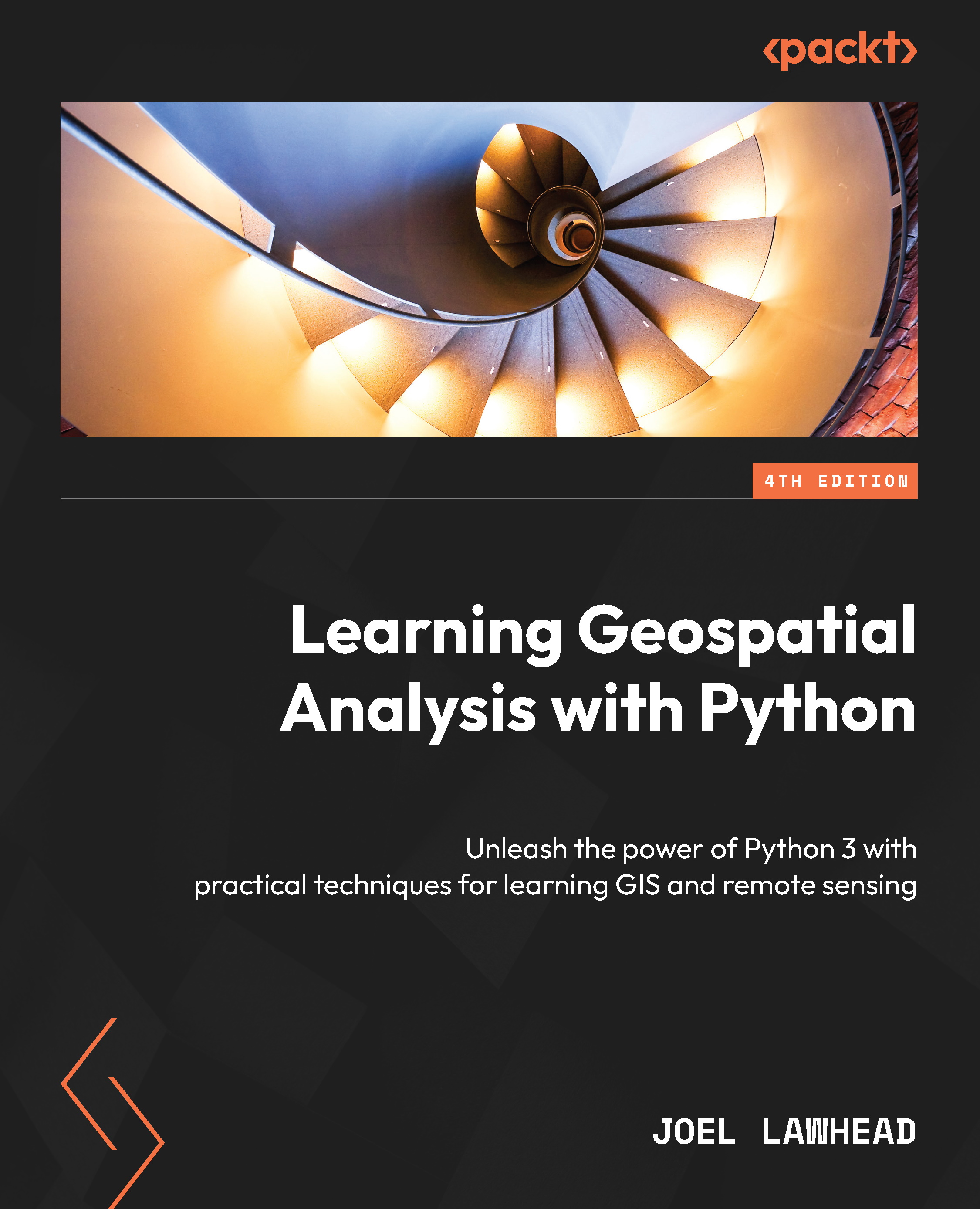
Learning Geospatial Analysis with Python

Learning Geospatial Analysis with Python: Unleash the power of Python 3 with practical techniques for learning GIS and remote sensing , Fourth Edition

Arrow left icon
Profile Icon Joel Lawhead
Arrow right icon
Free Trial
Full star icon Full star icon Full star icon Full star icon Full star icon 5 (7 Ratings)
Paperback Nov 2023 432 pages 4th Edition
eBook
zł79.99 zł135.99
Paperback
zł169.99
Subscription
Free Trial
Arrow left icon
Profile Icon Joel Lawhead
Arrow right icon
Free Trial
Full star icon Full star icon Full star icon Full star icon Full star icon 5 (7 Ratings)
Paperback Nov 2023 432 pages 4th Edition
eBook
zł79.99 zł135.99
Paperback
zł169.99
Subscription
Free Trial
eBook
zł79.99 zł135.99
Paperback
zł169.99
Subscription
Free Trial

What do you get with a Packt Subscription?

Free for first 7 days. $19.99 p/m after that. Cancel any time!
Product feature icon Unlimited ad-free access to the largest independent learning library in tech. Access this title and thousands more!
Product feature icon 50+ new titles added per month, including many first-to-market concepts and exclusive early access to books as they are being written.
Product feature icon Innovative learning tools, including AI book assistants, code context explainers, and text-to-speech.
Product feature icon Thousands of reference materials covering every tech concept you need to stay up to date.
Subscribe now
View plans & pricing
Table of content icon View table of contents Preview book icon Preview Book

Learning Geospatial Analysis with Python

Left arrow icon Right arrow icon
Download code icon Download Code

Key benefits

  • Create GIS solutions using the new features introduced in Python 3.10
  • Explore a range of GIS tools and libraries, including PostGIS, QGIS, and PROJ
  • Identify the tools and resources that best align with your specific needs
  • Purchase of the print or Kindle book includes a free PDF eBook

Description

Geospatial analysis is used in almost every domain you can think of, including defense, farming, and even medicine. In this special 10th anniversary edition, you'll embark on an exhilarating geospatial analysis adventure using Python. This fourth edition starts with the fundamental concepts, enhancing your expertise in geospatial analysis processes with the help of illustrations, basic formulas, and pseudocode for real-world applications. As you progress, you’ll explore the vast and intricate geospatial technology ecosystem, featuring thousands of software libraries and packages, each offering unique capabilities and insights. This book also explores practical Python GIS geospatial applications, remote sensing data, elevation data, and the dynamic world of geospatial modeling. It emphasizes the predictive and decision-making potential of geospatial technology, allowing you to visualize complex natural world concepts, such as environmental conservation, urban planning, and disaster management to make informed choices. You’ll also learn how to leverage Python to process real-time data and create valuable information products. By the end of this book, you'll have acquired the knowledge and techniques needed to build a complete geospatial application that can generate a report and can be further customized for different purposes.

Who is this book for?

This book is for Python developers, researchers, or analysts who want to perform geospatial modeling and GIS analysis with Python. Basic knowledge of digital mapping and analysis using Python or other scripting languages will be helpful.

What you will learn

  • Automate geospatial analysis workflows using Python
  • Understand the different formats in which geospatial data is available
  • Unleash geospatial tech tools to create stunning visualizations
  • Create thematic maps with Python tools such as PyShp, OGR, and the Python Imaging Library
  • Build a geospatial Python toolbox for analysis and application development
  • Unlock remote sensing secrets, detect changes, and process imagery
  • Leverage ChatGPT for solving Python geospatial solutions
  • Apply geospatial analysis to real-time data tracking and storm chasing

Product Details

Country selected
Publication date, Length, Edition, Language, ISBN-13
Publication date : Nov 24, 2023
Length: 432 pages
Edition : 4th
Language : English
ISBN-13 : 9781837639175
Category :
Languages :
Tools :

What do you get with a Packt Subscription?

Free for first 7 days. $19.99 p/m after that. Cancel any time!
Product feature icon Unlimited ad-free access to the largest independent learning library in tech. Access this title and thousands more!
Product feature icon 50+ new titles added per month, including many first-to-market concepts and exclusive early access to books as they are being written.
Product feature icon Innovative learning tools, including AI book assistants, code context explainers, and text-to-speech.
Product feature icon Thousands of reference materials covering every tech concept you need to stay up to date.
Subscribe now
View plans & pricing

Product Details

Publication date : Nov 24, 2023
Length: 432 pages
Edition : 4th
Language : English
ISBN-13 : 9781837639175
Category :
Languages :
Tools :

Packt Subscriptions

See our plans and pricing
Modal Close icon
$19.99 billed monthly
Feature tick icon Unlimited access to Packt's library of 7,000+ practical books and videos
Feature tick icon Constantly refreshed with 50+ new titles a month
Feature tick icon Exclusive Early access to books as they're written
Feature tick icon Solve problems while you work with advanced search and reference features
Feature tick icon Offline reading on the mobile app
Feature tick icon Simple pricing, no contract
$199.99 billed annually
Feature tick icon Unlimited access to Packt's library of 7,000+ practical books and videos
Feature tick icon Constantly refreshed with 50+ new titles a month
Feature tick icon Exclusive Early access to books as they're written
Feature tick icon Solve problems while you work with advanced search and reference features
Feature tick icon Offline reading on the mobile app
Feature tick icon Choose a DRM-free eBook or Video every month to keep
Feature tick icon PLUS own as many other DRM-free eBooks or Videos as you like for just zł20 each
Feature tick icon Exclusive print discounts
$279.99 billed in 18 months
Feature tick icon Unlimited access to Packt's library of 7,000+ practical books and videos
Feature tick icon Constantly refreshed with 50+ new titles a month
Feature tick icon Exclusive Early access to books as they're written
Feature tick icon Solve problems while you work with advanced search and reference features
Feature tick icon Offline reading on the mobile app
Feature tick icon Choose a DRM-free eBook or Video every month to keep
Feature tick icon PLUS own as many other DRM-free eBooks or Videos as you like for just zł20 each
Feature tick icon Exclusive print discounts

Frequently bought together


Stars icon
Total 593.97
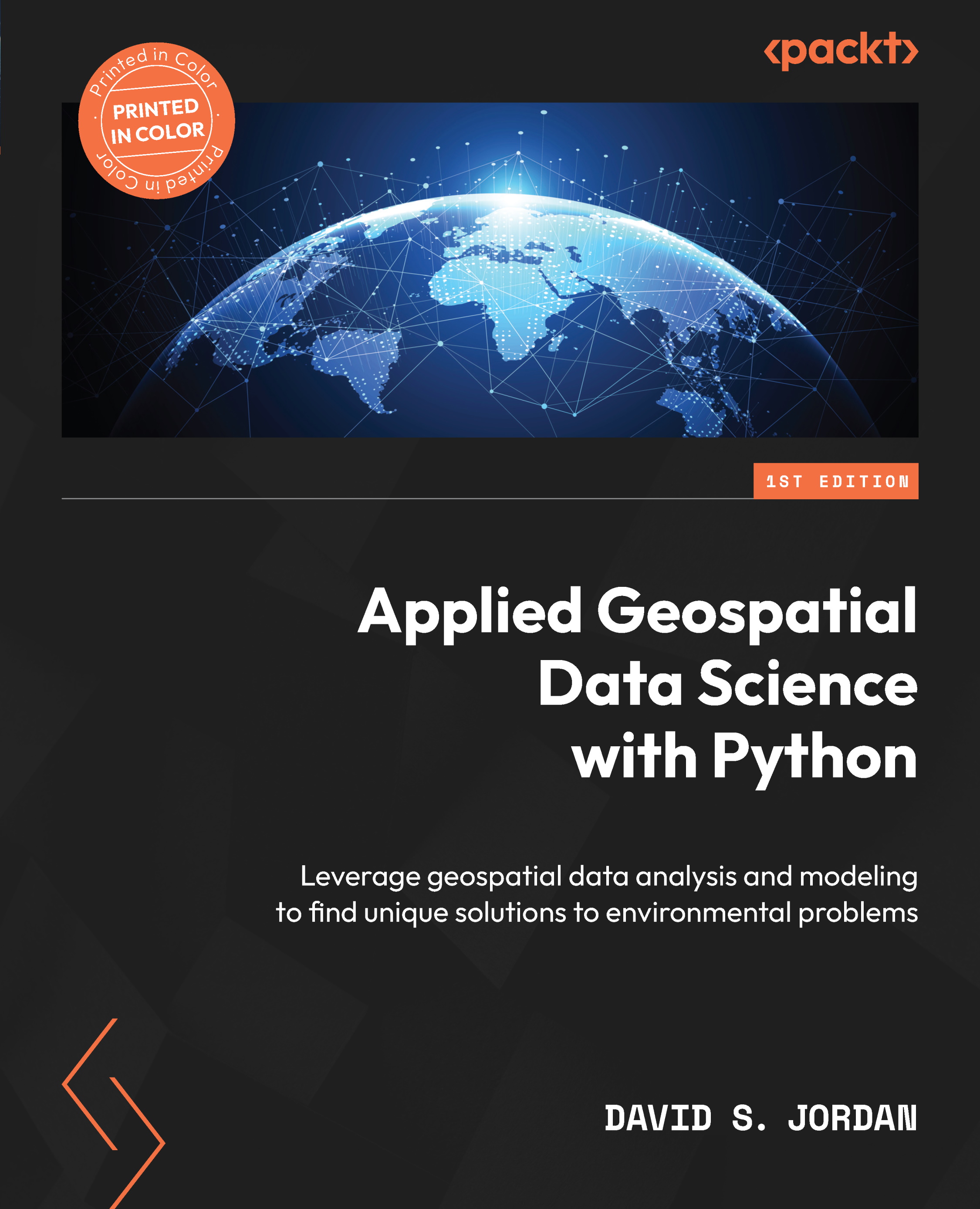
Applied Geospatial Data Science with Python
zł233.99
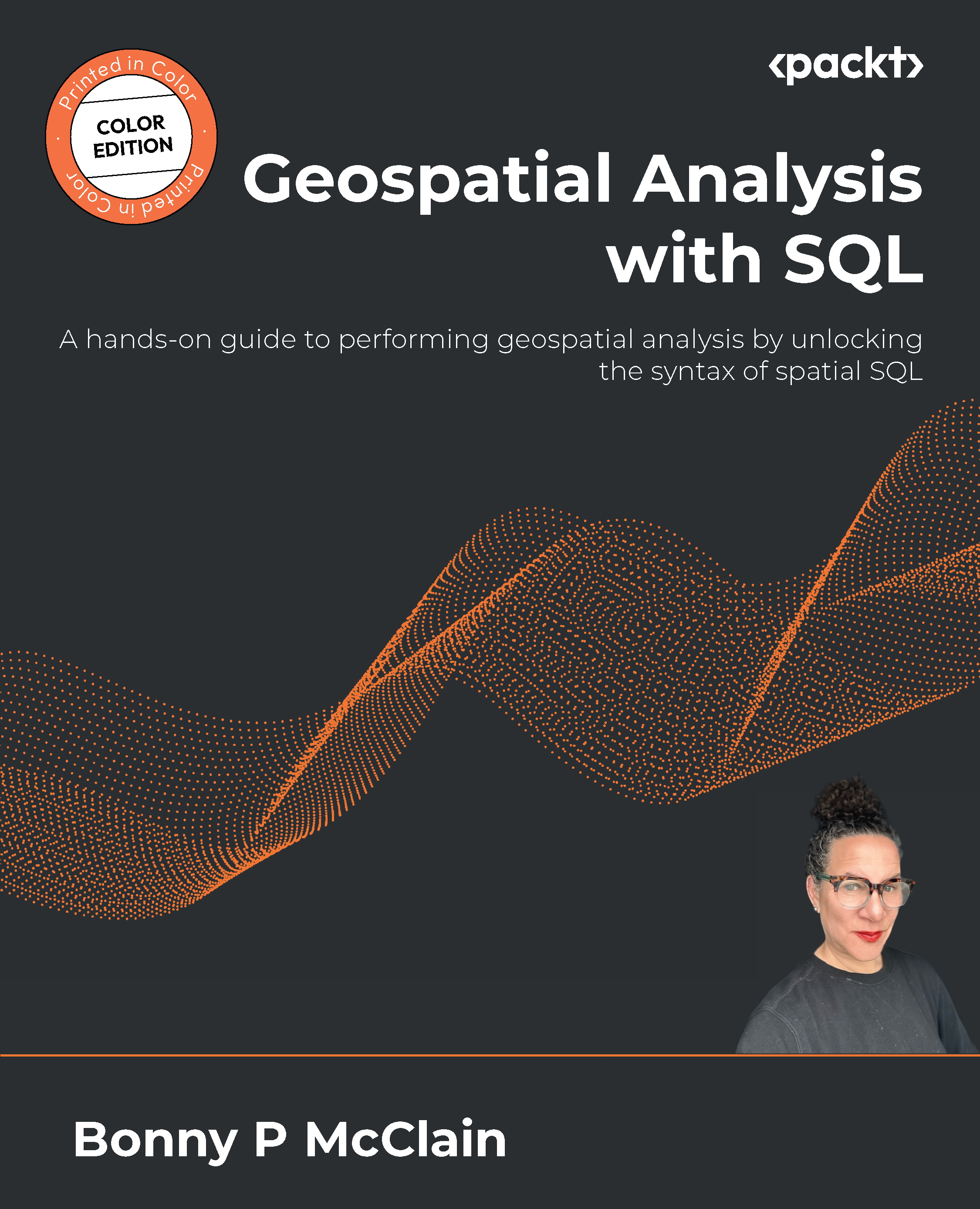
Geospatial Analysis with SQL
zł189.99
Learning Geospatial Analysis with Python
zł169.99
Total 593.97 Stars icon

Table of Contents

17 Chapters
Part 1:The History and the Present of the Industry Chevron down icon Chevron up icon
Chapter 1: Learning about Geospatial Analysis with Python Chevron down icon Chevron up icon
Chapter 2: Learning about Geospatial Data Chevron down icon Chevron up icon
Chapter 3: The Geospatial Technology Landscape Chevron down icon Chevron up icon
Part 2:Geospatial Analysis Concepts Chevron down icon Chevron up icon
Chapter 4: Geospatial Python Toolbox Chevron down icon Chevron up icon
Chapter 5: Python and Geospatial Algorithms Chevron down icon Chevron up icon
Chapter 6: Creating and Editing GIS Data Chevron down icon Chevron up icon
Chapter 7: Python and Remote Sensing Chevron down icon Chevron up icon
Chapter 8: Python and Elevation Data Chevron down icon Chevron up icon
Part 3:Practical Geospatial Processing Techniques Chevron down icon Chevron up icon
Chapter 9: Advanced Geospatial Modeling Chevron down icon Chevron up icon
Chapter 10: Working with Real-Time Data Chevron down icon Chevron up icon
Chapter 11: Putting It All Together Chevron down icon Chevron up icon
Assessments Chevron down icon Chevron up icon
Index Chevron down icon Chevron up icon
Other Books You May Enjoy Chevron down icon Chevron up icon

Customer reviews

Top Reviews
Rating distribution
Full star icon Full star icon Full star icon Full star icon Full star icon 5
(7 Ratings)
5 star 100%
4 star 0%
3 star 0%
2 star 0%
1 star 0%
Filter icon Filter
Top Reviews

Filter reviews by


Greg Cocks Feb 16, 2024
Full star icon Full star icon Full star icon Full star icon Full star icon 5
[disclaimers – (i) a publisher’s representative solicited a review of this book and provided an e-book version for that purpose but no recompense, (ii) this is my impartial, personal review - and hence is not an endorsement by my employer, implicit or otherwise.]--Chapters:Learning Geospatial Analysis with PythonLearning About Geospatial DataThe Geospatial Technology LandscapeGeospatial Python ToolboxPython And Geospatial AlgorithmsCreating And Editing GIS DataPython And Remote SensingPython And Elevation DataAdvanced Geospatial ModelingWorking With Real-Time DataPutting It All TogetherAssessments--Anecdotal I know: in a previous role, I wrote, tested and applied code for ‘geospatial analysis with Python’, applied hydrologic science. With a new role – which I am grateful for – I don’t get to do this often. When the publisher asked me to look at this new (4th Edition) of this book and provide my impression, I was therefore very happy to do so, a nudge to get me back into some old tasks in a guided way, that will help my current role in a technologies platform agnostic way.My initial look over this book has, frankly, got me excited, as cliché as that might sound! The chapters are well laid out, leading you into your exploration and learning, the writing is far from dry, the description of options and different possible approaches is excellent and so much more.The first three chapters bring you into the space, and are wonderful refreshers for those more experienced, with some reminders that GIS, spatial analysis and applied science, business, technology, etc is for a purpose, to help solve problems, ‘better, faster, stronger’ – helping tale away through code and association automation some of the mundanity of spatial data processing, analysis and results presentation and implementation in pragmatic ways – with associated reduction in errors, increase in accuracy, etc. That all sounds a little ‘fluffy I know, but I think it is the core of what we do as spatial professionals, especially in research and/or bringing systems to a production environment.The chapters following are where you get to ‘dig in’, with outstanding descriptions of the what, how, why of the various software and libraries that form the foundation of the book and are used throughout, descriptions of many spatial algorithms and how to apply them in a Python setting, ditto with the large volume of readily available and powerful remote sensing (open) data, ditto the strengths and what to be careful with in terms of elevation data.As the author states, “geospatial data editing and processing helps use understand the world as it is”, and this is the thread of the chapter on geospatial modeling, and for me the most powerful chapter in the book, as the applied scientist that I like to consider myself.Working with real-time data is – frankly – something I have not had a lot of experience in and so I look forward to the exposure and grounding that this chapter will bring, as I can see myself wanting if not needing to use it ongoing.The final chapter is one that, through my initial look, will be the most powerful & worthwhile for me. For those of you old enough, the dry-as-dust ‘worked examples’ like the Northwind database and other such are not in evidence here. I used to teach a little (and also for some of my mentees) the one thing I tried to get across is to work with real-world data and problem-solving as soon and as often as you can in your learning processes, to experience all of its warts, missing info, non-clean contributing datasets, and more – and this chapter appears to do just that! (as you will expect from a self-help book like this, especially one of its evident quality and usefulness, there are example code and data files to download – and my initial appraisal is that they are excellent, and I know that I am using that word a lot in this review.)In my opinion, you will like this book, get value from it, not get bored or ‘stuck’, and will come out the other side a better spatial professional, and I certainly expect to do so as I work through it over the coming months.
Amazon Verified review Amazon
jakethesnake Feb 21, 2024
Full star icon Full star icon Full star icon Full star icon Full star icon 5
I recently had the pleasure of diving into 'Geospatial Analysis with Python - Fourth Edition,' and it has been an enlightening experience. This book masterfully unravels the complexities of geospatial analysis, making it accessible and engaging. The authors do an excellent job of blending theoretical knowledge with practical applications, providing readers with the tools and confidence to tackle their own geospatial projects. The updated content in this edition, including the latest Python libraries and techniques, has been particularly valuable. Whether you're a beginner or looking to sharpen your skills, this book is a must-have for anyone interested in unlocking the power of Python for geospatial analysis. Highly recommended!
Amazon Verified review Amazon
John D Jan 19, 2024
Full star icon Full star icon Full star icon Full star icon Full star icon 5
This is not your typical geospatial and python book! While seemingly geared towards beginners it has content that is interesting even for seasoned professionals. Some of the key aspects I enjoyed most about this book are:1. Full examples of common geospatial algorithms written in python2. The comprehensive layout of the FOSS geospatial ecosystem3. Useful real-world code for accessing and cleaning data4. The background history of GIS and remote sensingMy main critique would be that for a book about analysis, I found the example analytics to be a little basic. There are also a couple of examples of using ChatGPT to help you write code which I think would have been better as an aside rather than an example.All said though, it's a great book, and I will be referencing it in the future!
Amazon Verified review Amazon
Dagoberto Orozco Feb 19, 2024
Full star icon Full star icon Full star icon Full star icon Full star icon 5
As a geologist learning Python I found this book very helpful since it uses practical examples that I can apply my the job. Moreover it was useful to refresh some of the subjects related to remote sensing and to understand what other tools for geospatial analysis are out there. The examples used in the book are easy to follow, well explain and realistic.
Amazon Verified review Amazon
Eniola Olakanmi Mar 12, 2024
Full star icon Full star icon Full star icon Full star icon Full star icon 5
This book is well packaged with good illustrations for anyone interested in Geospatial analysis with python. I love the fact that it covered the geospatial analysis tools including remote sensing and GIS. I am sure this is well detailed for both beginners and professional. I found chapters 5 and 6 very interesting. I'm still using the book anyways but I highly recommend.
Amazon Verified review Amazon
Get free access to Packt library with over 7500+ books and video courses for 7 days!
Start Free Trial

FAQs

What is included in a Packt subscription? Chevron down icon Chevron up icon

A subscription provides you with full access to view all Packt and licnesed content online, this includes exclusive access to Early Access titles. Depending on the tier chosen you can also earn credits and discounts to use for owning content

How can I cancel my subscription? Chevron down icon Chevron up icon

To cancel your subscription with us simply go to the account page - found in the top right of the page or at https://subscription.packtpub.com/my-account/subscription - From here you will see the ‘cancel subscription’ button in the grey box with your subscription information in.

What are credits? Chevron down icon Chevron up icon

Credits can be earned from reading 40 section of any title within the payment cycle - a month starting from the day of subscription payment. You also earn a Credit every month if you subscribe to our annual or 18 month plans. Credits can be used to buy books DRM free, the same way that you would pay for a book. Your credits can be found in the subscription homepage - subscription.packtpub.com - clicking on ‘the my’ library dropdown and selecting ‘credits’.

What happens if an Early Access Course is cancelled? Chevron down icon Chevron up icon

Projects are rarely cancelled, but sometimes it's unavoidable. If an Early Access course is cancelled or excessively delayed, you can exchange your purchase for another course. For further details, please contact us here.

Where can I send feedback about an Early Access title? Chevron down icon Chevron up icon

If you have any feedback about the product you're reading, or Early Access in general, then please fill out a contact form here and we'll make sure the feedback gets to the right team. 

Can I download the code files for Early Access titles? Chevron down icon Chevron up icon

We try to ensure that all books in Early Access have code available to use, download, and fork on GitHub. This helps us be more agile in the development of the book, and helps keep the often changing code base of new versions and new technologies as up to date as possible. Unfortunately, however, there will be rare cases when it is not possible for us to have downloadable code samples available until publication.

When we publish the book, the code files will also be available to download from the Packt website.

How accurate is the publication date? Chevron down icon Chevron up icon

The publication date is as accurate as we can be at any point in the project. Unfortunately, delays can happen. Often those delays are out of our control, such as changes to the technology code base or delays in the tech release. We do our best to give you an accurate estimate of the publication date at any given time, and as more chapters are delivered, the more accurate the delivery date will become.

How will I know when new chapters are ready? Chevron down icon Chevron up icon

We'll let you know every time there has been an update to a course that you've bought in Early Access. You'll get an email to let you know there has been a new chapter, or a change to a previous chapter. The new chapters are automatically added to your account, so you can also check back there any time you're ready and download or read them online.

I am a Packt subscriber, do I get Early Access? Chevron down icon Chevron up icon

Yes, all Early Access content is fully available through your subscription. You will need to have a paid for or active trial subscription in order to access all titles.

How is Early Access delivered? Chevron down icon Chevron up icon

Early Access is currently only available as a PDF or through our online reader. As we make changes or add new chapters, the files in your Packt account will be updated so you can download them again or view them online immediately.

How do I buy Early Access content? Chevron down icon Chevron up icon

Early Access is a way of us getting our content to you quicker, but the method of buying the Early Access course is still the same. Just find the course you want to buy, go through the check-out steps, and you’ll get a confirmation email from us with information and a link to the relevant Early Access courses.

What is Early Access? Chevron down icon Chevron up icon

Keeping up to date with the latest technology is difficult; new versions, new frameworks, new techniques. This feature gives you a head-start to our content, as it's being created. With Early Access you'll receive each chapter as it's written, and get regular updates throughout the product's development, as well as the final course as soon as it's ready.We created Early Access as a means of giving you the information you need, as soon as it's available. As we go through the process of developing a course, 99% of it can be ready but we can't publish until that last 1% falls in to place. Early Access helps to unlock the potential of our content early, to help you start your learning when you need it most. You not only get access to every chapter as it's delivered, edited, and updated, but you'll also get the finalized, DRM-free product to download in any format you want when it's published. As a member of Packt, you'll also be eligible for our exclusive offers, including a free course every day, and discounts on new and popular titles.

Modal Close icon
Modal Close icon