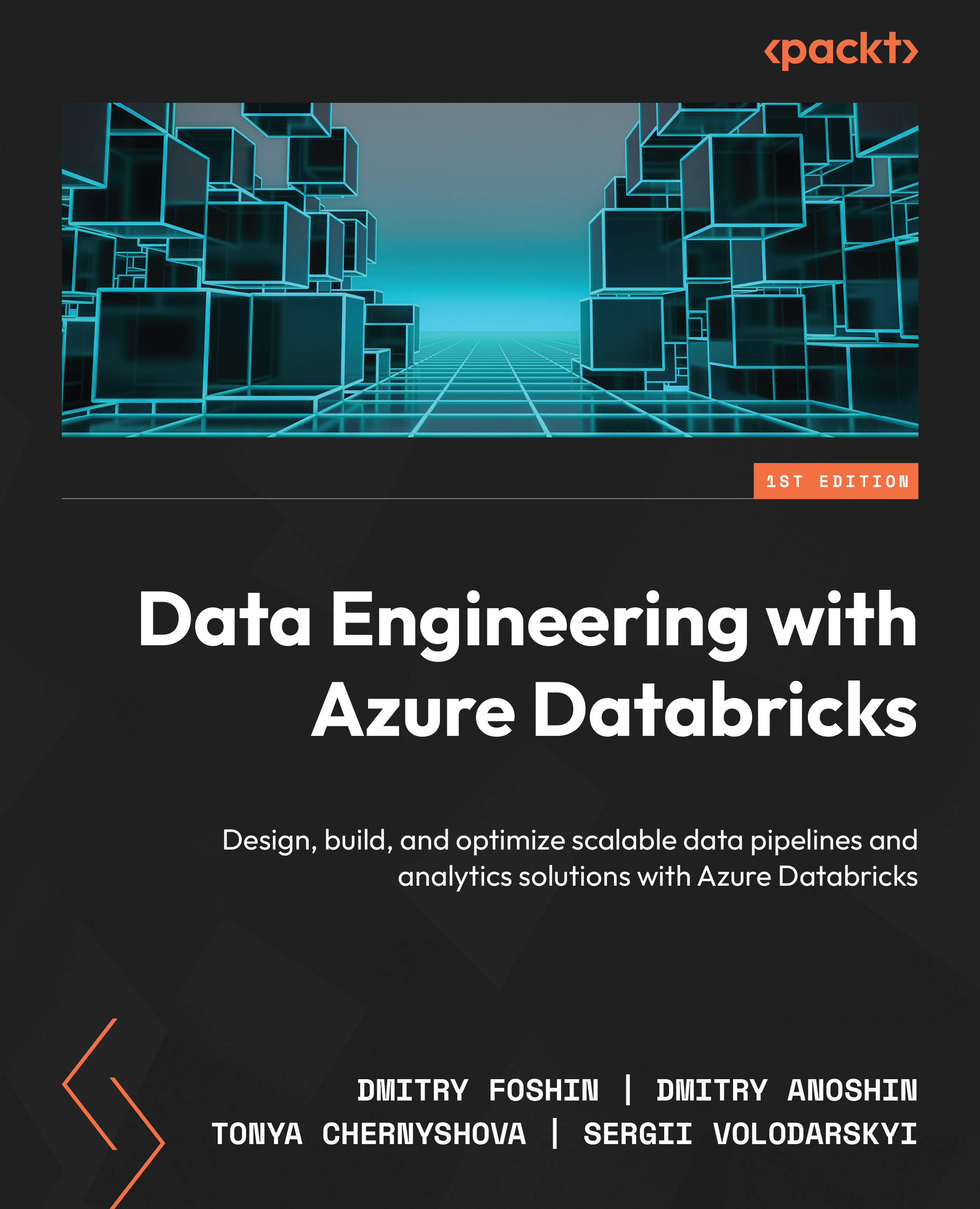
Build scalable data pipelines using Apache Spark and Delta Lake
Automate workflows and manage data governance with Unity Catalog
Learn real-time processing and structured streaming with practical use cases
Implement CI/CD, DevOps, and security for production-ready data solutions
Explore Databricks-native ML, AutoML, and Generative AI integration
Description
"Data Engineering with Azure Databricks" is your essential guide to building scalable, secure, and high-performing data pipelines using the powerful Databricks platform on Azure. Designed for data engineers, architects, and developers, this book demystifies the complexities of Spark-based workloads, Delta Lake, Unity Catalog, and real-time data processing.
Beginning with the foundational role of Azure Databricks in modern data engineering, you’ll explore how to set up robust environments, manage data ingestion with Auto Loader, optimize Spark performance, and orchestrate complex workflows using tools like Azure Data Factory and Airflow.
The book offers deep dives into structured streaming, Delta Live Tables, and Delta Lake’s ACID features for data reliability and schema evolution. You’ll also learn how to manage security, compliance, and access controls using Unity Catalog, and gain insights into managing CI/CD pipelines with Azure DevOps and Terraform.
With a special focus on machine learning and generative AI, the final chapters guide you in automating model workflows, leveraging MLflow, and fine-tuning large language models on Databricks. Whether you're building a modern data lakehouse or operationalizing analytics at scale, this book provides the tools and insights you need.
Who is this book for?
This book is for data engineers, solution architects, cloud professionals, and software engineers seeking to build robust and scalable data pipelines using Azure Databricks. Whether you're migrating legacy systems, implementing a modern lakehouse architecture, or optimizing data workflows for performance, this guide will help you leverage the full power of Databricks on Azure. A basic understanding of Python, Spark, and cloud infrastructure is recommended.
What you will learn
Set up a full-featured Azure Databricks environment
Implement batch and streaming ingestion using Auto Loader
Optimize Spark jobs with partitioning and caching
Build real-time pipelines with structured streaming and DLT
Manage data governance using Unity Catalog
Orchestrate production workflows with jobs and ADF
Apply CI/CD best practices with Azure DevOps and Git
Secure data with RBAC, encryption, and compliance standards
Unlimited Tech Books & Videos from ₹667 p/mGet full library access, upgrade to Premium for 1 free title to keep every month + up to 50% off store purchases.
Dmitry Foshin is a Business Intelligence team leader focused on delivering business insights to the management team through data engineering, analytics, and visualization. He has led and executed complex full-stack BI solutions (from ETL processes to building DWHs and reporting) using Azure technologies, Data Lake, Data Factory, Data Bricks, MS Office 365, Power BI, and Tableau. He has also successfully launched numerous data analytics projects – both on-premises and in the cloud – that help achieve corporate goals for international FMCG companies, banks, and manufacturing companies.
Dmitry Anoshin is a data-centric technologist and a recognized expert in building and implementing big data and analytics solutions. He has a successful track record of implementing business and digital intelligence projects across retail, finance, marketing, and e-commerce. Dmitry possesses in-depth knowledge of digital/business intelligence, ETL, data warehousing, and big data technologies. He has extensive experience in data integration and is proficient in various data warehousing methodologies. Dmitry has consistently exceeded project expectations across the financial, machine tool, and retail industries. He has completed a number of multinational full BI/DI solution life cycle implementation projects. With expertise in data modeling, Dmitry also has a background and business experience in multiple relational databases, OLAP systems, and NoSQL databases. He is also an active speaker at data conferences and helps people to adopt cloud analytics.
Tonya Chernyshova is an experienced Data Engineer with over 10 years in the field, including time at Amazon. Specializing in Data Modeling, Automation, Cloud Computing (AWS and Azure), and Data Visualization, she has a strong track record of delivering scalable, maintainable data products. Her expertise drives data-driven insights and business growth, showcasing her proficiency in leveraging cloud technologies to enhance data capabilities.
Sergii Volodarskyi is a Data Engineer working daily on the Databricks ecosystem, across both platform and product data engineering. His expertise spans the full spectrum of modern data platform delivery, from designing lakehouse architectures and building CI/CD pipelines to extracting data from APIs and shipping analytical products that drive business decisions. This book is a reflection of experience and best practices built up across real projects. He actively shares his knowledge with the engineering community and is a builder with a deep interest in the intersection of data, AI, and software engineering.
Where there is an eBook version of a title available, you can buy it from the book details for that title. Add either the standalone eBook or the eBook and print book bundle to your shopping cart. Your eBook will show in your cart as a product on its own. After completing checkout and payment in the normal way, you will receive your receipt on the screen containing a link to a personalised PDF download file. This link will remain active for 30 days. You can download backup copies of the file by logging in to your account at any time.
If you already have Adobe reader installed, then clicking on the link will download and open the PDF file directly. If you don't, then save the PDF file on your machine and download the Reader to view it.
Please Note: Packt eBooks are non-returnable and non-refundable.
Packt eBook and Licensing When you buy an eBook from Packt Publishing, completing your purchase means you accept the terms of our licence agreement. Please read the full text of the agreement. In it we have tried to balance the need for the ebook to be usable for you the reader with our needs to protect the rights of us as Publishers and of our authors. In summary, the agreement says:
You may make copies of your eBook for your own use onto any machine
You may not pass copies of the eBook on to anyone else
How can I make a purchase on your website?
If you want to purchase a video course, eBook or Bundle (Print+eBook) please follow below steps:
Register on our website using your email address and the password.
Search for the title by name or ISBN using the search option.
Select the title you want to purchase.
Choose the format you wish to purchase the title in; if you order the Print Book, you get a free eBook copy of the same title.
Proceed with the checkout process (payment to be made using Credit Card, Debit Cart, or PayPal)
Where can I access support around an eBook?
If you experience a problem with using or installing Adobe Reader, the contact Adobe directly.
To view the errata for the book, see www.packtpub.com/support and view the pages for the title you have.
To view your account details or to download a new copy of the book go to www.packtpub.com/account
Our eBooks are currently available in a variety of formats such as PDF and ePubs. In the future, this may well change with trends and development in technology, but please note that our PDFs are not Adobe eBook Reader format, which has greater restrictions on security.
You will need to use Adobe Reader v9 or later in order to read Packt's PDF eBooks.
What are the benefits of eBooks?
You can get the information you need immediately
You can easily take them with you on a laptop
You can download them an unlimited number of times
You can print them out
They are copy-paste enabled
They are searchable
There is no password protection
They are lower price than print
They save resources and space
What is an eBook?
Packt eBooks are a complete electronic version of the print edition, available in PDF and ePub formats. Every piece of content down to the page numbering is the same. Because we save the costs of printing and shipping the book to you, we are able to offer eBooks at a lower cost than print editions.
When you have purchased an eBook, simply login to your account and click on the link in Your Download Area. We recommend you saving the file to your hard drive before opening it.
For optimal viewing of our eBooks, we recommend you download and install the free Adobe Reader version 9.


 United States

 Great Britain
 India
India
 Germany
 France
 Canada
 Russia
 Spain
Spain
 Brazil
 Australia
 Singapore
 Canary Islands
 Hungary
 Ukraine
 Luxembourg
 Estonia
 Lithuania
 South Korea
 Turkey
 Switzerland
 Colombia
 Taiwan
 Chile
Chile
 Norway
 Ecuador
 Indonesia
 New Zealand
 Cyprus
 Denmark
 Finland
 Poland
 Malta
Malta
 Czechia
 Austria
 Sweden
 Italy
Italy
 Egypt
Egypt
 Belgium
 Portugal
 Slovenia
 Ireland
 Romania
 Greece
 Argentina
 Netherlands
 Bulgaria
 Latvia
 South Africa
 Malaysia
 Japan
Japan
 Slovakia
 Philippines
 Mexico
 Thailand