Search icon CANCEL
Subscription
0
Cart icon
Your Cart (0 item)
Close icon
You have no products in your basket yet
Save more on your purchases! discount-offer-chevron-icon
Savings automatically calculated. No voucher code required.
Arrow left icon
Explore Products
Best Sellers
New Releases
Books
Videos
Audiobooks
Learning Hub
Newsletter Hub
Free Learning
Arrow right icon
timer SALE ENDS IN
0 Days
:
00 Hours
:
00 Minutes
:
00 Seconds
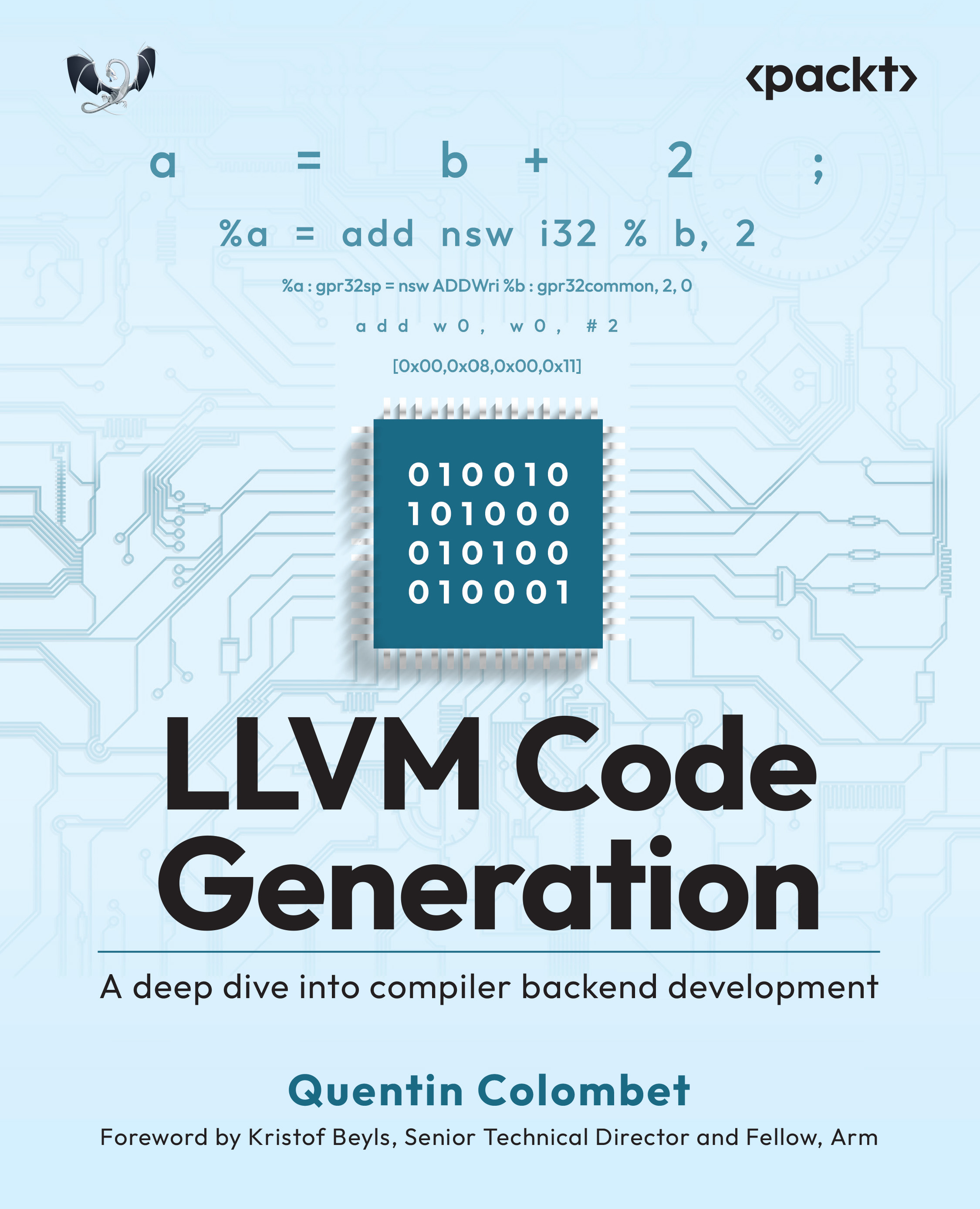
LLVM Code Generation

LLVM Code Generation: A deep dive into compiler backend development

Arrow left icon
Profile Icon Quentin Colombet
Arrow right icon
$19.99 per month
Full star icon Empty star icon Empty star icon Empty star icon Empty star icon 1 (1 Ratings)
Paperback May 2025 620 pages 1st Edition
eBook
€8.98 €29.99
Paperback
€37.99
Subscription
Free Trial
Renews at $19.99p/m
Arrow left icon
Profile Icon Quentin Colombet
Arrow right icon
$19.99 per month
Full star icon Empty star icon Empty star icon Empty star icon Empty star icon 1 (1 Ratings)
Paperback May 2025 620 pages 1st Edition
eBook
€8.98 €29.99
Paperback
€37.99
Subscription
Free Trial
Renews at $19.99p/m
eBook
€8.98 €29.99
Paperback
€37.99
Subscription
Free Trial
Renews at $19.99p/m

What do you get with a Packt Subscription?

Free for first 7 days. $19.99 p/m after that. Cancel any time!
Product feature icon Unlimited ad-free access to the largest independent learning library in tech. Access this title and thousands more!
Product feature icon 50+ new titles added per month, including many first-to-market concepts and exclusive early access to books as they are being written.
Product feature icon Innovative learning tools, including AI book assistants, code context explainers, and text-to-speech.
Product feature icon Thousands of reference materials covering every tech concept you need to stay up to date.
Subscribe now
View plans & pricing
Table of content icon View table of contents Preview book icon Preview Book

LLVM Code Generation

Building LLVM and Understanding the Directory Structure

The LLVM infrastructure provides a set of libraries that can be assembled to create different tools and compilers.

LLVM originally stood for Low-Level Virtual Machine. Nowadays, it is much more than that, as you will shortly learn, and people just use LLVM as a name.

Given the sheer volume of code that makes the LLVM repository, it can be daunting to even know where to start.

In this chapter, we will give you the keys to approach and use this code base confidently. Using this knowledge, you will be able to do the following:

  • Understand the different components that make a compiler
  • Build and test the LLVM project
  • Navigate LLVM’s directory structure and locate the implementation of different components
  • Contribute to the LLVM project

This chapter covers the basics needed to get started with LLVM. If you are already familiar with the LLVM infrastructure or followed the tutorial...

Technical requirements

To work with the LLVM code base, you need specific tools on your system. In this section, we list the required versions of these tools for the latest major LLVM release: 20.1.0.

Later, in Identifying the right version of the tools, you will learn how to find the version of the tools required to build a specific version of LLVM, including older and newer releases and the LLVM top-of-tree (that is, the actively developed repository). Additionally, you will learn how to install them.

With no further due, here are the versions of the tools required for LLVM 20.1.0:

Tool

Required version

Git

None specified

C/C++ toolchain

>=Clang 5.0

>=Apple Clang 10.0

>=GCC 7.4

&gt...

Getting ready for LLVM’s world

In the Technical requirement section, we already listed which version of tools you needed to work with LLVM 20.1.0. However, LLVM is a lively project and what is required today may be different than what is required tomorrow. Also, to step back a bit, you may not know why you need these tools to begin with and/or how to get them.

This section addresses these questions, and you will learn the following in the process:

  • The purpose of each required tool
  • How to check that your environment has the proper tools
  • How to install the proper tools

Depending on how familiar you are with development on Linux/macOS, this setup can be tedious or a walk in the park.

Ultimately, this section aims to teach you how to go beyond a fixed release of LLVM by giving you the knowledge required to find the information you need.

If you are familiar with package managers (e.g., the apt-get command-line tool on Linux and Homebrew...

Building a compiler

In this section, we will introduce the different parts of what makes a compiler and how they relate to the LLVM code base. In the process, you will do the following:

  • Understand the overall architecture of a compiler
  • Learn how to build Clang from the source
  • Be able to decide which components of LLVM you need to build

If you are already familiar with the components of a compiler toolchain and want to jump straight into the action, skip directly to the Building LLVM section.

What is a compiler?

The definition of a compiler means different things for different people. For instance, for a student in their first year of computer science, a compiler may be seen as a tool that translates a source language into executable code. This is a possible definition, but it is also a very coarse-grain one.

When you look closer at a compiler, you will find that it is a collection of different tools, or libraries, working together to achieve...

Building LLVM

This is where your journey as a backend developer starts: you will learn how to build the core LLVM project.

Instead of just dropping a bunch of commands for you to run (we will do some of that too, we promise), you will discover the most relevant knobs that you can use to tailor the build process to your needs.

We believe this is important knowledge to gain as it will help you optimize your development process and increase your productivity by focusing on what you need to build/run for your use cases.

To set the context, the core LLVM project contains all the necessary pieces to build an optimizing backend from LLVM IR down to assembly code/an object file for 20+ different architectures. This is a lot of code and chances are that you do not care about all these architectures. Therefore, at the very least, learning how to build only the ones you care about will save you compile time and down the road will improve your development speed.

Configuring the...

Testing a compiler

In the previous section, you have learned how to run the core LLVM unit tests, but this is only the beginning of the story. There are two big missing pieces:

  • How do you understand and reproduce a failing unit test?
  • How do you go beyond unit testing?

Let us answer these questions in the following sections. However, first, we need a primer on some of the tools/infrastructure used for testing in LLVM.

Crash course on the Google test infrastructure

LLVM uses the Google test infrastructure (gtest) for some of its unit tests.

The tests based on gtest are regular C++ codes and produce regular executables. If you open one of the source files of the tests using this framework, you will find gtest-specific directives (e.g., EXPECT_EQ, TEST, etc.) but nothing complicated beyond that.

Running the related executable will directly reproduce whatever issue you may want to investigate and all the techniques you know for debugging C++ code...

Understanding the directory structure

In this section, you will learn the basics of how the LLVM folders are organized. This knowledge will come in handy when you start contributing to LLVM. This will help you shape patches that follow the philosophy behind the directory structure and hence, help you avoid unnecessary rounds of reviews where you would have to fix that.

High-level directory structure

At a high level, the LLVM code base is organized into projects: Clang, MLIR, the LLVM debugger (LLDB), and many more. Each project has its own directory, and its name matches the name of the related project in lowercase: clang, mlir, lldb, and so on.

You need to use these directory names in the LLVM_ENABLE_PROJECTS CMake variable to build the related projects.

The common theme around these projects is that they use or contribute to a part of the LLVM infrastructure.

Focusing on the core LLVM project

Unsurprisingly, the core LLVM project lives in the llvm directory...

Summary

In this chapter, you learned how to set up your development environment and how to find the required version of the different tools to build the different versions of the LLVM infrastructure, including the open-source repository. This is a necessary step to be able to get started with building the LLVM infrastructure.

Next, you discovered the main components that make a compiler toolchain, namely the driver, frontend, backend, linker, and standard library, and which LLVM project they map to. This information will come in handy when you decide what you want to build out of the LLVM infrastructure.

After that, you dove into the build configurations of the core LLVM project and learned how to tweak the CMake variables to tailor the build to your needs while balancing the debuggability of the produced artifacts and the build time. You also learned how to use Ninja, the driver of the build system, efficiently to reduce the turnaround time between development, building,...

Quiz time

Now that you have completed reading this chapter, answer the following questions to test your knowledge:

  1. You have a pristine clone of the LLVM code base and yet the build fails with weird compiler errors. What could be the reason?

The most likely reasons are as follows:

  • The LLVM code base is temporarily broken.
  • Check the build bots at https://lab.llvm.org/buildbot/.
  • Your environment is not properly set up.
  • Check that your tools meet the expected minimal requirements. See Installing the right tools.
  1. You have a C file, and you are curious about what the LLVM IR looks like without optimization. How can you print this IR using Clang?

You can run the following:

$ clang -S -O0 -emit-llvm myFile.c -o -

See Experimenting with Clang.

  1. You want to build LLVM for just the AMDGPU and X86 backends. Which CMake variable should you set and how do you set it?

You want to set the variable...

Quiz time

Now that you have completed reading this chapter, answer the following questions to test your knowledge:

  1. You have a pristine clone of the LLVM code base and yet the build fails with weird compiler errors. What could be the reason?

The most likely reasons are as follows:

  • The LLVM code base is temporarily broken.
  • Check the build bots at https://lab.llvm.org/buildbot/.
  • Your environment is not properly set up.
  • Check that your tools meet the expected minimal requirements. See Installing the right tools.
  1. You have a C file, and you are curious about what the LLVM IR looks like without optimization. How can you print this IR using Clang?

You can run the following:

$ clang -S -O0 -emit-llvm myFile.c -o -

See Experimenting with Clang.

  1. You want to build LLVM for just the AMDGPU and X86 backends. Which CMake variable should you set and how do you set it?

You want to set the variable...

Left arrow icon Right arrow icon
Download code icon Download Code

Key benefits

  • Understand the steps involved in generating assembly code from LLVM IR
  • Learn the key constructs needed to leverage LLVM for your hardware or backend
  • Strengthen your understanding with targeted exercises and practical examples in every chapter

Description

The LLVM infrastructure is a popular compiler ecosystem widely used in the tech industry and academia. This technology is crucial for both experienced and aspiring compiler developers looking to make an impact in the field. Written by Quentin Colombet, a veteran LLVM contributor and architect of the GlobalISel framework, this book provides a primer on the main aspects of LLVM, with an emphasis on its backend infrastructure; that is, everything needed to transform the intermediate representation (IR) produced by frontends like Clang into assembly code and object files. You’ll learn how to write an optimizing code generator for a toy backend in LLVM. The chapters will guide you step by step through building this backend while exploring key concepts, such as the ABI, cost model, and register allocation. You’ll also find out how to express these concepts using LLVM's existing infrastructure and how established backends address these challenges. Furthermore, the book features code snippets that demonstrate the actual APIs. By the end of this book, you’ll have gained a deeper understanding of LLVM. The concepts presented are expected to remain stable across different LLVM versions, making this book a reliable quick reference guide for understanding LLVM.

Who is this book for?

This book is for both beginners to LLVM and experienced LLVM developers. If you’re new to LLVM, it offers a clear, approachable guide to compiler backends, starting with foundational concepts. For seasoned LLVM developers, it dives into less-documented areas such as TableGen, MachineIR, and MC, enabling you to solve complex problems and expand your expertise. Whether you’re starting out or looking to deepen your knowledge, this book has something for you.

What you will learn

  • Understand essential compiler concepts, such as SSA, dominance, and ABI
  • Build and extend LLVM backends for creating custom compiler features
  • Optimize code by manipulating LLVM's Intermediate Representation
  • Contribute effectively to LLVM open-source projects and development
  • Develop debugging skills for LLVM optimizations and passes
  • Grasp how encoding and (dis)assembling work in the context of compilers
  • Utilize LLVM's TableGen DSL for creating custom compiler models

Product Details

Country selected
Publication date, Length, Edition, Language, ISBN-13
Publication date : May 23, 2025
Length: 620 pages
Edition : 1st
Language : English
ISBN-13 : 9781837637782
Category :
Languages :
Tools :

What do you get with a Packt Subscription?

Free for first 7 days. $19.99 p/m after that. Cancel any time!
Product feature icon Unlimited ad-free access to the largest independent learning library in tech. Access this title and thousands more!
Product feature icon 50+ new titles added per month, including many first-to-market concepts and exclusive early access to books as they are being written.
Product feature icon Innovative learning tools, including AI book assistants, code context explainers, and text-to-speech.
Product feature icon Thousands of reference materials covering every tech concept you need to stay up to date.
Subscribe now
View plans & pricing

Product Details

Publication date : May 23, 2025
Length: 620 pages
Edition : 1st
Language : English
ISBN-13 : 9781837637782
Category :
Languages :
Tools :

Packt Subscriptions

See our plans and pricing
Modal Close icon
$19.99 billed monthly
Feature tick icon Unlimited access to Packt's library of 7,000+ practical books and videos
Feature tick icon Constantly refreshed with 50+ new titles a month
Feature tick icon Exclusive Early access to books as they're written
Feature tick icon Solve problems while you work with advanced search and reference features
Feature tick icon Offline reading on the mobile app
Feature tick icon Simple pricing, no contract
$199.99 billed annually
Feature tick icon Unlimited access to Packt's library of 7,000+ practical books and videos
Feature tick icon Constantly refreshed with 50+ new titles a month
Feature tick icon Exclusive Early access to books as they're written
Feature tick icon Solve problems while you work with advanced search and reference features
Feature tick icon Offline reading on the mobile app
Feature tick icon Choose a DRM-free eBook or Video every month to keep
Feature tick icon PLUS own as many other DRM-free eBooks or Videos as you like for just $5 each
Feature tick icon Exclusive print discounts
$279.99 billed in 18 months
Feature tick icon Unlimited access to Packt's library of 7,000+ practical books and videos
Feature tick icon Constantly refreshed with 50+ new titles a month
Feature tick icon Exclusive Early access to books as they're written
Feature tick icon Solve problems while you work with advanced search and reference features
Feature tick icon Offline reading on the mobile app
Feature tick icon Choose a DRM-free eBook or Video every month to keep
Feature tick icon PLUS own as many other DRM-free eBooks or Videos as you like for just $5 each
Feature tick icon Exclusive print discounts

Table of Contents

29 Chapters
Part 1: Getting Started with LLVM Chevron down icon Chevron up icon
Building LLVM and Understanding the Directory Structure Chevron down icon Chevron up icon
Contributing to LLVM Chevron down icon Chevron up icon
Compiler Basics and How They Map to LLVM APIs Chevron down icon Chevron up icon
Writing Your First Optimization Chevron down icon Chevron up icon
Dealing with Pass Managers Chevron down icon Chevron up icon
TableGen – LLVM Swiss Army Knife for Modeling Chevron down icon Chevron up icon
Part 2: Middle-End: LLVM IR to LLVM IR Chevron down icon Chevron up icon
Understanding LLVM IR Chevron down icon Chevron up icon
Survey of the Existing Passes Chevron down icon Chevron up icon
Introducing Target-Specific Constructs Chevron down icon Chevron up icon
Hands-On Debugging LLVM IR Passes Chevron down icon Chevron up icon
Part 3: Introduction to the Backend Chevron down icon Chevron up icon
Getting Started with the Backend Chevron down icon Chevron up icon
Getting Started with the Machine Code Layer Chevron down icon Chevron up icon
The Machine Pass Pipeline Chevron down icon Chevron up icon
Part 4: LLVM IR to Machine IR Chevron down icon Chevron up icon
Getting Started with Instruction Selection Chevron down icon Chevron up icon
Instruction Selection: The IR Building Phase Chevron down icon Chevron up icon
Instruction Selection: The Legalization Phase Chevron down icon Chevron up icon
Instruction Selection: The Selection Phase and Beyond Chevron down icon Chevron up icon
Part 5: Final Lowering and Optimizations Chevron down icon Chevron up icon
Instruction Scheduling Chevron down icon Chevron up icon
Register Allocation Chevron down icon Chevron up icon
Lowering of the Stack Layout Chevron down icon Chevron up icon
Getting Started with the Assembler Chevron down icon Chevron up icon
Unlock Your Book’s Exclusive Benefits Chevron down icon Chevron up icon
Other Books You May Enjoy Chevron down icon Chevron up icon
Index Chevron down icon Chevron up icon

Customer reviews

Rating distribution
Full star icon Empty star icon Empty star icon Empty star icon Empty star icon 1
(1 Ratings)
5 star 0%
4 star 0%
3 star 0%
2 star 0%
1 star 100%
Tilak Aug 23, 2025
Full star icon Empty star icon Empty star icon Empty star icon Empty star icon 1
AI assistant button does not work. Packt rushes to put 'AI' in their stuff to follow market trend but completely useless. Non responsive button There is no natural voice for the play button which also sucks. All I see around AI AI AI - Give me money..
Subscriber review Packt
Get free access to Packt library with over 7500+ books and video courses for 7 days!
Start Free Trial

FAQs

What is included in a Packt subscription? Chevron down icon Chevron up icon

A subscription provides you with full access to view all Packt and licnesed content online, this includes exclusive access to Early Access titles. Depending on the tier chosen you can also earn credits and discounts to use for owning content

How can I cancel my subscription? Chevron down icon Chevron up icon

To cancel your subscription with us simply go to the account page - found in the top right of the page or at https://subscription.packtpub.com/my-account/subscription - From here you will see the ‘cancel subscription’ button in the grey box with your subscription information in.

What are credits? Chevron down icon Chevron up icon

Credits can be earned from reading 40 section of any title within the payment cycle - a month starting from the day of subscription payment. You also earn a Credit every month if you subscribe to our annual or 18 month plans. Credits can be used to buy books DRM free, the same way that you would pay for a book. Your credits can be found in the subscription homepage - subscription.packtpub.com - clicking on ‘the my’ library dropdown and selecting ‘credits’.

What happens if an Early Access Course is cancelled? Chevron down icon Chevron up icon

Projects are rarely cancelled, but sometimes it's unavoidable. If an Early Access course is cancelled or excessively delayed, you can exchange your purchase for another course. For further details, please contact us here.

Where can I send feedback about an Early Access title? Chevron down icon Chevron up icon

If you have any feedback about the product you're reading, or Early Access in general, then please fill out a contact form here and we'll make sure the feedback gets to the right team. 

Can I download the code files for Early Access titles? Chevron down icon Chevron up icon

We try to ensure that all books in Early Access have code available to use, download, and fork on GitHub. This helps us be more agile in the development of the book, and helps keep the often changing code base of new versions and new technologies as up to date as possible. Unfortunately, however, there will be rare cases when it is not possible for us to have downloadable code samples available until publication.

When we publish the book, the code files will also be available to download from the Packt website.

How accurate is the publication date? Chevron down icon Chevron up icon

The publication date is as accurate as we can be at any point in the project. Unfortunately, delays can happen. Often those delays are out of our control, such as changes to the technology code base or delays in the tech release. We do our best to give you an accurate estimate of the publication date at any given time, and as more chapters are delivered, the more accurate the delivery date will become.

How will I know when new chapters are ready? Chevron down icon Chevron up icon

We'll let you know every time there has been an update to a course that you've bought in Early Access. You'll get an email to let you know there has been a new chapter, or a change to a previous chapter. The new chapters are automatically added to your account, so you can also check back there any time you're ready and download or read them online.

I am a Packt subscriber, do I get Early Access? Chevron down icon Chevron up icon

Yes, all Early Access content is fully available through your subscription. You will need to have a paid for or active trial subscription in order to access all titles.

How is Early Access delivered? Chevron down icon Chevron up icon

Early Access is currently only available as a PDF or through our online reader. As we make changes or add new chapters, the files in your Packt account will be updated so you can download them again or view them online immediately.

How do I buy Early Access content? Chevron down icon Chevron up icon

Early Access is a way of us getting our content to you quicker, but the method of buying the Early Access course is still the same. Just find the course you want to buy, go through the check-out steps, and you’ll get a confirmation email from us with information and a link to the relevant Early Access courses.

What is Early Access? Chevron down icon Chevron up icon

Keeping up to date with the latest technology is difficult; new versions, new frameworks, new techniques. This feature gives you a head-start to our content, as it's being created. With Early Access you'll receive each chapter as it's written, and get regular updates throughout the product's development, as well as the final course as soon as it's ready.We created Early Access as a means of giving you the information you need, as soon as it's available. As we go through the process of developing a course, 99% of it can be ready but we can't publish until that last 1% falls in to place. Early Access helps to unlock the potential of our content early, to help you start your learning when you need it most. You not only get access to every chapter as it's delivered, edited, and updated, but you'll also get the finalized, DRM-free product to download in any format you want when it's published. As a member of Packt, you'll also be eligible for our exclusive offers, including a free course every day, and discounts on new and popular titles.

Modal Close icon
Modal Close icon