Search icon CANCEL
Subscription
0
Cart icon
Your Cart (0 item)
Close icon
You have no products in your basket yet
Save more on your purchases! discount-offer-chevron-icon
Savings automatically calculated. No voucher code required.
Arrow left icon
Explore Products
Best Sellers
New Releases
Books
Videos
Audiobooks
Learning Hub
Newsletter Hub
Free Learning
Arrow right icon
timer SALE ENDS IN
0 Days
:
00 Hours
:
00 Minutes
:
00 Seconds
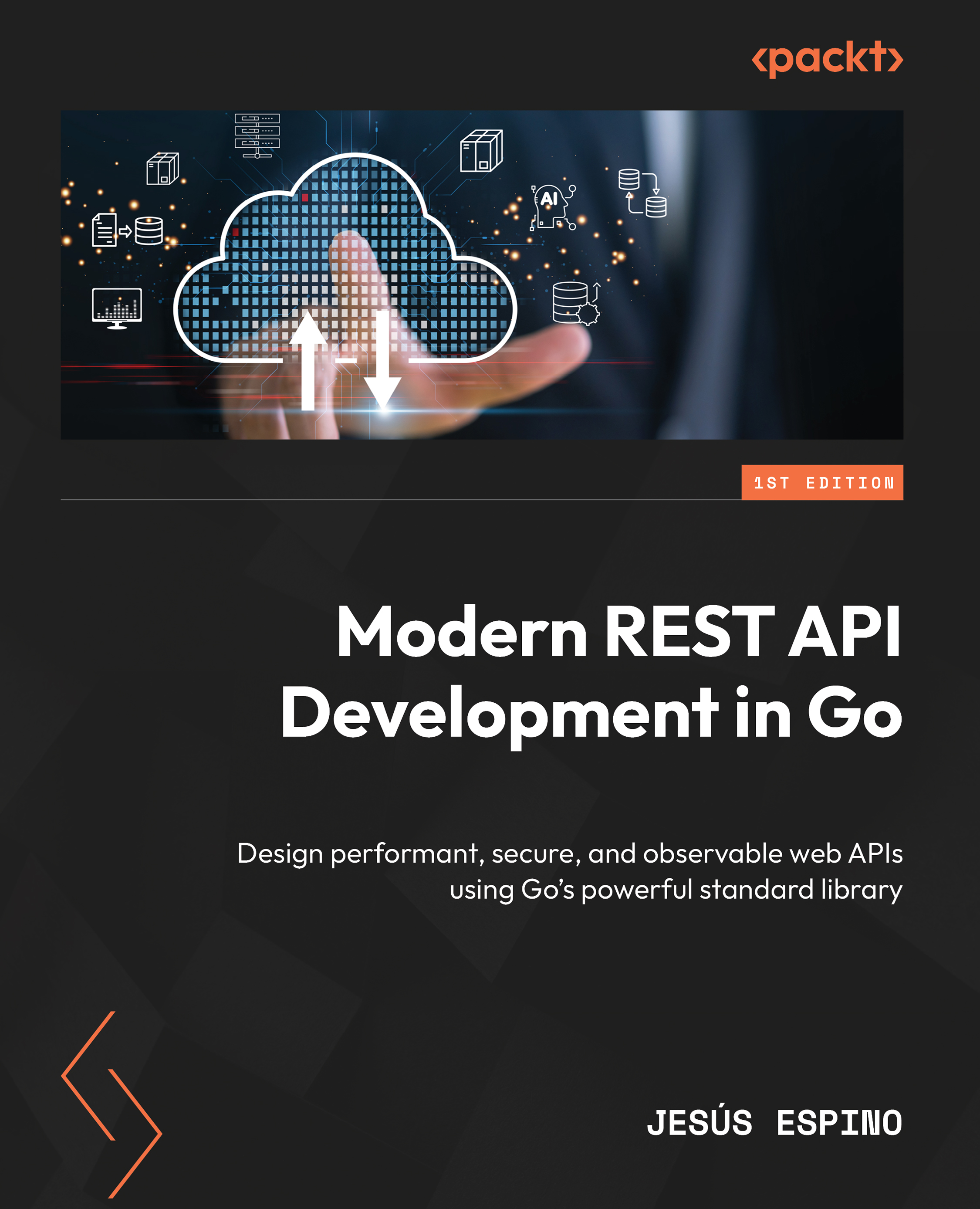
Modern REST API Development in Go

Modern REST API Development in Go: Design performant, secure, and observable web APIs using Go's powerful standard library

Arrow left icon
Profile Icon Jesús Espino
Arrow right icon
€18.99 per month
Paperback Aug 2025 294 pages 1st Edition
eBook
₹700 ₹2680.99
Paperback
₹3351.99
Subscription
Free Trial
Renews at €18.99p/m
Arrow left icon
Profile Icon Jesús Espino
Arrow right icon
€18.99 per month
Paperback Aug 2025 294 pages 1st Edition
eBook
₹700 ₹2680.99
Paperback
₹3351.99
Subscription
Free Trial
Renews at €18.99p/m
eBook
₹700 ₹2680.99
Paperback
₹3351.99
Subscription
Free Trial
Renews at €18.99p/m

What do you get with a Packt Subscription?

Free for first 7 days. ₹800 p/m after that. Cancel any time!
Product feature icon Unlimited ad-free access to the largest independent learning library in tech. Access this title and thousands more!
Product feature icon 50+ new titles added per month, including many first-to-market concepts and exclusive early access to books as they are being written.
Product feature icon Innovative learning tools, including AI book assistants, code context explainers, and text-to-speech.
Product feature icon Thousands of reference materials covering every tech concept you need to stay up to date.
Subscribe now
View plans & pricing
Table of content icon View table of contents Preview book icon Preview Book

Modern REST API Development in Go

Exploring REST APIs

A REST API can be simple or complicated, have thousands of different resources with millions of entities, or expose only one resource with a few entities. Every developer can decide how to use query parameters, HTTP headers, and HTTP verbs. Nothing is written in stone here because REST provides the guiding principles, but the developer always makes the final decision.

For this reason, it’s essential to have the right tools and resources to understand an API properly before consuming it, as well as the right tools to explore and investigate how to use that API in real life.

This chapter will explore three tools I consider the bread and butter of any API user:

  • OpenAPI: The OpenAPI documentation defines our REST API, declaring the resources, entities, and operations we can perform on each resource, as well as the authentication mechanism; everything is exposed in OpenAPI.
  • Postman: Postman is one of the most popular applications for...

Technical requirements

We won’t be writing any code in this chapter; instead, we’ll explore an API using the methods mentioned previously. To do so, we’ll need to have Postman and curl installed. We’ll also need to create a free account in Postman so that we can use the application to its fullest potential.

OpenAPI

OpenAPI is a standard from the OpenAPI Initiative that describes HTTP APIs and is the de facto standard for REST APIs.

It imparts a detailed description of all the URLs, methods, parameters, resources, entities, and serialization mechanisms available while also providing examples of how to use the API in code.

In this section, we’ll explore the basic shape of OpenAPI and the main things you need to look at to understand an API. However, we won’t get into the details of the OpenAPI format. Instead, I’ll help you understand an API through its OpenAPI documentation.

We’ll explore how to document APIs using OpenAPI in Chapter 11.

For now, let’s talk more about the OpenAPI file and its format.

The OpenAPI file

The OpenAPI file is a YAML Ain’t Markup Language (YAML) file containing general API information and a list of paths. Each path represents a URL in your API; you can have a set of accepted methods for that URL...

Postman

Postman is an HTTP client specially designed to consume APIs. It’s the de facto standard in the industry to explore and try APIs with a graphical interface. It’s compatible with OpenAPI and allows us to explore APIs but also interact with them directly there.

In this section, we’re going to explore the basic usage of Postman and give you a sneak peek at its potential. We’ll start by importing an API definition, studying it, and interacting with it by sending a request.

So, let’s start by installing the tool and importing an API.

Importing an API

You can download and install Postman locally from https://www.postman.com/downloads/ or directly from their web page at https://web.postman.co. It works perfectly fine in both cases, but you should consider using the installable application for local development.

One of the fantastic things about Postman is that it comes with many already existing APIs that are easy to incorporate...

curl

curl is the Swiss Army knife of REST API testing. It can build any request you need with the headers and parameters you want, all in a compact and easy-to-use CLI. If you don’t have it installed on your system, you can use your system package manager or follow the instructions at https://curl.se/.

If you’re like me and prefer to interact with the command line, you’ll love curl (and you probably already know it). Not only that, but curl is used everywhere and is supported by a lot of applications, so it isn’t rare to have curl command-line examples in API documentation that provide support for extracting curl calls from places such as the Web Developers Tools of Firefox and Chrome in the Network tab, allowing you to reproduce network calls in your command line by copy and pasting.

In this section, we’ll explore using the curl command to send requests and get information such as headers in the response.

Getting information

The...

Summary

In this chapter, we explored different ways to understand APIs better. First, we looked at using OpenAPI to get information on what we can do and how to use an API. We can explore APIs in read-only and “map” fashion using the YAML format or the OpenAPI-generated documentation pages. We saw how powerful and valuable this can be by looking at some examples and details about various parameters and methods.

Then, we considered another option – not only for exploring but also for interacting with APIs quickly and powerfully: Postman. We learned how to explore and interact with well-known public APIs or build our own and test them through the Postman interface.

Finally, we explored curl, a great CLI tool that provides us with everything we need to interact with our APIs from the command line and helps us with testing and debugging.

But this has nothing to do with Go, which is what this book is about. So, let’s jump into the next chapter and...

Left arrow icon Right arrow icon
Download code icon Download Code

Key benefits

  • Build scalable APIs using Go’s robust standard library and HTTP tooling
  • Explore security, observability, and testing from a backend engineering perspective
  • Learn foundational REST principles by building a complete Go-based project

Description

Modern REST API Development in Go is a hands-on guide to understanding and applying REST principles using Go’s powerful standard library. In an era where interconnected systems demand robust and performant APIs, Go offers the perfect combination of simplicity, performance, and tooling to build modern backend services. This book is centered around a complete, real-world REST API project and guides you through every stage of the development process, from building HTTP handlers to applying authentication and generating OpenAPI documentation. You’ll learn to structure your application, handle persistence with common libraries like GORM and Squirrel, apply observability patterns through logging and tracing, and ensure code quality through unit and integration tests. Each concept is grounded in REST theory and backed by idiomatic Go practices, enabling you to build APIs that are not only functional but production-ready. By the end of the book, you’ll be ready to design, build, and maintain REST APIs in Go.

Who is this book for?

This book is for developers who want to begin building REST APIs using the Go language. Whether you’re new to Go or experienced in backend development, you’ll gain practical skills and foundational knowledge to build secure, performant, and maintainable APIs. Ideal for backend engineers, system integrators, and full-stack developers entering the Go ecosystem.

What you will learn

  • Understand and implement HTTP handlers in Go
  • Create and manage RESTful routes
  • Persist and model data using GORM and Squirrel
  • Secure APIs with JWTs and basic authentication
  • Validate incoming requests with custom logic
  • Log and trace API activity for observability
  • Write unit and integration tests for endpoints
  • Generate API documentation using OpenAPI

Product Details

Country selected
Publication date, Length, Edition, Language, ISBN-13
Publication date : Aug 20, 2025
Length: 294 pages
Edition : 1st
Language : English
ISBN-13 : 9781836205371
Languages :
Concepts :
Tools :

What do you get with a Packt Subscription?

Free for first 7 days. ₹800 p/m after that. Cancel any time!
Product feature icon Unlimited ad-free access to the largest independent learning library in tech. Access this title and thousands more!
Product feature icon 50+ new titles added per month, including many first-to-market concepts and exclusive early access to books as they are being written.
Product feature icon Innovative learning tools, including AI book assistants, code context explainers, and text-to-speech.
Product feature icon Thousands of reference materials covering every tech concept you need to stay up to date.
Subscribe now
View plans & pricing

Product Details

Publication date : Aug 20, 2025
Length: 294 pages
Edition : 1st
Language : English
ISBN-13 : 9781836205371
Languages :
Concepts :
Tools :

Packt Subscriptions

See our plans and pricing
Modal Close icon
€18.99 billed monthly
Feature tick icon Unlimited access to Packt's library of 7,000+ practical books and videos
Feature tick icon Constantly refreshed with 50+ new titles a month
Feature tick icon Exclusive Early access to books as they're written
Feature tick icon Solve problems while you work with advanced search and reference features
Feature tick icon Offline reading on the mobile app
Feature tick icon Simple pricing, no contract
€189.99 billed annually
Feature tick icon Unlimited access to Packt's library of 7,000+ practical books and videos
Feature tick icon Constantly refreshed with 50+ new titles a month
Feature tick icon Exclusive Early access to books as they're written
Feature tick icon Solve problems while you work with advanced search and reference features
Feature tick icon Offline reading on the mobile app
Feature tick icon Choose a DRM-free eBook or Video every month to keep
Feature tick icon PLUS own as many other DRM-free eBooks or Videos as you like for just €5 each
Feature tick icon Exclusive print discounts
€264.99 billed in 18 months
Feature tick icon Unlimited access to Packt's library of 7,000+ practical books and videos
Feature tick icon Constantly refreshed with 50+ new titles a month
Feature tick icon Exclusive Early access to books as they're written
Feature tick icon Solve problems while you work with advanced search and reference features
Feature tick icon Offline reading on the mobile app
Feature tick icon Choose a DRM-free eBook or Video every month to keep
Feature tick icon PLUS own as many other DRM-free eBooks or Videos as you like for just €5 each
Feature tick icon Exclusive print discounts

Table of Contents

17 Chapters
Introduction to APIs Chevron down icon Chevron up icon
Exploring REST APIs Chevron down icon Chevron up icon
Building a REST Client Chevron down icon Chevron up icon
Designing Your REST API Chevron down icon Chevron up icon
Authentication and Authorization Chevron down icon Chevron up icon
Data Persistency Chevron down icon Chevron up icon
API Security Chevron down icon Chevron up icon
API Performance Chevron down icon Chevron up icon
Deploying Your API Chevron down icon Chevron up icon
Testing Chevron down icon Chevron up icon
Documenting with OpenAPI Chevron down icon Chevron up icon
Metrics, Logs, and Traces Chevron down icon Chevron up icon
Using GORM Chevron down icon Chevron up icon
Using the Echo Framework Chevron down icon Chevron up icon
Unlock Your Book’s Exclusive Benefits Chevron down icon Chevron up icon
Other Books You May Enjoy Chevron down icon Chevron up icon
Index Chevron down icon Chevron up icon
Get free access to Packt library with over 7500+ books and video courses for 7 days!
Start Free Trial

FAQs

What is included in a Packt subscription? Chevron down icon Chevron up icon

A subscription provides you with full access to view all Packt and licnesed content online, this includes exclusive access to Early Access titles. Depending on the tier chosen you can also earn credits and discounts to use for owning content

How can I cancel my subscription? Chevron down icon Chevron up icon

To cancel your subscription with us simply go to the account page - found in the top right of the page or at https://subscription.packtpub.com/my-account/subscription - From here you will see the ‘cancel subscription’ button in the grey box with your subscription information in.

What are credits? Chevron down icon Chevron up icon

Credits can be earned from reading 40 section of any title within the payment cycle - a month starting from the day of subscription payment. You also earn a Credit every month if you subscribe to our annual or 18 month plans. Credits can be used to buy books DRM free, the same way that you would pay for a book. Your credits can be found in the subscription homepage - subscription.packtpub.com - clicking on ‘the my’ library dropdown and selecting ‘credits’.

What happens if an Early Access Course is cancelled? Chevron down icon Chevron up icon

Projects are rarely cancelled, but sometimes it's unavoidable. If an Early Access course is cancelled or excessively delayed, you can exchange your purchase for another course. For further details, please contact us here.

Where can I send feedback about an Early Access title? Chevron down icon Chevron up icon

If you have any feedback about the product you're reading, or Early Access in general, then please fill out a contact form here and we'll make sure the feedback gets to the right team. 

Can I download the code files for Early Access titles? Chevron down icon Chevron up icon

We try to ensure that all books in Early Access have code available to use, download, and fork on GitHub. This helps us be more agile in the development of the book, and helps keep the often changing code base of new versions and new technologies as up to date as possible. Unfortunately, however, there will be rare cases when it is not possible for us to have downloadable code samples available until publication.

When we publish the book, the code files will also be available to download from the Packt website.

How accurate is the publication date? Chevron down icon Chevron up icon

The publication date is as accurate as we can be at any point in the project. Unfortunately, delays can happen. Often those delays are out of our control, such as changes to the technology code base or delays in the tech release. We do our best to give you an accurate estimate of the publication date at any given time, and as more chapters are delivered, the more accurate the delivery date will become.

How will I know when new chapters are ready? Chevron down icon Chevron up icon

We'll let you know every time there has been an update to a course that you've bought in Early Access. You'll get an email to let you know there has been a new chapter, or a change to a previous chapter. The new chapters are automatically added to your account, so you can also check back there any time you're ready and download or read them online.

I am a Packt subscriber, do I get Early Access? Chevron down icon Chevron up icon

Yes, all Early Access content is fully available through your subscription. You will need to have a paid for or active trial subscription in order to access all titles.

How is Early Access delivered? Chevron down icon Chevron up icon

Early Access is currently only available as a PDF or through our online reader. As we make changes or add new chapters, the files in your Packt account will be updated so you can download them again or view them online immediately.

How do I buy Early Access content? Chevron down icon Chevron up icon

Early Access is a way of us getting our content to you quicker, but the method of buying the Early Access course is still the same. Just find the course you want to buy, go through the check-out steps, and you’ll get a confirmation email from us with information and a link to the relevant Early Access courses.

What is Early Access? Chevron down icon Chevron up icon

Keeping up to date with the latest technology is difficult; new versions, new frameworks, new techniques. This feature gives you a head-start to our content, as it's being created. With Early Access you'll receive each chapter as it's written, and get regular updates throughout the product's development, as well as the final course as soon as it's ready.We created Early Access as a means of giving you the information you need, as soon as it's available. As we go through the process of developing a course, 99% of it can be ready but we can't publish until that last 1% falls in to place. Early Access helps to unlock the potential of our content early, to help you start your learning when you need it most. You not only get access to every chapter as it's delivered, edited, and updated, but you'll also get the finalized, DRM-free product to download in any format you want when it's published. As a member of Packt, you'll also be eligible for our exclusive offers, including a free course every day, and discounts on new and popular titles.

Modal Close icon
Modal Close icon