Search icon CANCEL
Subscription
0
Cart icon
Your Cart (0 item)
Close icon
You have no products in your basket yet
Save more on your purchases! discount-offer-chevron-icon
Savings automatically calculated. No voucher code required.
Arrow left icon
Explore Products
Best Sellers
New Releases
Books
Videos
Audiobooks
Learning Hub
Newsletter Hub
Free Learning
Arrow right icon
timer SALE ENDS IN
0 Days
:
00 Hours
:
00 Minutes
:
00 Seconds
Learning Unity iOS Game Development

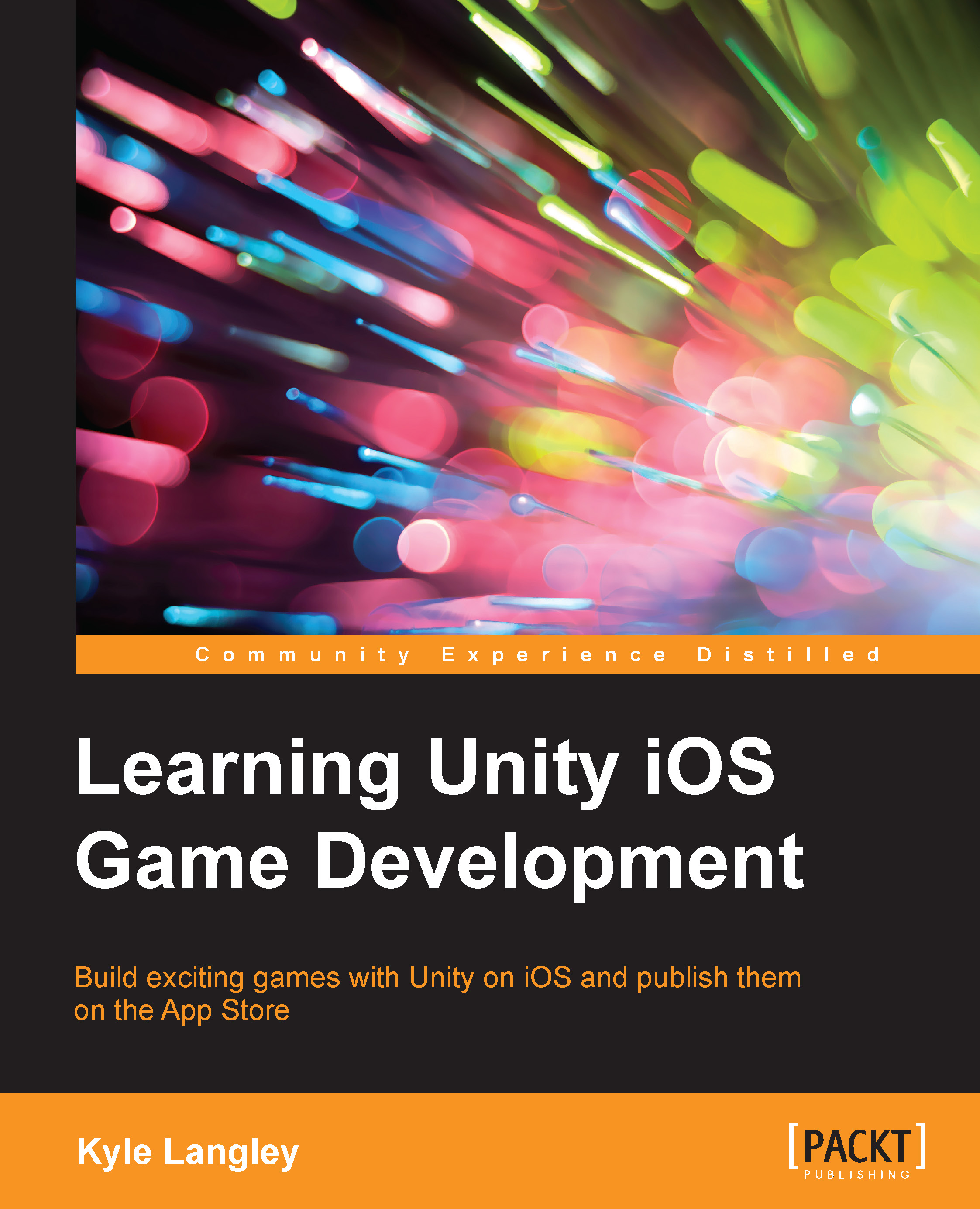
Learning Unity iOS Game Development: Build exciting games with Unity on iOS and publish them on the App Store

eBook
$35.99 $39.99
Paperback
$48.99
Subscription
Free Trial
Renews at $19.99p/m

What do you get with Print?

Product feature icon Instant access to your digital copy whilst your Print order is Shipped
Product feature icon Paperback book shipped to your preferred address
Product feature icon Redeem a companion digital copy on all Print orders
Product feature icon Access this title in our online reader with advanced features
Product feature icon DRM FREE - Read whenever, wherever and however you want
OR
Modal Close icon
Payment Processing...
tick Completed

Shipping Address

Billing Address

Shipping Methods
Table of content icon View table of contents Preview book icon Preview Book

Learning Unity iOS Game Development

Chapter 2. Player Input for Mobile Devices

One of the more unique aspects of mobile gaming is the input system. Unlike most other devices for gaming, mobile devices are not designed to take input (such as traditional gaming systems) and are instead in the spectrum of an entertainment device, meaning they are not solely used to play games. This means that we have to observe how the player is going to interact with the game differently as compared to devices specific to gaming—which have either dedicated or what you'd call standard input schemes that allow the player to have a pleasing experience.

The most successful games on the mobile platform do one thing well: they give the player a simple and responsive input. For example, games focused on puzzles such as connect three items of one type in a row by swiping types between each other, a slot machine, and casino games, which require the touch of a single button, or even the more complex games (such as the endless runner...

Creating the C# input class

The very first step is to create the C# class that will calculate the input from the player. To start, open Unity with the following steps:

  1. Right-click on the Assets folder and select Create and then Folder:
    Creating the C# input class
  2. I named my folder Scripts; you can give it any name you like, although I recommend something that keeps you organized.
  3. When this folder is created, right-click on it. Then, navigate to Create and select C# Class.
  4. You can again name this what you like; I chose PlayerInput.

Unity ships with its own Integrated Development Environment (IDE) called MonoDevelop. When you double-click on PlayerInput, this is what will open.

Tip

If you want to use a different IDE, you can do so by navigating to Edit | Preferences | External Tools and changing External Script Editor to something of your choice.

Now, double-click on PlayerInput.

When PlayerInput opens, it will have a default structure that Unity uses for classes created in the engine, as shown in the following code:

using...

What is Touch?

Touch is a struct. To put it differently, it is a group of different variables that hold information about what the input can do. It is possible to monitor multiple Touch structs at once if the user is trying to input more than one, although we are only looking for one.

We do not need all the information Unity's touch gives us. We only need the location on the screen where the touch started, how long the touch lasted in seconds, where the touch ended on the screen, and the current state of the touch. From this, we will be able to detect the type of input and the direction of the input, if the player tapped, or if the player swiped in a direction.

Our own Touch

The first step to coding our input class is to create our own struct that will hold the values we need. The benefit to creating our own Touch is that we can then use it for only what we need. It also gives us the means to use the mouse input to accomplish the same input logic as the device, allowing editor testing...

Creating the Input GameObject

Save the document and then maximize or select Unity. This will force the editor to compile the code that we have just written.

  1. On the left-hand side of the editor in the Hierarchy tab, right-click and select Create Empty. This will add a blank GameObject to the scene.
  2. Right-click on the GameObject that we just created and select Rename. Name it Input.
  3. While still having the Input GameObject selected, look to the right-hand side of the screen in Inspector and click on Add Component.
  4. When the search window pops up, enter the first half of what you called your input class. For example, when I enter player, my Player Input class will appear in the list:
    Creating the Input GameObject
  5. Click on your input class to add it to the Input GameObject. If everything goes according to plan, you will see the component added and SwipeTime and SwipeDistance both set to 0. Alternatively, you can add the Input component to GameObject by left-clicking, holding, and dragging it onto GameObject in the Hierarchy tab...

The Start function

Before we get to the core of the input logic, let's first set a default value to our ActiveTouch variable. As we don't want the game to start running with ActiveTouch.Phase to be set to anything but canceled, we need to set it.

Add the following code to the Start function:

  /* Use this for initialization */
  void Start ()
  {
    ActiveTouch.Phase = TouchPhase.Canceled;
  }

Tip

By default, this would be set to TouchPhase.Began, which would cause an unwanted touch to be detected when the game loads.

Starting to work with Update

Next, we will set up the Update function to look after any touch input from the user. In order to do this so that it works in the editor and on the device, we will need a bit of logic to repeat itself. This is because the mouse input isn't related to the touch input.

To begin, add the following code to the Update function:

  void Update () 
  {
    if (Application.isEditor)
    {
      if (Input.GetMouseButton(0))
      {
      }
    }
    else
    {
      if (Input.touches.Length > 0)
      {
      }
    }
  }

In this comparison, we will check whether the game can run in the editor. If it is not, we run what is in else.

If isEditor is true, we then check whether MouseButton(0) is pressed. Otherwise, as most people know, left-click on it.

If isEditor is false, we can check whether touches.Length is more than zero. If it is more than zero, we know that there is a touch on the screen.

Furthermore, you can also use platform-dependent conditions to check for specific...

Creating the C# input class


The very first step is to create the C# class that will calculate the input from the player. To start, open Unity with the following steps:

  1. Right-click on the Assets folder and select Create and then Folder:

  2. I named my folder Scripts; you can give it any name you like, although I recommend something that keeps you organized.

  3. When this folder is created, right-click on it. Then, navigate to Create and select C# Class.

  4. You can again name this what you like; I chose PlayerInput.

Unity ships with its own Integrated Development Environment (IDE) called MonoDevelop. When you double-click on PlayerInput, this is what will open.

Tip

If you want to use a different IDE, you can do so by navigating to Edit | Preferences | External Tools and changing External Script Editor to something of your choice.

Now, double-click on PlayerInput.

When PlayerInput opens, it will have a default structure that Unity uses for classes created in the engine, as shown in the following code:

using UnityEngine...

What is Touch?


Touch is a struct. To put it differently, it is a group of different variables that hold information about what the input can do. It is possible to monitor multiple Touch structs at once if the user is trying to input more than one, although we are only looking for one.

We do not need all the information Unity's touch gives us. We only need the location on the screen where the touch started, how long the touch lasted in seconds, where the touch ended on the screen, and the current state of the touch. From this, we will be able to detect the type of input and the direction of the input, if the player tapped, or if the player swiped in a direction.

Our own Touch

The first step to coding our input class is to create our own struct that will hold the values we need. The benefit to creating our own Touch is that we can then use it for only what we need. It also gives us the means to use the mouse input to accomplish the same input logic as the device, allowing editor testing that...

Creating the Input GameObject


Save the document and then maximize or select Unity. This will force the editor to compile the code that we have just written.

  1. On the left-hand side of the editor in the Hierarchy tab, right-click and select Create Empty. This will add a blank GameObject to the scene.

  2. Right-click on the GameObject that we just created and select Rename. Name it Input.

  3. While still having the Input GameObject selected, look to the right-hand side of the screen in Inspector and click on Add Component.

  4. When the search window pops up, enter the first half of what you called your input class. For example, when I enter player, my Player Input class will appear in the list:

  5. Click on your input class to add it to the Input GameObject. If everything goes according to plan, you will see the component added and SwipeTime and SwipeDistance both set to 0. Alternatively, you can add the Input component to GameObject by left-clicking, holding, and dragging it onto GameObject in the Hierarchy tab...

The Start function


Before we get to the core of the input logic, let's first set a default value to our ActiveTouch variable. As we don't want the game to start running with ActiveTouch.Phase to be set to anything but canceled, we need to set it.

Add the following code to the Start function:

  /* Use this for initialization */
  void Start ()
  {
    ActiveTouch.Phase = TouchPhase.Canceled;
  }

Tip

By default, this would be set to TouchPhase.Began, which would cause an unwanted touch to be detected when the game loads.

Left arrow icon Right arrow icon

Description

Over recent years, the market for mobile game development using Unity has grown multi-fold with an overwhelming 600 million gamers playing games developed using Unity engine. The newly launched Unity 5 offers a wide range of dedicated and powerful tools for iOS developers who intend to follow the basics and gradually elevate their skills to revolutionize the way they design and publish games for the App Store. From beginners, to those who are experienced making video games, this book goes through the steps of using Unity 5 to make a game from the ground up and setting the game up with iTunes Game Center features. The book begins with an introduction to setting up an iTunes Connect developer account, this will allow you to use Unity to its full potential with iOS. You will create a new app in iTunes Connect with the settings for Apple approval. You will learn, in detail, how to use Unity 5 and the programming language C# to make a fully interactive game that keeps track of player progress, Game Center Leaderboards, and Achievements, as well as displaying iAds and offering In-App purchases. Moving on, you’ll discover how to create development and release builds, enabling you to test the game on your device before finally submitting the game for Apple’s approval. By the end of the book, you will have a complete understanding of how iTunes and Unity can be used in combination to build and publish a fully interactive and reliable game to the App Store.

Who is this book for?

This book is for iOS developers who want to learn how to build games with Unity for the iOS platform. Some prior experience in game development would be useful.
Estimated delivery fee Deliver to United States

Economy delivery 10 - 13 business days

Free $6.95

Premium delivery 6 - 9 business days

$21.95
(Includes tracking information)

Product Details

Country selected
Publication date, Length, Edition, Language, ISBN-13
Publication date : Sep 29, 2015
Length: 230 pages
Edition : 1st
Language : English
ISBN-13 : 9781784399801
Vendor :
Unity Technologies
Languages :
Tools :

What do you get with Print?

Product feature icon Instant access to your digital copy whilst your Print order is Shipped
Product feature icon Paperback book shipped to your preferred address
Product feature icon Redeem a companion digital copy on all Print orders
Product feature icon Access this title in our online reader with advanced features
Product feature icon DRM FREE - Read whenever, wherever and however you want
OR
Modal Close icon
Payment Processing...
tick Completed

Shipping Address

Billing Address

Shipping Methods
Estimated delivery fee Deliver to United States

Economy delivery 10 - 13 business days

Free $6.95

Premium delivery 6 - 9 business days

$21.95
(Includes tracking information)

Product Details

Publication date : Sep 29, 2015
Length: 230 pages
Edition : 1st
Language : English
ISBN-13 : 9781784399801
Vendor :
Unity Technologies
Languages :
Tools :

Packt Subscriptions

See our plans and pricing
Modal Close icon
$19.99 billed monthly
Feature tick icon Unlimited access to Packt's library of 7,000+ practical books and videos
Feature tick icon Constantly refreshed with 50+ new titles a month
Feature tick icon Exclusive Early access to books as they're written
Feature tick icon Solve problems while you work with advanced search and reference features
Feature tick icon Offline reading on the mobile app
Feature tick icon Simple pricing, no contract
$199.99 billed annually
Feature tick icon Unlimited access to Packt's library of 7,000+ practical books and videos
Feature tick icon Constantly refreshed with 50+ new titles a month
Feature tick icon Exclusive Early access to books as they're written
Feature tick icon Solve problems while you work with advanced search and reference features
Feature tick icon Offline reading on the mobile app
Feature tick icon Choose a DRM-free eBook or Video every month to keep
Feature tick icon PLUS own as many other DRM-free eBooks or Videos as you like for just $5 each
Feature tick icon Exclusive print discounts
$279.99 billed in 18 months
Feature tick icon Unlimited access to Packt's library of 7,000+ practical books and videos
Feature tick icon Constantly refreshed with 50+ new titles a month
Feature tick icon Exclusive Early access to books as they're written
Feature tick icon Solve problems while you work with advanced search and reference features
Feature tick icon Offline reading on the mobile app
Feature tick icon Choose a DRM-free eBook or Video every month to keep
Feature tick icon PLUS own as many other DRM-free eBooks or Videos as you like for just $5 each
Feature tick icon Exclusive print discounts

Frequently bought together


Stars icon
Total $ 158.97
Unity 5  Game Optimization
$48.99
Unity 5.x Cookbook
$60.99
Learning Unity iOS Game Development
$48.99
Total $ 158.97 Stars icon

Table of Contents

8 Chapters
1. Requirements and Preparation Work Chevron down icon Chevron up icon
2. Player Input for Mobile Devices Chevron down icon Chevron up icon
3. Player Character, Obstacles, and Pickups Chevron down icon Chevron up icon
4. Editor Tool, Prefabs, and Game Level Chevron down icon Chevron up icon
5. Scene Background, the Game User Interface, and the Save Profile Chevron down icon Chevron up icon
6. Main Menu, iAds, Leaderboards, Store Purchases, and Achievements Chevron down icon Chevron up icon
7. Game Builds and Submission to Apple Chevron down icon Chevron up icon
Index Chevron down icon Chevron up icon

Customer reviews

Rating distribution
Full star icon Full star icon Full star icon Full star icon Empty star icon 4
(2 Ratings)
5 star 50%
4 star 0%
3 star 50%
2 star 0%
1 star 0%
Stephen Cowart Oct 14, 2015
Full star icon Full star icon Full star icon Full star icon Full star icon 5
I absolutely loved this book. The book is easy enough for beginners to follow. If you already know some unity, but want to know how to integrate some iOS specific functionality (i.e. gamecenter, iAds, etc.) this book is also right up your alley. I was able to complete this book over a weekend and had no problems. I'm now confident and ready to add gamecenter to my game and get it on the app store. I would highly recommend this book for anyone who is just beginning Unity or someone that just needs that extra help with iOS specific features. Well written.
Amazon Verified review Amazon
Cindy K. Oakes Jan 12, 2017
Full star icon Full star icon Full star icon Empty star icon Empty star icon 3
I started it, but had a question and tried to contact the author and was ignored.Really you tube videos are just as good.I may try it again now that I am a little better at unity.
Amazon Verified review Amazon
Get free access to Packt library with over 7500+ books and video courses for 7 days!
Start Free Trial

FAQs

What is the digital copy I get with my Print order? Chevron down icon Chevron up icon

When you buy any Print edition of our Books, you can redeem (for free) the eBook edition of the Print Book you’ve purchased. This gives you instant access to your book when you make an order via PDF, EPUB or our online Reader experience.

What is the delivery time and cost of print book? Chevron down icon Chevron up icon

Shipping Details

USA:

'

Economy: Delivery to most addresses in the US within 10-15 business days

Premium: Trackable Delivery to most addresses in the US within 3-8 business days

UK:

Economy: Delivery to most addresses in the U.K. within 7-9 business days.
Shipments are not trackable

Premium: Trackable delivery to most addresses in the U.K. within 3-4 business days!
Add one extra business day for deliveries to Northern Ireland and Scottish Highlands and islands

EU:

Premium: Trackable delivery to most EU destinations within 4-9 business days.

Australia:

Economy: Can deliver to P. O. Boxes and private residences.
Trackable service with delivery to addresses in Australia only.
Delivery time ranges from 7-9 business days for VIC and 8-10 business days for Interstate metro
Delivery time is up to 15 business days for remote areas of WA, NT & QLD.

Premium: Delivery to addresses in Australia only
Trackable delivery to most P. O. Boxes and private residences in Australia within 4-5 days based on the distance to a destination following dispatch.

India:

Premium: Delivery to most Indian addresses within 5-6 business days

Rest of the World:

Premium: Countries in the American continent: Trackable delivery to most countries within 4-7 business days

Asia:

Premium: Delivery to most Asian addresses within 5-9 business days

Disclaimer:
All orders received before 5 PM U.K time would start printing from the next business day. So the estimated delivery times start from the next day as well. Orders received after 5 PM U.K time (in our internal systems) on a business day or anytime on the weekend will begin printing the second to next business day. For example, an order placed at 11 AM today will begin printing tomorrow, whereas an order placed at 9 PM tonight will begin printing the day after tomorrow.


Unfortunately, due to several restrictions, we are unable to ship to the following countries:

  1. Afghanistan
  2. American Samoa
  3. Belarus
  4. Brunei Darussalam
  5. Central African Republic
  6. The Democratic Republic of Congo
  7. Eritrea
  8. Guinea-bissau
  9. Iran
  10. Lebanon
  11. Libiya Arab Jamahriya
  12. Somalia
  13. Sudan
  14. Russian Federation
  15. Syrian Arab Republic
  16. Ukraine
  17. Venezuela
What is custom duty/charge? Chevron down icon Chevron up icon

Customs duty are charges levied on goods when they cross international borders. It is a tax that is imposed on imported goods. These duties are charged by special authorities and bodies created by local governments and are meant to protect local industries, economies, and businesses.

Do I have to pay customs charges for the print book order? Chevron down icon Chevron up icon

The orders shipped to the countries that are listed under EU27 will not bear custom charges. They are paid by Packt as part of the order.

List of EU27 countries: www.gov.uk/eu-eea:

A custom duty or localized taxes may be applicable on the shipment and would be charged by the recipient country outside of the EU27 which should be paid by the customer and these duties are not included in the shipping charges been charged on the order.

How do I know my custom duty charges? Chevron down icon Chevron up icon

The amount of duty payable varies greatly depending on the imported goods, the country of origin and several other factors like the total invoice amount or dimensions like weight, and other such criteria applicable in your country.

For example:

  • If you live in Mexico, and the declared value of your ordered items is over $ 50, for you to receive a package, you will have to pay additional import tax of 19% which will be $ 9.50 to the courier service.
  • Whereas if you live in Turkey, and the declared value of your ordered items is over € 22, for you to receive a package, you will have to pay additional import tax of 18% which will be € 3.96 to the courier service.
How can I cancel my order? Chevron down icon Chevron up icon

Cancellation Policy for Published Printed Books:

You can cancel any order within 1 hour of placing the order. Simply contact customercare@packt.com with your order details or payment transaction id. If your order has already started the shipment process, we will do our best to stop it. However, if it is already on the way to you then when you receive it, you can contact us at customercare@packt.com using the returns and refund process.

Please understand that Packt Publishing cannot provide refunds or cancel any order except for the cases described in our Return Policy (i.e. Packt Publishing agrees to replace your printed book because it arrives damaged or material defect in book), Packt Publishing will not accept returns.

What is your returns and refunds policy? Chevron down icon Chevron up icon

Return Policy:

We want you to be happy with your purchase from Packtpub.com. We will not hassle you with returning print books to us. If the print book you receive from us is incorrect, damaged, doesn't work or is unacceptably late, please contact Customer Relations Team on customercare@packt.com with the order number and issue details as explained below:

  1. If you ordered (eBook, Video or Print Book) incorrectly or accidentally, please contact Customer Relations Team on customercare@packt.com within one hour of placing the order and we will replace/refund you the item cost.
  2. Sadly, if your eBook or Video file is faulty or a fault occurs during the eBook or Video being made available to you, i.e. during download then you should contact Customer Relations Team within 14 days of purchase on customercare@packt.com who will be able to resolve this issue for you.
  3. You will have a choice of replacement or refund of the problem items.(damaged, defective or incorrect)
  4. Once Customer Care Team confirms that you will be refunded, you should receive the refund within 10 to 12 working days.
  5. If you are only requesting a refund of one book from a multiple order, then we will refund you the appropriate single item.
  6. Where the items were shipped under a free shipping offer, there will be no shipping costs to refund.

On the off chance your printed book arrives damaged, with book material defect, contact our Customer Relation Team on customercare@packt.com within 14 days of receipt of the book with appropriate evidence of damage and we will work with you to secure a replacement copy, if necessary. Please note that each printed book you order from us is individually made by Packt's professional book-printing partner which is on a print-on-demand basis.

What tax is charged? Chevron down icon Chevron up icon

Currently, no tax is charged on the purchase of any print book (subject to change based on the laws and regulations). A localized VAT fee is charged only to our European and UK customers on eBooks, Video and subscriptions that they buy. GST is charged to Indian customers for eBooks and video purchases.

What payment methods can I use? Chevron down icon Chevron up icon

You can pay with the following card types:

  1. Visa Debit
  2. Visa Credit
  3. MasterCard
  4. PayPal
What is the delivery time and cost of print books? Chevron down icon Chevron up icon

Shipping Details

USA:

'

Economy: Delivery to most addresses in the US within 10-15 business days

Premium: Trackable Delivery to most addresses in the US within 3-8 business days

UK:

Economy: Delivery to most addresses in the U.K. within 7-9 business days.
Shipments are not trackable

Premium: Trackable delivery to most addresses in the U.K. within 3-4 business days!
Add one extra business day for deliveries to Northern Ireland and Scottish Highlands and islands

EU:

Premium: Trackable delivery to most EU destinations within 4-9 business days.

Australia:

Economy: Can deliver to P. O. Boxes and private residences.
Trackable service with delivery to addresses in Australia only.
Delivery time ranges from 7-9 business days for VIC and 8-10 business days for Interstate metro
Delivery time is up to 15 business days for remote areas of WA, NT & QLD.

Premium: Delivery to addresses in Australia only
Trackable delivery to most P. O. Boxes and private residences in Australia within 4-5 days based on the distance to a destination following dispatch.

India:

Premium: Delivery to most Indian addresses within 5-6 business days

Rest of the World:

Premium: Countries in the American continent: Trackable delivery to most countries within 4-7 business days

Asia:

Premium: Delivery to most Asian addresses within 5-9 business days

Disclaimer:
All orders received before 5 PM U.K time would start printing from the next business day. So the estimated delivery times start from the next day as well. Orders received after 5 PM U.K time (in our internal systems) on a business day or anytime on the weekend will begin printing the second to next business day. For example, an order placed at 11 AM today will begin printing tomorrow, whereas an order placed at 9 PM tonight will begin printing the day after tomorrow.


Unfortunately, due to several restrictions, we are unable to ship to the following countries:

  1. Afghanistan
  2. American Samoa
  3. Belarus
  4. Brunei Darussalam
  5. Central African Republic
  6. The Democratic Republic of Congo
  7. Eritrea
  8. Guinea-bissau
  9. Iran
  10. Lebanon
  11. Libiya Arab Jamahriya
  12. Somalia
  13. Sudan
  14. Russian Federation
  15. Syrian Arab Republic
  16. Ukraine
  17. Venezuela
Modal Close icon
Modal Close icon