Search icon CANCEL
Subscription
0
Cart icon
Your Cart (0 item)
Close icon
You have no products in your basket yet
Save more on your purchases! discount-offer-chevron-icon
Savings automatically calculated. No voucher code required.
Arrow left icon
Explore Products
Best Sellers
New Releases
Books
Videos
Audiobooks
Learning Hub
Newsletter Hub
Free Learning
Arrow right icon
timer SALE ENDS IN
0 Days
:
00 Hours
:
00 Minutes
:
00 Seconds
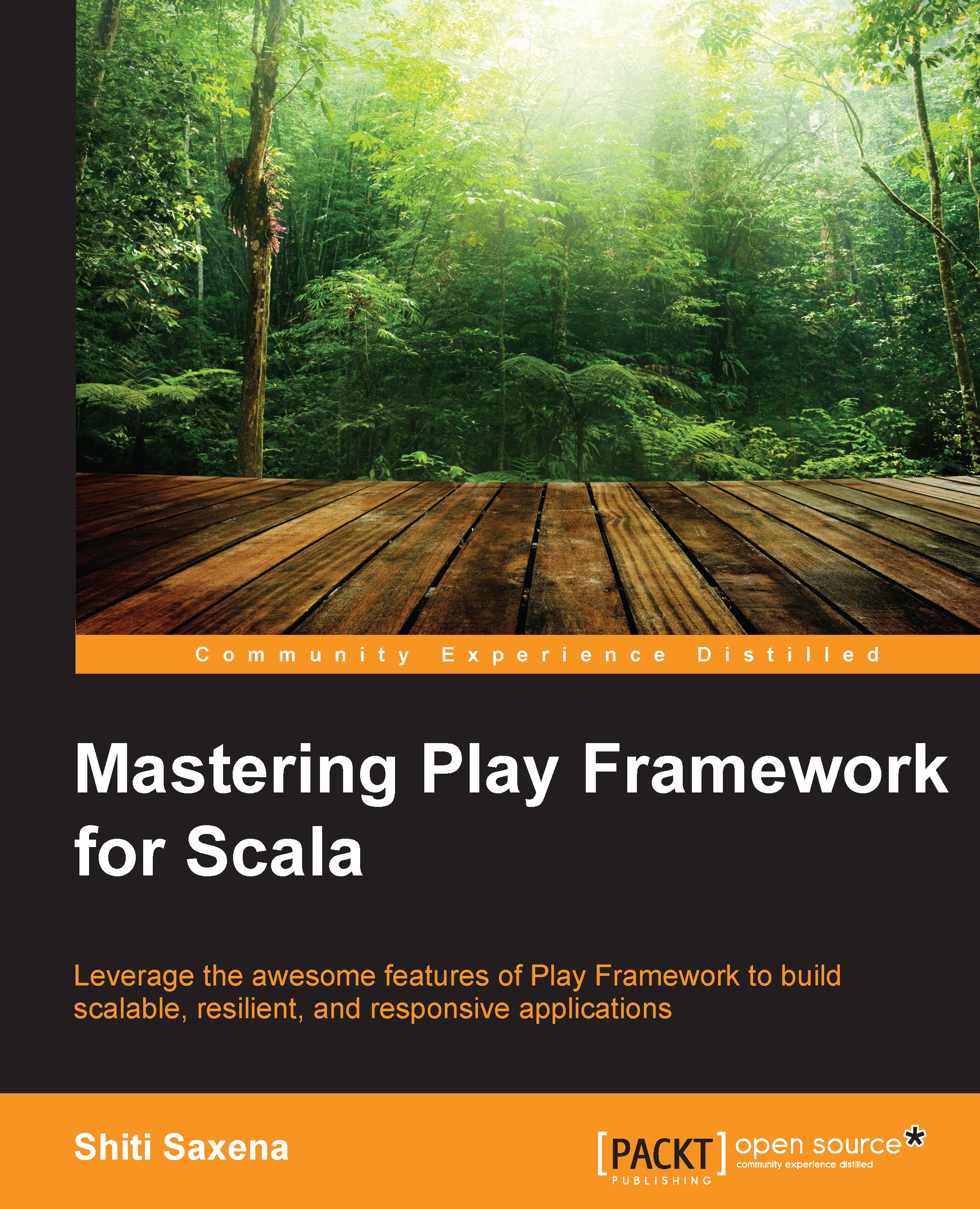
Mastering play framework for scala

Mastering play framework for scala: Leverage the awesome features of Play Framework to build scalable, resilient, and responsive applications

eBook
$9.99 $43.99
Paperback
$54.99
Subscription
Free Trial
Renews at $19.99p/m

What do you get with Print?

Product feature icon Instant access to your digital copy whilst your Print order is Shipped
Product feature icon Paperback book shipped to your preferred address
Product feature icon Redeem a companion digital copy on all Print orders
Product feature icon Access this title in our online reader with advanced features
Product feature icon DRM FREE - Read whenever, wherever and however you want
Modal Close icon
Payment Processing...
tick Completed

Shipping Address

Billing Address

Shipping Methods
Table of content icon View table of contents Preview book icon Preview Book

Mastering play framework for scala

Chapter 2. Defining Actions

If you're reading this, you've either survived the first chapter or skipped it. Either way, I am assuming you know the structure of a simple Play application. A controller in Play generates Action values and, to do so, it uses several objects and methods internally. In this chapter, we will see what goes on behind the scenes and how we can leverage these actions when we build our application.

In this chapter, we will be covering the following topics:

  • Defining Actions
  • Request body parsers
  • Action composition and troubleshooting

A dummy Artist model

In the following sections, we will give make reference to an artist model. It is a simple class with a companion object, defined as follows:

case class Artist(name: String, country: String)

object Artist {
  val availableArtist = Seq(Artist("Wolfgang Amadeus Mozart", "Austria"), 
    Artist("Ludwig van Beethoven", "Germany"), 
    Artist("Johann Sebastian Bach", "Germany"), 
    Artist("Frédéric François Chopin", "Poland"), 
    Artist("Joseph Haydn", "Austria"), 
    Artist("Antonio Lucio Vivaldi", "Italy"), 
    Artist("Franz Peter Schubert", "Austria"), 
    Artist("Franz Liszt", "Austria"), 
    Artist("Giuseppe Fortunino Francesco Verdi", "Austria")) 

  def fetch: Seq[Artist] = {
    availableArtist 
  } 

  def fetchByName(name: String): Seq[Artist] = {
    availableArtist...

Actions

An Action in Play defines how a server should respond to a request. The methods, which define an Action, are mapped to a request in the routes file. For example, let's define an Action which displays the information of all the artists as a response:

def listArtist = Action {
  Ok(views.html.home(Artist.fetch))
}

Now, to use this Action, we should map it to a request in the routes file.

GET     /api/artist       controllers.Application.listArtist

In this example, we fetch all the artists and send them with the view, as the response to the request.

Note

The term api used in the route file is just a URL prefix and is not mandatory.

Run the application and access http://localhost:9000/api/artist from the browser. A table with the available artist is visible.

Action takes a request and yields a result. It is an implementation of the EssentialAction trait. It is defined as:

trait EssentialAction extends (RequestHeader => Iteratee[Array[Byte], Result]) with Handler {
 
  def apply() = this...

Request body parsers

Consider the most common POST request in any application—the request sent for logins. Will it be sufficient if the request body has the user's credentials in, say, a JSON or XML format? Will the request handler be able to extract this data and process it directly? No, since the data in the request has to be understood by the application code, it must be translated into a compatible type. For example, XML sent in a request must be translated to Scala XML for a Scala application.

There are several libraries, such as Jackson, XStream, and so on, which can be used to achieve this task, but we wouldn't need them as Play supports this internally. Play provides request body parsers to transform the request body into equivalent Scala objects for some of the frequently used content types. In addition to this, we can extend existing parsers or define new ones.

Every Action has a parser. How do I know this ? Well, the Action object, which we used to define how our...

Extending a parser

Let's extend the JSON parser so that we get a subscription model. We will assume that the Subscription model is defined as follows:

case class Subscription(emailId: String, interval: String) 

Now, let's write a parser that transforms the request body into a subscription object. The following code should be written in a controller:

val parseAsSubscription = parse.using {
    request => 
      parse.json.map {
        body => 
          val emailId:String = (body \ "emailId").as[String] 
          val fromDate:Long = (body \ "fromDate").as[Long] 
          Subscription(emailId, fromDate)
      }
  }

  implicit val subWrites = Json.writes[Subscription]
  def getSub = Action(parseAsSubscription) {
    request => 
      val subscription: Subscription = request.body
      Ok(Json.toJson(subscription))
   } 

There are also tolerant parsers. By tolerant, we mean that errors in a format are not ignored. This simply means that it ignores the...

Exploring the results

In Play, the response to a request is a result. A result has two components: the response header and the response body. Let's look at a simple example of this:

def plainResult = Action {
  Result( 
    header = ResponseHeader(200, Map(CONTENT_TYPE -> "text/plain")), 
    body = Enumerator("This is the response from plainResult method".getBytes())
  )
}

Notice that we used an enumerator for the response body. An enumerator is a means to provide data to an iteratee. We will discuss these in detail in Chapter 6, Reactive Data Streams.

Apart from this, a result has additional functions that equips us with better means to handle response headers, sessions, cookies, and so on.

A result can send JSON, XML, and images as a response, apart from a String content. An easier way of generating a result is to use the result helpers. A result helper is used for most of the HTTP response status. As an example, let's see how the TODO Action that comes built...

A dummy Artist model


In the following sections, we will give make reference to an artist model. It is a simple class with a companion object, defined as follows:

case class Artist(name: String, country: String)

object Artist {
  val availableArtist = Seq(Artist("Wolfgang Amadeus Mozart", "Austria"), 
    Artist("Ludwig van Beethoven", "Germany"), 
    Artist("Johann Sebastian Bach", "Germany"), 
    Artist("Frédéric François Chopin", "Poland"), 
    Artist("Joseph Haydn", "Austria"), 
    Artist("Antonio Lucio Vivaldi", "Italy"), 
    Artist("Franz Peter Schubert", "Austria"), 
    Artist("Franz Liszt", "Austria"), 
    Artist("Giuseppe Fortunino Francesco Verdi", "Austria")) 

  def fetch: Seq[Artist] = {
    availableArtist 
  } 

  def fetchByName(name: String): Seq[Artist] = {
    availableArtist.filter(a => a.name.contains(name)) 
  } 

  def fetchByCountry(country: String): Seq[Artist] = {
    availableArtist.filter(a => a.country == country) 
  } 

  def fetchByNameOrCountry...

Actions


An Action in Play defines how a server should respond to a request. The methods, which define an Action, are mapped to a request in the routes file. For example, let's define an Action which displays the information of all the artists as a response:

def listArtist = Action {
  Ok(views.html.home(Artist.fetch))
}

Now, to use this Action, we should map it to a request in the routes file.

GET     /api/artist       controllers.Application.listArtist

In this example, we fetch all the artists and send them with the view, as the response to the request.

Note

The term api used in the route file is just a URL prefix and is not mandatory.

Run the application and access http://localhost:9000/api/artist from the browser. A table with the available artist is visible.

Action takes a request and yields a result. It is an implementation of the EssentialAction trait. It is defined as:

trait EssentialAction extends (RequestHeader => Iteratee[Array[Byte], Result]) with Handler {
 
  def apply() = this

...

Request body parsers


Consider the most common POST request in any application—the request sent for logins. Will it be sufficient if the request body has the user's credentials in, say, a JSON or XML format? Will the request handler be able to extract this data and process it directly? No, since the data in the request has to be understood by the application code, it must be translated into a compatible type. For example, XML sent in a request must be translated to Scala XML for a Scala application.

There are several libraries, such as Jackson, XStream, and so on, which can be used to achieve this task, but we wouldn't need them as Play supports this internally. Play provides request body parsers to transform the request body into equivalent Scala objects for some of the frequently used content types. In addition to this, we can extend existing parsers or define new ones.

Every Action has a parser. How do I know this ? Well, the Action object, which we used to define how our app should respond...

Extending a parser


Let's extend the JSON parser so that we get a subscription model. We will assume that the Subscription model is defined as follows:

case class Subscription(emailId: String, interval: String) 

Now, let's write a parser that transforms the request body into a subscription object. The following code should be written in a controller:

val parseAsSubscription = parse.using {
    request => 
      parse.json.map {
        body => 
          val emailId:String = (body \ "emailId").as[String] 
          val fromDate:Long = (body \ "fromDate").as[Long] 
          Subscription(emailId, fromDate)
      }
  }

  implicit val subWrites = Json.writes[Subscription]
  def getSub = Action(parseAsSubscription) {
    request => 
      val subscription: Subscription = request.body
      Ok(Json.toJson(subscription))
   } 

There are also tolerant parsers. By tolerant, we mean that errors in a format are not ignored. This simply means that it ignores the content type header in the request...

Exploring the results


In Play, the response to a request is a result. A result has two components: the response header and the response body. Let's look at a simple example of this:

def plainResult = Action {
  Result( 
    header = ResponseHeader(200, Map(CONTENT_TYPE -> "text/plain")), 
    body = Enumerator("This is the response from plainResult method".getBytes())
  )
}

Notice that we used an enumerator for the response body. An enumerator is a means to provide data to an iteratee. We will discuss these in detail in Chapter 6, Reactive Data Streams.

Apart from this, a result has additional functions that equips us with better means to handle response headers, sessions, cookies, and so on.

A result can send JSON, XML, and images as a response, apart from a String content. An easier way of generating a result is to use the result helpers. A result helper is used for most of the HTTP response status. As an example, let's see how the TODO Action that comes built in with Play is implemented...

Asynchronous Actions


Suppose that we are at a food court and place an order to eat something at a kiosk, we are given a token and a bill. Later, when the order is ready, the kiosk flashes the token number, and upon noticing it, we collect the order.

This is similar to a request with an asynchronous response cycle, where the kiosk acts like the server, the order acts similar to a request, and the token as a promise, which gets resolved when the order is ready.

Most operations are better handled asynchronously. This is also mostly preferred since it does not block server resources until the operation is completed.

Play Action is a helper object, which extends the ActionBuilder trait. The apply method of the ActionBuilder trait implements the Action trait, which we saw earlier. Let's take a look at the relevant code from the ActionBuilder trait:

trait ActionBuilder[+R[_]] extends ActionFunction[Request, R] { 
  self => 

  final def apply[A](bodyParser: BodyParser[A])(block: R[A] => 
   ...
Left arrow icon Right arrow icon

Description

This book is intended for those developers who are keen to master the internal workings of Play Framework to effectively build and deploy web-related apps.

Who is this book for?

This book is intended for those developers who are keen to master the internal workings of Play Framework to effectively build and deploy web-related apps.

What you will learn

  • Customize your framework to accommodate the specific requirements of an application
  • Develop responsive, reliable, and highly scalable applications using Play Framework
  • Build and customize Play Framework plugins that can be used in multiple Play applications
  • Familiarize yourself with thirdparty APIs to avoid rewriting existing code
  • Gain an insight into the various aspects of testing and debugging in Play to successfully test your apps
  • Get to know all about the concepts of WebSockets and Actors to process messages based on events
Estimated delivery fee Deliver to Taiwan

Standard delivery 10 - 13 business days

$12.95

Premium delivery 5 - 8 business days

$45.95
(Includes tracking information)

Product Details

Country selected
Publication date, Length, Edition, Language, ISBN-13
Publication date : May 29, 2015
Length: 274 pages
Edition : 1st
Language : English
ISBN-13 : 9781783983803
Languages :
Tools :

What do you get with Print?

Product feature icon Instant access to your digital copy whilst your Print order is Shipped
Product feature icon Paperback book shipped to your preferred address
Product feature icon Redeem a companion digital copy on all Print orders
Product feature icon Access this title in our online reader with advanced features
Product feature icon DRM FREE - Read whenever, wherever and however you want
Modal Close icon
Payment Processing...
tick Completed

Shipping Address

Billing Address

Shipping Methods
Estimated delivery fee Deliver to Taiwan

Standard delivery 10 - 13 business days

$12.95

Premium delivery 5 - 8 business days

$45.95
(Includes tracking information)

Product Details

Publication date : May 29, 2015
Length: 274 pages
Edition : 1st
Language : English
ISBN-13 : 9781783983803
Languages :
Tools :

Packt Subscriptions

See our plans and pricing
Modal Close icon
$19.99 billed monthly
Feature tick icon Unlimited access to Packt's library of 7,000+ practical books and videos
Feature tick icon Constantly refreshed with 50+ new titles a month
Feature tick icon Exclusive Early access to books as they're written
Feature tick icon Solve problems while you work with advanced search and reference features
Feature tick icon Offline reading on the mobile app
Feature tick icon Simple pricing, no contract
$199.99 billed annually
Feature tick icon Unlimited access to Packt's library of 7,000+ practical books and videos
Feature tick icon Constantly refreshed with 50+ new titles a month
Feature tick icon Exclusive Early access to books as they're written
Feature tick icon Solve problems while you work with advanced search and reference features
Feature tick icon Offline reading on the mobile app
Feature tick icon Choose a DRM-free eBook or Video every month to keep
Feature tick icon PLUS own as many other DRM-free eBooks or Videos as you like for just $5 each
Feature tick icon Exclusive print discounts
$279.99 billed in 18 months
Feature tick icon Unlimited access to Packt's library of 7,000+ practical books and videos
Feature tick icon Constantly refreshed with 50+ new titles a month
Feature tick icon Exclusive Early access to books as they're written
Feature tick icon Solve problems while you work with advanced search and reference features
Feature tick icon Offline reading on the mobile app
Feature tick icon Choose a DRM-free eBook or Video every month to keep
Feature tick icon PLUS own as many other DRM-free eBooks or Videos as you like for just $5 each
Feature tick icon Exclusive print discounts

Frequently bought together


Stars icon
Total $ 136.97
Mastering play framework for scala
$54.99
Learning Concurrent Programming in Scala
$48.99
Play Framework essentials
$32.99
Total $ 136.97 Stars icon

Table of Contents

14 Chapters
1. Getting Started with Play Chevron down icon Chevron up icon
2. Defining Actions Chevron down icon Chevron up icon
3. Building Routes Chevron down icon Chevron up icon
4. Exploring Views Chevron down icon Chevron up icon
5. Working with Data Chevron down icon Chevron up icon
6. Reactive Data Streams Chevron down icon Chevron up icon
7. Playing with Globals Chevron down icon Chevron up icon
8. WebSockets and Actors Chevron down icon Chevron up icon
9. Testing Chevron down icon Chevron up icon
10. Debugging and Logging Chevron down icon Chevron up icon
11. Web Services and Authentication Chevron down icon Chevron up icon
12. Play in Production Chevron down icon Chevron up icon
13. Writing Play Plugins Chevron down icon Chevron up icon
Index Chevron down icon Chevron up icon

Customer reviews

Top Reviews
Rating distribution
Full star icon Full star icon Full star icon Half star icon Empty star icon 3.2
(10 Ratings)
5 star 30%
4 star 20%
3 star 10%
2 star 20%
1 star 20%
Filter icon Filter
Top Reviews

Filter reviews by


adnan baloch Jun 21, 2015
Full star icon Full star icon Full star icon Full star icon Full star icon 5
If you are a beginner or intermediate level Scala developer interested in dabbling in web development, this is the book for you. Concepts are presented in a very easy to understand manner that will appeal to readers of all skill levels. The author discusses how to leverage the power of the Play framework to get the benefits of REST and MVC pattern without worrying about the nitty gritty details since the framework is designed to make everything manageable. Whether the readers are interested in connectivity with relational databases or NoSQL databases, this book has them covered. Additionally, entire chapters dedicated to websockets, testing, logging, debugging, web services and authentication serve to empower the users with all the knowledge they need to design and develop rock solid web applications. Finally, readers will see how to deploy their Play applications in production using popular web servers and writing their own custom Play plugins to take care of any functionality not offered by the framework.
Amazon Verified review Amazon
Kevshouse Jun 16, 2015
Full star icon Full star icon Full star icon Full star icon Full star icon 5
Many books either assume the reader is already an expert of difficult sums and bombard one with complexity from page 1 or miss out important development steps such as Unit Testing and Debugging.Shiti Saxena follows a different and refreshing approach leading the student in the basics of Play right through to Development, Deployment and the Packaging of applications.
Amazon Verified review Amazon
Amazon Customer Nov 26, 2015
Full star icon Full star icon Full star icon Full star icon Full star icon 5
I am new to Scala and Play, so I did need a book to give me overall picture as well as detailed examples. Luckily, I bought the book and found it very useful for me. The book also explains quite well what is the implementation of Play in each subject, which I like too.Really good book and highly recommended (especially for beginners)!
Amazon Verified review Amazon
Piotr Zalewski Jun 17, 2015
Full star icon Full star icon Full star icon Full star icon Empty star icon 4
The book is well structured and will be useful for understanding the basic principles of developing with Play Framework. You start learning from very simple example, and chapter after chapter you are more familiar with many aspects of Play. Its great book for beginners, but also a more advanced Play developers will find many interesting things. Ill expected a few more practical tips for a bigger applications, as Play is used in many places (from small to very complex), maybe some examples from real life (especially in chapter about Play in production). But it's good enough, and everyone could find something useful.
Amazon Verified review Amazon
Ryblov Alexandr Jun 16, 2015
Full star icon Full star icon Full star icon Full star icon Empty star icon 4
This book provides the necessary information to start developing with Play Framework. Although the some information is brief (chapters about Aktors, Working with Data), author covers all the major issues. As for me, chapter 10 (Debugging and Logging) and chapter 12 (production) contain a lot of useful information. The book is well structured and will be useful for understanding the basic principles of developing with Play Framework
Amazon Verified review Amazon
Get free access to Packt library with over 7500+ books and video courses for 7 days!
Start Free Trial

FAQs

What is the digital copy I get with my Print order? Chevron down icon Chevron up icon

When you buy any Print edition of our Books, you can redeem (for free) the eBook edition of the Print Book you’ve purchased. This gives you instant access to your book when you make an order via PDF, EPUB or our online Reader experience.

What is the delivery time and cost of print book? Chevron down icon Chevron up icon

Shipping Details

USA:

'

Economy: Delivery to most addresses in the US within 10-15 business days

Premium: Trackable Delivery to most addresses in the US within 3-8 business days

UK:

Economy: Delivery to most addresses in the U.K. within 7-9 business days.
Shipments are not trackable

Premium: Trackable delivery to most addresses in the U.K. within 3-4 business days!
Add one extra business day for deliveries to Northern Ireland and Scottish Highlands and islands

EU:

Premium: Trackable delivery to most EU destinations within 4-9 business days.

Australia:

Economy: Can deliver to P. O. Boxes and private residences.
Trackable service with delivery to addresses in Australia only.
Delivery time ranges from 7-9 business days for VIC and 8-10 business days for Interstate metro
Delivery time is up to 15 business days for remote areas of WA, NT & QLD.

Premium: Delivery to addresses in Australia only
Trackable delivery to most P. O. Boxes and private residences in Australia within 4-5 days based on the distance to a destination following dispatch.

India:

Premium: Delivery to most Indian addresses within 5-6 business days

Rest of the World:

Premium: Countries in the American continent: Trackable delivery to most countries within 4-7 business days

Asia:

Premium: Delivery to most Asian addresses within 5-9 business days

Disclaimer:
All orders received before 5 PM U.K time would start printing from the next business day. So the estimated delivery times start from the next day as well. Orders received after 5 PM U.K time (in our internal systems) on a business day or anytime on the weekend will begin printing the second to next business day. For example, an order placed at 11 AM today will begin printing tomorrow, whereas an order placed at 9 PM tonight will begin printing the day after tomorrow.


Unfortunately, due to several restrictions, we are unable to ship to the following countries:

  1. Afghanistan
  2. American Samoa
  3. Belarus
  4. Brunei Darussalam
  5. Central African Republic
  6. The Democratic Republic of Congo
  7. Eritrea
  8. Guinea-bissau
  9. Iran
  10. Lebanon
  11. Libiya Arab Jamahriya
  12. Somalia
  13. Sudan
  14. Russian Federation
  15. Syrian Arab Republic
  16. Ukraine
  17. Venezuela
What is custom duty/charge? Chevron down icon Chevron up icon

Customs duty are charges levied on goods when they cross international borders. It is a tax that is imposed on imported goods. These duties are charged by special authorities and bodies created by local governments and are meant to protect local industries, economies, and businesses.

Do I have to pay customs charges for the print book order? Chevron down icon Chevron up icon

The orders shipped to the countries that are listed under EU27 will not bear custom charges. They are paid by Packt as part of the order.

List of EU27 countries: www.gov.uk/eu-eea:

A custom duty or localized taxes may be applicable on the shipment and would be charged by the recipient country outside of the EU27 which should be paid by the customer and these duties are not included in the shipping charges been charged on the order.

How do I know my custom duty charges? Chevron down icon Chevron up icon

The amount of duty payable varies greatly depending on the imported goods, the country of origin and several other factors like the total invoice amount or dimensions like weight, and other such criteria applicable in your country.

For example:

  • If you live in Mexico, and the declared value of your ordered items is over $ 50, for you to receive a package, you will have to pay additional import tax of 19% which will be $ 9.50 to the courier service.
  • Whereas if you live in Turkey, and the declared value of your ordered items is over € 22, for you to receive a package, you will have to pay additional import tax of 18% which will be € 3.96 to the courier service.
How can I cancel my order? Chevron down icon Chevron up icon

Cancellation Policy for Published Printed Books:

You can cancel any order within 1 hour of placing the order. Simply contact customercare@packt.com with your order details or payment transaction id. If your order has already started the shipment process, we will do our best to stop it. However, if it is already on the way to you then when you receive it, you can contact us at customercare@packt.com using the returns and refund process.

Please understand that Packt Publishing cannot provide refunds or cancel any order except for the cases described in our Return Policy (i.e. Packt Publishing agrees to replace your printed book because it arrives damaged or material defect in book), Packt Publishing will not accept returns.

What is your returns and refunds policy? Chevron down icon Chevron up icon

Return Policy:

We want you to be happy with your purchase from Packtpub.com. We will not hassle you with returning print books to us. If the print book you receive from us is incorrect, damaged, doesn't work or is unacceptably late, please contact Customer Relations Team on customercare@packt.com with the order number and issue details as explained below:

  1. If you ordered (eBook, Video or Print Book) incorrectly or accidentally, please contact Customer Relations Team on customercare@packt.com within one hour of placing the order and we will replace/refund you the item cost.
  2. Sadly, if your eBook or Video file is faulty or a fault occurs during the eBook or Video being made available to you, i.e. during download then you should contact Customer Relations Team within 14 days of purchase on customercare@packt.com who will be able to resolve this issue for you.
  3. You will have a choice of replacement or refund of the problem items.(damaged, defective or incorrect)
  4. Once Customer Care Team confirms that you will be refunded, you should receive the refund within 10 to 12 working days.
  5. If you are only requesting a refund of one book from a multiple order, then we will refund you the appropriate single item.
  6. Where the items were shipped under a free shipping offer, there will be no shipping costs to refund.

On the off chance your printed book arrives damaged, with book material defect, contact our Customer Relation Team on customercare@packt.com within 14 days of receipt of the book with appropriate evidence of damage and we will work with you to secure a replacement copy, if necessary. Please note that each printed book you order from us is individually made by Packt's professional book-printing partner which is on a print-on-demand basis.

What tax is charged? Chevron down icon Chevron up icon

Currently, no tax is charged on the purchase of any print book (subject to change based on the laws and regulations). A localized VAT fee is charged only to our European and UK customers on eBooks, Video and subscriptions that they buy. GST is charged to Indian customers for eBooks and video purchases.

What payment methods can I use? Chevron down icon Chevron up icon

You can pay with the following card types:

  1. Visa Debit
  2. Visa Credit
  3. MasterCard
  4. PayPal
What is the delivery time and cost of print books? Chevron down icon Chevron up icon

Shipping Details

USA:

'

Economy: Delivery to most addresses in the US within 10-15 business days

Premium: Trackable Delivery to most addresses in the US within 3-8 business days

UK:

Economy: Delivery to most addresses in the U.K. within 7-9 business days.
Shipments are not trackable

Premium: Trackable delivery to most addresses in the U.K. within 3-4 business days!
Add one extra business day for deliveries to Northern Ireland and Scottish Highlands and islands

EU:

Premium: Trackable delivery to most EU destinations within 4-9 business days.

Australia:

Economy: Can deliver to P. O. Boxes and private residences.
Trackable service with delivery to addresses in Australia only.
Delivery time ranges from 7-9 business days for VIC and 8-10 business days for Interstate metro
Delivery time is up to 15 business days for remote areas of WA, NT & QLD.

Premium: Delivery to addresses in Australia only
Trackable delivery to most P. O. Boxes and private residences in Australia within 4-5 days based on the distance to a destination following dispatch.

India:

Premium: Delivery to most Indian addresses within 5-6 business days

Rest of the World:

Premium: Countries in the American continent: Trackable delivery to most countries within 4-7 business days

Asia:

Premium: Delivery to most Asian addresses within 5-9 business days

Disclaimer:
All orders received before 5 PM U.K time would start printing from the next business day. So the estimated delivery times start from the next day as well. Orders received after 5 PM U.K time (in our internal systems) on a business day or anytime on the weekend will begin printing the second to next business day. For example, an order placed at 11 AM today will begin printing tomorrow, whereas an order placed at 9 PM tonight will begin printing the day after tomorrow.


Unfortunately, due to several restrictions, we are unable to ship to the following countries:

  1. Afghanistan
  2. American Samoa
  3. Belarus
  4. Brunei Darussalam
  5. Central African Republic
  6. The Democratic Republic of Congo
  7. Eritrea
  8. Guinea-bissau
  9. Iran
  10. Lebanon
  11. Libiya Arab Jamahriya
  12. Somalia
  13. Sudan
  14. Russian Federation
  15. Syrian Arab Republic
  16. Ukraine
  17. Venezuela
Modal Close icon
Modal Close icon