Search icon CANCEL
Subscription
0
Cart icon
Your Cart (0 item)
Close icon
You have no products in your basket yet
Arrow left icon
Explore Products
Best Sellers
New Releases
Books
Events
Videos
Audiobooks
Packt Hub
Free Learning
Arrow right icon
timer SALE ENDS IN
0 Days
:
00 Hours
:
00 Minutes
:
00 Seconds
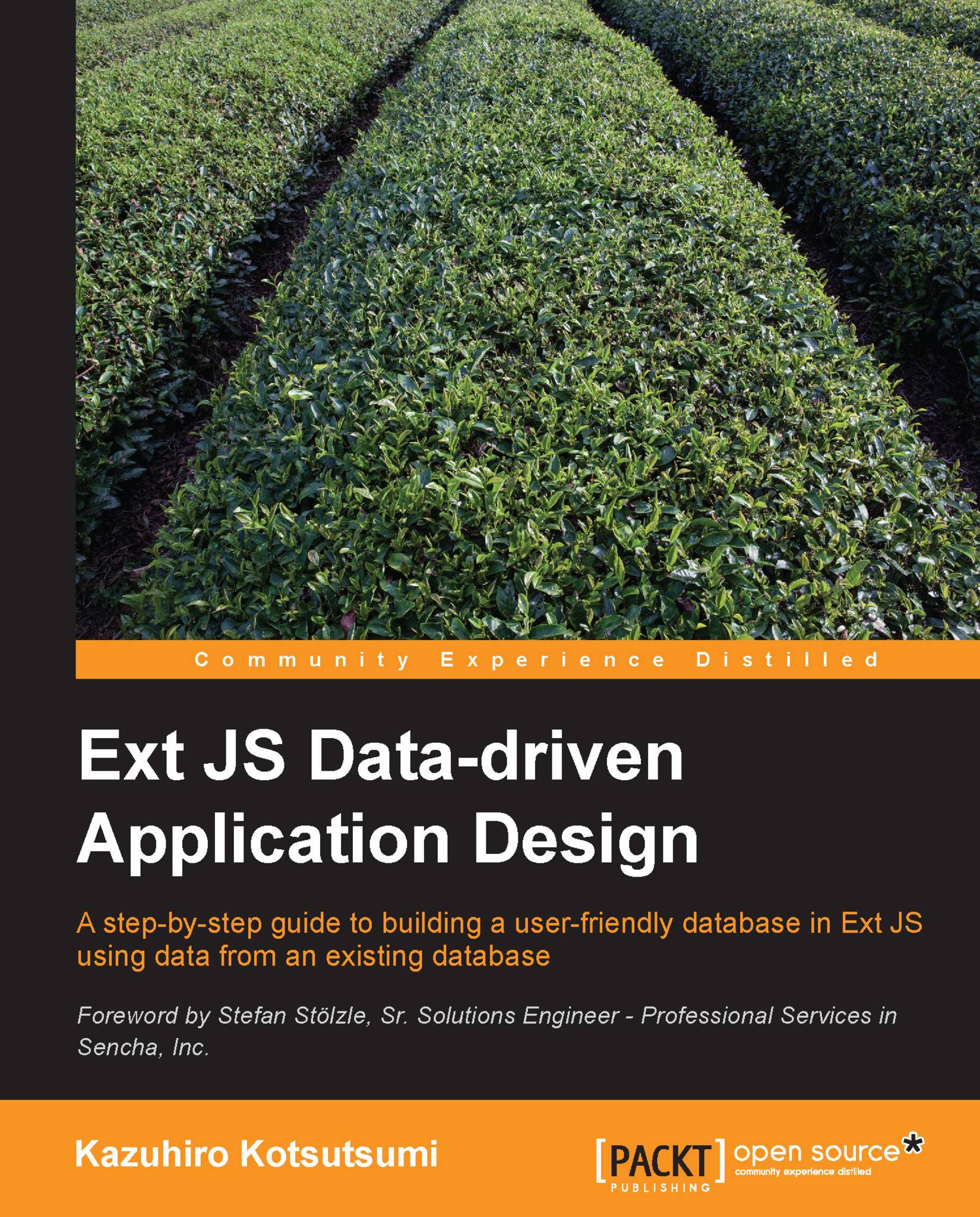
Ext JS Data-driven Application Design

Ext JS Data-driven Application Design: Learn how to build a user-friendly database in Ext JS using data from an existing database with this step-by-step tutorial. Takes you from first principles right through to implementation.

Arrow left icon
Profile Icon Kazuhiro Kotsutsumi
Arrow right icon
$21.59 $23.99
Full star icon Full star icon Full star icon Half star icon Empty star icon 3.2 (6 Ratings)
eBook Dec 2013 162 pages 1st Edition
eBook
$21.59 $23.99
Paperback
$40.99
eBook + Subscription
$24.99 Monthly
Arrow left icon
Profile Icon Kazuhiro Kotsutsumi
Arrow right icon
$21.59 $23.99
Full star icon Full star icon Full star icon Half star icon Empty star icon 3.2 (6 Ratings)
eBook Dec 2013 162 pages 1st Edition
eBook
$21.59 $23.99
Paperback
$40.99
eBook + Subscription
$24.99 Monthly
eBook
$21.59 $23.99
Paperback
$40.99
eBook + Subscription
$24.99 Monthly

What do you get with eBook?

Product feature icon Instant access to your Digital eBook purchase
Product feature icon Download this book in EPUB and PDF formats
Product feature icon Access this title in our online reader with advanced features
Product feature icon DRM FREE - Read whenever, wherever and however you want
Modal Close icon
Payment Processing...
tick Completed

Billing Address

Table of content icon View table of contents Preview book icon Preview Book

Ext JS Data-driven Application Design

Chapter 1. Data Structure

This book will take you step-by-step through the process of building a clear and user-friendly sales management database in Ext JS using information from an existing database.

This book is intended for intermediate Ext JS developers with operational knowledge of MySQL and who want to improve their programming skills and create a higher-level application.

The finished application will give you a working sales management database. However, the true value of this book is the hands-on process of creating the application, and the opportunity to easily transfer and incorporate features introduced in this book in your own future applications.

The standout features we will look at while building this application are as follows:

  • History-supported back button functionality: We will customize the Ext JS function to create a lighter method to scroll forwards and backwards while staying on a single page.

  • More efficient screen management: We'll learn how simply registering a screen and naming conventions can help you cut down on the screen change processes; meaning you can focus more on the implementation behind each screen. Also, it will be easier to interact with the history just by conforming to this architecture.

  • Communication methods with Ext.Direct: Ext.Direct has a close affinity with Ext applications which makes for easier connection, easier maintenance, and removes the need for the client side to change the URL. Also, if you use Ext.Direct, you can reduce the stress on the server side as it combines multiple server requests into just one request.

  • Data display methods with charts: In Ext JS, by simply adjusting the store and the data structure set to display in a grid, we can display the data graphically in a chart.

This chapter will give you the basic building blocks of your database. In this chapter of the book, you will write the SQL code and and create tables in MySQL.

Creating each operation and testing

Because we will use PHP in later stages, let's prepare each operation now. Here, we will insert some temporary data.

Remember to check that the acquisition and update operations are working properly.

User authentication

These are some SQL code you can use to develop your database.

You can look for a user by inputting an e-mail address and password. You can assume it was successful if the count is 1.

For increased password security, after having carried out MD5 encryption, you should store the password as a character string of 40 characters after being put through SHA1.

SELECT
    COUNT(id) as auth
FROM
    users
WHERE
    users.email = 'extkazuhiro@xenophy.com'
AND
    users.passwd = SHA1(MD5('password'))
AND
    users.status = 1;

Selecting the user list

This is used when you want to collect data for use in a grid. Make note of the fact that we are not performing the limit operation with PagingToolbar:

SELECT
    users.id,
    users.email,
    users.lastname,
    users.firstname
FROM
    users
WHERE
    users.status = 1;

Adding users

To add a user, put the current time in created and modified:

INSERT INTO users (
    email,
    passwd,
    lastname,
    firstname,
    modified,
    created
) VALUES (
    'someone@xenophy.com',
    SHA1(MD5('password')),
    'Kotsutsumi',
    'Kazuhiro',
    NOW(),
    NOW()
);

Updating the user information

Every time the modified file should be set to NOW() for it to be used as a time stamp. Other fields should be updated as needed.

UPDATE
    users
SET
    email='extkazuhiro@xenophy.com',
    passwd=SHA1(MD5('password')),
    lastname='Kotsutsumi',
    firstname='Kazuhiro',
    modified=NOW()
WHERE
    id=1

Deleting users

Deletion from this system is not a hard purge where the user data is permanently deleted. Instead we will use a soft purge, where the user data is not displayed after deletion but remains in the system. Therefore, note that we will use UPDATE, not DELETE. In the following code, status=9 denotes that the user has been deleted but not displayed. (status=1 will denote that the user is active).

UPDATE
    users
SET
    status=9
WHERE
    id=1

The Customers table

Although Add, Update, and Delete are necessary operations, we'll come to these in the later chapter, so we can leave it out at this time.

The customer information list

Here we are preparing the SQL code to pull information about customers later on:

SELECT
    customers.id,
    customers.name,
    customers.addr1,
    customers.addr2,
    customers.city,
    customers.state,
    customers.zip,
    customers.country,
    customers.phone,
    customers.fax
FROM
    customers
WHERE
    customers.status = 1;

Selecting the quotation list

Next comes the code for selecting the Quotation lists. This is similar to what we saw for the customer information list. For the code, please refer to the source file under 11_s electing_quotation_list.sql.

Items

The code for items will select the quotation items from the database. This will pick up items where quotations.status is 1 and quotation.parent is 1:

SELECT quotations.description, 
  quotations.qty, 
  quotations.price, 
  quotations.sum
FROM
  quotations
WHERE
  quotations.'status' = 1
AND
  quotations.parent = 1

As this is similar to Customers, you can again leave out Add, Update, and Delete for now.

The Bill table

Again let's leave out Add, Update and Delete for now because the Bill table is similar to what preceded this.

It's straightforward to say that once a quotation has been accepted, a bill is produced. Therefore, in data structures such as ours, Quotation and Bill are related. The only difference is that Bill contains the extra Quotation ID to create the relationship between the two.

Also, remember the customer information list is almost the same as the quotation list.

Summary

In this chapter, we have defined the structure of the database we will use in this book.

You might have your own databases that you want to present in Ext JS. This is just a sample database that we can build on in the coming chapters.

In the next chapter we will begin the process of building the whole application. Don't worry, we'll explain each step.

Bill and Bills


The Bill table is almost the same as the Quotation table. However, the Bill table can sometimes contain the ID of an associated Quotation table.

Bill

The following screenshot shows the Bill table:

Bills

Similar to Quotations, in Bills you can store each item that is ordered:

Creating and dealing with the customer structure tables


We will be using MySQL, and the database character is set to utf8 and collation is set to utf8_bin. When SQL describes the details of what we defined previously, each of these components are as follows.

The User table

The User table we prepared earlier becomes operational when the following code is executed. It's important to remember to include AUTO_INCREMENT in the id column; otherwise, you have to input it manually:

SET NAMES utf8;
SET FOREIGN_KEY_CHECKS = 0;

DROP TABLE IF EXISTS 'users';
CREATE TABLE 'users' (
  'id' bigint(20) NOT NULL AUTO_INCREMENT,
  'status' tinyint(1) NOT NULL DEFAULT '1',
  'email' varchar(255) NOT NULL,
  'passwd' char(40) NOT NULL,
  'lastname' varchar(20) NOT NULL,
  'firstname' varchar(20) NOT NULL,
  'modified' datetime DEFAULT NULL,
  'created' datetime NOT NULL,
  PRIMARY KEY ('id')
) ENGINE=InnoDB DEFAULT CHARSET=utf8 ROW_FORMAT=DYNAMIC;

SET FOREIGN_KEY_CHECKS = 1;

The Customer table

Once the following code is executed, the Customer table becomes operational:

SET NAMES utf8;
SET FOREIGN_KEY_CHECKS = 0;

DROP TABLE IF EXISTS 'customers';
CREATE TABLE 'customers' (
  'id' bigint(20) NOT NULL AUTO_INCREMENT,
  'status' tinyint(1) NOT NULL DEFAULT '1',
  'name' varchar(255) NOT NULL,
  'addr1' varchar(255) NOT NULL,
  'addr2' varchar(255) DEFAULT NULL,
  'city' varchar(50) NOT NULL,
  'state' varchar(50) NOT NULL,
  'zip' varchar(10) NOT NULL,
  'country' varchar(50) NOT NULL,
  'phone' varchar(50) NOT NULL,
  'fax' varchar(50) DEFAULT NULL,
  'modified' datetime DEFAULT NULL,
  'created' datetime NOT NULL,
  PRIMARY KEY ('id')
) ENGINE=InnoDB DEFAULT CHARSET=utf8 ROW_FORMAT=DYNAMIC;

SET FOREIGN_KEY_CHECKS = 1;

This is the foundation of creating an initial set of tables that can later be populated with data.

The Quotation table

This is the corresponding code for the Quotation table. As with the Customer table, this code snippet will lay the foundation of our table.

SET NAMES utf8;
SET FOREIGN_KEY_CHECKS = 0;

DROP TABLE IF EXISTS 'quotation';
CREATE TABLE 'quotation' (
  'id' bigint(20) NOT NULL AUTO_INCREMENT,
  'status' tinyint(1) NOT NULL DEFAULT '1',
  'customer' bigint(20) NOT NULL,
  'note' text NOT NULL,
  'modified' datetime DEFAULT NULL,
  'created' datetime NOT NULL,
  PRIMARY KEY ('id')
) ENGINE=InnoDB DEFAULT CHARSET=utf8 ROW_FORMAT=DYNAMIC;

DROP TABLE IF EXISTS 'quotations';
CREATE TABLE 'quotations' (
  'id' bigint(20) NOT NULL AUTO_INCREMENT,
  'status' tinyint(1) NOT NULL DEFAULT '1',
  'parent' bigint(20) NOT NULL,
  'description' varchar(255) NOT NULL,
  'qty' int(11) NOT NULL,
  'price' int(11) NOT NULL,
  'sum' int(11) NOT NULL,
  'modified' datetime DEFAULT NULL,
  'created' datetime NOT NULL,
  PRIMARY KEY ('id'),
  KEY 'parent' ('parent')
) ENGINE=InnoDB DEFAULT CHARSET=utf8 ROW_FORMAT=DYNAMIC;

SET FOREIGN_KEY_CHECKS = 1;

The Bill table

As with the previous two code snippets, the following code for the Bill table is very similar to the Quotation table, so this can be found in the source file under 04_bill_table.sql.

These are all the tables we need for this database. Now let's move on to testing after creating each operation.

Creating each operation and testing


Because we will use PHP in later stages, let's prepare each operation now. Here, we will insert some temporary data.

Remember to check that the acquisition and update operations are working properly.

User authentication

These are some SQL code you can use to develop your database.

You can look for a user by inputting an e-mail address and password. You can assume it was successful if the count is 1.

For increased password security, after having carried out MD5 encryption, you should store the password as a character string of 40 characters after being put through SHA1.

SELECT
    COUNT(id) as auth
FROM
    users
WHERE
    users.email = 'extkazuhiro@xenophy.com'
AND
    users.passwd = SHA1(MD5('password'))
AND
    users.status = 1;

Selecting the user list

This is used when you want to collect data for use in a grid. Make note of the fact that we are not performing the limit operation with PagingToolbar:

SELECT
    users.id,
    users.email,
    users.lastname,
    users.firstname
FROM
    users
WHERE
    users.status = 1;

Adding users

To add a user, put the current time in created and modified:

INSERT INTO users (
    email,
    passwd,
    lastname,
    firstname,
    modified,
    created
) VALUES (
    'someone@xenophy.com',
    SHA1(MD5('password')),
    'Kotsutsumi',
    'Kazuhiro',
    NOW(),
    NOW()
);

Updating the user information

Every time the modified file should be set to NOW() for it to be used as a time stamp. Other fields should be updated as needed.

UPDATE
    users
SET
    email='extkazuhiro@xenophy.com',
    passwd=SHA1(MD5('password')),
    lastname='Kotsutsumi',
    firstname='Kazuhiro',
    modified=NOW()
WHERE
    id=1

Deleting users

Deletion from this system is not a hard purge where the user data is permanently deleted. Instead we will use a soft purge, where the user data is not displayed after deletion but remains in the system. Therefore, note that we will use UPDATE, not DELETE. In the following code, status=9 denotes that the user has been deleted but not displayed. (status=1 will denote that the user is active).

UPDATE
    users
SET
    status=9
WHERE
    id=1

The Customers table


Although Add, Update, and Delete are necessary operations, we'll come to these in the later chapter, so we can leave it out at this time.

The customer information list

Here we are preparing the SQL code to pull information about customers later on:

SELECT
    customers.id,
    customers.name,
    customers.addr1,
    customers.addr2,
    customers.city,
    customers.state,
    customers.zip,
    customers.country,
    customers.phone,
    customers.fax
FROM
    customers
WHERE
    customers.status = 1;

Selecting the quotation list

Next comes the code for selecting the Quotation lists. This is similar to what we saw for the customer information list. For the code, please refer to the source file under 11_s electing_quotation_list.sql.

Items

The code for items will select the quotation items from the database. This will pick up items where quotations.status is 1 and quotation.parent is 1:

SELECT quotations.description, 
  quotations.qty, 
  quotations.price, 
  quotations.sum
FROM
  quotations
WHERE
  quotations.'status' = 1
AND
  quotations.parent = 1

As this is similar to Customers, you can again leave out Add, Update, and Delete for now.

The Bill table


Again let's leave out Add, Update and Delete for now because the Bill table is similar to what preceded this.

It's straightforward to say that once a quotation has been accepted, a bill is produced. Therefore, in data structures such as ours, Quotation and Bill are related. The only difference is that Bill contains the extra Quotation ID to create the relationship between the two.

Also, remember the customer information list is almost the same as the quotation list.

Summary


In this chapter, we have defined the structure of the database we will use in this book.

You might have your own databases that you want to present in Ext JS. This is just a sample database that we can build on in the coming chapters.

In the next chapter we will begin the process of building the whole application. Don't worry, we'll explain each step.

Left arrow icon Right arrow icon

Key benefits

  • Discover how to layout the application structure with MVC and Sencha Cmd
  • Learn to use Ext Direct during the application build process
  • Understand how to set up the history support in the browser

Description

Sencha Ext JS is an industry leader for business-standard web application development. Ext JS is a leading JavaScript framework that comes with a myriad of components, APIs, and extensive documentation that you can harness to build powerful and interactive applications. Using Ext JS, you can quickly develop rich desktop web applications that are compatible with all major browsers. This book will enable you to build databases using information from an existing database with Ext JS. It covers the MVC application architecture that enables development teams to work independently on one project. Additionally, the book teaches advanced charting capability, enabling developers to create state-of-the-art charts just once. These charts are compatible with major browsers without the need to rely on plugins. This hands-on, practical guide will take you through the mechanics of building an application. In this instance, we will use this application to manage existing data structures in the form of a database. You will begin by making SQL and tables in MySQL and will then move on to developing the project environment and introducing Sencha Cmd. You will learn to create a form to input data and monitor the state of the input, while seeing how Ext Direct will validate the form on the server side. Finally, you will have a working application that is ready for you to customize to suit your needs. You can also use it as a template for any future projects when you need a similar database.

Who is this book for?

If you are an intermediate in Sencha Ext JS, "Ext JS Data-driven Application Design" is the tutorial for you. You need to be familiar with JavaScript and have basic operational knowledge of MySQL. If you want to be able to systematically construct an application from the first step to implementation, this book will be useful for you.

What you will learn

  • Understand an existing virtual company s data structure, and make SQL and tables in MySQL
  • Develop the environment of the project while introducing Sencha Cmd and using Ext.util.History at the same time
  • Create a form to input data and transmit the data to a server via Ext Direct
  • Discover how to display data and create data searches
  • Implement a report that displays four different types of graph on the dashboard
  • Implement the data import/export process to restore or backup the data

Product Details

Country selected
Publication date, Length, Edition, Language, ISBN-13
Publication date : Dec 24, 2013
Length: 162 pages
Edition : 1st
Language : English
ISBN-13 : 9781782165453
Vendor :
Sencha
Languages :
Tools :

What do you get with eBook?

Product feature icon Instant access to your Digital eBook purchase
Product feature icon Download this book in EPUB and PDF formats
Product feature icon Access this title in our online reader with advanced features
Product feature icon DRM FREE - Read whenever, wherever and however you want
Modal Close icon
Payment Processing...
tick Completed

Billing Address

Product Details

Publication date : Dec 24, 2013
Length: 162 pages
Edition : 1st
Language : English
ISBN-13 : 9781782165453
Vendor :
Sencha
Languages :
Tools :

Packt Subscriptions

See our plans and pricing
Modal Close icon
$19.99 billed monthly
Feature tick icon Unlimited access to Packt's library of 7,000+ practical books and videos
Feature tick icon Constantly refreshed with 50+ new titles a month
Feature tick icon Exclusive Early access to books as they're written
Feature tick icon Solve problems while you work with advanced search and reference features
Feature tick icon Offline reading on the mobile app
Feature tick icon Simple pricing, no contract
$199.99 billed annually
Feature tick icon Unlimited access to Packt's library of 7,000+ practical books and videos
Feature tick icon Constantly refreshed with 50+ new titles a month
Feature tick icon Exclusive Early access to books as they're written
Feature tick icon Solve problems while you work with advanced search and reference features
Feature tick icon Offline reading on the mobile app
Feature tick icon Choose a DRM-free eBook or Video every month to keep
Feature tick icon PLUS own as many other DRM-free eBooks or Videos as you like for just $5 each
Feature tick icon Exclusive print discounts
$279.99 billed in 18 months
Feature tick icon Unlimited access to Packt's library of 7,000+ practical books and videos
Feature tick icon Constantly refreshed with 50+ new titles a month
Feature tick icon Exclusive Early access to books as they're written
Feature tick icon Solve problems while you work with advanced search and reference features
Feature tick icon Offline reading on the mobile app
Feature tick icon Choose a DRM-free eBook or Video every month to keep
Feature tick icon PLUS own as many other DRM-free eBooks or Videos as you like for just $5 each
Feature tick icon Exclusive print discounts

Frequently bought together


Stars icon
Total $ 138.97
Ext JS Data-driven Application Design
$40.99
Enterprise Application Development with Ext JS and Spring
$57.99
Ext JS 4 Plugin and Extension Development
$39.99
Total $ 138.97 Stars icon

Table of Contents

6 Chapters
Data Structure Chevron down icon Chevron up icon
Planning Application Design Chevron down icon Chevron up icon
Data Input Chevron down icon Chevron up icon
List and Search Chevron down icon Chevron up icon
Reporting Chevron down icon Chevron up icon
Data Management Chevron down icon Chevron up icon

Customer reviews

Top Reviews
Rating distribution
Full star icon Full star icon Full star icon Half star icon Empty star icon 3.2
(6 Ratings)
5 star 16.7%
4 star 33.3%
3 star 16.7%
2 star 16.7%
1 star 16.7%
Filter icon Filter
Top Reviews

Filter reviews by


Sagi Jan 25, 2014
Full star icon Full star icon Full star icon Full star icon Full star icon 5
In this rather short book (definitely worth the price) you will walk through the steps needed to create a data driven solution using ExtJS.To learn this, the author teaches you to build a sales management database and system.You will learn how to choose entities accordingly (though I believe most of the people coming to this sort of book will already be able to make this happen).You will learn how to build ExtJS controllers to respond to users' requests, needed views and understand the workflow, a "soft" back button to work with the framework and more.One of the major gems you will find in this book is one of the things many people who are new to working with extjs combined with a server is the user of Ext.Direct with php.(Though I'm not a big fan of php! I'd would rather it be written for nodejs..but that's just me)In conclusion this book is definitely a tool for those who want to escalate their knowledge of extjs to the next level and develop products for this growing market.
Amazon Verified review Amazon
Shinobu Kawano Feb 09, 2014
Full star icon Full star icon Full star icon Full star icon Empty star icon 4
If you are totally beginner of Ext JS, and want to learn how to implement a real-life application with it, I recommend “Mastering Ext JS“. Because the contents of “Ext JS Data-driven Application Design” is quite unique and I don’t know it’s a best practice or not. That’s why I think it’s not fit for a beginner.The other hand, you have experience of Ext JS app development, and want to learn how to create more quality architecture, this book might be for you. You will learn a new concept and it would be a hint to consider how to create a higher-level applications. I learned many ideas from this book and was inspired.
Amazon Verified review Amazon
Luigi Feb 08, 2014
Full star icon Full star icon Full star icon Full star icon Empty star icon 4
I read very quickly this book, that is short and condensed. It is a step-by-step guide that drives you through the building of an ExtJS application that interacts with data. It explains how to leverage on ExtJS MVC model for building a robust and easy to mantain application. I appreciated especially the Reporting chapter, where it's explained how to use data for builing charts (that are part of the ExtJS framework).
Amazon Verified review Amazon
Alok Ranjan Feb 03, 2014
Full star icon Full star icon Full star icon Empty star icon Empty star icon 3
This book seems to be the first book which attempts to explain step-by-step process to create the whole application using ExtJS. Most of the book often talks about the concept, which at times leaves some of the key aspects of application development and support. After following the book very closely, eventually you get an application and that should give confidence to first timers who want to build their own application.While I had a bit high expectation from the book, I must say that the overall presentation is pretty average. I found that words used in the book were often the synonyms which I am not very used to. So, it took some time to have appropriate mapping of words with the concept. At times I felt as if the author has put some incorrect word. However, after reading couple of chapter it was clear that instead of creating a class the author is making a class. Also, I wanted to build the application incrementally and it took time to understand the incremental changes and put them into main project.Some of the statements were so casual that I was wondering what was the need for putting that statement. For example in one of the place the author says “It has been a while since we saw an image, so we’ve displayed a column for now; however, let’s start to create the necessary objects for this list.”.Of course I am passionate about Sencha ExtJS and after going through this book at times I felt that the reader will get an impression that the ExtJS is something difficult to grasp and master. The presentation of content could have been much better. I would have liked to see the basic concepts of an application being explained and then make use of that concept to give the readers the step-by-step process for creating an application. I felt that there was too much to-and-fro and reference to Component Testing again and again was a killer.You can read my complete review comment on below URL:http://blogs.walkingtree.in/2014/01/31/extjs-data-driven-book-review/
Amazon Verified review Amazon
G. Hayward May 29, 2014
Full star icon Full star icon Empty star icon Empty star icon Empty star icon 2
I am very disappointed with Packet Publishing for put out a book that can only be described as a half finished effort. The example files do not work as described by the book. The sentence structure is very hard to follow.
Amazon Verified review Amazon
Get free access to Packt library with over 7500+ books and video courses for 7 days!
Start Free Trial

FAQs

How do I buy and download an eBook? Chevron down icon Chevron up icon

Where there is an eBook version of a title available, you can buy it from the book details for that title. Add either the standalone eBook or the eBook and print book bundle to your shopping cart. Your eBook will show in your cart as a product on its own. After completing checkout and payment in the normal way, you will receive your receipt on the screen containing a link to a personalised PDF download file. This link will remain active for 30 days. You can download backup copies of the file by logging in to your account at any time.

If you already have Adobe reader installed, then clicking on the link will download and open the PDF file directly. If you don't, then save the PDF file on your machine and download the Reader to view it.

Please Note: Packt eBooks are non-returnable and non-refundable.

Packt eBook and Licensing When you buy an eBook from Packt Publishing, completing your purchase means you accept the terms of our licence agreement. Please read the full text of the agreement. In it we have tried to balance the need for the ebook to be usable for you the reader with our needs to protect the rights of us as Publishers and of our authors. In summary, the agreement says:

  • You may make copies of your eBook for your own use onto any machine
  • You may not pass copies of the eBook on to anyone else
How can I make a purchase on your website? Chevron down icon Chevron up icon

If you want to purchase a video course, eBook or Bundle (Print+eBook) please follow below steps:

  1. Register on our website using your email address and the password.
  2. Search for the title by name or ISBN using the search option.
  3. Select the title you want to purchase.
  4. Choose the format you wish to purchase the title in; if you order the Print Book, you get a free eBook copy of the same title. 
  5. Proceed with the checkout process (payment to be made using Credit Card, Debit Cart, or PayPal)
Where can I access support around an eBook? Chevron down icon Chevron up icon
  • If you experience a problem with using or installing Adobe Reader, the contact Adobe directly.
  • To view the errata for the book, see www.packtpub.com/support and view the pages for the title you have.
  • To view your account details or to download a new copy of the book go to www.packtpub.com/account
  • To contact us directly if a problem is not resolved, use www.packtpub.com/contact-us
What eBook formats do Packt support? Chevron down icon Chevron up icon

Our eBooks are currently available in a variety of formats such as PDF and ePubs. In the future, this may well change with trends and development in technology, but please note that our PDFs are not Adobe eBook Reader format, which has greater restrictions on security.

You will need to use Adobe Reader v9 or later in order to read Packt's PDF eBooks.

What are the benefits of eBooks? Chevron down icon Chevron up icon
  • You can get the information you need immediately
  • You can easily take them with you on a laptop
  • You can download them an unlimited number of times
  • You can print them out
  • They are copy-paste enabled
  • They are searchable
  • There is no password protection
  • They are lower price than print
  • They save resources and space
What is an eBook? Chevron down icon Chevron up icon

Packt eBooks are a complete electronic version of the print edition, available in PDF and ePub formats. Every piece of content down to the page numbering is the same. Because we save the costs of printing and shipping the book to you, we are able to offer eBooks at a lower cost than print editions.

When you have purchased an eBook, simply login to your account and click on the link in Your Download Area. We recommend you saving the file to your hard drive before opening it.

For optimal viewing of our eBooks, we recommend you download and install the free Adobe Reader version 9.

Modal Close icon
Modal Close icon