Search icon CANCEL
Subscription
0
Cart icon
Your Cart (0 item)
Close icon
You have no products in your basket yet
Save more on your purchases! discount-offer-chevron-icon
Savings automatically calculated. No voucher code required.
Arrow left icon
Explore Products
Best Sellers
New Releases
Books
Videos
Audiobooks
Learning Hub
Newsletter Hub
Free Learning
Arrow right icon
timer SALE ENDS IN
0 Days
:
00 Hours
:
00 Minutes
:
00 Seconds
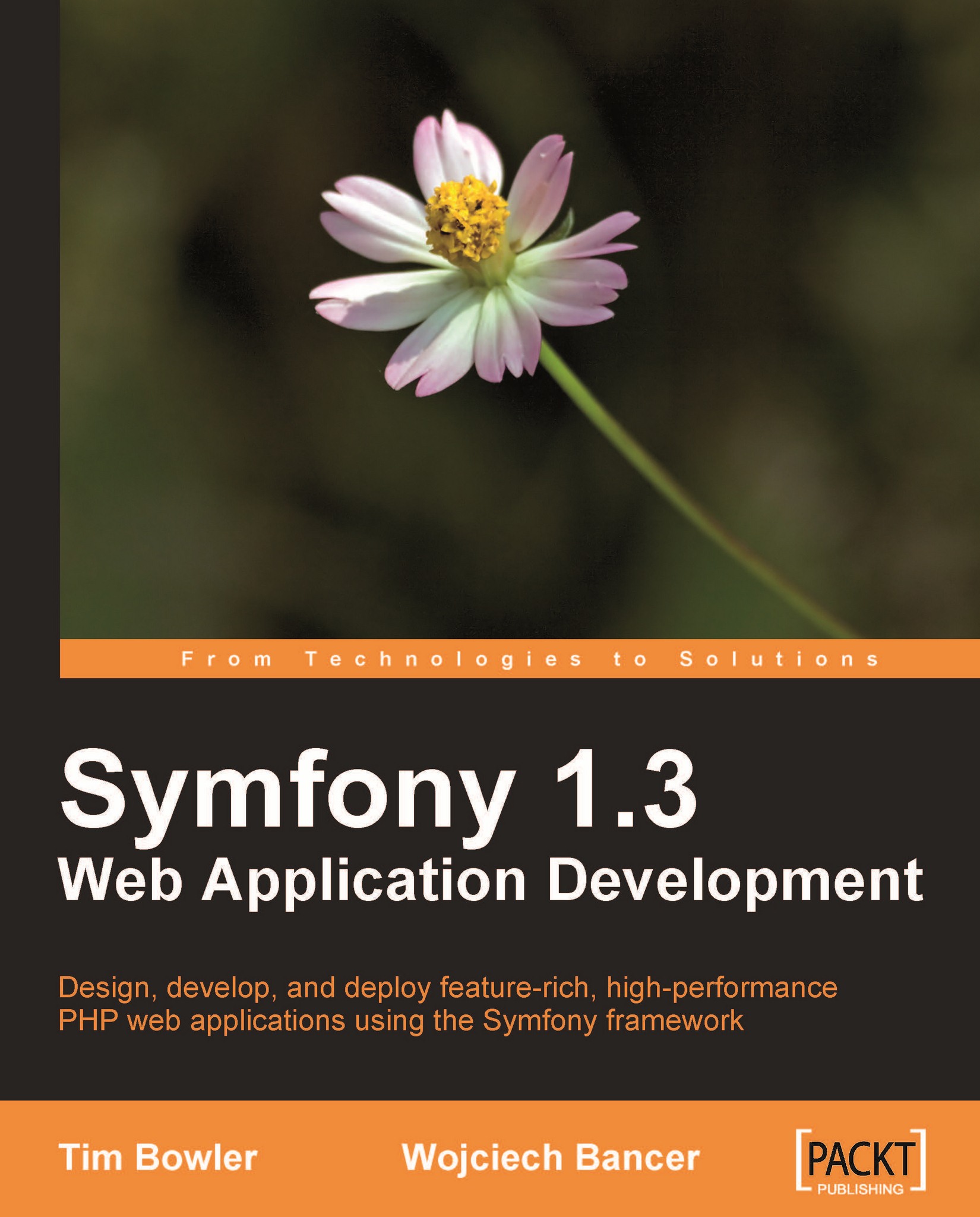
Symfony 1.3 Web Application Development

Symfony 1.3 Web Application Development: Design, develop, and deploy feature-rich, high-performance PHP web applications using the Symfony framework

eBook
€8.98 €25.99
Paperback
€32.99
Subscription
Free Trial
Renews at €18.99p/m

What do you get with Print?

Product feature icon Instant access to your digital copy whilst your Print order is Shipped
Product feature icon Paperback book shipped to your preferred address
Product feature icon Redeem a companion digital copy on all Print orders
Product feature icon Access this title in our online reader with advanced features
Product feature icon DRM FREE - Read whenever, wherever and however you want
Modal Close icon
Payment Processing...
tick Completed

Shipping Address

Billing Address

Shipping Methods
Table of content icon View table of contents Preview book icon Preview Book

Symfony 1.3 Web Application Development

Chapter 1. Getting Started with Symfony

This chapter is an overview of the Symfony framework and how good it is to develop with. It will cover how Symphony conforms to the MVC pattern, the main features, general coding guidelines, and how to install it.

By the end of this chapter you will know:

  • About the MVC pattern

  • How Symfony incorporates the MVC pattern

  • How to install Symfony

Exploring Symfony

Symfony was released in October 2005 by Fabien Potencier who is the CEO of Sensio, which is a French web agency (http://www.sensio.com). After Fabien used the framework on several projects successfully, he decided to release the project under an open source license. Ever since its first release, the Symfony community has increased dramatically and continues to do so.

The community can be found at http://www.symfony-project.org/.

The framework

A framework is aimed at reducing the development time without the need to sacrifice maintainability, scalability, or quality. Symfony can take less than a day to learn, comes with many tools and classes, and is easy to install. This means the developer can spend more time developing the application. All of these reasons and many more are why Symfony has come about, and why it has maintained its place as one of the best PHP5 frameworks.

The current trends at the moment seem to revolve around agile development methodologies with groups of developers working on the same web application. Using the Symfony framework, developers are aided in writing structured and maintainable code. This is all down to the framework's strict implementation of the Model-View-Controller (MVC) paradigm and modulization.

"It aims to speed up the creation and maintenance of web applications, and to replace the repetitive coding tasks by power, control and pleasure."

More information about this project can be found at http://www.symfony-project.org/about.

The Model-View-Controller pattern

Many books go into the details of what the MVC pattern is and how it works. However, we will just look at the basic overview and how Symfony incorporates the pattern.

The MVC pattern is designed to split the presentation and business logic, and has a controller that manages the user's interactions between the two.

When you first use Symfony to generate the skeleton code for a new application and module, you can see exactly how Symfony strictly abides by the MVC pattern.

Controller

The controller is responsible for processing user events. The controllers in Symfony are split into several components.

  1. 1. It is the entry point into the application.

  2. 2. It determines what action is required to execute.

  3. 3. Loads the configurations.

  4. 4. Executes the filters.

One great feature about the controller being the entry point is that any time a site needs to go down for maintenance, the controller can simply be disabled. Creation of a new application in Symfony creates two controllers:

  • A controller for the production environment

  • A controller for the development environment

The difference between the two is the debug information and error displaying.

The controller calls an action, which is what drives the application. The action contains all of the application logic and has the ability to access everything from the request, sessions, authentication, and core Symfony objects.

Model

The model layer represents the applications data and the business rules used to manipulate and access it.

Symfony's model layer is split into two separate layers—an Object Relational Mapping (ORM) layer and a data abstraction layer. Of course, there are a few good PHP5 ORM and database abstraction libraries that already exist. Therefore, rather than reinventing the wheel, the framework incorporates the Doctrine ORM (http://www.doctrine-project.org/) which is the defualt ORM layer, with the option of using the Propel ORM (http://propel.phpdb.org). The second layer, being the data abstraction layer is handled by PHP Data Objects (PDO).

Database abstraction means database portability. Every database vendor will have a slight variant in their SQL syntax. Therefore, by moving your application to another RDBMS, a developer would have to amend certain queries. But with a database abstraction layer, this portability becomes transparent.

Object relational mapping turns database tables, rows, and different variable types into objects. As Symfony is written using OOP, it makes sense that the data is returned as an object.

At the moment, Symfony comes shipped with Propel 1.2 as it's default ORM. However, this whole ORM layer can be easily changed. For example, the ORM layer can be changed to Doctrine (http://www.phpdoctrine.org/).

Views

A view, which is commonly referred to as a template, is displayed to the user. These templates are completely separated from controllers and models. They mainly comprise of XHTML markup and presentation logic in the form of PHP tags. Although Symphony's template system has matured, the view layer can be replaced with another template engine, such as Smarty (https://smarty.php.net) through a plugin, for example.

Taking a look at the key features

We have looked at Symfony's implementation of the MVC pattern. Next, let's go over some of the features that Symfony has to offer in order to cut down development time.

Forms and validation

This is one of those repetitive requirements that a developer always has to face. Using Symfony, the development time is decreased due to the form subframework. There are two types of form:

  • Propel form is a form that is based on a database table(s). These forms persist the submitted data to the table(s) that they are based on. As part of the generation task(s), these forms are automatically created along with validation. Although we can easily customize both form and validation, the default forms are a great way to display an initial prototype.

  • Simple form is a form that doesn't persist data to the database. Although they are not generated, they follow the same approach as the Propel-based forms.

Plugins

One of Symfony's best features is its plugin architecture. So, many units of functionality can be written as a plugin and used time and again. The available plugins either help a developer in some way, or provide full, feature-rich applications. Looking at the plugin repository, numerous plugins have been submitted by the community and it continues to grow. You can visit http://trac.symfony-project.com/wiki/SymfonyPlugins to know more about Symfony Plugins. A few of the main plugins are:

  • sfGuardPlugin: Web asset management

  • sfSimpleBlog: Simple blog for your site

  • sfSimpleCMSPlugin: Create a CMS

  • sfLucenePlugin: Integrates the Zend framework's search engine

Internationalization and localization

Many web applications offer locale translations and services based on your locale. Symfony provides interfaces, standards, and localized helpers to make internationalization (i18N) and localization (l10N) simple.

There are two places where time is cut down. The first is by using XLIFF dictionary files for static template text. Wrapping sentences or words inside a special helper function will automatically do all the lookups in the dictionary files. Also, using a task on the command line, will do all of this for you. The second place is within the ORM layer, which provides additional methods for I18N lookups.

Generators

When writing a web application, more often than not, a backend administration area is needed to manage content. This can increase development time dramatically. Symfony has generators which when run from a task on the command line can scaffold forms on the front end and also backend administration forms. These forms are based on a model, just like when creating normal forms. Not only are the forms created, but also all of the code to provide a form with the ability to Create Retrieve Update and Delete (CRUD) records in the database. The backend-generated forms also use a theme to create better-looking forms.

Cache

Cache is the fastest method of retrieving information. In Symfony, templates, partials, components, and actions can all be cached to speed up the response times. Configuration of the cache is also governed by a configuration file. Although there are a few configuration YAML files, they are all converted into PHP arrays and cached the first time the application runs. By default the cache is stored on the file system, but a small amend to one of the configuration files can easily swap this to another caching mechanism such as memcache, for example.

Testing

Test-driven development is the key to bug-free and well-written code. Symfony provides the ability for unit and functional testing. Unit tests enable the developer to test functions and methods for input and output. While functionality tests helps the developer to test for functional issues that would be executed in the browser, Symfony has its own testing framework called Lime. This testing framework is useful for both unit testing and functional testing. All test output can be saved in the xUnit format.

Configuration files

By default, all the files are written in the YAML format (http://www.yaml.org/). When first run, the configuration is read and then written to cache as a native PHP array. Many of Symfony's features are customizable in the many configuration files.

As you can see, Symfony is a solid framework that contains many features, is dynamic, and more importantly, cuts down development time. Also, parts of Symfony can be extended, replaced with a plugin and provides a bridge for other frameworks, which we will look at later.

Exploring Symfony


Symfony was released in October 2005 by Fabien Potencier who is the CEO of Sensio, which is a French web agency (http://www.sensio.com). After Fabien used the framework on several projects successfully, he decided to release the project under an open source license. Ever since its first release, the Symfony community has increased dramatically and continues to do so.

The community can be found at http://www.symfony-project.org/.

The framework

A framework is aimed at reducing the development time without the need to sacrifice maintainability, scalability, or quality. Symfony can take less than a day to learn, comes with many tools and classes, and is easy to install. This means the developer can spend more time developing the application. All of these reasons and many more are why Symfony has come about, and why it has maintained its place as one of the best PHP5 frameworks.

The current trends at the moment seem to revolve around agile development methodologies with groups of developers working on the same web application. Using the Symfony framework, developers are aided in writing structured and maintainable code. This is all down to the framework's strict implementation of the Model-View-Controller (MVC) paradigm and modulization.

"It aims to speed up the creation and maintenance of web applications, and to replace the repetitive coding tasks by power, control and pleasure."

More information about this project can be found at http://www.symfony-project.org/about.

The Model-View-Controller pattern

Many books go into the details of what the MVC pattern is and how it works. However, we will just look at the basic overview and how Symfony incorporates the pattern.

The MVC pattern is designed to split the presentation and business logic, and has a controller that manages the user's interactions between the two.

When you first use Symfony to generate the skeleton code for a new application and module, you can see exactly how Symfony strictly abides by the MVC pattern.

Controller

The controller is responsible for processing user events. The controllers in Symfony are split into several components.

  1. 1. It is the entry point into the application.

  2. 2. It determines what action is required to execute.

  3. 3. Loads the configurations.

  4. 4. Executes the filters.

One great feature about the controller being the entry point is that any time a site needs to go down for maintenance, the controller can simply be disabled. Creation of a new application in Symfony creates two controllers:

  • A controller for the production environment

  • A controller for the development environment

The difference between the two is the debug information and error displaying.

The controller calls an action, which is what drives the application. The action contains all of the application logic and has the ability to access everything from the request, sessions, authentication, and core Symfony objects.

Model

The model layer represents the applications data and the business rules used to manipulate and access it.

Symfony's model layer is split into two separate layers—an Object Relational Mapping (ORM) layer and a data abstraction layer. Of course, there are a few good PHP5 ORM and database abstraction libraries that already exist. Therefore, rather than reinventing the wheel, the framework incorporates the Doctrine ORM (http://www.doctrine-project.org/) which is the defualt ORM layer, with the option of using the Propel ORM (http://propel.phpdb.org). The second layer, being the data abstraction layer is handled by PHP Data Objects (PDO).

Database abstraction means database portability. Every database vendor will have a slight variant in their SQL syntax. Therefore, by moving your application to another RDBMS, a developer would have to amend certain queries. But with a database abstraction layer, this portability becomes transparent.

Object relational mapping turns database tables, rows, and different variable types into objects. As Symfony is written using OOP, it makes sense that the data is returned as an object.

At the moment, Symfony comes shipped with Propel 1.2 as it's default ORM. However, this whole ORM layer can be easily changed. For example, the ORM layer can be changed to Doctrine (http://www.phpdoctrine.org/).

Views

A view, which is commonly referred to as a template, is displayed to the user. These templates are completely separated from controllers and models. They mainly comprise of XHTML markup and presentation logic in the form of PHP tags. Although Symphony's template system has matured, the view layer can be replaced with another template engine, such as Smarty (https://smarty.php.net) through a plugin, for example.

Taking a look at the key features

We have looked at Symfony's implementation of the MVC pattern. Next, let's go over some of the features that Symfony has to offer in order to cut down development time.

Forms and validation

This is one of those repetitive requirements that a developer always has to face. Using Symfony, the development time is decreased due to the form subframework. There are two types of form:

  • Propel form is a form that is based on a database table(s). These forms persist the submitted data to the table(s) that they are based on. As part of the generation task(s), these forms are automatically created along with validation. Although we can easily customize both form and validation, the default forms are a great way to display an initial prototype.

  • Simple form is a form that doesn't persist data to the database. Although they are not generated, they follow the same approach as the Propel-based forms.

Plugins

One of Symfony's best features is its plugin architecture. So, many units of functionality can be written as a plugin and used time and again. The available plugins either help a developer in some way, or provide full, feature-rich applications. Looking at the plugin repository, numerous plugins have been submitted by the community and it continues to grow. You can visit http://trac.symfony-project.com/wiki/SymfonyPlugins to know more about Symfony Plugins. A few of the main plugins are:

  • sfGuardPlugin: Web asset management

  • sfSimpleBlog: Simple blog for your site

  • sfSimpleCMSPlugin: Create a CMS

  • sfLucenePlugin: Integrates the Zend framework's search engine

Internationalization and localization

Many web applications offer locale translations and services based on your locale. Symfony provides interfaces, standards, and localized helpers to make internationalization (i18N) and localization (l10N) simple.

There are two places where time is cut down. The first is by using XLIFF dictionary files for static template text. Wrapping sentences or words inside a special helper function will automatically do all the lookups in the dictionary files. Also, using a task on the command line, will do all of this for you. The second place is within the ORM layer, which provides additional methods for I18N lookups.

Generators

When writing a web application, more often than not, a backend administration area is needed to manage content. This can increase development time dramatically. Symfony has generators which when run from a task on the command line can scaffold forms on the front end and also backend administration forms. These forms are based on a model, just like when creating normal forms. Not only are the forms created, but also all of the code to provide a form with the ability to Create Retrieve Update and Delete (CRUD) records in the database. The backend-generated forms also use a theme to create better-looking forms.

Cache

Cache is the fastest method of retrieving information. In Symfony, templates, partials, components, and actions can all be cached to speed up the response times. Configuration of the cache is also governed by a configuration file. Although there are a few configuration YAML files, they are all converted into PHP arrays and cached the first time the application runs. By default the cache is stored on the file system, but a small amend to one of the configuration files can easily swap this to another caching mechanism such as memcache, for example.

Testing

Test-driven development is the key to bug-free and well-written code. Symfony provides the ability for unit and functional testing. Unit tests enable the developer to test functions and methods for input and output. While functionality tests helps the developer to test for functional issues that would be executed in the browser, Symfony has its own testing framework called Lime. This testing framework is useful for both unit testing and functional testing. All test output can be saved in the xUnit format.

Configuration files

By default, all the files are written in the YAML format (http://www.yaml.org/). When first run, the configuration is read and then written to cache as a native PHP array. Many of Symfony's features are customizable in the many configuration files.

As you can see, Symfony is a solid framework that contains many features, is dynamic, and more importantly, cuts down development time. Also, parts of Symfony can be extended, replaced with a plugin and provides a bridge for other frameworks, which we will look at later.

Coding guidelines


One thing that I have learned in the past is to always establish coding guidelines. Following some of the eXtreme programming principles—namely, pair programming—I have learned that having a set of guidelines helps team integration and code readability.

Symfony-specific guidelines

These are some Symfony-specific guidelines:

  • One module is not for one page. The only time where this might be ruled out is if there is a strong possibility of the module being extended.

    For instance, if you have general footer pages, these could be a part of the general module. Also, grouping functionality allows code to be refactored into a plugin during development.

  • Application-specific settings should always go in the app.yml file.

  • When using a mail plugin for sending out emails, abide by the MVC pattern.

    That means use the action and templates rather than storing content inside a variable.

  • Keep PHP to an absolute minimum within templates.

  • Database table names should be plural and PHP models names should be singular.

Installing Symfony


There are three ways in which you can install and set up Symfony on your local system:

  • Using the sandbox

  • Checking out of subversion

  • Installing via PEAR

Version 1.3 was not released at the time of the writing this book, so I cannot provide you with the exact links to install it. However, I can point you in the direction of some more useful documentation located on the Symfony web site at http://www.symfony-project.org/installation and http://www.symfony-project.org/getting-started/1_2/en/.

The fastest way of setting up Symfony, especially for the first time, is to download the sandbox. The sandbox works straight out of box and contains the basic application already created for you.

The sandbox can be downloaded from http://www.symfony-project.org/get/symfony-stable.tgz 0.

If you follow the PEAR route, you can use that installation to create your own sandbox at http://www.symfony-project.org/blog/2009/06/10/new-in-symfony-1-3-project-creation-customization.

Note

For developing with Version 1.3, I used two methods to obtain a sandbox.

Checked out Symfony from SVN into a temporary folder:

>mkdir symfony_1.3 && cd symfony_1.3
>svn co http://svn.symfony-project.com/branches/1.3

Next I used the Symfony create_sandbox script to create a zipped up sandbox:

>data/bin/create_sandbox.sh

After running the command you will see the package being build. Afterwards, you will see two new files in the current folder, sf_sandbox.tgz and sf_sandbox.zip. You can extract either one and rename the folder from sf_sandbox to milkshake. Afterwards you can place this folder in your workspace folder.

Summary


In this chapter, we saw the MVC framework and an overview of some of Symfony's key features that help to save time on development. These features consisted of plugins, generators, internationalization, forms and validation.

We can see how simple it is to get Symfony up and running on our local computer. Being eager to start, get ready for the coming chapters.

Left arrow icon Right arrow icon

Key benefits

  • Create powerful web applications by leveraging the power of this Model-View-Controller-based framework
  • Covers all the new features of version 1.3 ñ many exciting plug-ins for you
  • Learn by doing without getting into too much theoretical detail ñ create a "real-life" milkshake store application
  • Includes best practices to shorten your development time and improve performance

Description

With its flexible architecture, the Symfony framework allows you to build modern web applications and web services easily and rapidly. The MVC components separate the logic from the user interface and therefore make developing, changing, and testing your applications much faster. Using Symfony you can minimize repetitive coding tasks, optimize performance, and easily integrate with other libraries and frameworks. Although this framework contains with many powerful features, most developers do not exploit Symfony to its full potential. This book makes it easy to get started and produce a powerful and professional-looking web site utilizing the many features of Symfony. Taking you through a real-life application, it covers all major Symfony framework features without pushing you into too much theoretical detail, as well as throwing some light on the best practices for rapid application development. This book takes you through detailed examples as well as covering the foundations that you will need to get the most out of the Symfony framework. You will learn to shorten the development time of your complex applications and maintain them with ease. You will create several useful plug-ins and add them to your application and automate common tasks. The book also covers best practices and discussions on security and optimization. You will learn to utilize all major features of this framework by implementing them in your application. By the end, you should have a good understanding of the development features of Symfony (for Propel as well as Doctrine editions), and be able to deploy a high-performance web site quite easily.

Who is this book for?

This book is for PHP web developers who want to get started with Symfony 1.3. If you are already using Symfony 1.0 or are new to Symfony, you will learn how to use it in the best way to produce better applications faster.Basic knowledge of Object Oriented design and ORM will be quite helpful.

What you will learn

  • Set up the foundations for a database-driven web site using Symfony
  • Create a list of products by accessing data from a database, paginate the menu, and then customize its look
  • Create formsófrom simple contact forms to complex onesówith user-defined fields using sfFormExtraPlugin
  • Send email notifications to the customers using PHP SwiftMailer library
  • Create quick development task plug-ins to save your development time and package them into your application
  • Configure and customize Symfony s admin generator to create a nice looking back-office
  • Secure your backend application with the Symfony authentication mechanism, leveraging the power of the sfGuardPlug-in security and authentication plug-in
  • Create an advanced admin panel with JavaScript that allows image files to be uploaded and thumbnails to be automatically generated
  • Enhance your search mechanism by using the JQueryAutoComplete Widget to add an auto-complete feature to it
  • Allow your users to choose their preferred language for display by introducing internationalization and localization to your application
  • Integrate a component from another framework into your application with minimum effort
  • Optimize the response time of your site by using compression and caching
Estimated delivery fee Deliver to Romania

Premium delivery 7 - 10 business days

€25.95
(Includes tracking information)

Product Details

Country selected
Publication date, Length, Edition, Language, ISBN-13
Publication date : Sep 21, 2009
Length: 228 pages
Edition : 1st
Language : English
ISBN-13 : 9781847194565
Languages :
Tools :

What do you get with Print?

Product feature icon Instant access to your digital copy whilst your Print order is Shipped
Product feature icon Paperback book shipped to your preferred address
Product feature icon Redeem a companion digital copy on all Print orders
Product feature icon Access this title in our online reader with advanced features
Product feature icon DRM FREE - Read whenever, wherever and however you want
Modal Close icon
Payment Processing...
tick Completed

Shipping Address

Billing Address

Shipping Methods
Estimated delivery fee Deliver to Romania

Premium delivery 7 - 10 business days

€25.95
(Includes tracking information)

Product Details

Publication date : Sep 21, 2009
Length: 228 pages
Edition : 1st
Language : English
ISBN-13 : 9781847194565
Languages :
Tools :

Packt Subscriptions

See our plans and pricing
Modal Close icon
€18.99 billed monthly
Feature tick icon Unlimited access to Packt's library of 7,000+ practical books and videos
Feature tick icon Constantly refreshed with 50+ new titles a month
Feature tick icon Exclusive Early access to books as they're written
Feature tick icon Solve problems while you work with advanced search and reference features
Feature tick icon Offline reading on the mobile app
Feature tick icon Simple pricing, no contract
€189.99 billed annually
Feature tick icon Unlimited access to Packt's library of 7,000+ practical books and videos
Feature tick icon Constantly refreshed with 50+ new titles a month
Feature tick icon Exclusive Early access to books as they're written
Feature tick icon Solve problems while you work with advanced search and reference features
Feature tick icon Offline reading on the mobile app
Feature tick icon Choose a DRM-free eBook or Video every month to keep
Feature tick icon PLUS own as many other DRM-free eBooks or Videos as you like for just €5 each
Feature tick icon Exclusive print discounts
€264.99 billed in 18 months
Feature tick icon Unlimited access to Packt's library of 7,000+ practical books and videos
Feature tick icon Constantly refreshed with 50+ new titles a month
Feature tick icon Exclusive Early access to books as they're written
Feature tick icon Solve problems while you work with advanced search and reference features
Feature tick icon Offline reading on the mobile app
Feature tick icon Choose a DRM-free eBook or Video every month to keep
Feature tick icon PLUS own as many other DRM-free eBooks or Videos as you like for just €5 each
Feature tick icon Exclusive print discounts

Frequently bought together


Stars icon
Total 57.98
Symfony2 Essentials
€24.99
Symfony 1.3 Web Application Development
€32.99
Total 57.98 Stars icon

Table of Contents

10 Chapters
Getting Started with Symfony Chevron down icon Chevron up icon
Developing Our Application Chevron down icon Chevron up icon
Adding the Business Logic and Complex Application Logic Chevron down icon Chevron up icon
User Interaction and Email Automation Chevron down icon Chevron up icon
Generating the Admin Area Chevron down icon Chevron up icon
Advanced Forms and JavaScript Chevron down icon Chevron up icon
Internationalizing our Global Positions Chevron down icon Chevron up icon
Extending Symfony Chevron down icon Chevron up icon
Optimizing for Performance Chevron down icon Chevron up icon
Final Tweaks and Deployment Chevron down icon Chevron up icon

Customer reviews

Rating distribution
Full star icon Full star icon Full star icon Empty star icon Empty star icon 3
(1 Ratings)
5 star 0%
4 star 0%
3 star 100%
2 star 0%
1 star 0%
James Herrmann Dec 01, 2009
Full star icon Full star icon Full star icon Empty star icon Empty star icon 3
I purchased this book around the beginning of November. Construction and print quality are both very good. From a writing standpoint, the book is easy to read and conversational. There are some typos (I've found around 10) but none of them are in code samples which is important. I'll be submitting these back to the publisher so later versions are corrected.For those learning Symfony, this book is a mixed bag. Beginning with the positives, you will learn the basic approach to developing in Symfony. Areas I particularly liked include instruction on project setup (chap1&2), forms (chap4) and optimization (chap9).On the downside, Propel is the ORM that is referenced throughout this text. There are virtually no code samples in regard to Doctrine. This is particularly egregious because Doctrine is the default ORM library for Symfony as of version 1.3. As Fabien Potencier (creator of Symfony) puts it, "As Doctrine is the future of symfony, we decided to make it the default choice when creating a new project". Don't assume the book contains code samples for both. It doesn't.Like myself, you may find yourself using the Symfony website/forums A LOT to get additional information on topics. This is because the book is somewhat light on details. I would liken it much more in-line with the Visual QuickStart books that Peachpit produces. The idea being, get something up-and-running quickly.The book does not cover Unit and Functional testing using the lime Testing Framework; a built-in library. This is a significant omission. Automated testing is an integral component of today's RAD programming frameworks (ala Rails).As for Symfony 1.3 specific information, they do a pretty good job. For instance, the use of csrf_secret for securing forms is discussed. However, 1.3 offers easy ways to use Swiftmailer to send emails. This is not covered. The old pattern is used.If you are going to use Propel and are a Symfony beginner, you'll be in good shape with this book. Otherwise, I'd say wait for 'Practical symfony 1.4 for Doctrine' or use the website's tutorials. The Symfony framework itself is a wonderful product. I've enjoyed using it immensely.
Amazon Verified review Amazon
Get free access to Packt library with over 7500+ books and video courses for 7 days!
Start Free Trial

FAQs

What is the digital copy I get with my Print order? Chevron down icon Chevron up icon

When you buy any Print edition of our Books, you can redeem (for free) the eBook edition of the Print Book you’ve purchased. This gives you instant access to your book when you make an order via PDF, EPUB or our online Reader experience.

What is the delivery time and cost of print book? Chevron down icon Chevron up icon

Shipping Details

USA:

'

Economy: Delivery to most addresses in the US within 10-15 business days

Premium: Trackable Delivery to most addresses in the US within 3-8 business days

UK:

Economy: Delivery to most addresses in the U.K. within 7-9 business days.
Shipments are not trackable

Premium: Trackable delivery to most addresses in the U.K. within 3-4 business days!
Add one extra business day for deliveries to Northern Ireland and Scottish Highlands and islands

EU:

Premium: Trackable delivery to most EU destinations within 4-9 business days.

Australia:

Economy: Can deliver to P. O. Boxes and private residences.
Trackable service with delivery to addresses in Australia only.
Delivery time ranges from 7-9 business days for VIC and 8-10 business days for Interstate metro
Delivery time is up to 15 business days for remote areas of WA, NT & QLD.

Premium: Delivery to addresses in Australia only
Trackable delivery to most P. O. Boxes and private residences in Australia within 4-5 days based on the distance to a destination following dispatch.

India:

Premium: Delivery to most Indian addresses within 5-6 business days

Rest of the World:

Premium: Countries in the American continent: Trackable delivery to most countries within 4-7 business days

Asia:

Premium: Delivery to most Asian addresses within 5-9 business days

Disclaimer:
All orders received before 5 PM U.K time would start printing from the next business day. So the estimated delivery times start from the next day as well. Orders received after 5 PM U.K time (in our internal systems) on a business day or anytime on the weekend will begin printing the second to next business day. For example, an order placed at 11 AM today will begin printing tomorrow, whereas an order placed at 9 PM tonight will begin printing the day after tomorrow.


Unfortunately, due to several restrictions, we are unable to ship to the following countries:

  1. Afghanistan
  2. American Samoa
  3. Belarus
  4. Brunei Darussalam
  5. Central African Republic
  6. The Democratic Republic of Congo
  7. Eritrea
  8. Guinea-bissau
  9. Iran
  10. Lebanon
  11. Libiya Arab Jamahriya
  12. Somalia
  13. Sudan
  14. Russian Federation
  15. Syrian Arab Republic
  16. Ukraine
  17. Venezuela
What is custom duty/charge? Chevron down icon Chevron up icon

Customs duty are charges levied on goods when they cross international borders. It is a tax that is imposed on imported goods. These duties are charged by special authorities and bodies created by local governments and are meant to protect local industries, economies, and businesses.

Do I have to pay customs charges for the print book order? Chevron down icon Chevron up icon

The orders shipped to the countries that are listed under EU27 will not bear custom charges. They are paid by Packt as part of the order.

List of EU27 countries: www.gov.uk/eu-eea:

A custom duty or localized taxes may be applicable on the shipment and would be charged by the recipient country outside of the EU27 which should be paid by the customer and these duties are not included in the shipping charges been charged on the order.

How do I know my custom duty charges? Chevron down icon Chevron up icon

The amount of duty payable varies greatly depending on the imported goods, the country of origin and several other factors like the total invoice amount or dimensions like weight, and other such criteria applicable in your country.

For example:

  • If you live in Mexico, and the declared value of your ordered items is over $ 50, for you to receive a package, you will have to pay additional import tax of 19% which will be $ 9.50 to the courier service.
  • Whereas if you live in Turkey, and the declared value of your ordered items is over € 22, for you to receive a package, you will have to pay additional import tax of 18% which will be € 3.96 to the courier service.
How can I cancel my order? Chevron down icon Chevron up icon

Cancellation Policy for Published Printed Books:

You can cancel any order within 1 hour of placing the order. Simply contact customercare@packt.com with your order details or payment transaction id. If your order has already started the shipment process, we will do our best to stop it. However, if it is already on the way to you then when you receive it, you can contact us at customercare@packt.com using the returns and refund process.

Please understand that Packt Publishing cannot provide refunds or cancel any order except for the cases described in our Return Policy (i.e. Packt Publishing agrees to replace your printed book because it arrives damaged or material defect in book), Packt Publishing will not accept returns.

What is your returns and refunds policy? Chevron down icon Chevron up icon

Return Policy:

We want you to be happy with your purchase from Packtpub.com. We will not hassle you with returning print books to us. If the print book you receive from us is incorrect, damaged, doesn't work or is unacceptably late, please contact Customer Relations Team on customercare@packt.com with the order number and issue details as explained below:

  1. If you ordered (eBook, Video or Print Book) incorrectly or accidentally, please contact Customer Relations Team on customercare@packt.com within one hour of placing the order and we will replace/refund you the item cost.
  2. Sadly, if your eBook or Video file is faulty or a fault occurs during the eBook or Video being made available to you, i.e. during download then you should contact Customer Relations Team within 14 days of purchase on customercare@packt.com who will be able to resolve this issue for you.
  3. You will have a choice of replacement or refund of the problem items.(damaged, defective or incorrect)
  4. Once Customer Care Team confirms that you will be refunded, you should receive the refund within 10 to 12 working days.
  5. If you are only requesting a refund of one book from a multiple order, then we will refund you the appropriate single item.
  6. Where the items were shipped under a free shipping offer, there will be no shipping costs to refund.

On the off chance your printed book arrives damaged, with book material defect, contact our Customer Relation Team on customercare@packt.com within 14 days of receipt of the book with appropriate evidence of damage and we will work with you to secure a replacement copy, if necessary. Please note that each printed book you order from us is individually made by Packt's professional book-printing partner which is on a print-on-demand basis.

What tax is charged? Chevron down icon Chevron up icon

Currently, no tax is charged on the purchase of any print book (subject to change based on the laws and regulations). A localized VAT fee is charged only to our European and UK customers on eBooks, Video and subscriptions that they buy. GST is charged to Indian customers for eBooks and video purchases.

What payment methods can I use? Chevron down icon Chevron up icon

You can pay with the following card types:

  1. Visa Debit
  2. Visa Credit
  3. MasterCard
  4. PayPal
What is the delivery time and cost of print books? Chevron down icon Chevron up icon

Shipping Details

USA:

'

Economy: Delivery to most addresses in the US within 10-15 business days

Premium: Trackable Delivery to most addresses in the US within 3-8 business days

UK:

Economy: Delivery to most addresses in the U.K. within 7-9 business days.
Shipments are not trackable

Premium: Trackable delivery to most addresses in the U.K. within 3-4 business days!
Add one extra business day for deliveries to Northern Ireland and Scottish Highlands and islands

EU:

Premium: Trackable delivery to most EU destinations within 4-9 business days.

Australia:

Economy: Can deliver to P. O. Boxes and private residences.
Trackable service with delivery to addresses in Australia only.
Delivery time ranges from 7-9 business days for VIC and 8-10 business days for Interstate metro
Delivery time is up to 15 business days for remote areas of WA, NT & QLD.

Premium: Delivery to addresses in Australia only
Trackable delivery to most P. O. Boxes and private residences in Australia within 4-5 days based on the distance to a destination following dispatch.

India:

Premium: Delivery to most Indian addresses within 5-6 business days

Rest of the World:

Premium: Countries in the American continent: Trackable delivery to most countries within 4-7 business days

Asia:

Premium: Delivery to most Asian addresses within 5-9 business days

Disclaimer:
All orders received before 5 PM U.K time would start printing from the next business day. So the estimated delivery times start from the next day as well. Orders received after 5 PM U.K time (in our internal systems) on a business day or anytime on the weekend will begin printing the second to next business day. For example, an order placed at 11 AM today will begin printing tomorrow, whereas an order placed at 9 PM tonight will begin printing the day after tomorrow.


Unfortunately, due to several restrictions, we are unable to ship to the following countries:

  1. Afghanistan
  2. American Samoa
  3. Belarus
  4. Brunei Darussalam
  5. Central African Republic
  6. The Democratic Republic of Congo
  7. Eritrea
  8. Guinea-bissau
  9. Iran
  10. Lebanon
  11. Libiya Arab Jamahriya
  12. Somalia
  13. Sudan
  14. Russian Federation
  15. Syrian Arab Republic
  16. Ukraine
  17. Venezuela
Modal Close icon
Modal Close icon