Search icon CANCEL
Subscription
0
Cart icon
Your Cart (0 item)
Close icon
You have no products in your basket yet
Save more on your purchases! discount-offer-chevron-icon
Savings automatically calculated. No voucher code required.
Arrow left icon
Explore Products
Best Sellers
New Releases
Books
Events
Videos
Audiobooks
Packt Hub
Free Learning
Arrow right icon
timer SALE ENDS IN
0 Days
:
00 Hours
:
00 Minutes
:
00 Seconds
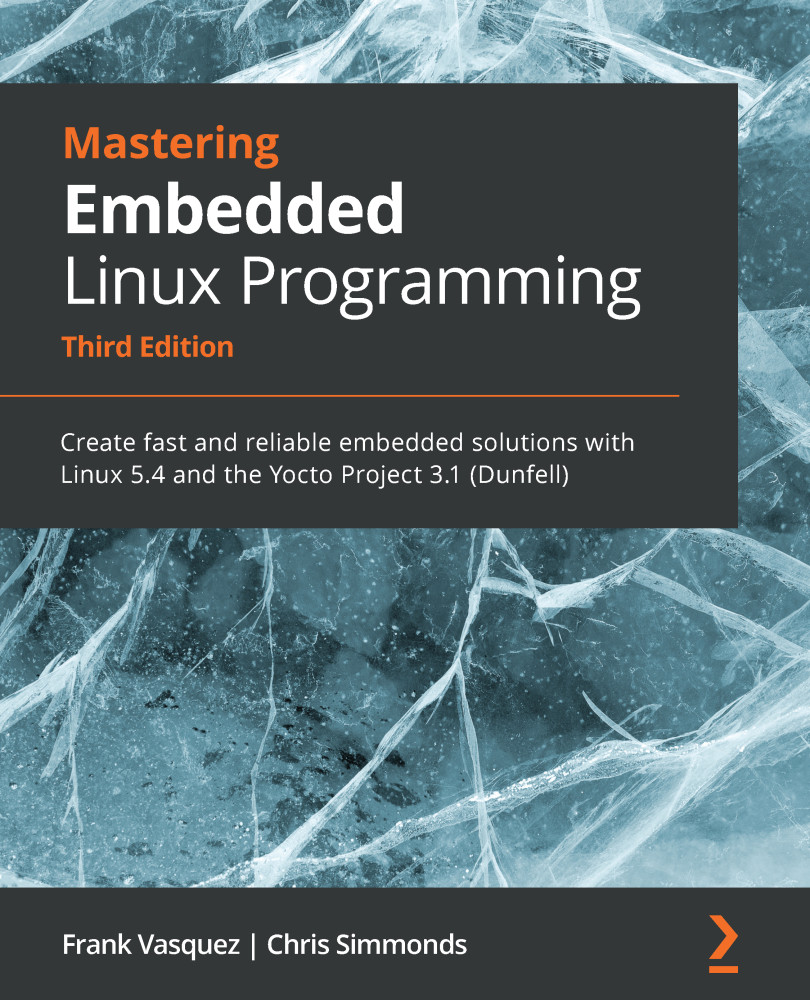
Mastering Embedded Linux Programming

Mastering Embedded Linux Programming: Create fast and reliable embedded solutions with Linux 5.4 and the Yocto Project 3.1 (Dunfell) , Third Edition

Arrow left icon
Profile Icon Frank Vasquez Profile Icon Chris Simmonds
Arrow right icon
zł79.99 zł235.99
Full star icon Full star icon Full star icon Full star icon Half star icon 4.5 (22 Ratings)
eBook May 2021 758 pages 3rd Edition
eBook
zł79.99 zł235.99
Paperback
zł294.99
Subscription
Free Trial
Arrow left icon
Profile Icon Frank Vasquez Profile Icon Chris Simmonds
Arrow right icon
zł79.99 zł235.99
Full star icon Full star icon Full star icon Full star icon Half star icon 4.5 (22 Ratings)
eBook May 2021 758 pages 3rd Edition
eBook
zł79.99 zł235.99
Paperback
zł294.99
Subscription
Free Trial
eBook
zł79.99 zł235.99
Paperback
zł294.99
Subscription
Free Trial

What do you get with eBook?

Product feature icon Instant access to your Digital eBook purchase
Product feature icon Download this book in EPUB and PDF formats
Product feature icon Access this title in our online reader with advanced features
Product feature icon DRM FREE - Read whenever, wherever and however you want
Product feature icon AI Assistant (beta) to help accelerate your learning
Modal Close icon
Payment Processing...
tick Completed

Billing Address

Table of content icon View table of contents Preview book icon Preview Book

Mastering Embedded Linux Programming

Left arrow icon Right arrow icon
Download code icon Download Code

Key benefits

  • Master build systems, toolchains, and kernel integration for embedded Linux
  • Set up custom Linux distros with Yocto and manage board-specific configurations
  • Learn real-world debugging, memory handling, and system performance tuning

Description

If you’re looking for a book that will demystify embedded Linux, then you’ve come to the right place. Mastering Embedded Linux Programming is a fully comprehensive guide that can serve both as means to learn new things or as a handy reference. The first few chapters of this book will break down the fundamental elements that underpin all embedded Linux projects: the toolchain, the bootloader, the kernel, and the root filesystem. After that, you will learn how to create each of these elements from scratch and automate the process using Buildroot and the Yocto Project. As you progress, the book will show you how to implement an effective storage strategy for flash memory chips and install updates to a device remotely once it’s deployed. You’ll also learn about the key aspects of writing code for embedded Linux, such as how to access hardware from apps, the implications of writing multi-threaded code, and techniques to manage memory in an efficient way. The final chapters demonstrate how to debug your code, whether it resides in apps or in the Linux kernel itself. You’ll also cover the different tracers and profilers that are available for Linux so that you can quickly pinpoint any performance bottlenecks in your system. By the end of this Linux book, you’ll be able to create efficient and secure embedded devices using Linux.

Who is this book for?

If you’re a systems software engineer or system administrator who wants to learn how to implement Linux on embedded devices, then this book is for you. It's also aimed at embedded systems engineers accustomed to programming for low-power microcontrollers, who can use this book to help make the leap to high-speed systems on chips that can run Linux. Anyone who develops hardware that needs to run Linux will find something useful in this book – but before you get started, you'll need a solid grasp on POSIX standard, C programming, and shell scripting.

What you will learn

  • Use Buildroot and the Yocto Project to create embedded Linux systems
  • Troubleshoot BitBake build failures and streamline your Yocto development workflow
  • Update IoT devices securely in the field using Mender or balena
  • Prototype peripheral additions by reading schematics, modifying device trees, soldering breakout boards, and probing pins with a logic analyzer
  • Interact with hardware without having to write kernel device drivers
  • Divide your system up into services supervised by BusyBox runit
  • Debug devices remotely using GDB and measure the performance of systems using tools such as perf, ftrace, eBPF, and Callgrind

Product Details

Country selected
Publication date, Length, Edition, Language, ISBN-13
Publication date : May 14, 2021
Length: 758 pages
Edition : 3rd
Language : English
ISBN-13 : 9781789535112
Category :
Languages :
Tools :

What do you get with eBook?

Product feature icon Instant access to your Digital eBook purchase
Product feature icon Download this book in EPUB and PDF formats
Product feature icon Access this title in our online reader with advanced features
Product feature icon DRM FREE - Read whenever, wherever and however you want
Product feature icon AI Assistant (beta) to help accelerate your learning
Modal Close icon
Payment Processing...
tick Completed

Billing Address

Product Details

Publication date : May 14, 2021
Length: 758 pages
Edition : 3rd
Language : English
ISBN-13 : 9781789535112
Category :
Languages :
Tools :

Packt Subscriptions

See our plans and pricing
Modal Close icon
$19.99 billed monthly
Feature tick icon Unlimited access to Packt's library of 7,000+ practical books and videos
Feature tick icon Constantly refreshed with 50+ new titles a month
Feature tick icon Exclusive Early access to books as they're written
Feature tick icon Solve problems while you work with advanced search and reference features
Feature tick icon Offline reading on the mobile app
Feature tick icon Simple pricing, no contract
$199.99 billed annually
Feature tick icon Unlimited access to Packt's library of 7,000+ practical books and videos
Feature tick icon Constantly refreshed with 50+ new titles a month
Feature tick icon Exclusive Early access to books as they're written
Feature tick icon Solve problems while you work with advanced search and reference features
Feature tick icon Offline reading on the mobile app
Feature tick icon Choose a DRM-free eBook or Video every month to keep
Feature tick icon PLUS own as many other DRM-free eBooks or Videos as you like for just zł20 each
Feature tick icon Exclusive print discounts
$279.99 billed in 18 months
Feature tick icon Unlimited access to Packt's library of 7,000+ practical books and videos
Feature tick icon Constantly refreshed with 50+ new titles a month
Feature tick icon Exclusive Early access to books as they're written
Feature tick icon Solve problems while you work with advanced search and reference features
Feature tick icon Offline reading on the mobile app
Feature tick icon Choose a DRM-free eBook or Video every month to keep
Feature tick icon PLUS own as many other DRM-free eBooks or Videos as you like for just zł20 each
Feature tick icon Exclusive print discounts

Frequently bought together


Stars icon
Total 783.97
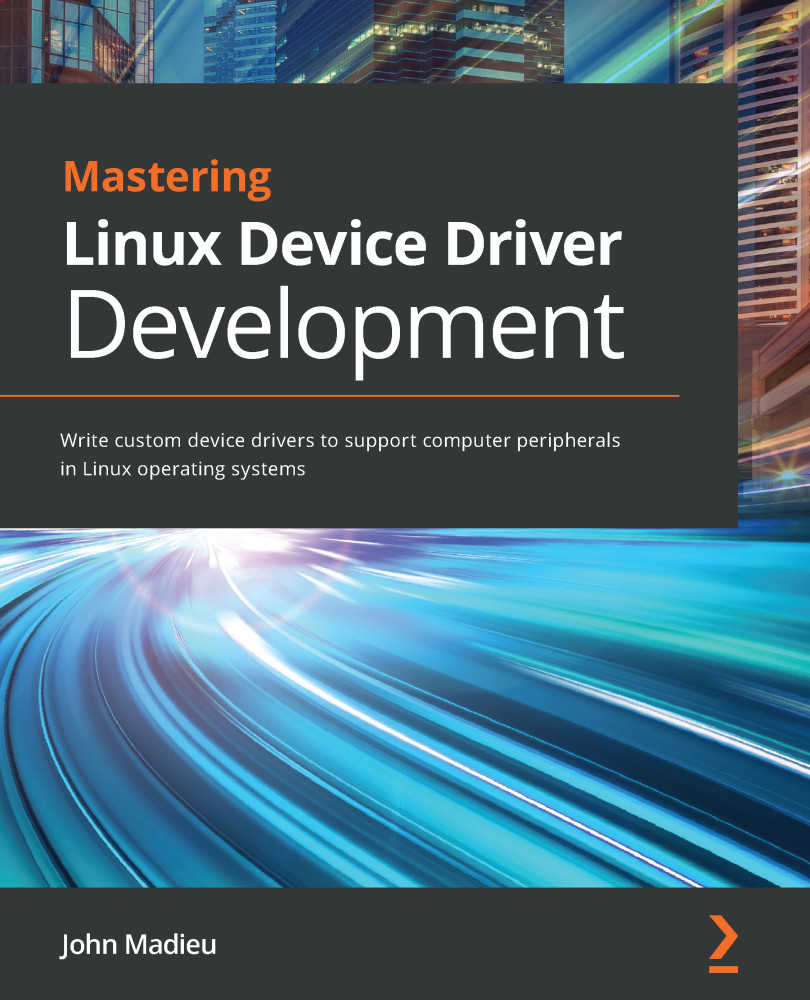
Mastering Linux Device Driver Development
zł254.99
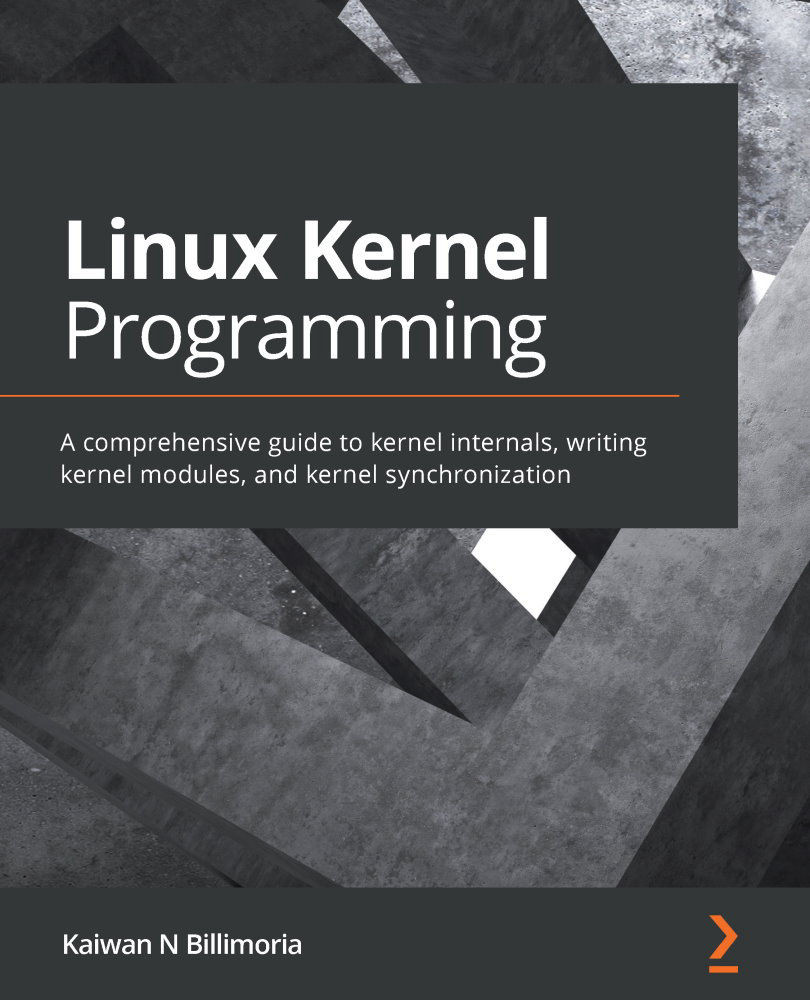
Linux Kernel Programming
zł233.99
Mastering Embedded Linux Programming
zł294.99
Total 783.97 Stars icon

Table of Contents

26 Chapters
Section 1: Elements of Embedded Linux Chevron down icon Chevron up icon
Chapter 1: Starting Out Chevron down icon Chevron up icon
Chapter 2: Learning about Toolchains Chevron down icon Chevron up icon
Chapter 3: All about Bootloaders Chevron down icon Chevron up icon
Chapter 4: Configuring and Building the Kernel Chevron down icon Chevron up icon
Chapter 5: Building a Root Filesystem Chevron down icon Chevron up icon
Chapter 6: Selecting a Build System Chevron down icon Chevron up icon
Chapter 7: Developing with Yocto Chevron down icon Chevron up icon
Chapter 8: Yocto Under the Hood Chevron down icon Chevron up icon
Section 2: System Architecture and Design Decisions Chevron down icon Chevron up icon
Chapter 9: Creating a Storage Strategy Chevron down icon Chevron up icon
Chapter 10: Updating Software in the Field Chevron down icon Chevron up icon
Chapter 11: Interfacing with Device Drivers Chevron down icon Chevron up icon
Chapter 12: Prototyping with Breakout Boards Chevron down icon Chevron up icon
Chapter 13: Starting Up – The init Program Chevron down icon Chevron up icon
Chapter 14: Starting with BusyBox runit Chevron down icon Chevron up icon
Chapter 15: Managing Power Chevron down icon Chevron up icon
Section 3: Writing Embedded Applications Chevron down icon Chevron up icon
Chapter 16: Packaging Python Chevron down icon Chevron up icon
Chapter 17: Learning about Processes and Threads Chevron down icon Chevron up icon
Chapter 18: Managing Memory Chevron down icon Chevron up icon
Section 4: Debugging and Optimizing Performance Chevron down icon Chevron up icon
Chapter 19: Debugging with GDB Chevron down icon Chevron up icon
Chapter 20: Profiling and Tracing Chevron down icon Chevron up icon
Chapter 21: Real-Time Programming Chevron down icon Chevron up icon
Other Books You May Enjoy Chevron down icon Chevron up icon

Customer reviews

Top Reviews
Rating distribution
Full star icon Full star icon Full star icon Full star icon Half star icon 4.5
(22 Ratings)
5 star 77.3%
4 star 13.6%
3 star 0%
2 star 4.5%
1 star 4.5%
Filter icon Filter
Top Reviews

Filter reviews by


Mathieu Jan 12, 2024
Full star icon Full star icon Full star icon Full star icon Full star icon 5
Really good book, full of schematics, I like it.
Subscriber review Packt
Yaacov B. Jul 31, 2023
Full star icon Full star icon Full star icon Full star icon Full star icon 5
Amazon Verified review Amazon
Ross W. Porter May 15, 2021
Full star icon Full star icon Full star icon Full star icon Full star icon 5
Caveat - I work for a software company that is mentioned in the book, which is how I became acquainted with one of the authors. So I probably have some biases.This book could easily be a college textbook. In a good way - a textbook that reads well and that you keep as a handy reference. The book covers a wide gamut - from bootloaders to kernels to developing with Yocto to profiling & tracing. It's a good progression. It definitely demystified some concepts for me, especially related to kernels. Even though I skimmed some chapters, later chapters still made sense - a sign of good writing.So who is this book for? IMHO, it's for people that are familiar with at least a few of the concepts (chapters) in the book. But want to learn the concepts & details in the other chapters, and generally go deeper. And importantly, it's the kind of book where you can read it as you need it e.g. read a few relevant chapter when you have a related work project coming up.
Amazon Verified review Amazon
Matthew S. Dec 04, 2022
Full star icon Full star icon Full star icon Full star icon Full star icon 5
A good, solid book book detailing how to create embedded Linux systems, mainly concentrating on the Yocto build system but it does touch on Buildroot and has a section on how to roll your own.I have not had the time to read it all yet but the sections i have read, have been clear and instructive.I bought this book to pair with a Coursera course I was taking and it was a good match.
Amazon Verified review Amazon
Steve Jun 23, 2021
Full star icon Full star icon Full star icon Full star icon Full star icon 5
Full disclosure: I was given a copy of this book to review.This is an extremely thorough tutorial, well-organized and well-written. The authors do an excellent job of explaining concepts and showing examples that go into the fine details. They also provide references for further reading, so the book forms the root of a curated study tree. This gives you guidance on navigating the vast ocean of additional material so you can focus on just what you need at the moment.One of the real strengths is that it covers multiple ways of doing things, for multiple targets. It's very hands-on, addressing a number of practical questions that embedded Linux novices will have. Even if you only end up using 10% of the material, it will be a win, saving you hours of frustration and searching for information. I’ve stumbled into these various tools and fought enough of these battles to wish I’d had this book ages ago.It covers doing things manually, a step at a time, and two build automation systems, buildroot and Yocto.It covers 3 different Linux targets: QEMU, Raspberry Pi 4, and Beagle Bone Black. This is a powerful mix.- QEMU is a machine emulator and virtualizer that allows you to emulate a variety of target systems on your development host. That means you can test your actual code and system before you have hardware, for multiple different hardware targets.- Raspberry Pi is a powerful and accessible Linux platform with full desktop system capability and communications. It’s an excellent way to transition non-embedded developers to embedded work.- Beagle Bone Black is a more typical embedded platform.The combination of these gives you a wide range of options for learning and development environments. You can experiment with a variety of different emulated platforms and processors, then try it out on real hardware. That will you the background to apply it to other hardware.The book is divided into 4 sections:“Section 1: Elements of Embedded Linux" covers configuring and building embedded Linux systems. It covers getting setup to work with the 3 targets, toolchains and cross-compiling, working with bootloaders, configuring and building the kernel, the root filesystem, and working with the buildroot and Yocto build systems. This takes you step by step getting your Linux distro from source code to running on your target."Section 2: System Architecture and Design Decisions" covers system-level architecture. It covers flash storage strategy for system and user partitions, field software updates and OTA (Over The Air update), working with device drivers, working with breakout boards, system startup, and power management."Section 3: Writing Embedded Applications" covers applications that run on embedded Linux. Since Python has become so popular for embedded machine learning applications, it covers using Python with several virtualization methods. Then it covers more conventional embedded system topics with processes, threads, and memory management, including memory mapping."Section 4: Debugging and Optimizing Performance" covers how to evaluate problems and performance. It covers a number of debugging and tracing tools, for both kernel and userspace. It finishes up with real-time programming, where the system needs to be truly deterministic in responding to events within defined deadlines in order to be deemed to be working properly, and missed deadlines have consequences.Could it have more on any given topic? Of course. Any book with "mastering" in the title is claiming a high bar. But for each each of these topics, it covers a number of tools and practical usage. One of the challenges of working with Linux is that there are multiple ways of doing things due to its open-source nature. Different developers have taken different approaches to the same problems. That makes it more difficult to master all possibilities, but offers more flexibility to meet your needs. It also means that a single book covering all of them in full detail would require thousands of pages.This book provides a roadmap for further study, with hints, advice, hands-on examples you can try yourself, and recommended reading. The real value it provides is in the practical guidance, getting you up and running on the right path quickly.
Amazon Verified review Amazon
Get free access to Packt library with over 7500+ books and video courses for 7 days!
Start Free Trial

FAQs

How do I buy and download an eBook? Chevron down icon Chevron up icon

Where there is an eBook version of a title available, you can buy it from the book details for that title. Add either the standalone eBook or the eBook and print book bundle to your shopping cart. Your eBook will show in your cart as a product on its own. After completing checkout and payment in the normal way, you will receive your receipt on the screen containing a link to a personalised PDF download file. This link will remain active for 30 days. You can download backup copies of the file by logging in to your account at any time.

If you already have Adobe reader installed, then clicking on the link will download and open the PDF file directly. If you don't, then save the PDF file on your machine and download the Reader to view it.

Please Note: Packt eBooks are non-returnable and non-refundable.

Packt eBook and Licensing When you buy an eBook from Packt Publishing, completing your purchase means you accept the terms of our licence agreement. Please read the full text of the agreement. In it we have tried to balance the need for the ebook to be usable for you the reader with our needs to protect the rights of us as Publishers and of our authors. In summary, the agreement says:

  • You may make copies of your eBook for your own use onto any machine
  • You may not pass copies of the eBook on to anyone else
How can I make a purchase on your website? Chevron down icon Chevron up icon

If you want to purchase a video course, eBook or Bundle (Print+eBook) please follow below steps:

  1. Register on our website using your email address and the password.
  2. Search for the title by name or ISBN using the search option.
  3. Select the title you want to purchase.
  4. Choose the format you wish to purchase the title in; if you order the Print Book, you get a free eBook copy of the same title. 
  5. Proceed with the checkout process (payment to be made using Credit Card, Debit Cart, or PayPal)
Where can I access support around an eBook? Chevron down icon Chevron up icon
  • If you experience a problem with using or installing Adobe Reader, the contact Adobe directly.
  • To view the errata for the book, see www.packtpub.com/support and view the pages for the title you have.
  • To view your account details or to download a new copy of the book go to www.packtpub.com/account
  • To contact us directly if a problem is not resolved, use www.packtpub.com/contact-us
What eBook formats do Packt support? Chevron down icon Chevron up icon

Our eBooks are currently available in a variety of formats such as PDF and ePubs. In the future, this may well change with trends and development in technology, but please note that our PDFs are not Adobe eBook Reader format, which has greater restrictions on security.

You will need to use Adobe Reader v9 or later in order to read Packt's PDF eBooks.

What are the benefits of eBooks? Chevron down icon Chevron up icon
  • You can get the information you need immediately
  • You can easily take them with you on a laptop
  • You can download them an unlimited number of times
  • You can print them out
  • They are copy-paste enabled
  • They are searchable
  • There is no password protection
  • They are lower price than print
  • They save resources and space
What is an eBook? Chevron down icon Chevron up icon

Packt eBooks are a complete electronic version of the print edition, available in PDF and ePub formats. Every piece of content down to the page numbering is the same. Because we save the costs of printing and shipping the book to you, we are able to offer eBooks at a lower cost than print editions.

When you have purchased an eBook, simply login to your account and click on the link in Your Download Area. We recommend you saving the file to your hard drive before opening it.

For optimal viewing of our eBooks, we recommend you download and install the free Adobe Reader version 9.

Modal Close icon
Modal Close icon