Search icon CANCEL
Subscription
0
Cart icon
Your Cart (0 item)
Close icon
You have no products in your basket yet
Arrow left icon
Explore Products
Best Sellers
New Releases
Books
Events
Videos
Audiobooks
Packt Hub
Free Learning
Arrow right icon
timer SALE ENDS IN
0 Days
:
00 Hours
:
00 Minutes
:
00 Seconds
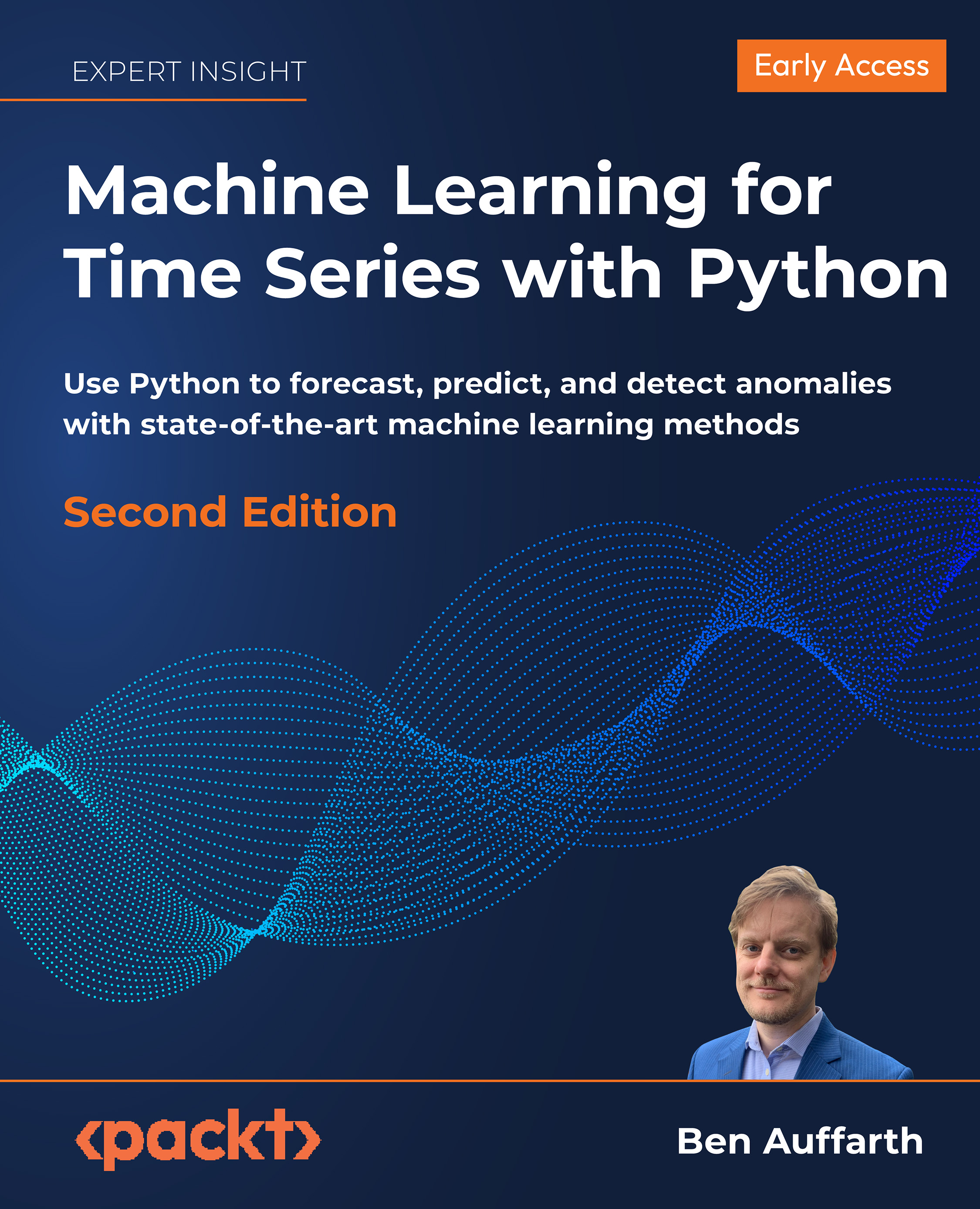
Machine Learning for Time Series with Python

Machine Learning for Time Series with Python: Use Python to forecast, predict, and detect anomalies with state-of-the-art machine learning methods , Second Edition

Arrow left icon
Profile Icon Ben Auffarth
Arrow right icon
Early Access Early Access Publishing in Sep 2026
₱2551.99
Paperback Sep 2026 409 pages 2nd Edition
eBook
₱1530.74 ₱2040.99
Paperback
₱2551.99
Arrow left icon
Profile Icon Ben Auffarth
Arrow right icon
Early Access Early Access Publishing in Sep 2026
₱2551.99
Paperback Sep 2026 409 pages 2nd Edition
eBook
₱1530.74 ₱2040.99
Paperback
₱2551.99
eBook
₱1530.74 ₱2040.99
Paperback
₱2551.99

What do you get with Print?

Product feature icon Instant access to your digital copy whilst your Print order is Shipped
Product feature icon Paperback book shipped to your preferred address
Product feature icon Redeem a companion digital copy on all Print orders
Product feature icon Access this title in our online reader with advanced features
Product feature icon DRM FREE - Read whenever, wherever and however you want
Modal Close icon
Payment Processing...
tick Completed

Shipping Address

Billing Address

Shipping Methods
Table of content icon View table of contents Preview book icon Preview Book

Machine Learning for Time Series with Python

Join our book community on Discord

Image

https://packt.link/EarlyAccessCommunity

Time series problems are critical in industry and academia, with applications ranging from stock market analysis to predicting consumer behavior in retail. As the landscape of machine learning for time series continues to evolve, practitioners are faced with a vast array of libraries and algorithms. However, building reliable forecasting systems requires the understanding of what makes time series fundamentally different from the cross-sectional data that most machine learning methods assume. Building such systems end to end is what this book teaches: modern models including time-series foundation models, global and hierarchical forecasting, conformal prediction intervals, drift detection, and the operational habits production demands.

In this chapter, we will explore why modern, technically advanced forecasting systems can fail spectacularly when faced with unexpected events, a phenomenon we call the Prediction Paradox. We will examine case studies from major retailers like Target and Amazon during the COVID-19 pandemic and the historical precedent set by Nike's supply chain disaster to understand this enduring challenge. We will also introduce the Iceberg Problem, which illustrates that the visible algorithm is only 5% of the work, while the hidden 95%—including data engineering, validation strategy, and monitoring—ultimately determines production success. Both ideas are why we treat conformal prediction as foundational rather than an afterthought: paradox-prone models need coverage guarantees, and operating safely on the iceberg's hidden 95% means knowing when a forecast cannot be trusted.

After reading this chapter, you will understand what makes time series data unique, know the main types of time series problems, and have a framework for approaching any temporal analysis project. The sections are structured as follows:

  • The evolution of forecasting methods
  • When do smart models fail?
  • What is a time series?
  • Why algorithms aren't enough
  • Why choose Python?
  • Common pitfalls and how to avoid them

Let's have a look at how forecasting and time series methods have changed throughout history as we take a whirlwind quest from star charts to supercomputers.

Your purchase includes a free PDF copy + exclusive extras

Your purchase includes a DRM-free PDF copy of this book, 7-day trial to the Packt+ library (no credit card required), and additional exclusive extras. See the Free benefits with your book section in the Preface to unlock them instantly and maximize your learning.

The evolution of forecasting methods

Humanity's quest to forecast the future has always walked a fine line between reverence and fear. From merchants in medieval Europe who were accused of witchcraft for accurately predicting market trends to court astronomers in ancient China who faced execution for failing to predict solar eclipses, the stakes have always been high. For centuries, our methods were no more reliable than reading tea leaves. Today, we have replaced these arcane arts with time series analysis—a sophisticated blend of statistics, mathematics, and machine learning that allows us to decode the patterns of our world.

This journey toward data-driven analysis has been long. In 1854, even though Vice Admiral Robert FitzRoy's early weather predictions were dismissed as quack prognostications, he was laying the groundwork for a more systematic approach to forecasting. The field took a mathematical leap forward with Francis Galton's work on regression in the 1880s, but the next true revolution arrived in the 1970s, when George Box and Gwilym Jenkins introduced their powerful ARIMA models, providing a rigorous framework for time-dependent data that is still a cornerstone of the field today.

The digital age, however, catalyzed an explosion of innovation that brought both unprecedented power and new forms of peril. The 2010 Flash Crash, when the Dow Jones plunged nearly 1,000 points in minutes, was triggered by high-frequency trading algorithms reacting to time series data at millisecond intervals. This event was a stark demonstration of the potential pitfalls of modern forecasting, spurring the development of more sophisticated models capable of detecting and responding to anomalies in real time.

The dawn of this computational era can be traced to a single, room-sized machine: the Electronic Numerical Integrator and Computer (ENIAC). Originally used for calculating artillery trajectories, this behemoth of 17,500 vacuum tubes was repurposed by programming pioneers like Betty Snyder to run the world's first numerical weather predictions.

https://lh3.googleusercontent.com/65H8Ea25Ni_wG_EE44DMbNr09EE7laQbAST15gomlOKOYNvs99E2Kwx864QXgPDUXDNglp7bwQPxkLsE-BTCrEApFpdu4UKS4-AqWjzV949wDdloMQO3nGrPnzmEW-z9e1H_FTZi9BuuDXIw2FMduoytKggOM0yhlmLRyiBakDhQBCc-CUrjXwEiTfKIMg

Figure 1.1: Electronic Numerical Integrator and Computer (ENIAC). Betty Snyder, one of the earliest programmers of the ENIAC, stands in front of the machine that ushered in the era of computational forecasting. (Source: Wikimedia Commons)

The computational path ENIAC forged leads directly to the massive, AI-driven systems of today, like Google's MetNet, which processes petabytes of data to predict weather with remarkable accuracy. Yet, our dependence on these complex data streams creates new vulnerabilities. During the COVID-19 pandemic, the grounding of roughly 75% of commercial aircraft starkly revealed this fragility. The loss of atmospheric data collected by these planes—which can reduce forecast errors by up to 20%—led to a notable decrease in weather forecast accuracy.

Modern forecasting in 2026 has a wider toolbox still. It now includes Time-Series Foundation Models (TSFMs) like Amazon's Chronos-2 and Nixtla's TimeGPT, platform-native forecasting endpoints, conformal prediction intervals, and hierarchical or global models that share strength across thousands of related series. None of this retires the Prediction Paradox: a TSFM trained on 2019 demand patterns can still mistake a regime shift for noise.

This brings us to the Prediction Paradox in its modern form. We have journeyed from tea leaves to AI, building systems of incredible sophistication. Why, then, as we saw with retailers during that same pandemic, do these powerful models still fail so catastrophically?

What is a time series?

A time series is a sequence of data points collected at successive time intervals, where the temporal ordering carries information that would be lost if we shuffled the observations.

From stock prices ticking minute by minute to seasonal sales patterns repeating yearly, this kind of data surrounds us and standard machine learning methods miss what the order alone tells us.

As we discussed in the previous section, the failures at Target, Amazon, and Nike weren't caused by inadequate algorithms but by misunderstanding what time series data actually represents. When Target's machine learning models treated March 2020 toilet paper purchases as independent observations that happened to occur in chronological order, they missed the fundamental temporal dependencies that drive panic buying behavior. The models failed because they applied cross-sectional thinking to temporal data.

Before we can build systems that work reliably when patterns change, we need to establish the mathematical foundations that make time series fundamentally different from the static datasets most machine learning methods assume.

A time series is a sequence of data points measured at successive time intervals, where the temporal ordering contains crucial information about relationships and system behavior.

This simple definition captures the key insight: time isn't just a convenient index for organizing data—it's the primary organizing principle that enables powerful analytical techniques unavailable in cross-sectional analysis. Time series datasets describe how the world changes over time, often addressing the fundamental question of how the past influences the present and future.

More formally, we can think of a time series as observations from an underlying data-generating process that evolves over time:

  • Univariate time series: {x, x, x, ..., xₜ} where each xₜ represents a single measurement at time t
  • Multivariate time series: Multiple related variables measured simultaneously over time

The crucial distinction is that these aren't random collections of numbers—they're realizations of systematic processes where past values provide information about future values through temporal dependencies.

Formally, a time series represents a mathematical mapping from a time domain B19536_01_001.png to a measurable space B19536_01_002.png:

B19536_01_003.png

Here, B19536_01_004.png is typically integer-valued (B19536_01_005.png for discrete time) and k represents the dimensionality of the variables being measured. When B19536_01_006.png, we have a univariate time series tracking a single variable over time. When B19536_01_007.png, we have a multivariate time series simultaneously tracking multiple related variables.

Time series data typically contains several key components that help us understand its structure:

  • Trend: The long-term direction or movement in the data, such as gradual increase in global temperatures over decades
  • Seasonality: Regular, predictable patterns that repeat at fixed intervals, like daily temperature cycles or weekly retail sales patterns
  • Cycles: Longer-term fluctuations that don't have fixed periods, such as business cycles in economic data
  • Irregularity/noise: Random fluctuations that can't be attributed to trend, seasonality, or cycles

Understanding these components helps determine the right modeling approach. For example, data with strong seasonality might benefit from explicit seasonal decomposition, while trending data might need differencing or trend-aware models.

The temporal structure enables powerful analytical techniques. We can create lag features using past values to predict future outcomes, identify seasonal patterns that repeat at regular intervals, and detect structural breaks where underlying relationships fundamentally change. However, this temporal dependence also violates the independence assumptions that make standard machine learning techniques reliable.

Concrete examples: time series in the python context

Understanding time series through concrete examples reveals why these mathematical properties matter for practical analysis. Consider three representative datasets that illustrate different aspects of temporal data:

Google Trends Search Volume Data provides an excellent example of multivariate time series with relative scaling challenges:

Month

Python (Worldwide)

R (Worldwide)

Julia (Worldwide)

2004-01-01

31

13

1

2004-02-01

29

13

1

2004-03-01

33

13

1

2004-04-01

31

14

1

2004-05-01

32

13

1

Table 1.1: Example of Time Series Data: Google Trends data for data science languages Python, Julia, and R

We'll go into detail about the structure of time series data in Chapter 2. For now, it should suffice to say that this is a multivariate time series, with columns for Python, R, and Julia. The first column is the index, a date column, and its period is the month. In cases where we have only a single variable, we speak of a univariate series. This dataset would be univariate if we had only one programming language instead of three.

Google Trends provides relative rather than absolute search volumes, normalized on a 0-100 scale where 100 represents peak popularity for the selected time period. The temporal dependencies become apparent when you consider that programming language popularity doesn't change randomly—community adoption, major releases, and educational trends create persistent patterns over months and years. This comparison has to be taken with a grain of salt because of how Google's categories are organized. The reader is invited to do their own comparisons.

  • Financial Time Series illustrate the highest-stakes temporal dependencies in business applications. Daily stock prices exemplify how past values directly influence future probabilities. Unlike cross-sectional data where shuffling observations preserves information content, randomizing stock price sequences destroys the fundamental relationships that make financial analysis possible. The closing price on Tuesday provides information about Wednesday's likely trading range, creating autocorrelation structures that sophisticated models can exploit.
  • Sensor and IoT Data reveal the irregular timestamp challenges that separate real-world applications from academic datasets. Industrial sensors might record temperature readings every minute during normal operations but switch to continuous monitoring when anomalies are detected. Network traffic monitoring systems often record data-on-change rather than fixed intervals, creating sparse observations during quiet periods and dense measurements during peak usage.

Understanding these temporal properties reveals why the sophisticated failures we've examined aren't caused by inadequate algorithms—they result from a fundamental misunderstanding of what determines production success in temporal domains.

When do smart models fail?

Our forecasting engines had never been more advanced. Yet that very complexity created a dangerous paradox. In March 2020, as COVID‑19 swept the globe, these state‑of‑the‑art systems at major retailers began producing wildly inaccurate predictions.

At Target, machine‑learning models trained on years of stable history couldn't explain an 845 percent surge in toilet‑paper demand or an 89 percent collapse in apparel sales. At Amazon, inventory algorithms that had expertly balanced millions of SKUs suddenly flooded warehouses with home‑gym and office‑gear nobody needed—while critical cleaning and health products vanished from shelves. These failures weren't the result of simple spreadsheet errors but of forecasting pipelines—some pure ML, others decomposition‑based—that either omitted an explicit seasonality‑and‑anomaly step or relied on static, pre‑pandemic settings. Instead of flagging the March–April 2020 spikes as one‑off shocks, they folded them into their trend and seasonal baselines, yielding persistent over‑ and under‑forecasts until the models were hurriedly re‑tuned.

It's important to remember that these weren't simple statistical models running on outdated spreadsheets, but ML systems built by world-class data science teams using state-of-the-art methods. Yet, within weeks, billions of dollars in forecasting infrastructure were rendered nearly useless. Walmart's demand‑planning engines—which normally allocate stock across 4,700 stores with surgical precision—began issuing orders that bore no relation to real buying patterns. CVS Health's prescription models, built on years of consistent patient behavior, missed the surge in anxiety‑drug scripts and failed to anticipate the drop in routine refills as people skipped doctor visits. Across retail and healthcare, systems once lauded for their high validation scores and rigorous A/B tests became sources of systematic error instead of competitive advantage.

In the next section, we'll examine the technical sophistication that made these failures so surprising and instructive.

These failures reveal why time series requires different thinking. The sophisticated feature engineering that works well for cross-sectional data can become actively harmful when underlying patterns change faster than models can adapt. These organizations were deploying methods that represented the pinnacle of data science best practices circa 2020:

  • Advanced feature engineering: Target's models incorporated over 200 engineered features, including rolling averages, seasonal decompositions, vacation effects, weather impacts, and complex interaction terms between promotional activities and product categories. These feature engineering techniques, properly implemented, are covered systematically in Chapter 5.
  • Ensemble methods: Amazon's systems combined Random Forest, XGBoost, and neural network predictions using sophisticated stacking approaches validated through extensive backtesting and A/B tests. Chapter 5 demonstrates how to implement these ensemble approaches using modern Python frameworks designed for production reliability.
  • Real-time processing: Walmart's demand forecasting updated hourly, ingesting point-of-sale data, weather forecasts, social media sentiment, and economic indicators through streaming analytics pipelines. The monitoring and real-time adaptation strategies that could have detected these failures early are covered in Chapter 10.
  • Rigorous validation: These weren't models hastily deployed without testing. They had been validated using time series cross-validation, stress-tested against historical anomalies like Black Friday and hurricane seasons, and deployed with appropriate prediction intervals and monitoring systems. However, they used validation approaches designed for stable environments rather than the dynamic validation frameworks that we'll cover starting with Chapter 3.

Yet when consumer behavior shifted faster than their training pipelines could adapt, even the most advanced machine learning became a liability. The sophisticated feature engineering that captured nuanced seasonal patterns became actively misleading when seasonality disappeared overnight. The ensemble methods that provided robust predictions during normal times amplified errors when all component models failed simultaneously.

Understanding temporal dependencies is crucial because they create both opportunities and challenges. While past values can provide powerful predictive information, they also mean that patterns can change over time: a phenomenon called concept drift, where the statistical relationship between inputs and the target shifts, so a model trained on yesterday's distribution gradually becomes wrong on tomorrow's. The same dependencies that make forecasting possible also make validation harder: the data-generating process itself moves with the calendar, so a holdout score collected last quarter cannot certify how the model will behave this quarter. A validation framework for time series therefore has to score both how well a model fits the past and how quickly that fit decays as the world drifts.

Before we can build systems that work reliably when patterns change, we need to establish what makes time series fundamentally different from the static datasets most machine learning methods assume.

The key insight is that time series data violates a fundamental assumption of most machine learning methods: that observations are independent and identically distributed. When we treat temporal observations as independent data points that just happen to be ordered chronologically, we miss the crucial dependencies between past and future values. This is why techniques that work well for cross-sectional data—like random train/test splits or standard feature engineering—can fail with time series.

Why algorithms aren't enough

The rest of this section reads through three lenses on the same problem: failure modes name the symptoms, gaps trace the root causes, and patterns offer the remedies.

When Virginia Tech researchers studied machine learning models for patient deterioration prediction in 2024, they discovered a shocking paradox: models with 94% validation accuracy failed to recognize 66% of critical patient deterioration cases in actual clinical settings.

Similar to our previous examples, this wasn't a case of using inadequate algorithms. These were cutting-edge ensemble models combining Long Short-Term Memory (LSTMs), gradient boosting, and attention mechanisms, developed by teams with deep clinical expertise using rigorous validation protocols. Yet when deployed where lives depended on them, the most technically sophisticated approaches became sources of systematic error rather than competitive advantage. The Iceberg Problem made the difference: the algorithm above the waterline was excellent, while the 95% below it (data quality, workflow integration, calibration to clinical decision thresholds) went unbuilt.

Why advanced models still fail

Understanding why technically sound models fail in time series applications helps you avoid common pitfalls in your own projects. These failure modes show how development metrics can be misleading and what to focus on instead.

Failure mode 1: misleading validation metrics

The Promise: Healthcare AI systems achieved 94% accuracy on retrospective datasets, with excellent AUC scores and statistically significant improvements over baseline methods.

The Reality: In actual clinical deployment, these same models failed to generate adequate mortality risk scores for any synthesized emergency scenarios, remaining essentially blind to life-threatening conditions they were designed to detect.

The Root Cause: The models achieved high accuracy on historical data for statistical loss functions on clean, historical data, but clinical utility depends on entirely different factors—the ability to detect rare emergencies, integration with nursing workflows, and generating actionable insights rather than just accurate predictions. This illustrates a key time series principle: validation accuracy doesn't guarantee real-world performance when temporal patterns change or when business requirements differ from statistical objectives.

Development Metrics

Production Reality

✓ 94 % accuracy

✗ 66% Failure Rate

✓ Excellent AUC

✗ Missed Critical Cases

✓ Statistical Significance

✗ Workflow Integration

✓ Clean Data

✗ Real-world Complexity

Table 1.2: Healthcare AI System – an example of a validation failure

This pattern repeats across industries. Financial models with impressive backtests fail during market volatility. Energy forecasting systems with high scores cannot handle renewable energy integration. The sophistication that enables excellent validation metrics often creates brittleness under real operational conditions.

Failure mode 2: integration breakdown

The Promise: Advanced enterprise software deployed with proper implementation planning.

The Reality: Nike's $400 million supply chain disaster in 2000, where sophisticated algorithms couldn't overcome business process integration failures.

The Root Cause: Nike attempted to implement three massive enterprise systems (SCM, ERP, and CRM) simultaneously across their global operations. The sophisticated algorithms assumed they would operate within stable, well-integrated business processes. They deployed sophisticated forecasting algorithms without properly testing them with real data. This mirrors what happens when data scientists build models in clean notebooks but don't account for production data quality issues. Nike encountered legacy system incompatibilities, data quality issues, and organizational resistance that no amount of algorithmic sophistication could overcome.

Event

Outcome

2000: Deploy advanced forecasting

Months later: wildly wrong orders

Legacy and process gaps

$100M+ inventory disaster

Lesson:

Algorithm ≠ System

Table 1.3: Example for an integration breakdown

Twenty years later, retailers faced identical failures during COVID-19, despite having access to far more sophisticated machine learning infrastructure. Target's ensemble models, Amazon's distributed processing, and Walmart's real-time analytics all failed simultaneously because they optimized for stable patterns that no longer existed.

Failure mode 3: inability to adapt to change

The Promise: Sophisticated models trained on years of stable historical data.

The Reality: COVID-19 rendered billions of dollars in forecasting infrastructure nearly useless within weeks as consumption patterns shifted faster than retraining pipelines could adapt.

The Root Cause: The sophisticated feature engineering that captured nuanced seasonal patterns became actively misleading when seasonality disappeared overnight. Ensemble methods that provided robust predictions during normal times amplified errors when all component models failed simultaneously.

Period

Model Behavior

Result

Before

Sophisticated ML leads to success

Stable performance

During

Same ML becomes blind to changes

Systematic failure

After

Pattern shifts cause obsolescence

Model retraining can't keep up

Table 1.4: Example for a failure to adapt

The three fundamental gaps

These failures reveal three systematic gaps that no amount of algorithmic sophistication can bridge.

Gap 1: temporal assumption violations

Traditional machine learning assumes training data represents future environments accurately enough for reliable extrapolation. Time series data systematically violates this assumption through concept drift, structural breaks, and regime changes that render historical patterns misleading rather than predictive.

The Algorithm Perspective: Optimize for historical accuracy using sophisticated ensembles and feature engineering.

The Reality: Historical patterns become actively harmful when underlying systems change faster than retraining pipelines can adapt.

Gap 2: misalignment with business needs

Algorithms optimize for mathematical objectives that may have little relationship to actual business value. Minimizing Root Mean Squared Error (RMSE) or maximizing Area Under the ROC Curve (AUC) scores doesn't automatically improve inventory decisions, clinical outcomes, or operational efficiency.

The Algorithm Perspective: Achieve impressive validation metrics using state-of-the-art architectures.

The Reality: Statistical accuracy measures often inversely correlate with business utility when operational constraints and human workflows are ignored.

Gap 3: the problem with fixed models

Static optimization approaches assume that finding the best model architecture and hyperparameters solves the forecasting problem permanently. Time series applications require continuous adaptation as patterns evolve.

The Algorithm Perspective: Build sophisticated models that capture complex patterns in historical data.

The Reality: The ability to adapt quickly when patterns change matters more than the sophistication of pattern recognition within stable environments.

The pattern of hype-driven tool selection exemplifies the broader challenge. Facebook's Prophet library was promoted very broadly to teams who lacked the expertise to understand its limitations and became a default choice. The result is disastrously inaccurate forecasts that shattered stakeholder trust—exactly the systematic failure mode that sophisticated algorithms alone cannot prevent.

Building adaptive systems

The sophisticated failures across healthcare, retail, and supply chain reveal a fundamental truth: your algorithm represents roughly 5% of what determines production success. Google's experience building machine learning at scale confirms this insight—as their engineering teams discovered, most of the problems you will face are, in fact, engineering problems, not machine learning problems.

The remaining 95% consists of problem formulation, data engineering, validation strategy, monitoring systems, and business integration. This isn't just Google's perspective—it's documented in the influential Hidden Technical Debt in Machine Learning Systems paper, which shows Machine Learning (ML) code as a tiny box surrounded by massive infrastructure requirements for configuration, data collection, feature extraction, monitoring, and serving.

Instead of starting with What algorithm should I use? successful practitioners ask four diagnostic questions that prevent the failure patterns we've examined. Each question leads to specific steps that guide technical decisions, forming a natural workflow (see Table 1.5).

Step

Purpose

Assess forecastability

Determines if modeling is worthwhile

Clarify decisions

Guides problem formulation and technical requirements

Plan for change

Shapes validation strategy and monitoring design

Build adaptation capability

Ensures long-term system reliability

Table 1.5: The natural workflow for building adaptive forecasting systems

Question 1: is this problem actually foreseeable?

Calculate signal-to-noise ratios before building complex models. Some series are inherently random and won't benefit from sophisticated approaches.

In order to check if a problem is forecastable, try the following steps:

  1. Plot your data first: A visual pass catches obvious trends, gaps, and outliers, though many real signals only surface once a model fits them
  2. Build naive baselines: Last value, seasonal naive, simple averages
  3. Assess improvement potential: Can any method beat these baselines significantly?
  4. Set realistic expectations: Communicate inherent limitations to stakeholders
  5. Quick diagnostic: If random walk performs as well as sophisticated methods, invest effort elsewhere

Question 2: what decisions will this prediction enable?

Connect technical outputs to business workflows. Ensure your model enhances rather than complicates human decision-making.

Ask these before building your model:

  1. Define the decision context: Inventory planning? Capacity allocation? Resource scheduling?
  2. Choose the right problem type: Forecasting, classification, anomaly detection, or regression?
  3. Understand decision timing: Real-time responses or batch processing?
  4. Clarify interpretability needs: Black box acceptable or explanations required?
  5. Reality check: Models optimized for statistical accuracy often ignore operational constraints and fail despite impressive validation scores

Question 3: how will patterns change over time?

Design for concept drift detection from day one. Build systems that adapt when relationships break down rather than assuming historical stability.

Here's how to prepare for pattern shifts:

  1. Assess temporal stability: Are patterns stationary or evolving?
  2. Design proper validation: Use temporal cross-validation, never random splits (covered in Chapter 3)
  3. Plan monitoring systems: How will you detect when models degrade?
  4. Build fallback strategies: What simplified approaches maintain basic functionality?
  5. Key insight: The ability to adapt quickly when patterns change matters more than initial algorithmic sophistication

Question 4: how quickly can I adapt when I'm wrong?

Prioritize retraining infrastructure over marginal accuracy improvements. Build systems that survive pattern changes rather than just optimizing for stable conditions.

Here are steps you can take to stay responsive:

  1. Design retraining pipelines: Automated or manual model updates?
  2. Implement uncertainty quantification: Provide prediction intervals, not just point estimates
  3. Establish performance thresholds: When do you trigger model updates?
  4. Plan deployment workflows: How fast can you deploy fixes when patterns shift?
  5. Success indicator: You can deploy model updates within days of detecting performance degradation, not months

This diagnostic approach transforms potential disasters into systematic capabilities. You'll build systems that maintain stakeholder trust through honest uncertainty communication rather than false precision that inevitably disappoints.

The technical details of validation strategies, metric selection, and performance evaluation are covered systematically in Chapter 3. The journey begins with understanding your data's temporal properties and continues through building production systems that adapt gracefully when reality violates your assumptions.

This progression transforms the disaster patterns we've examined into systematic capabilities. You'll learn temporal validation that prevents the data leakage that makes models look good in development but fail in production. You'll master uncertainty quantification that enables risk-aware decision making rather than false precision. You'll build monitoring systems that detect concept drift before it destroys business value.

Most importantly, you'll develop the professional judgment to communicate limitations transparently rather than overselling capabilities—earning stakeholder trust through reliable uncertainty estimates rather than impressive point forecasts that inevitably disappoint.

The journey begins with understanding your data's temporal properties and continues through to building production systems that adapt gracefully when reality violates your assumptions. In Chapter 2, we'll be building these capabilities systematically.

The failures at Target, Nike, and healthcare systems weren't inevitable—they were preventable with the right approach to tool selection and system design. Python's mature ecosystem provides unique advantages for building such adaptive systems.

Why choose python?

When organizations evaluate their analytics capabilities, they don't think about crystal balls or fortune telling—they think about dashboards, monitoring systems, and automated decision-making platforms. Time series analysis has evolved far beyond statistical forecasting to become the foundation for intelligent systems that power competitive advantage across every major industry. The question isn't whether to invest in temporal analytics, but how to build systems that work reliably when business decisions depend on them.

Python offers comprehensive coverage of time series techniques, from classical statistical methods to modern machine learning approaches, with libraries optimized for different types of problems and performance requirements. While other environments lock you into single approaches, Python enables strategic navigation across complementary libraries, each optimized for different aspects of production time series challenges.

Choosing the right tools for time series problems

Inside Python, the time series toolkit fans out across four problem types: forecasting, classification, anomaly detection, and regression.

These four overlap at the edges. A sensor classifier needs an anomaly detector for its unlabeled tail; a regression model gives you the levers a forecast needs to steer; an anomaly that recurs becomes a classifier candidate. Even so, each one foregrounds a distinct question. Forecasting asks what comes next. Classification asks what kind of pattern this is. Anomaly detection asks does this look like anything we've seen before. Regression asks what drives the target and by how much. Naming the question first is the cheapest decision in the project, and the one that determines which corner of the ecosystem the rest of the work lives in. The four sections below walk each problem type in turn, naming the production systems already running and the Python libraries the rest of this book draws on.

Forecasting

Forecasting predicts future values to drive planning. Mount Sinai Health System learned the value during COVID-19, when its demand models projected ventilator and ICU-bed needs three weeks ahead and let hospitals stage supplies before the peak hit. Pacific Gas and Electric runs the same pattern on the demand side, forecasting consumer electricity usage to set dynamic prices that shave peak load away.

The pattern repeats wherever a decision today depends on a number tomorrow. NextEra Energy fuses weather forecasts with historical generation to dispatch wind and solar hours in advance. Uber surge pricing scores thousands of concurrent series at sub-second latency. Amazon stages inventory across fulfillment centers, Netflix places content close to viewing demand, YouTube anticipates per-user engagement, Google rides temporal query patterns to keep search relevant as topics trend, and Tesla forecasts Supercharger usage to plan network expansion.

Python's forecasting stack reflects this breadth. statsmodels, sktime, and darts cover the classical baselines (ARIMA, exponential smoothing, state-space models) every credible project should benchmark against. Nixtla's statsforecast, neuralforecast, and mlforecast suite scale those ideas to thousands of series with global and hierarchical models, which is what teams reach for once one model has to serve every store, region, or SKU. AWS GluonTS adds probabilistic deep learning when point predictions stop being enough.

The 2026 frontier sits in foundation models like Amazon's Chronos-2 and Nixtla's TimeGPT, both introduced earlier in this chapter; they often beat handcrafted baselines without any retraining at all. Prophet still earns a place when monthly retail seasonality dominates, though reaching for it by default is the failure mode the Why advanced models still fail section warns against.

Classification

Classification labels temporal patterns so the right action fires automatically. The catch is that the label depends on the shape of the recent history, which is what separates time-series classification from a snapshot classifier looking at one row.

Johns Hopkins Hospital's Early Warning System reads multivariate vital signs to flag patients whose trajectories match septic-shock precursors, alerting clinicians hours before symptoms become obvious. On factory floors, 3M classifies temperature, pressure, and vibration patterns from production sensors to stop quality defects before they reach packaging, and General Electric monitors aircraft engines, wind turbines, and power plants the same way to schedule maintenance before components fail. Meta classifies temporal activity patterns in account behavior to identify fake accounts and coordinated abuse. Financial institutions classify transaction sequences to flag fraud across millions of daily payments without trapping legitimate customers in a wall of false declines.

sktime and aeon are the entry points for time-series classifiers across the major families (shapelet, dictionary-based, interval, deep). tslearn covers distance-based methods like dynamic time warping for cases where samples arrive on uneven timestamps.

tsfresh sits one layer up, turning a raw series into hundreds of summary statistics that feed scikit-learn or gradient-boosting pipelines when the goal is interpretable importance scores rather than end-to-end deep learning.

Anomaly detection

Anomaly detection flags observations whose pattern deviates enough from baseline to warrant attention, which is what separates a working monitor from one that drowns its operators in alerts.

Cybersecurity teams use it to spot network intrusions inside enterprise traffic; cloud providers use it to predict server failures from system-metric drift before customer impact; energy grid operators use it to catch equipment anomalies before they cascade into outages. The same lens applies to high-frequency trading, where signal extraction at the microsecond scale matters more than long-horizon planning. It also underwrites predictive maintenance whenever a defect signature has not yet been cataloged for a classifier. The open-set problem, where the unknowns dominate the knowns, is exactly the regime where 3M's quality monitors and GE's industrial-IoT platforms earn their keep.

Python tooling runs through PyOD for the broad catalog of detectors (isolation forest, autoencoder, copula-based, distance-based) and Merlion and Kats for production-monitoring framings that bundle detection with thresholding and root-cause hooks.

river handles online detection where points arrive one at a time and the model never sees the whole stream at once, and darts' anomaly-detection module fits in when a team is already invested in darts for forecasting and wants to share a single residual signal between the two.

Regression

Regression explores how external factors drive a target series, which is the right framing when the question is causal or counterfactual rather than what comes next.

Banks use it for Value-at-Risk models that project potential losses against millions of transactions while leaving the audit trail regulators demand for capital allocation. Marketing teams trace how campaigns move sales across channels and time horizons; urban planners measure how transit changes ripple into traffic and economic activity; central banks study how policy moves employment, inflation, and growth over time. Tesla's Autopilot is regression at its most demanding: cameras, radar, and ultrasonic sensors stream into models that predict how nearby vehicles will move next, and that is multivariate temporal regression even when the network underneath is a deep one.

Python here leans on scikit-learn and statsmodels for the parametric core that gives you coefficients, standard errors, and a story to tell a regulator.

causalimpact and DoWhy step in when the question is whether one series caused a change in another, providing the counterfactual machinery (synthetic controls, propensity weighting, instrumental variables) to make the answer defensible rather than a correlation dressed in temporal clothing.

In production, the four rarely live alone. GE runs predictive-maintenance pipelines that classify known failure signatures, then run anomaly detection on what is left and feed a forecasting model that schedules technician visits, all from the same telemetry stream. Uber's surge-pricing forecast feeds a classification model that decides which drivers to nudge into a busy zone. Mount Sinai's COVID forecasts drove a regression model on staff capacity, asking which interventions would change the trajectory most. Later chapters chain libraries along those seams. Python's advantage lives in multi-model systems no library was designed to own end-to-end.

Core principles for production-ready systems

Across forecasting, classification, anomaly detection, and regression a set of shared principles separates successful production systems from demos.

  • Adaptation and robust monitoring: Success comes from systems that adapt as patterns evolve. Monitoring concept drift and performance degradation often matters more than the sophistication of the underlying models, and Tesla, for instance, constantly updates its Autopilot models as it encounters new driving scenarios.
  • Business integration: The most effective time series systems augment human decision-making. Doctors use early warning systems to focus their attention rather than to automate a diagnosis; traders use price predictions to inform strategy rather than to execute trades blindly. The goal is to extend expert judgment.
  • Rigorous uncertainty quantification: Moving beyond single point predictions to provide statistically sound confidence intervals is essential for critical decisions. Financial risk models must quantify potential losses, energy trading systems must incorporate volatility forecasts, and healthcare alerts must be calibrated based on prediction uncertainty to be trustworthy.

Meeting these multifaceted requirements is precisely where Python's ecosystem provides its strategic advantage. The ability to combine specialized libraries (statistical frameworks for interpretability, production libraries for efficiency, deep learning for complex patterns, and uncertainty tools for reliability) is what allows organizations to build temporal intelligence that drives real-world value.

Chapter 4 translates these principles into actionable criteria. The goal is to create adaptive systems that continue working reliably when temporal patterns inevitably change. Choosing the right tool requires understanding not just what is available but also recognizing the systematic failure patterns that derail even sophisticated implementations. Six critical patterns emerge consistently across industries and decades.

Common pitfalls and how to avoid them

The COVID-19 retail disasters, healthcare AI blindness, and energy forecasting failures weren't isolated incidents—they represent systematic patterns that emerge when organizations apply traditional data science thinking to temporal challenges. After analyzing hundreds of production time series failures across industries, six critical failure patterns consistently emerge. Each pattern has a corresponding solution framework that successful organizations use to build adaptive systems rather than brittle technical demonstrations.

Understanding these patterns and their solutions provides a diagnostic framework for recognizing when your time series initiatives are heading toward failure, and more importantly, actionable strategies for building systems that work reliably when business decisions depend on them.

Pattern 1: static system thinking to dynamic system design

As we've seen from the retail and healthcare examples, one of the most common failure modes occurs when teams treat time series data as if it were static. Let's examine this pattern in detail.

The failure pattern: Many practitioners treat time series data as collections of independent observations that happen to be ordered chronologically. They assume patterns learned from historical data will continue indefinitely and view forecasting as extrapolating stable trends into the future. This leads to models that work well in development but fail when deployed.

The fix: Design for regime change detection from day one. Build systems designed to earn and maintain stakeholder trust through transparent adaptation when fundamental patterns shift, rather than waiting for performance degradation to become obvious. Implement automated concept drift detection with predefined fallback strategies when historical relationships break down.

Implementation path: Chapter 3 will show you how to implement temporal validation that prevents data leakage and tests model robustness when patterns shift. Chapter 10's monitoring frameworks provide real-time concept drift detection that triggers alerts before business impact occurs, enabling rapid response through simplified models or human intervention.

Success indicator: Your system detects and responds to pattern changes within days rather than months, maintaining reliable performance during market disruptions while competitors' models fail systematically.

Pattern 2: optimization mindset to adaptation infrastructure

The failure pattern: Teams focus on finding the single best model with highest accuracy on historical validation data, treating model development as a one-time optimization problem. They spend weeks fine-tuning hyperparameters to achieve marginal accuracy improvements while building no infrastructure for ongoing adaptation. This mindset created financial risk management failures where highly optimized Value-at-Risk models worked well historically but failed systematically during market volatility.

The fix: Build retraining pipelines before optimizing algorithms. Invest in infrastructure that enables rapid model iteration and deployment within hours rather than pursuing algorithmic perfection that becomes obsolete when patterns change. Design automated retraining workflows with performance monitoring that can deploy updated models faster than manual processes.

Implementation path: Chapter 5's scalable machine learning frameworks prioritize rapid experimentation and automated retraining over complex architectures. Chapter 10's production workflows provide MLOps pipelines that can retrain and deploy models automatically when performance thresholds are exceeded, maintaining system reliability without manual intervention.

Success indicator: You can deploy model updates within 24-48 hours of detecting performance degradation, rather than requiring months of redevelopment when historical patterns become obsolete.

Pattern 3: point estimate fixation to uncertainty-aware decision-making

The failure pattern: Organizations provide single-point predictions that appear precise and confident, treating uncertainty as secondary consideration or post-processing step. Stakeholders make high-stakes decisions based on false precision, leading to catastrophic failures when reality falls outside narrow prediction bands. The energy grid operators who failed during extreme weather relied on point forecasts of renewable generation without accounting for prediction uncertainty during volatile conditions.

The fix: Use conformal prediction for distribution-free uncertainty quantification. Replace traditional Gaussian-assumption prediction intervals that rely on stable statistical properties with conformal prediction methods that provide coverage guarantees regardless of model choice or data distribution. This approach offers mathematically rigorous uncertainty estimates that remain valid even when underlying patterns change—exactly the reliability guarantee that the failures at Target, Nike, and healthcare systems lacked. Unlike traditional parametric prediction intervals that assume stable statistical properties, conformal prediction provides valid coverage even when patterns change, making it the technical cornerstone for building systems of trust rather than just accurate models.

Implementation path: Chapter 8 provides comprehensive coverage of conformal prediction techniques using MAPIE that can wrap any trained model to generate statistically guaranteed prediction intervals. These uncertainty estimates enable risk-aware inventory planning, capacity management, and resource allocation decisions that remain robust during volatile periods.

Success indicator: Business stakeholders make explicitly risk-adjusted decisions using 90% prediction intervals with formal coverage guarantees, leading to better operational outcomes when forecasts are inevitably wrong rather than treating predictions as precise facts.

Pattern 4: independence assumptions to temporal structure respect

The Failure pattern: Teams apply standard machine learning validation techniques like random train-test splits and k-fold cross-validation to time series data, assuming observations are independent. This creates subtle data leakage, where models appear highly accurate during development but completely fail in production because they've learned to predict using information that won't be available at prediction time.

The fix: Validate with respect to temporal order, never random splits (the i.i.d. argument from What is a time series? applies). Implement time series cross-validation that strictly respects temporal structure and tests models under realistic prediction scenarios. Design validation frameworks that mirror production constraints, ensuring development metrics actually predict deployment performance.

Implementation path: Chapter 3's validation frameworks provide systematic temporal cross-validation techniques that prevent data leakage while testing model robustness under realistic conditions. These approaches ensure that impressive development results translate to reliable production performance rather than providing falsely optimistic estimates.

Success indicator: Your development validation metrics accurately predict production performance within narrow margins, rather than discovering 20-40% performance drops after deployment that indicate temporal data leakage.

Pattern 5: technical metric obsession to business value alignment

The failure pattern: Organizations optimize for statistical accuracy measures like RMSE or Mean Absolute Percentage Error (MAPE) that are easy to compute and compare across models, assuming that improving technical metrics automatically improves business outcomes. This leads to investing modeling effort in improvements that have minimal business impact while ignoring the factors that actually drive operational value.

The fix: Learn to align metrics with actual decision-making. Instead of defaulting to RMSE or Mean Absolute Error (MAE), develop evaluation metrics that directly measure business impact—inventory holding costs, stockout penalties, capacity utilization rates—rather than generic statistical measures. Focus modeling effort on the prediction errors that cause the highest business costs. Chapter 3 shows you how to translate business requirements into appropriate loss functions.

Implementation path: The evaluation strategies we'll introduce in Chapter 3 demonstrate how to translate business decisions into appropriate loss functions and validation approaches. These business-aligned metrics ensure that model improvements translate directly to operational value rather than just better scores on academic benchmarks.

Success indicator: A 10% improvement in your custom business metrics translates to measurable cost savings or revenue increases, while improvements in statistical metrics correlate strongly with operational outcomes.

Pattern 6: model artifact focus to production system design

The failure pattern: Teams view model development as complete when they have a trained algorithm that performs well on validation data, treating deployment, monitoring, and maintenance as separate concerns handled by other teams. Models that work excellently in notebooks fail when deployed because they can't handle production data quality issues, latency requirements, or integration constraints.

The fix: Plan for deployment from the start. Thinking about how your model will be used helps you make better design decisions. This book teaches deployment-friendly practices throughout, culminating in Chapter 10's hands-on MLOps workflows.

Implementation path: Chapter 10's production workflows provide complete MLOps frameworks designed specifically for time series applications, including model registries, automated deployment pipelines, and monitoring systems that detect operational issues before they impact business decisions.

Success Indicator: Your models maintain stable performance in production environments with real data quality issues, latency constraints, and integration requirements, rather than only functioning in controlled development environments.

Summary

The sophisticated failures at Target, Amazon, and Nike weren't inevitable—they were preventable with the right understanding of how to build adaptive systems for temporal data. The six failure patterns we've identified and their corresponding solutions provide both the conceptual foundation and practical framework needed to build systems that work reliably when patterns change, not just when they stay the same.

These common mistakes provide a learning roadmap: you'll master temporal validation that respects time structure, develop models that adapt when patterns change, implement uncertainty quantification for better decisions, align metrics with business goals, and build deployment-ready systems from the start.

The next chapter begins building these capabilities with the practical foundations of data engineering and visualization—turning the conceptual framework into working systems that handle the temporal challenges that break standard machine learning approaches.

Let's begin.

Resources

Get this book's PDF version and more

Scan the QR code (or go to packtpub.com/unlock). Search for this book by name, confirm the edition, and then follow the steps on the page.

Image

Image

Note: Keep your invoice handy. Purchases made directly from Packt don't require an invoice.

Left arrow icon Right arrow icon
Download code icon Download Code

Key benefits

  • Explore time series forecasting and time series analysis in Python using ARIMA, SARIMA, GARCH, gradient boosting, and recurrent neural networks.
  • Improve predictive modeling with feature engineering and forecasting machine learning techniques.
  • Apply demand forecasting and financial forecasting methods through practical case studies and real-world datasets.

Description

The Python ecosystem offers a wide range of tools for time series analysis and time series forecasting. Machine Learning for Time Series, Second Edition provides a practical guide to building forecasting systems while developing a solid understanding of modern predictive modeling techniques. Starting with the fundamentals of time series data, you'll learn how to prepare datasets, perform feature engineering, and build forecasting pipelines. The book covers traditional methods such as ARIMA, SARIMA, and GARCH, alongside machine learning approaches including gradient boosting, recurrent neural networks, and deep learning models. Through practical examples and clear explanations, you'll learn how to choose the right model for the right problem and improve forecasting accuracy across multiple applications. Updated content includes forecasting and signal extraction for financial markets, plus case studies from operations management, digital marketing, healthcare, and financial forecasting. By the end of this book, you'll be able to confidently perform time series analysis and build effective forecasting systems using Python.

Who is this book for?

This book is ideal for data analysts, data scientists, and Python developers who want instantly useful and practical recipes to implement today, and a comprehensive reference book for tomorrow. Basic knowledge of the Python Programming language is a must, while familiarity with statistics will help you get the most out of this book.

What you will learn

  • Visualize time series data with ease
  • Characterize seasonal and correlation patterns through autocorrelation and statistical techniques
  • Get to grips with classical time series models such as ARMA, ARIMA, and more
  • Understand modern time series methods including the latest deep learning and gradient boosting methods
  • Choose the right method to solve time-series problems
  • Become familiar with libraries such as Prophet, sktime, statsmodels, XGBoost, and TensorFlow
  • Understand both the advantages and disadvantages of common models
  • Evaluate high-performance forecasting solutions
Estimated delivery fee Deliver to Philippines

Premium delivery 5 - 8 business days

₱2548.95
(Includes tracking information)

Product Details

Country selected
Publication date, Length, Edition, Language, ISBN-13
Publication date : Sep 04, 2026
Length: 409 pages
Edition : 2nd
Language : English
ISBN-13 : 9781837631339
Category :

What do you get with Print?

Product feature icon Instant access to your digital copy whilst your Print order is Shipped
Product feature icon Paperback book shipped to your preferred address
Product feature icon Redeem a companion digital copy on all Print orders
Product feature icon Access this title in our online reader with advanced features
Product feature icon DRM FREE - Read whenever, wherever and however you want
Modal Close icon
Payment Processing...
tick Completed

Shipping Address

Billing Address

Shipping Methods
Estimated delivery fee Deliver to Philippines

Premium delivery 5 - 8 business days

₱2548.95
(Includes tracking information)

Product Details

Publication date : Sep 04, 2026
Length: 409 pages
Edition : 2nd
Language : English
ISBN-13 : 9781837631339
Category :

Packt Subscriptions

See our plans and pricing
Modal Close icon
$19.99 billed monthly
Feature tick icon Unlimited access to Packt's library of 7,000+ practical books and videos
Feature tick icon Constantly refreshed with 50+ new titles a month
Feature tick icon Exclusive Early access to books as they're written
Feature tick icon Solve problems while you work with advanced search and reference features
Feature tick icon Offline reading on the mobile app
Feature tick icon Simple pricing, no contract
$199.99 billed annually
Feature tick icon Unlimited access to Packt's library of 7,000+ practical books and videos
Feature tick icon Constantly refreshed with 50+ new titles a month
Feature tick icon Exclusive Early access to books as they're written
Feature tick icon Solve problems while you work with advanced search and reference features
Feature tick icon Offline reading on the mobile app
Feature tick icon Choose a DRM-free eBook or Video every month to keep
Feature tick icon PLUS own as many other DRM-free eBooks or Videos as you like for just ₱260 each
Feature tick icon Exclusive print discounts
$279.99 billed in 18 months
Feature tick icon Unlimited access to Packt's library of 7,000+ practical books and videos
Feature tick icon Constantly refreshed with 50+ new titles a month
Feature tick icon Exclusive Early access to books as they're written
Feature tick icon Solve problems while you work with advanced search and reference features
Feature tick icon Offline reading on the mobile app
Feature tick icon Choose a DRM-free eBook or Video every month to keep
Feature tick icon PLUS own as many other DRM-free eBooks or Videos as you like for just ₱260 each
Feature tick icon Exclusive print discounts

Table of Contents

7 Chapters
Welcome to Packt Early Access Chevron down icon Chevron up icon

Chapter 1: Towards Modern Forecasting Chevron down icon Chevron up icon
Chapter 2: Preparing and Visualizing Time Series Data Chevron down icon Chevron up icon
Chapter 3: Classical Models and Validation Chevron down icon Chevron up icon
Chapter 4: Forecasting with Machine Learning Chevron down icon Chevron up icon
Chapter 5: Feature Engineering and Tree-Based Models Chevron down icon Chevron up icon
Chapter 6: Multivariate and Hierarchical Forecasting Chevron down icon Chevron up icon
Get free access to Packt library with over 7500+ books and video courses for 7 days!
Start Free Trial

FAQs

What is the digital copy I get with my Print order? Chevron down icon Chevron up icon

When you buy any Print edition of our Books, you can redeem (for free) the eBook edition of the Print Book you’ve purchased. This gives you instant access to your book when you make an order via PDF, EPUB or our online Reader experience.

What is the delivery time and cost of print book? Chevron down icon Chevron up icon

Shipping Details

USA:

'

Economy: Delivery to most addresses in the US within 10-15 business days

Premium: Trackable Delivery to most addresses in the US within 3-8 business days

UK:

Economy: Delivery to most addresses in the U.K. within 7-9 business days.
Shipments are not trackable

Premium: Trackable delivery to most addresses in the U.K. within 3-4 business days!
Add one extra business day for deliveries to Northern Ireland and Scottish Highlands and islands

EU:

Premium: Trackable delivery to most EU destinations within 4-9 business days.

Australia:

Economy: Can deliver to P. O. Boxes and private residences.
Trackable service with delivery to addresses in Australia only.
Delivery time ranges from 7-9 business days for VIC and 8-10 business days for Interstate metro
Delivery time is up to 15 business days for remote areas of WA, NT & QLD.

Premium: Delivery to addresses in Australia only
Trackable delivery to most P. O. Boxes and private residences in Australia within 4-5 days based on the distance to a destination following dispatch.

India:

Premium: Delivery to most Indian addresses within 5-6 business days

Rest of the World:

Premium: Countries in the American continent: Trackable delivery to most countries within 4-7 business days

Asia:

Premium: Delivery to most Asian addresses within 5-9 business days

Disclaimer:
All orders received before 5 PM U.K time would start printing from the next business day. So the estimated delivery times start from the next day as well. Orders received after 5 PM U.K time (in our internal systems) on a business day or anytime on the weekend will begin printing the second to next business day. For example, an order placed at 11 AM today will begin printing tomorrow, whereas an order placed at 9 PM tonight will begin printing the day after tomorrow.


Unfortunately, due to several restrictions, we are unable to ship to the following countries:

  1. Afghanistan
  2. American Samoa
  3. Belarus
  4. Brunei Darussalam
  5. Central African Republic
  6. The Democratic Republic of Congo
  7. Eritrea
  8. Guinea-bissau
  9. Iran
  10. Lebanon
  11. Libiya Arab Jamahriya
  12. Somalia
  13. Sudan
  14. Russian Federation
  15. Syrian Arab Republic
  16. Ukraine
  17. Venezuela
What is custom duty/charge? Chevron down icon Chevron up icon

Customs duty are charges levied on goods when they cross international borders. It is a tax that is imposed on imported goods. These duties are charged by special authorities and bodies created by local governments and are meant to protect local industries, economies, and businesses.

Do I have to pay customs charges for the print book order? Chevron down icon Chevron up icon

The orders shipped to the countries that are listed under EU27 will not bear custom charges. They are paid by Packt as part of the order.

List of EU27 countries: www.gov.uk/eu-eea:

A custom duty or localized taxes may be applicable on the shipment and would be charged by the recipient country outside of the EU27 which should be paid by the customer and these duties are not included in the shipping charges been charged on the order.

How do I know my custom duty charges? Chevron down icon Chevron up icon

The amount of duty payable varies greatly depending on the imported goods, the country of origin and several other factors like the total invoice amount or dimensions like weight, and other such criteria applicable in your country.

For example:

  • If you live in Mexico, and the declared value of your ordered items is over $ 50, for you to receive a package, you will have to pay additional import tax of 19% which will be $ 9.50 to the courier service.
  • Whereas if you live in Turkey, and the declared value of your ordered items is over € 22, for you to receive a package, you will have to pay additional import tax of 18% which will be € 3.96 to the courier service.
How can I cancel my order? Chevron down icon Chevron up icon

Cancellation Policy for Published Printed Books:

You can cancel any order within 1 hour of placing the order. Simply contact customercare@packt.com with your order details or payment transaction id. If your order has already started the shipment process, we will do our best to stop it. However, if it is already on the way to you then when you receive it, you can contact us at customercare@packt.com using the returns and refund process.

Please understand that Packt Publishing cannot provide refunds or cancel any order except for the cases described in our Return Policy (i.e. Packt Publishing agrees to replace your printed book because it arrives damaged or material defect in book), Packt Publishing will not accept returns.

What is your returns and refunds policy? Chevron down icon Chevron up icon

Return Policy:

We want you to be happy with your purchase from Packtpub.com. We will not hassle you with returning print books to us. If the print book you receive from us is incorrect, damaged, doesn't work or is unacceptably late, please contact Customer Relations Team on customercare@packt.com with the order number and issue details as explained below:

  1. If you ordered (eBook, Video or Print Book) incorrectly or accidentally, please contact Customer Relations Team on customercare@packt.com within one hour of placing the order and we will replace/refund you the item cost.
  2. Sadly, if your eBook or Video file is faulty or a fault occurs during the eBook or Video being made available to you, i.e. during download then you should contact Customer Relations Team within 14 days of purchase on customercare@packt.com who will be able to resolve this issue for you.
  3. You will have a choice of replacement or refund of the problem items.(damaged, defective or incorrect)
  4. Once Customer Care Team confirms that you will be refunded, you should receive the refund within 10 to 12 working days.
  5. If you are only requesting a refund of one book from a multiple order, then we will refund you the appropriate single item.
  6. Where the items were shipped under a free shipping offer, there will be no shipping costs to refund.

On the off chance your printed book arrives damaged, with book material defect, contact our Customer Relation Team on customercare@packt.com within 14 days of receipt of the book with appropriate evidence of damage and we will work with you to secure a replacement copy, if necessary. Please note that each printed book you order from us is individually made by Packt's professional book-printing partner which is on a print-on-demand basis.

What tax is charged? Chevron down icon Chevron up icon

Currently, no tax is charged on the purchase of any print book (subject to change based on the laws and regulations). A localized VAT fee is charged only to our European and UK customers on eBooks, Video and subscriptions that they buy. GST is charged to Indian customers for eBooks and video purchases.

What payment methods can I use? Chevron down icon Chevron up icon

You can pay with the following card types:

  1. Visa Debit
  2. Visa Credit
  3. MasterCard
  4. PayPal
What is the delivery time and cost of print books? Chevron down icon Chevron up icon

Shipping Details

USA:

'

Economy: Delivery to most addresses in the US within 10-15 business days

Premium: Trackable Delivery to most addresses in the US within 3-8 business days

UK:

Economy: Delivery to most addresses in the U.K. within 7-9 business days.
Shipments are not trackable

Premium: Trackable delivery to most addresses in the U.K. within 3-4 business days!
Add one extra business day for deliveries to Northern Ireland and Scottish Highlands and islands

EU:

Premium: Trackable delivery to most EU destinations within 4-9 business days.

Australia:

Economy: Can deliver to P. O. Boxes and private residences.
Trackable service with delivery to addresses in Australia only.
Delivery time ranges from 7-9 business days for VIC and 8-10 business days for Interstate metro
Delivery time is up to 15 business days for remote areas of WA, NT & QLD.

Premium: Delivery to addresses in Australia only
Trackable delivery to most P. O. Boxes and private residences in Australia within 4-5 days based on the distance to a destination following dispatch.

India:

Premium: Delivery to most Indian addresses within 5-6 business days

Rest of the World:

Premium: Countries in the American continent: Trackable delivery to most countries within 4-7 business days

Asia:

Premium: Delivery to most Asian addresses within 5-9 business days

Disclaimer:
All orders received before 5 PM U.K time would start printing from the next business day. So the estimated delivery times start from the next day as well. Orders received after 5 PM U.K time (in our internal systems) on a business day or anytime on the weekend will begin printing the second to next business day. For example, an order placed at 11 AM today will begin printing tomorrow, whereas an order placed at 9 PM tonight will begin printing the day after tomorrow.


Unfortunately, due to several restrictions, we are unable to ship to the following countries:

  1. Afghanistan
  2. American Samoa
  3. Belarus
  4. Brunei Darussalam
  5. Central African Republic
  6. The Democratic Republic of Congo
  7. Eritrea
  8. Guinea-bissau
  9. Iran
  10. Lebanon
  11. Libiya Arab Jamahriya
  12. Somalia
  13. Sudan
  14. Russian Federation
  15. Syrian Arab Republic
  16. Ukraine
  17. Venezuela
Modal Close icon
Modal Close icon