Search icon CANCEL
Subscription
0
Cart icon
Your Cart (0 item)
Close icon
You have no products in your basket yet
Arrow left icon
Explore Products
Best Sellers
New Releases
Books
Events
Videos
Audiobooks
Packt Hub
Free Learning
Arrow right icon
timer SALE ENDS IN
0 Days
:
00 Hours
:
00 Minutes
:
00 Seconds
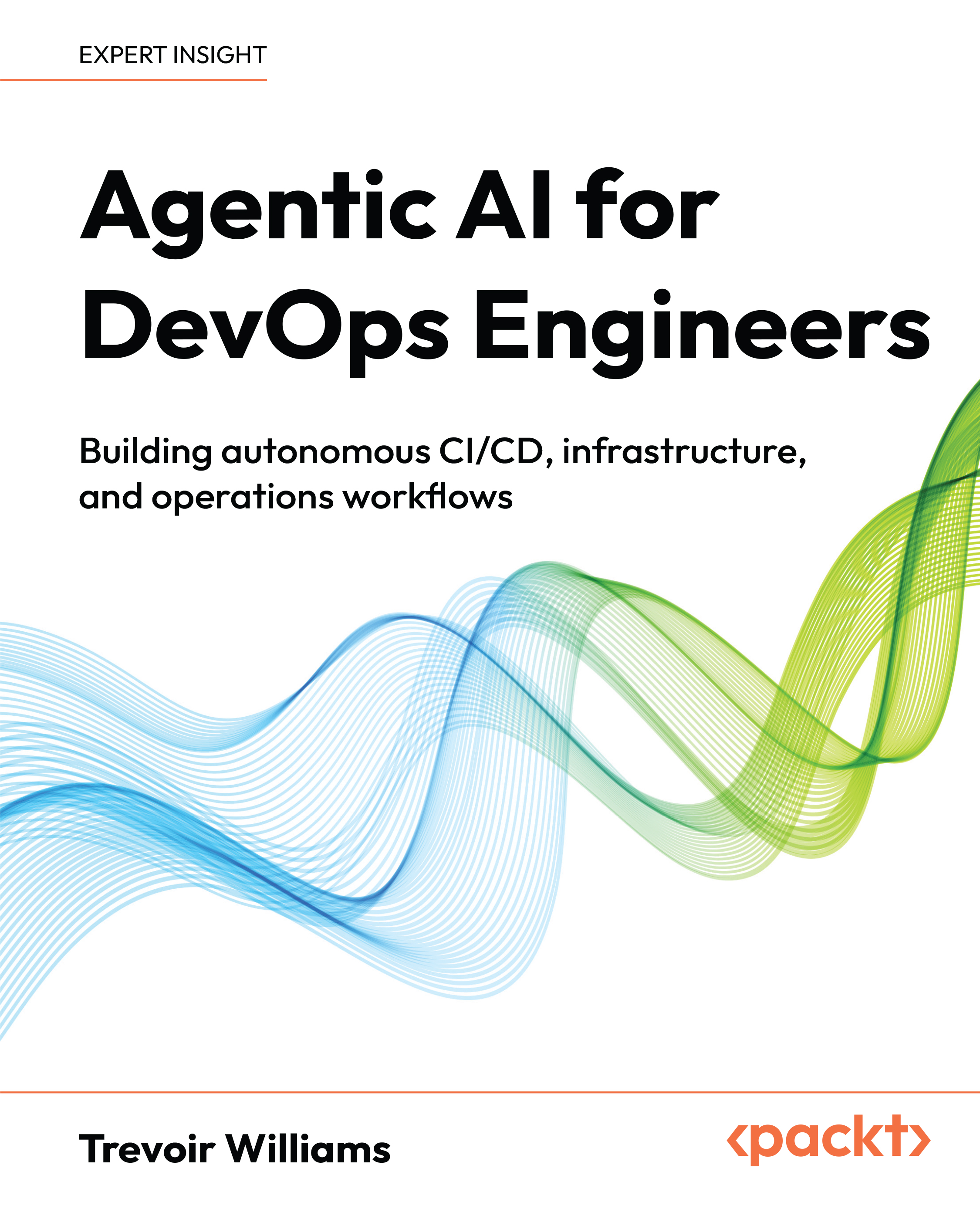
Agentic AI for DevOps Engineers

Agentic AI for DevOps Engineers: Building autonomous CI/CD, infrastructure, and operations workflows

Arrow left icon
Profile Icon Trevoir Williams
Arrow right icon
₱2296.99
Paperback Jul 2026 270 pages 1st Edition
eBook
₱1653.29 ₱1836.99
Paperback
₱2296.99
Arrow left icon
Profile Icon Trevoir Williams
Arrow right icon
₱2296.99
Paperback Jul 2026 270 pages 1st Edition
eBook
₱1653.29 ₱1836.99
Paperback
₱2296.99
eBook
₱1653.29 ₱1836.99
Paperback
₱2296.99

What do you get with Print?

Product feature icon Instant access to your digital copy whilst your Print order is Shipped
Product feature icon Paperback book shipped to your preferred address
Product feature icon Redeem a companion digital copy on all Print orders
Product feature icon Access this title in our online reader with advanced features
Product feature icon DRM FREE - Read whenever, wherever and however you want
Product feature icon AI Assistant (beta) to help accelerate your learning
Modal Close icon
Payment Processing...
tick Completed

Shipping Address

Billing Address

Shipping Methods
Table of content icon View table of contents Preview book icon Preview Book

Agentic AI for DevOps Engineers

1

Generative AI Concepts for DevOps

This chapter explores generative AI concepts for DevOps engineers. We're going to look at how generative AI can be used across the DevOps lifecycle, the difference between AI-assisted and AI-autonomous DevOps, and the risks that teams need to be aware of, including hallucinations, drift, and overreach.

The discussion in this chapter is mainly thought-provoking and high-level. Before using AI to assist with DevOps work, it is important to understand the key concepts and the parts of the DevOps lifecycle where AI can add value without introducing unnecessary operational risk.

The following topics will be covered in this chapter:

  • How generative AI helps DevOps engineers
  • Mapping AI to real DevOps work
  • AI-assisted and AI-autonomous DevOps
  • Risks associated with AI usage

Let's get started!

Download the PDF version of this book

Your purchase includes a DRM-free PDF copy of this book, the code bundle, and a range of exclusive benefits. To unlock everything, follow the Free benefits with your book section in the Preface.

How generative AI helps DevOps engineers

DevOps is heavy work. Engineers write pipelines, review code and configurations, interpret logs and incidents, automate infrastructure, and understand cloud and server environments. The work is not only about execution; it is also about interpretation.

Engineers constantly translate intent into pipelines, configurations, and infrastructure. For this reason, having an assistant can be beneficial.

At the same time, DevOps relies on predictability and repeatability. Ambiguous tools introduce operational risk. If generative AI is going to be used in DevOps, it must be clearly understood, because poorly understood tools introduce risk rather than reduce it.

What is generative AI?

Generative AI refers to software systems that generate new content rather than executing predefined instructions. These systems can produce text, code, configurations, and summaries. This is especially useful in a DevOps context because much of DevOps work is text-based.

The output from generative AI is not hard-coded. It is based on learned patterns rather than fixed rules. This is useful in dynamic systems that are constantly evolving, but it also means that generative AI should not be treated in the same way as deterministic automation.

One of the biggest misconceptions about generative AI is that it is just another form of automation. Automation executes known steps, whereas generative AI can propose new outputs and is more malleable and dynamic.

This distinction matters because accountability in DevOps never shifts to the tool. Humans remain responsible for approving, validating, and deploying changes.

What is an LLM?

Whenever generative AI is discussed, large language models (LLMs) is usually part of the conversation. An LLM is a type of generative AI model trained on large volumes of text, code, documentation, and other structured language-like data. Most modern LLMs are based on transformer architectures, which enable models to analyze a prompt and generate a likely continuation. A token may be a word, part of a word, a punctuation mark, a line of code, or another small unit of text that the model can process.

Every part of an LLM output is generated from patterns the model has learned during training and from the context available in the current prompt. They generate output using statistical models to inform the likely outputs based on the input they receive, which is limited by the model's context window. If important details are missing from that context, the output may be incomplete, outdated, or unsafe.

For DevOps engineers, this distinction is important. LLMs can be very useful for explaining errors, summarizing incidents, drafting YAML pipelines, generating shell commands, describing infrastructure-as-code templates, and producing first-pass documentation. However, their outputs should be treated as suggestions rather than verified facts. Recent guidance on generative AI risk management emphasizes that systems can produce convincing yet incorrect information, expose security and privacy risks, and encourage overreliance if humans treat their output as authoritative. In DevOps, that means LLM-generated code, commands, remediation steps, and configuration changes must still be reviewed, tested, and approved before they are used in a real environment.

Automation in DevOps

Automation is highly beneficial in DevOps. It introduces scripts, pipelines, and workflows, and it must be deterministic and repeatable. Deterministic means the output is predictable. If a process fails, the failure should also be predictable under a particular situation.

When LLMs are merged with DevOps automation, the distinction becomes important. Automation is rule-based and deterministic, whereas LLMs are probabilistic and context-driven. Automation executes, while LLMs suggest.

This is why generative AI must be treated as an assistant rather than an autonomous actor, especially within pipelines. Pipelines require a guarantee of consistency, and LLMs are too dynamic to provide that guarantee on their own.

Mapping AI to real DevOps work

After defining generative AI and LLMs, the next step is to map AI to real DevOps work and avoid low-impact or risky use cases. So, let us quickly refresh our understanding of the DevOps lifecycle.

Figure 1.1: The DevOps lifecycle overview

Figure 1.1: The DevOps lifecycle overview

The DevOps cycle is a continuous flow of planning, coding, building, testing, releasing, deploying, operating, and monitoring software. Each stage feeds the next, while feedback from production informs future planning and improvement. This loop is designed to help teams deliver changes quickly while preserving quality, reliability, and control.

AI works best in knowledge-heavy stages where engineers interpret information and make decisions. It works poorly in execution-heavy stages where consistency and determinism matter most. Putting AI into certain cases can come at the expense of stability.

The goal is not to use AI everywhere, but to use AI where variability is helpful and avoid it where predictability is required.

Decision-making should always remain a human responsibility. The value of AI in each stage is also relative to the project, the team, and several other factors. You might find caveats based on your situation, where what I describe might not necessarily apply to you.

Let's look at a few areas where AI can be used:

  • Plan Planning is one area where AI can provide high value. It can summarize requirements and tickets, translate ideas into technical tasks, draft architecture notes and architectural decision records, and identify risks and open questions.
  • Code: The next high-value area is coding. In the coding stage, AI can reduce friction by drafting boilerplate patterns, suggesting refactors, highlighting potential issues, and assisting during pull request reviews.

    AI should not replace thoughtful code review or architectural judgment. It helps with repetitive work, scaffolding, and early reviews, but it does not remove the need for engineering judgment.

  • Build: During the build phase, AI has low value. Builds must be deterministic, and failures should be predictable. AI should not influence build logic. This is a classic case where traditional automation remains superior, and AI should stay out of the execution path.
  • Test: Testing is another high-value area. AI can suggest test cases, identify missing coverage, draft test data scenarios, and explain failing tests. AI can propose scenarios and explain failures, while humans still decide what belongs in the test suite.

    So, it is useful to have AI review or audit code to identify edge cases, because these are the kinds of things that human beings might miss, and identifying them can take a lot of brainpower and effort.

  • Operate: The operate phase is also a strong area for AI support because huge amounts of data are generated, especially logs. AI can help with log summarization, error pattern detection, incident timeline drafting, and post-incident reviews.

    AI does not replace monitoring tools or on-call judgment, but it can reduce the cognitive overload of processing large volumes of operational data.

  • Release: In the release phase, AI has moderate value. It can draft release notes, summarize changes, highlight breaking changes, and generate supporting release readiness reviews. This helps with the coordination, communication, and confidence required for each release. AI helps by summarizing changes and quickly producing human-readable artifacts.
  • Monitor: Monitoring also has moderate value. Monitoring tools produce signals, but humans still need to interpret them. AI can help interpret metric trends, explain alerts in plain language, correlate events across systems, and support continuous improvement.

There are also areas where AI adds little to no value, or where it should be avoided because of the risks. These include direct production deployments, secrets management, approvals and approval bypasses, security enforcement decisions, and anything involving irreversible actions. AI should not be placed in charge of these areas and, in some cases, should not even be involved.

AI does add value across the DevOps lifecycle. At a high level, the high-value areas are planning, coding, testing, and operations. The moderate-value areas are release and monitoring. The low-value areas are build, execution, and deployment.

AI supports thinking, not execution. It accelerates understanding, not accountability. In the next section, we'll look at the difference between AI-assisted and AI-autonomous DevOps and why keeping humans in the loop is non-negotiable.

AI-assisted and AI-autonomous DevOps

In this section, we're going to draw a clear line between AI-assisted DevOps and AI-autonomous DevOps, as these two ideas are often conflated but are not the same.

  • AI-assisted DevOps: In DevOps, production outcomes matter more than anything else because production outcomes are what DevOps governs. Failures have real-world impact, and accountability should not and cannot be delegated away from human beings. No matter how advanced the tooling becomes, accountability should always remain with the engineering team.

    AI should be used as a supporting actor. It can propose suggestions, and humans can review those suggestions and make decisions. Changes remain traceable and auditable, and the final authority stays with the engineering team.

    Examples of AI-assisted DevOps include drafting a YAML pipeline, suggesting infrastructure templates, summarizing pull requests, and explaining test failures or incidents. The key is that AI input is treated as a starting point, not a final answer.

  • AI-autonomous DevOps: AI-autonomous DevOps refers to a situation where AI initiates changes, executes pipeline steps, approves its own output, and receives minimal or no human review.

    This can make execution appear faster because there are fewer human steps. There is also a perception that efficiency has been gained. AI autonomy looks attractive because it appears faster, and fewer approvals and decision points can feel efficient.

    That changes when something goes wrong, and at that point, the recovery time often outweighs any short-term gains.

    Some of the risks of an AI-autonomous process include probabilistic outputs, limited system context, no real accountability, difficulty attributing failures, small errors that propagate quickly across systems, and complex rollbacks.

    And of course, the blast radius increases with each layer of difficulty. A single incorrect decision can cascade across environments before anybody realizes what has happened. This is the opposite of what we want to achieve as DevOps engineers.

So, the better operating model is to let AI assist, let humans decide, let automation execute, and then validate the results of those executions. This balance delivers speed without sacrificing control.

Figure 1.2: The recommended approach

Figure 1.2: The recommended approach

AI assistance helps scale expertise and reduce cognitive load for DevOps engineers. AI-autonomous DevOps scales risk, so accountability should not be outsourced to another system.

Risks associated with AI usage

We're continuing to evaluate how AI can add value and how we can use it responsibly. Responsible AI use also requires awareness of the risks. AI is not inherently dangerous, but misunderstanding it usually leads to failures.

So in this section, we're going to understand AI-specific risks, why DevOps teams are uniquely exposed, and how we can design systems that fail safely.

The three core AI risk categories are hallucinations, drift, and overreach. Understanding these risks is critical before integrating AI into pipelines or workflows.

  • Hallucinations: Hallucinations occur when an AI system produces outputs that sound correct but are factually wrong. The most dangerous aspect is the confidence in the output. AI systems do not signal uncertainty the way humans do, which makes blind trust especially risky.

    In DevOps, hallucinations do not just cause bad answers; they can cause broken systems. A single incorrect configuration or command can result in failed deployments, outages, and security exposure. This is why AI output must always be reviewed, validated, and tested. We should always have our remediation steps ready.

  • Drift: Drift occurs when AI output becomes less accurate over time, not because the model changed, but because the environment did. This is especially relevant in a field that is constantly evolving. AI is usually trained up to a certain point, which means it can produce deprecated syntax, outdated configuration values, outdated cloud service defaults, obsolete security recommendations, and outdated framework assumptions, because AI systems do not automatically keep pace unless they are explicitly updated.
  • Overreach: Overreach occurs when AI is allowed to operate beyond an advisory role. This is not a failure of the model; it is a failure of the system.

    When AI can execute possibly irreversible actions or bypass human review, errors can scale automatically in a DevOps environment. Human visibility is reduced, rollback becomes difficult, and recovery from failure is often slower and more complex than the work the AI was meant to accelerate.

It is important to be clear that risk is not a reason to avoid AI. Every DevOps tool introduces some risk to the process. The important step is to acknowledge these risks and design systems that manage them deliberately. Avoidance limits growth, but unmanaged adoption creates failure.

Designing for safety means keeping a human in the loop by default. AI tools should be given read-only or advisory roles, with clear restrictions on what they can do in the system.

Figure 1.3: Designing for safety

Figure 1.3: Designing for safety

Teams also need explicit approval gates, observability, and audit trails. AI output should be treated as incorrect until it is validated before execution. This helps limit the blast radius.

The difference between success and failure lies in whether teams design with these risks in mind.

Summary

This chapter reviewed what generative AI is and what it is not, where it adds value, where assistance beats autonomy, and how to recognize and manage the risks associated with AI.

AI assistance is valuable because it reduces cognitive load and repetitive work for DevOps engineers in the field.

However, generative AI tools can make mistakes. Engineering expertise should still be the deciding factor in task execution.

With the theory in place, the next chapter can move into practical applications of generative AI in DevOps.

Left arrow icon Right arrow icon
Download code icon Download Code

Key benefits

  • Build autonomous CI/CD, infrastructure, and operations workflows using AI agents
  • Learn AI-driven automation for observability, incident response, and cloud operations
  • Implement real-world Agentic AI solutions with DevOps tools, LLMs, and modern platforms

Description

Agentic AI for DevOps is a practical, hands-on guide to building autonomous DevOps workflows powered by AI agents, LLMs, and intelligent automation systems. The book shows you how to modernize software delivery and cloud operations by integrating AI into CI/CD pipelines, infrastructure automation, observability, incident response, and platform engineering. You’ll learn how to design AI-driven workflows that can analyze logs, automate deployments, optimize infrastructure, remediate failures, and improve operational efficiency with minimal human intervention. Through real-world projects and demonstrations, the book explores the use of AI copilots, orchestration frameworks, cloud-native tooling, and DevOps platforms to create scalable and production-ready autonomous systems. The book also covers prompt engineering, AI workflow orchestration, security, governance, and best practices for building reliable AI-powered DevOps environments. By the end of the book, you’ll be able to confidently build, deploy, and manage AI-driven DevOps systems that improve speed, reliability, scalability, and operational efficiency. *Email sign-up and proof of purchase required

Who is this book for?

This book is designed for DevOps engineers, platform engineers, SREs, cloud architects, automation specialists, and software developers who want to leverage Agentic AI to automate and optimize modern DevOps workflows. It is ideal for professionals looking to build autonomous CI/CD pipelines, AI-driven infrastructure automation, intelligent monitoring systems, self-healing operations, and scalable cloud-native workflows using AI agents, LLMs, and modern DevOps platforms.

What you will learn

  • Build a practical foundation in Generative AI for DevOps
  • Apply AI across GitHub, Azure DevOps, and CI/CD workflows
  • Use AI to improve automation, infrastructure, and operational efficiency
  • Implement AI with guardrails, governance, and enterprise awareness
  • Evaluate agentic AI for advanced DevOps scenarios
  • Understand how agentic AI, tools, memory, and MCP extend DevOps automation
  • Use AI to improve code, pipelines, infrastructure as code, and documentation
Estimated delivery fee Deliver to Philippines

Premium delivery 5 - 8 business days

₱2548.95
(Includes tracking information)

Product Details

Country selected
Publication date, Length, Edition, Language, ISBN-13
Publication date : Jul 30, 2026
Length: 270 pages
Edition : 1st
Language : English
ISBN-13 : 9781808083570
Concepts :

What do you get with Print?

Product feature icon Instant access to your digital copy whilst your Print order is Shipped
Product feature icon Paperback book shipped to your preferred address
Product feature icon Redeem a companion digital copy on all Print orders
Product feature icon Access this title in our online reader with advanced features
Product feature icon DRM FREE - Read whenever, wherever and however you want
Product feature icon AI Assistant (beta) to help accelerate your learning
Modal Close icon
Payment Processing...
tick Completed

Shipping Address

Billing Address

Shipping Methods
Estimated delivery fee Deliver to Philippines

Premium delivery 5 - 8 business days

₱2548.95
(Includes tracking information)

Product Details

Publication date : Jul 30, 2026
Length: 270 pages
Edition : 1st
Language : English
ISBN-13 : 9781808083570
Concepts :

Packt Subscriptions

See our plans and pricing
Modal Close icon
$19.99 billed monthly
Feature tick icon Unlimited access to Packt's library of 7,000+ practical books and videos
Feature tick icon Constantly refreshed with 50+ new titles a month
Feature tick icon Exclusive Early access to books as they're written
Feature tick icon Solve problems while you work with advanced search and reference features
Feature tick icon Offline reading on the mobile app
Feature tick icon Simple pricing, no contract
$199.99 billed annually
Feature tick icon Unlimited access to Packt's library of 7,000+ practical books and videos
Feature tick icon Constantly refreshed with 50+ new titles a month
Feature tick icon Exclusive Early access to books as they're written
Feature tick icon Solve problems while you work with advanced search and reference features
Feature tick icon Offline reading on the mobile app
Feature tick icon Choose a DRM-free eBook or Video every month to keep
Feature tick icon PLUS own as many other DRM-free eBooks or Videos as you like for just ₱260 each
Feature tick icon Exclusive print discounts
$279.99 billed in 18 months
Feature tick icon Unlimited access to Packt's library of 7,000+ practical books and videos
Feature tick icon Constantly refreshed with 50+ new titles a month
Feature tick icon Exclusive Early access to books as they're written
Feature tick icon Solve problems while you work with advanced search and reference features
Feature tick icon Offline reading on the mobile app
Feature tick icon Choose a DRM-free eBook or Video every month to keep
Feature tick icon PLUS own as many other DRM-free eBooks or Videos as you like for just ₱260 each
Feature tick icon Exclusive print discounts

Table of Contents

11 Chapters
Chapter 1: Generative AI Concepts for DevOps Chevron down icon Chevron up icon
Chapter 2: Practical Applications of Generative AI in DevOps Chevron down icon Chevron up icon
Chapter 3: DevOps AI Tools, Governance, and Enterprise Readiness Chevron down icon Chevron up icon
Chapter 4: Integrating Generative AI Into DevOps Pipelines Chevron down icon Chevron up icon
Chapter 5: Agentic AI for CI/CD Failure Triage and PR Quality Assessment Chevron down icon Chevron up icon
Chapter 6: Agentic AI for Advanced DevOps Scenarios: Memory and MCP Chevron down icon Chevron up icon
Chapter 7: Multi-Agent Incident Response and Agent Observability Chevron down icon Chevron up icon
Chapter 8: Conclusion and Next Steps: Applying Generative AI to DevOps Responsibly Chevron down icon Chevron up icon
Chapter 9: Unlock Your Exclusive Benefits Chevron down icon Chevron up icon
Other Books You May Enjoy Chevron down icon Chevron up icon
Index Chevron down icon Chevron up icon
Get free access to Packt library with over 7500+ books and video courses for 7 days!
Start Free Trial

FAQs

What is the digital copy I get with my Print order? Chevron down icon Chevron up icon

When you buy any Print edition of our Books, you can redeem (for free) the eBook edition of the Print Book you’ve purchased. This gives you instant access to your book when you make an order via PDF, EPUB or our online Reader experience.

What is the delivery time and cost of print book? Chevron down icon Chevron up icon

Shipping Details

USA:

'

Economy: Delivery to most addresses in the US within 10-15 business days

Premium: Trackable Delivery to most addresses in the US within 3-8 business days

UK:

Economy: Delivery to most addresses in the U.K. within 7-9 business days.
Shipments are not trackable

Premium: Trackable delivery to most addresses in the U.K. within 3-4 business days!
Add one extra business day for deliveries to Northern Ireland and Scottish Highlands and islands

EU:

Premium: Trackable delivery to most EU destinations within 4-9 business days.

Australia:

Economy: Can deliver to P. O. Boxes and private residences.
Trackable service with delivery to addresses in Australia only.
Delivery time ranges from 7-9 business days for VIC and 8-10 business days for Interstate metro
Delivery time is up to 15 business days for remote areas of WA, NT & QLD.

Premium: Delivery to addresses in Australia only
Trackable delivery to most P. O. Boxes and private residences in Australia within 4-5 days based on the distance to a destination following dispatch.

India:

Premium: Delivery to most Indian addresses within 5-6 business days

Rest of the World:

Premium: Countries in the American continent: Trackable delivery to most countries within 4-7 business days

Asia:

Premium: Delivery to most Asian addresses within 5-9 business days

Disclaimer:
All orders received before 5 PM U.K time would start printing from the next business day. So the estimated delivery times start from the next day as well. Orders received after 5 PM U.K time (in our internal systems) on a business day or anytime on the weekend will begin printing the second to next business day. For example, an order placed at 11 AM today will begin printing tomorrow, whereas an order placed at 9 PM tonight will begin printing the day after tomorrow.


Unfortunately, due to several restrictions, we are unable to ship to the following countries:

  1. Afghanistan
  2. American Samoa
  3. Belarus
  4. Brunei Darussalam
  5. Central African Republic
  6. The Democratic Republic of Congo
  7. Eritrea
  8. Guinea-bissau
  9. Iran
  10. Lebanon
  11. Libiya Arab Jamahriya
  12. Somalia
  13. Sudan
  14. Russian Federation
  15. Syrian Arab Republic
  16. Ukraine
  17. Venezuela
What is custom duty/charge? Chevron down icon Chevron up icon

Customs duty are charges levied on goods when they cross international borders. It is a tax that is imposed on imported goods. These duties are charged by special authorities and bodies created by local governments and are meant to protect local industries, economies, and businesses.

Do I have to pay customs charges for the print book order? Chevron down icon Chevron up icon

The orders shipped to the countries that are listed under EU27 will not bear custom charges. They are paid by Packt as part of the order.

List of EU27 countries: www.gov.uk/eu-eea:

A custom duty or localized taxes may be applicable on the shipment and would be charged by the recipient country outside of the EU27 which should be paid by the customer and these duties are not included in the shipping charges been charged on the order.

How do I know my custom duty charges? Chevron down icon Chevron up icon

The amount of duty payable varies greatly depending on the imported goods, the country of origin and several other factors like the total invoice amount or dimensions like weight, and other such criteria applicable in your country.

For example:

  • If you live in Mexico, and the declared value of your ordered items is over $ 50, for you to receive a package, you will have to pay additional import tax of 19% which will be $ 9.50 to the courier service.
  • Whereas if you live in Turkey, and the declared value of your ordered items is over € 22, for you to receive a package, you will have to pay additional import tax of 18% which will be € 3.96 to the courier service.
How can I cancel my order? Chevron down icon Chevron up icon

Cancellation Policy for Published Printed Books:

You can cancel any order within 1 hour of placing the order. Simply contact customercare@packt.com with your order details or payment transaction id. If your order has already started the shipment process, we will do our best to stop it. However, if it is already on the way to you then when you receive it, you can contact us at customercare@packt.com using the returns and refund process.

Please understand that Packt Publishing cannot provide refunds or cancel any order except for the cases described in our Return Policy (i.e. Packt Publishing agrees to replace your printed book because it arrives damaged or material defect in book), Packt Publishing will not accept returns.

What is your returns and refunds policy? Chevron down icon Chevron up icon

Return Policy:

We want you to be happy with your purchase from Packtpub.com. We will not hassle you with returning print books to us. If the print book you receive from us is incorrect, damaged, doesn't work or is unacceptably late, please contact Customer Relations Team on customercare@packt.com with the order number and issue details as explained below:

  1. If you ordered (eBook, Video or Print Book) incorrectly or accidentally, please contact Customer Relations Team on customercare@packt.com within one hour of placing the order and we will replace/refund you the item cost.
  2. Sadly, if your eBook or Video file is faulty or a fault occurs during the eBook or Video being made available to you, i.e. during download then you should contact Customer Relations Team within 14 days of purchase on customercare@packt.com who will be able to resolve this issue for you.
  3. You will have a choice of replacement or refund of the problem items.(damaged, defective or incorrect)
  4. Once Customer Care Team confirms that you will be refunded, you should receive the refund within 10 to 12 working days.
  5. If you are only requesting a refund of one book from a multiple order, then we will refund you the appropriate single item.
  6. Where the items were shipped under a free shipping offer, there will be no shipping costs to refund.

On the off chance your printed book arrives damaged, with book material defect, contact our Customer Relation Team on customercare@packt.com within 14 days of receipt of the book with appropriate evidence of damage and we will work with you to secure a replacement copy, if necessary. Please note that each printed book you order from us is individually made by Packt's professional book-printing partner which is on a print-on-demand basis.

What tax is charged? Chevron down icon Chevron up icon

Currently, no tax is charged on the purchase of any print book (subject to change based on the laws and regulations). A localized VAT fee is charged only to our European and UK customers on eBooks, Video and subscriptions that they buy. GST is charged to Indian customers for eBooks and video purchases.

What payment methods can I use? Chevron down icon Chevron up icon

You can pay with the following card types:

  1. Visa Debit
  2. Visa Credit
  3. MasterCard
  4. PayPal
What is the delivery time and cost of print books? Chevron down icon Chevron up icon

Shipping Details

USA:

'

Economy: Delivery to most addresses in the US within 10-15 business days

Premium: Trackable Delivery to most addresses in the US within 3-8 business days

UK:

Economy: Delivery to most addresses in the U.K. within 7-9 business days.
Shipments are not trackable

Premium: Trackable delivery to most addresses in the U.K. within 3-4 business days!
Add one extra business day for deliveries to Northern Ireland and Scottish Highlands and islands

EU:

Premium: Trackable delivery to most EU destinations within 4-9 business days.

Australia:

Economy: Can deliver to P. O. Boxes and private residences.
Trackable service with delivery to addresses in Australia only.
Delivery time ranges from 7-9 business days for VIC and 8-10 business days for Interstate metro
Delivery time is up to 15 business days for remote areas of WA, NT & QLD.

Premium: Delivery to addresses in Australia only
Trackable delivery to most P. O. Boxes and private residences in Australia within 4-5 days based on the distance to a destination following dispatch.

India:

Premium: Delivery to most Indian addresses within 5-6 business days

Rest of the World:

Premium: Countries in the American continent: Trackable delivery to most countries within 4-7 business days

Asia:

Premium: Delivery to most Asian addresses within 5-9 business days

Disclaimer:
All orders received before 5 PM U.K time would start printing from the next business day. So the estimated delivery times start from the next day as well. Orders received after 5 PM U.K time (in our internal systems) on a business day or anytime on the weekend will begin printing the second to next business day. For example, an order placed at 11 AM today will begin printing tomorrow, whereas an order placed at 9 PM tonight will begin printing the day after tomorrow.


Unfortunately, due to several restrictions, we are unable to ship to the following countries:

  1. Afghanistan
  2. American Samoa
  3. Belarus
  4. Brunei Darussalam
  5. Central African Republic
  6. The Democratic Republic of Congo
  7. Eritrea
  8. Guinea-bissau
  9. Iran
  10. Lebanon
  11. Libiya Arab Jamahriya
  12. Somalia
  13. Sudan
  14. Russian Federation
  15. Syrian Arab Republic
  16. Ukraine
  17. Venezuela
Modal Close icon
Modal Close icon