Search icon CANCEL
Subscription
0
Cart icon
Your Cart (0 item)
Close icon
You have no products in your basket yet
Save more on your purchases! discount-offer-chevron-icon
Savings automatically calculated. No voucher code required.
Arrow left icon
Explore Products
Best Sellers
New Releases
Books
Videos
Audiobooks
Learning Hub
Newsletter Hub
Free Learning
Arrow right icon
timer SALE ENDS IN
0 Days
:
00 Hours
:
00 Minutes
:
00 Seconds
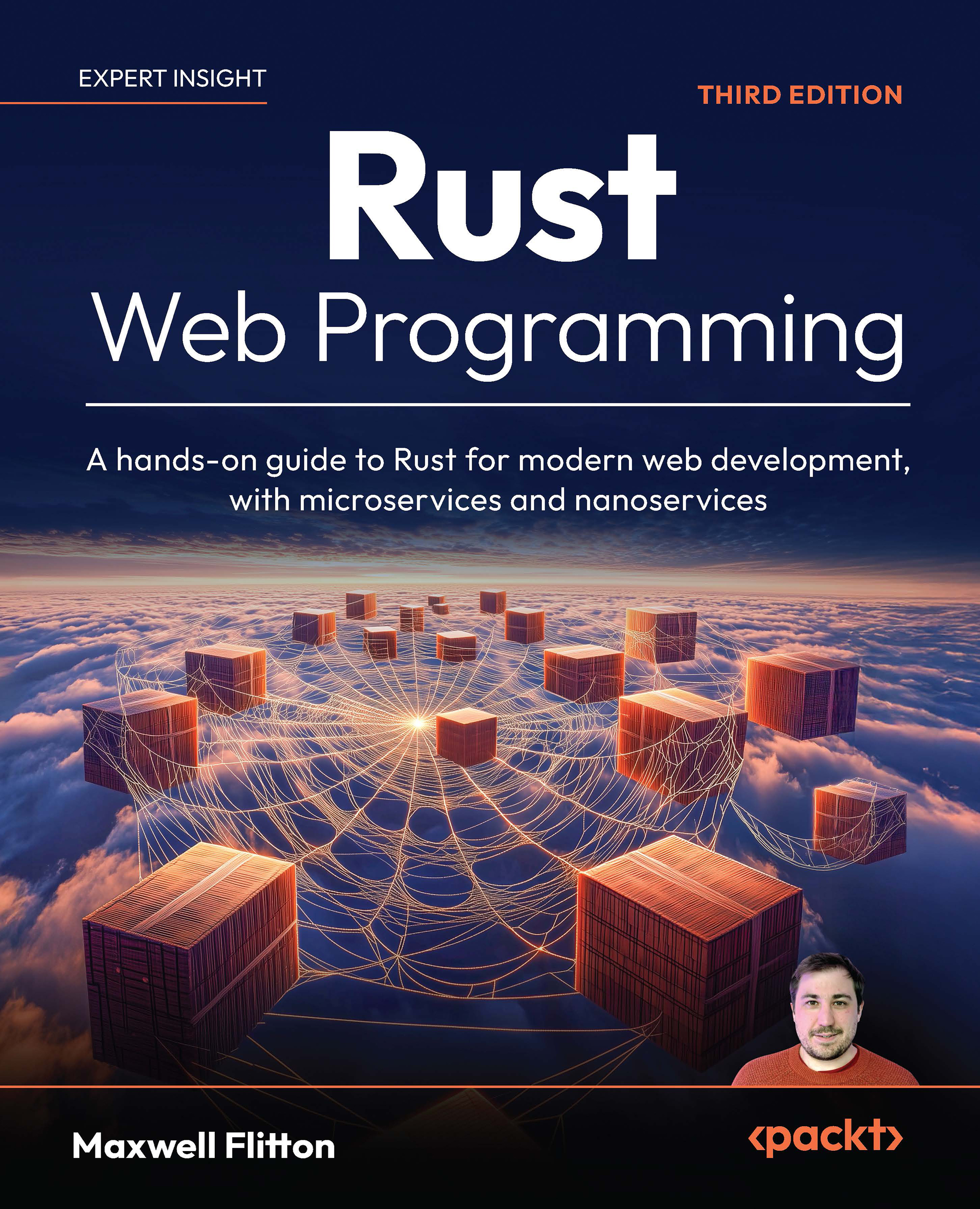
Rust Web Programming

Rust Web Programming: A hands-on guide to Rust for modern web development, with microservices and nanoservices , Third Edition

eBook
€26.99 €29.99
Paperback
€37.99
Subscription
Free Trial
Renews at €18.99p/m

What do you get with Print?

Product feature icon Instant access to your digital copy whilst your Print order is Shipped
Product feature icon Paperback book shipped to your preferred address
Product feature icon Redeem a companion digital copy on all Print orders
Product feature icon Access this title in our online reader with advanced features
Product feature icon DRM FREE - Read whenever, wherever and however you want
Modal Close icon
Payment Processing...
tick Completed

Shipping Address

Billing Address

Shipping Methods
Table of content icon View table of contents Preview book icon Preview Book

Rust Web Programming

Further Reading

  1. Hands on Functional Programming in Rust (2018) Andrew Johnson: chapter one (generics and structs)
  2. Mastering Rust (2019) Rahul Sharma and Vesa Kaihlavirta: chapter one (A tour of the language)
  3. The Problem With Single-threaded Shared Mutability (2015) by Manish Goregaokar: https://manishearth.github.io/blog/2015/05/17/the-problem-with-shared-mutability/

Rust Project Developers, 2024. The Rust Programming Language. [online] Available at: https://doc.rust-lang.org/book/ [Accessed 21 June 2024]

Latimer, N., 2020. Programming Rust. [online] Available at: https://doc.rust-lang.org/stable/rust-by-example/ [Accessed 21 June 2024].

Technical requirements

You can download the example project and code for this book by following the instructions in the Download the example code files section in the Preface of this book.

This chapter’s code files are included in the downloadable code bundle.

Verifying with traits

Enums can empower structs so that they can handle multiple types. This can also be translated for any type of function or data structure. However, this can lead to a lot of repetition. Take, for instance, a User struct. Users have a core set of values, such as a username and password; however, they could also have extra functionality based on roles. With users, we must check roles before firing certain processes based on the traits that the user has implemented.

Through the creation of a simple program that defines users and their roles, we can demonstrate how to wrap up structs with traits:

  1. We define our users with the following code:
    struct AdminUser {
        username: String,
        password: String
    }
    struct User {
        username: String,
        password: String
    }
    

We can see in the preceding code that the User and AdminUser structs have the same fields. For this exercise, we just need two different structs to demonstrate the effect...

Metaprogramming with macros

Metaprogramming can generally be described as a way in which a program can manipulate itself based on certain instructions.

Considering the strong typing Rust has, one of the simplest ways in which we can meta-program is by using generics. A classic example of demonstrating generics is through coordinates, as follows:

struct Coordinate <T> {
    x: T,
    y: T
}
fn main() {
    let one = Coordinate{x: 50, y: 50};
    let two = Coordinate{x: 500, y: 500};
    let three = Coordinate{x: 5.6, y: 5.6};
}

In the preceding snippet, the Coordinate struct is defined with a single generic parameter, T. This T is a placeholder that can represent any type. When we create an instance of Coordinate, Rust’s compiler replaces T with specific types. In our example:

  • one uses T as i32
  • three uses T as f62

This flexibility allows the Coordinate struct to handle different types of numbers without needing implementations for...

Mapping messages with macros

Throughout the book, we will be using a web framework to match HTTP requests to the right function to be handled. However, there are times when you want to accept a message over a TCP connection and match the handling function based on the message received. (It does not have to be via TCP; I have found this type of macro to be useful for module interfaces or receiving messages via a channel.) In this section, we will implement a simple macro that will reduce the amount of code we need to write when mapping a struct to a function.

We map our messages using macros by carrying out the following steps:

  1. Defining our contracts and contract handler
  2. Defining functions to handle contracts
  3. Building a register contract macro
  4. Using our macro in a program

We will start with step 1.

Defining our contracts and contract handler

To map messages, we initially must define the data contracts that we will be mapping to our...

Configuring our functions with traits

In a Rust web program, we generally have a series of layers and APIs. These layers usually consist of a frontend, backend, and data access layer. With these layers, we can have multiple different frameworks and engines. Throughout the book, we will be building out our web application so we can swap these frameworks and engines out.

These frameworks should have minimal footprint on your code, with clear separation between the interfaces. With web frameworks, you still must run a server using the web framework. We can swap out different engines, frameworks, and crates by using traits with no reference to self.

To demonstrate how this works, we are going to add another endpoint and data contract that gets a user by name from the database. Our database could be any database. We do not want our code to commit to having a particular data storage engine to run; this would not be flexible. To make an interaction with a database flexible, we implement...

Checking struct state with the compiler

There are times when the state of a struct and certain processes are just not appropriate anymore. A nice, clear example would be a database transaction. While a database transaction is in progress, certain processes are appropriate, such as adding another operation to the transaction. You may also want to commit your transaction or roll it back. However, once we have committed our transaction, we cannot roll it back or add another operation to the transaction; we need another transaction for this. Considering this, I would want my compiler to check and ensure that I am not passing in a transaction into certain functions once the transaction is no longer in progress. The compiler will not only give me instant feedback, but it will also be safer, as it could be that only certain edge cases could cause a bug, increasing the chance of the bug slipping through tests. We can start by defining a state with our struct.

Defining the state of a struct...

Summary

In this chapter, we covered some useful Rust-specific patterns that will take our code to the next level. We can enable multiple permissions for a struct using multiple traits. We then scaled our ability to write Rust code with macros, where we mapped data contracts with functions to handle them. Finally, we revisited traits to configure functions and implemented the type state pattern to lock down our struct.

These approaches can help you solve problems in Rust in an elegant, secure, and scalable way. You can use these approaches to solve problems you generally come across outside of web programming, too. Throughout the book, we will be revisiting these approaches to solve problems in web programming. Hopefully, with these approaches, you can see that Rust is a safe, yet flexible and powerful language. Whenever I am feeling a little too sure of myself, I remind myself that some super smart people came up with the Rust programming language and traits. This always reminds...

Questions

  1. How can we enable multiple permissions for a struct?
  2. How can we ensure that two permissions are enabled for a struct that can be passed into a function?
  3. Let us say I wanted a struct that had an ID field and nothing more. I wanted that ID field to be a string in some cases and an i32 in others. How could I achieve this?
  4. I want to have a function that calls an I/O function in it, but I want the implementation of the I/O call to be flexible, enabling other developers to slot in different implementations. How can I do this?
  5. Let us say I have a struct that passes through a process of steps, and I want to lock down my struct so it cannot be passed into functions outside of the current step. How can I do this?

Answers

  1. We can declare a trait per permission. We can then implement multiple traits in a struct.
  2. We can ensure that two traits are implemented for the struct being passed into the function with <T: TraitA + TraitB>.
  3. We would exploit generics, where the generic parameter would map to the ID field; we could then create StructA<i32> and StructA<String>.
  4. We can define a trait where the functions for the trait do not have a reference to self. This trait can then be passed to the function as a trait parameter with function_a<T: SomeTrait>(), so we can define the function struct with function_a<SomeStruct>().
  5. We can implement the type state pattern.

Learn more on Discord

To join the Discord community for this book – where you can share feedback, ask questions to the author, and learn about new releases – follow this QR code: https://packt.link/EaKXL

Left arrow icon Right arrow icon
Download code icon Download Code

Key benefits

  • Get a comprehensive introduction to Rust for full-stack web development
  • Explore the exciting evolution of Rust in recent years with WebAssembly, Axum, native TLS, and SurrealDB
  • Build code in a scalable way with microservice and nanoservice design patterns

Description

Rust is no longer just for systems programming. This book will show you why this safe and performant language is a crucial up-and-coming option for developing web applications, and get you on your way to building fully functional Rust web apps. You don’t need any experience with Rust to get started, and this new edition also comes with a shallower learning curve. You’ll get hands-on with emerging Rust web frameworks including Actix, Axum, Rocket, and Hyper. You’ll look at injecting Rust into the frontend with WebAssembly and HTTPS configuration with NGINX. Later, you’ll move on to more advanced async topics, exploring TCP and framing, and implementing async systems. As you work through the book, you’ll build a to-do application with authentication using a microservice architecture that compiles into one Rust binary, including the embedding of a frontend JavaScript application in the same binary. The application will have end-to-end atomic testing and a deployment pipeline. By the end of this book, you’ll fully understand the significance of Rust for web development. You’ll also have the confidence to build robust, functional, and scalable Rust web applications from scratch.

Who is this book for?

This book is for web developers who are looking to learn or adopt Rust to build safe and performant web applications. This includes developers familiar with languages such as Python, Ruby, and JavaScript. You don’t need any prior experience in Rust to start this book. However, you’ll need a solid understanding of web development principles, along with basic knowledge of HTML, CSS, and JavaScript to get the most out of it.

What you will learn

  • Build scalable Rust web applications as monoliths or microservices
  • Develop a deeper understanding of async Rust
  • Get to grips with Rust language features such as traits and the borrow checker
  • Manage authentication and databases in Rust web apps
  • Build app infrastructure on AWS using Terraform
  • Learn how to package and deploy Rust servers
  • Build unit tests and end-to-end tests for your Rust web apps with Python
Estimated delivery fee Deliver to Norway

Standard delivery 10 - 13 business days

€11.95

Premium delivery 3 - 6 business days

€16.95
(Includes tracking information)

Product Details

Country selected
Publication date, Length, Edition, Language, ISBN-13
Publication date : Jan 30, 2026
Length: 674 pages
Edition : 3rd
Language : English
ISBN-13 : 9781835887769
Languages :

What do you get with Print?

Product feature icon Instant access to your digital copy whilst your Print order is Shipped
Product feature icon Paperback book shipped to your preferred address
Product feature icon Redeem a companion digital copy on all Print orders
Product feature icon Access this title in our online reader with advanced features
Product feature icon DRM FREE - Read whenever, wherever and however you want
Modal Close icon
Payment Processing...
tick Completed

Shipping Address

Billing Address

Shipping Methods
Estimated delivery fee Deliver to Norway

Standard delivery 10 - 13 business days

€11.95

Premium delivery 3 - 6 business days

€16.95
(Includes tracking information)

Product Details

Publication date : Jan 30, 2026
Length: 674 pages
Edition : 3rd
Language : English
ISBN-13 : 9781835887769
Languages :

Packt Subscriptions

See our plans and pricing
Modal Close icon
€18.99 billed monthly
Feature tick icon Unlimited access to Packt's library of 7,000+ practical books and videos
Feature tick icon Constantly refreshed with 50+ new titles a month
Feature tick icon Exclusive Early access to books as they're written
Feature tick icon Solve problems while you work with advanced search and reference features
Feature tick icon Offline reading on the mobile app
Feature tick icon Simple pricing, no contract
€189.99 billed annually
Feature tick icon Unlimited access to Packt's library of 7,000+ practical books and videos
Feature tick icon Constantly refreshed with 50+ new titles a month
Feature tick icon Exclusive Early access to books as they're written
Feature tick icon Solve problems while you work with advanced search and reference features
Feature tick icon Offline reading on the mobile app
Feature tick icon Choose a DRM-free eBook or Video every month to keep
Feature tick icon PLUS own as many other DRM-free eBooks or Videos as you like for just €5 each
Feature tick icon Exclusive print discounts
€264.99 billed in 18 months
Feature tick icon Unlimited access to Packt's library of 7,000+ practical books and videos
Feature tick icon Constantly refreshed with 50+ new titles a month
Feature tick icon Exclusive Early access to books as they're written
Feature tick icon Solve problems while you work with advanced search and reference features
Feature tick icon Offline reading on the mobile app
Feature tick icon Choose a DRM-free eBook or Video every month to keep
Feature tick icon PLUS own as many other DRM-free eBooks or Videos as you like for just €5 each
Feature tick icon Exclusive print discounts

Table of Contents

23 Chapters
A Quick Introduction to Rust Chevron down icon Chevron up icon
Useful Rust Patterns for Web Programming Chevron down icon Chevron up icon
Designing Your Web Application in Rust Chevron down icon Chevron up icon
Async Rust Chevron down icon Chevron up icon
Handling HTTP Requests Chevron down icon Chevron up icon
Processing HTTP Requests Chevron down icon Chevron up icon
Displaying Content in the Browser Chevron down icon Chevron up icon
Injecting Rust in the Frontend with WebAssembly Chevron down icon Chevron up icon
Data Persistence with PostgreSQL Chevron down icon Chevron up icon
Managing User Sessions Chevron down icon Chevron up icon
Communicating Between Servers Chevron down icon Chevron up icon
Caching Auth Sessions Chevron down icon Chevron up icon
Observability Through Logging Chevron down icon Chevron up icon
Unit Testing Chevron down icon Chevron up icon
End-to-End Testing Chevron down icon Chevron up icon
Deploying Our Application on AWS Chevron down icon Chevron up icon
Configuring HTTPS with NGINX on AWS Chevron down icon Chevron up icon
Practicalities of Using Microservices and Nanoservices Chevron down icon Chevron up icon
Low-Level Networking Chevron down icon Chevron up icon
Distributed Computing Chevron down icon Chevron up icon
Unlock Your Exclusive Benefits Chevron down icon Chevron up icon
Other Books You May Enjoy Chevron down icon Chevron up icon
Index Chevron down icon Chevron up icon

Customer reviews

Rating distribution
Full star icon Full star icon Full star icon Full star icon Empty star icon 4
(1 Ratings)
5 star 0%
4 star 100%
3 star 0%
2 star 0%
1 star 0%
Daniel Sep 24, 2024
Full star icon Full star icon Full star icon Full star icon Empty star icon 4
The graph in chapter 1 "what is rust) that display the bench mark of different frameworks has some numbers format that need to be reviewed. There should be an easy way to provide feedback on the book for early access titles (easy to spot erratas for you guys)
Subscriber review Packt
Get free access to Packt library with over 7500+ books and video courses for 7 days!
Start Free Trial

FAQs

What is the digital copy I get with my Print order? Chevron down icon Chevron up icon

When you buy any Print edition of our Books, you can redeem (for free) the eBook edition of the Print Book you’ve purchased. This gives you instant access to your book when you make an order via PDF, EPUB or our online Reader experience.

What is the delivery time and cost of print book? Chevron down icon Chevron up icon

Shipping Details

USA:

'

Economy: Delivery to most addresses in the US within 10-15 business days

Premium: Trackable Delivery to most addresses in the US within 3-8 business days

UK:

Economy: Delivery to most addresses in the U.K. within 7-9 business days.
Shipments are not trackable

Premium: Trackable delivery to most addresses in the U.K. within 3-4 business days!
Add one extra business day for deliveries to Northern Ireland and Scottish Highlands and islands

EU:

Premium: Trackable delivery to most EU destinations within 4-9 business days.

Australia:

Economy: Can deliver to P. O. Boxes and private residences.
Trackable service with delivery to addresses in Australia only.
Delivery time ranges from 7-9 business days for VIC and 8-10 business days for Interstate metro
Delivery time is up to 15 business days for remote areas of WA, NT & QLD.

Premium: Delivery to addresses in Australia only
Trackable delivery to most P. O. Boxes and private residences in Australia within 4-5 days based on the distance to a destination following dispatch.

India:

Premium: Delivery to most Indian addresses within 5-6 business days

Rest of the World:

Premium: Countries in the American continent: Trackable delivery to most countries within 4-7 business days

Asia:

Premium: Delivery to most Asian addresses within 5-9 business days

Disclaimer:
All orders received before 5 PM U.K time would start printing from the next business day. So the estimated delivery times start from the next day as well. Orders received after 5 PM U.K time (in our internal systems) on a business day or anytime on the weekend will begin printing the second to next business day. For example, an order placed at 11 AM today will begin printing tomorrow, whereas an order placed at 9 PM tonight will begin printing the day after tomorrow.


Unfortunately, due to several restrictions, we are unable to ship to the following countries:

  1. Afghanistan
  2. American Samoa
  3. Belarus
  4. Brunei Darussalam
  5. Central African Republic
  6. The Democratic Republic of Congo
  7. Eritrea
  8. Guinea-bissau
  9. Iran
  10. Lebanon
  11. Libiya Arab Jamahriya
  12. Somalia
  13. Sudan
  14. Russian Federation
  15. Syrian Arab Republic
  16. Ukraine
  17. Venezuela
What is custom duty/charge? Chevron down icon Chevron up icon

Customs duty are charges levied on goods when they cross international borders. It is a tax that is imposed on imported goods. These duties are charged by special authorities and bodies created by local governments and are meant to protect local industries, economies, and businesses.

Do I have to pay customs charges for the print book order? Chevron down icon Chevron up icon

The orders shipped to the countries that are listed under EU27 will not bear custom charges. They are paid by Packt as part of the order.

List of EU27 countries: www.gov.uk/eu-eea:

A custom duty or localized taxes may be applicable on the shipment and would be charged by the recipient country outside of the EU27 which should be paid by the customer and these duties are not included in the shipping charges been charged on the order.

How do I know my custom duty charges? Chevron down icon Chevron up icon

The amount of duty payable varies greatly depending on the imported goods, the country of origin and several other factors like the total invoice amount or dimensions like weight, and other such criteria applicable in your country.

For example:

  • If you live in Mexico, and the declared value of your ordered items is over $ 50, for you to receive a package, you will have to pay additional import tax of 19% which will be $ 9.50 to the courier service.
  • Whereas if you live in Turkey, and the declared value of your ordered items is over € 22, for you to receive a package, you will have to pay additional import tax of 18% which will be € 3.96 to the courier service.
How can I cancel my order? Chevron down icon Chevron up icon

Cancellation Policy for Published Printed Books:

You can cancel any order within 1 hour of placing the order. Simply contact customercare@packt.com with your order details or payment transaction id. If your order has already started the shipment process, we will do our best to stop it. However, if it is already on the way to you then when you receive it, you can contact us at customercare@packt.com using the returns and refund process.

Please understand that Packt Publishing cannot provide refunds or cancel any order except for the cases described in our Return Policy (i.e. Packt Publishing agrees to replace your printed book because it arrives damaged or material defect in book), Packt Publishing will not accept returns.

What is your returns and refunds policy? Chevron down icon Chevron up icon

Return Policy:

We want you to be happy with your purchase from Packtpub.com. We will not hassle you with returning print books to us. If the print book you receive from us is incorrect, damaged, doesn't work or is unacceptably late, please contact Customer Relations Team on customercare@packt.com with the order number and issue details as explained below:

  1. If you ordered (eBook, Video or Print Book) incorrectly or accidentally, please contact Customer Relations Team on customercare@packt.com within one hour of placing the order and we will replace/refund you the item cost.
  2. Sadly, if your eBook or Video file is faulty or a fault occurs during the eBook or Video being made available to you, i.e. during download then you should contact Customer Relations Team within 14 days of purchase on customercare@packt.com who will be able to resolve this issue for you.
  3. You will have a choice of replacement or refund of the problem items.(damaged, defective or incorrect)
  4. Once Customer Care Team confirms that you will be refunded, you should receive the refund within 10 to 12 working days.
  5. If you are only requesting a refund of one book from a multiple order, then we will refund you the appropriate single item.
  6. Where the items were shipped under a free shipping offer, there will be no shipping costs to refund.

On the off chance your printed book arrives damaged, with book material defect, contact our Customer Relation Team on customercare@packt.com within 14 days of receipt of the book with appropriate evidence of damage and we will work with you to secure a replacement copy, if necessary. Please note that each printed book you order from us is individually made by Packt's professional book-printing partner which is on a print-on-demand basis.

What tax is charged? Chevron down icon Chevron up icon

Currently, no tax is charged on the purchase of any print book (subject to change based on the laws and regulations). A localized VAT fee is charged only to our European and UK customers on eBooks, Video and subscriptions that they buy. GST is charged to Indian customers for eBooks and video purchases.

What payment methods can I use? Chevron down icon Chevron up icon

You can pay with the following card types:

  1. Visa Debit
  2. Visa Credit
  3. MasterCard
  4. PayPal
What is the delivery time and cost of print books? Chevron down icon Chevron up icon

Shipping Details

USA:

'

Economy: Delivery to most addresses in the US within 10-15 business days

Premium: Trackable Delivery to most addresses in the US within 3-8 business days

UK:

Economy: Delivery to most addresses in the U.K. within 7-9 business days.
Shipments are not trackable

Premium: Trackable delivery to most addresses in the U.K. within 3-4 business days!
Add one extra business day for deliveries to Northern Ireland and Scottish Highlands and islands

EU:

Premium: Trackable delivery to most EU destinations within 4-9 business days.

Australia:

Economy: Can deliver to P. O. Boxes and private residences.
Trackable service with delivery to addresses in Australia only.
Delivery time ranges from 7-9 business days for VIC and 8-10 business days for Interstate metro
Delivery time is up to 15 business days for remote areas of WA, NT & QLD.

Premium: Delivery to addresses in Australia only
Trackable delivery to most P. O. Boxes and private residences in Australia within 4-5 days based on the distance to a destination following dispatch.

India:

Premium: Delivery to most Indian addresses within 5-6 business days

Rest of the World:

Premium: Countries in the American continent: Trackable delivery to most countries within 4-7 business days

Asia:

Premium: Delivery to most Asian addresses within 5-9 business days

Disclaimer:
All orders received before 5 PM U.K time would start printing from the next business day. So the estimated delivery times start from the next day as well. Orders received after 5 PM U.K time (in our internal systems) on a business day or anytime on the weekend will begin printing the second to next business day. For example, an order placed at 11 AM today will begin printing tomorrow, whereas an order placed at 9 PM tonight will begin printing the day after tomorrow.


Unfortunately, due to several restrictions, we are unable to ship to the following countries:

  1. Afghanistan
  2. American Samoa
  3. Belarus
  4. Brunei Darussalam
  5. Central African Republic
  6. The Democratic Republic of Congo
  7. Eritrea
  8. Guinea-bissau
  9. Iran
  10. Lebanon
  11. Libiya Arab Jamahriya
  12. Somalia
  13. Sudan
  14. Russian Federation
  15. Syrian Arab Republic
  16. Ukraine
  17. Venezuela
Modal Close icon
Modal Close icon