Search icon CANCEL
Subscription
0
Cart icon
Your Cart (0 item)
Close icon
You have no products in your basket yet
Save more on your purchases! discount-offer-chevron-icon
Savings automatically calculated. No voucher code required.
Arrow left icon
Explore Products
Best Sellers
New Releases
Books
Events
Videos
Audiobooks
Packt Hub
Free Learning
Arrow right icon
timer SALE ENDS IN
0 Days
:
00 Hours
:
00 Minutes
:
00 Seconds
Arrow up icon
GO TO TOP
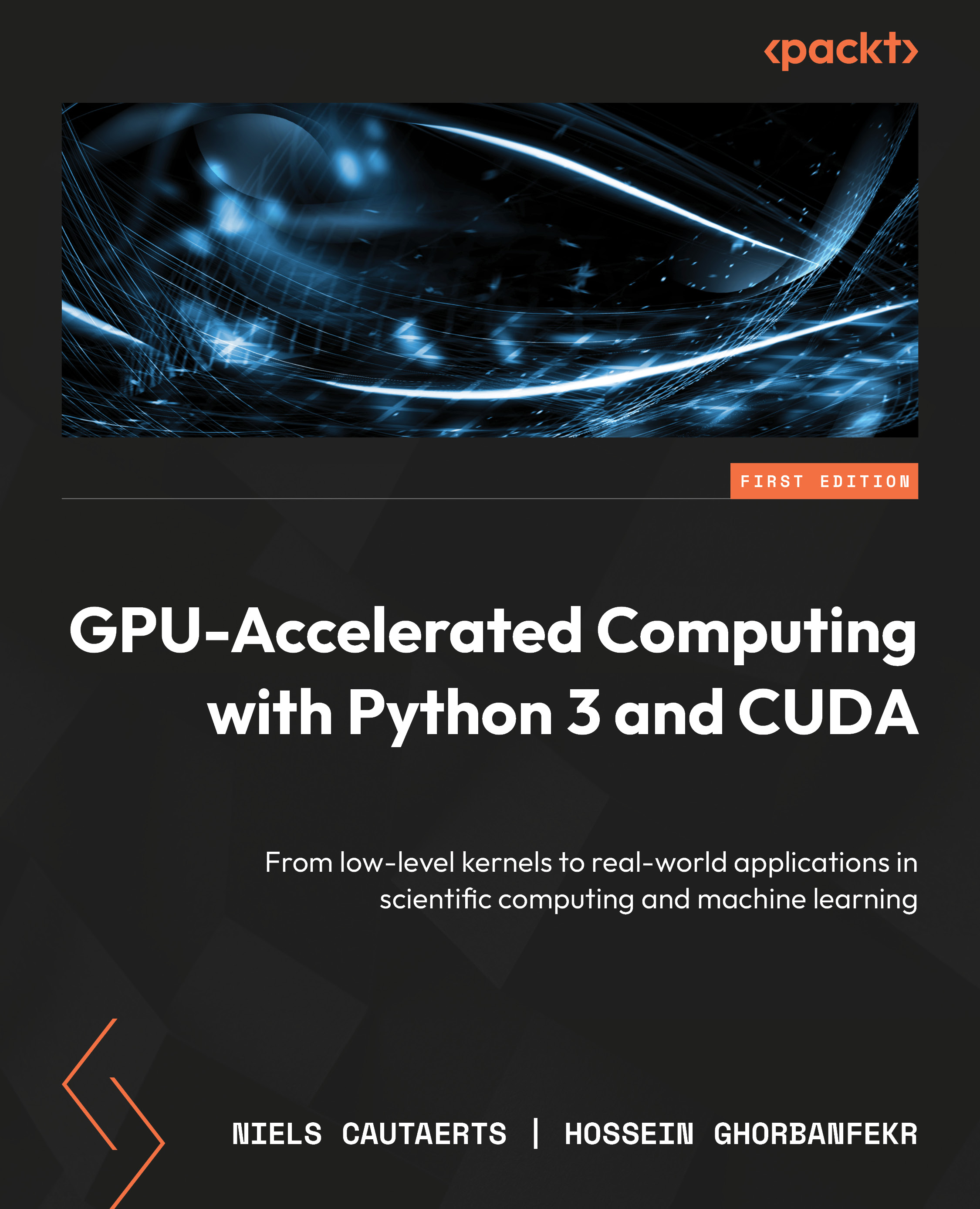
GPU-Accelerated Computing with Python 3 and CUDA

You're reading from   GPU-Accelerated Computing with Python 3 and CUDA From low-level kernels to real-world applications in scientific computing and machine learning

Arrow left icon
Product type Paperback
Published in Mar 2026
Publisher Packt
ISBN-13 9781803245423
Length 534 pages
Edition 1st Edition
Languages
Tools
Arrow right icon
Authors (2):
Arrow left icon
Niels Cautaerts Niels Cautaerts
Author Profile Icon Niels Cautaerts
Niels Cautaerts
Hossein Ghorbanfekr Hossein Ghorbanfekr
Author Profile Icon Hossein Ghorbanfekr
Hossein Ghorbanfekr
Arrow right icon
View More author details
Toc

Table of Contents (24) Chapters Close

Preface 1. Part 1: Fundamentals of GPU programming with CUDA in Python 3
2. Chapter 1: Why GPU Programming with CUDA in Python 3? FREE CHAPTER 3. Chapter 2: Setting Up a GPU Programming Environment Locally and in the Cloud 4. Chapter 3: Writing and Executing CUDA Kernels with Numba-CUDA 5. Chapter 4: Profiling and Debugging CUDA Code 6. Part 2: Performance Optimization and Advanced CUDA Topics
7. Chapter 5: Optimizing the Performance of CUDA Code 8. Chapter 6: Enabling Concurrency Using CUDA Streams 9. Chapter 7: Scaling to Multiple GPUs 10. Part 3: Using High-Level Python Libraries for GPU Computation
11. Chapter 8: Bringing NumPy and SciPy to the GPU with CuPy 12. Chapter 9: Bringing pandas and scikit-learn to the GPU with Rapids 13. Chapter 10: Solving Optimization Problems on the GPU with JAX 14. Part 4: Real-World Example Applications
15. Chapter 11: Solving the Heat Equation on the GPU 16. Chapter 12: Image Processing and Computer Vision on the GPU 17. Chapter 13: Simulating Atomic Interactions on the GPU 18. Chapter 14: Implementing Your Own Transformer-Based Language Model 19. Part 5: Beyond This Book
20. Chapter 15: Expanding and Deepening Your GPU Programming Knowledge 21. Chapter 16: Unlock Your Exclusive Benefits 22. Other Books You May Enjoy 23. Index

1

Why GPU Programming with CUDA in Python 3?

What do blockchain and artificial intelligence (AI) have in common?

At a surface level, both technologies have, in recent years, garnered a lot of media attention and investment and formed the basis for many start-ups. But beneath these applications lies a common technological foundation: general-purpose computing on graphics processing units (GPGPUs) to accelerate massively parallel computations. While the long-term impact of AI and blockchain is yet to be felt, GPGPU has already demonstrated its immense value across a multitude of fields and application areas, despite receiving significantly less public attention.

GPU programming is traditionally taught through low-level programming languages such as C or C++. This book takes a different approach and teaches GPGPU through various libraries available in Python 3. This makes the subject more accessible to our target audience: data scientists and researchers who primarily use Python and seek to accelerate computationally intensive code. This book focuses entirely on the CUDA platform, which is the most popular GPU programming framework that runs exclusively on NVIDIA hardware.

In this chapter, we will learn what GPGPU and CUDA are and how to recognize scenarios that benefit from GPGPU. We will also learn how to estimate and measure the benefits of accelerating our computations using GPGPU. We will also review the limitations of GPGPU, because unfortunately, it is not a magic bullet that can speed up any computation:

  • Understand the benefits, application areas, and limitations of GPU computing
  • Calculate the theoretical compute capacity of devices
  • Identify which types of problems benefit from massive parallelization, and estimate performance gains with Amdahl's law
  • Recognize additional factors, such as data transfers, that influence computing performance
  • Use cProfile and Scalene to discover bottlenecks in Python code

Your purchase includes a free PDF copy + exclusive extras

Your purchase includes a DRM-free PDF copy of this book, 7-day trial to the Packt+ library (no credit card required), and additional exclusive extras. See the Free benefits with your book section in the Preface to unlock them instantly and maximize your learning.

CONTINUE READING
83
Tech Concepts
36
Programming languages
73
Tech Tools
Icon Unlimited access to the largest independent learning library in tech of over 8,000 expert-authored tech books and videos.
Icon Innovative learning tools, including AI book assistants, code context explainers, and text-to-speech.
Icon 50+ new titles added per month and exclusive early access to books as they are being written.
GPU-Accelerated Computing with Python 3 and CUDA
You have been reading a chapter from
GPU-Accelerated Computing with Python 3 and CUDA
Published in: Mar 2026
Publisher: Packt
ISBN-13: 9781803245423
Register for a free Packt account to unlock a world of extra content!
A free Packt account unlocks extra newsletters, articles, discounted offers, and much more. Start advancing your knowledge today.
Unlock this book and the full library FREE for 7 days
Get unlimited access to 7000+ expert-authored eBooks and videos courses covering every tech area you can think of
Renews at €18.99/month. Cancel anytime
Modal Close icon
Modal Close icon