Search icon CANCEL
Subscription
0
Cart icon
Your Cart (0 item)
Close icon
You have no products in your basket yet
Save more on your purchases! discount-offer-chevron-icon
Savings automatically calculated. No voucher code required.
Arrow left icon
Explore Products
Best Sellers
New Releases
Books
Videos
Audiobooks
Learning Hub
Newsletter Hub
Free Learning
Arrow right icon
timer SALE ENDS IN
0 Days
:
00 Hours
:
00 Minutes
:
00 Seconds
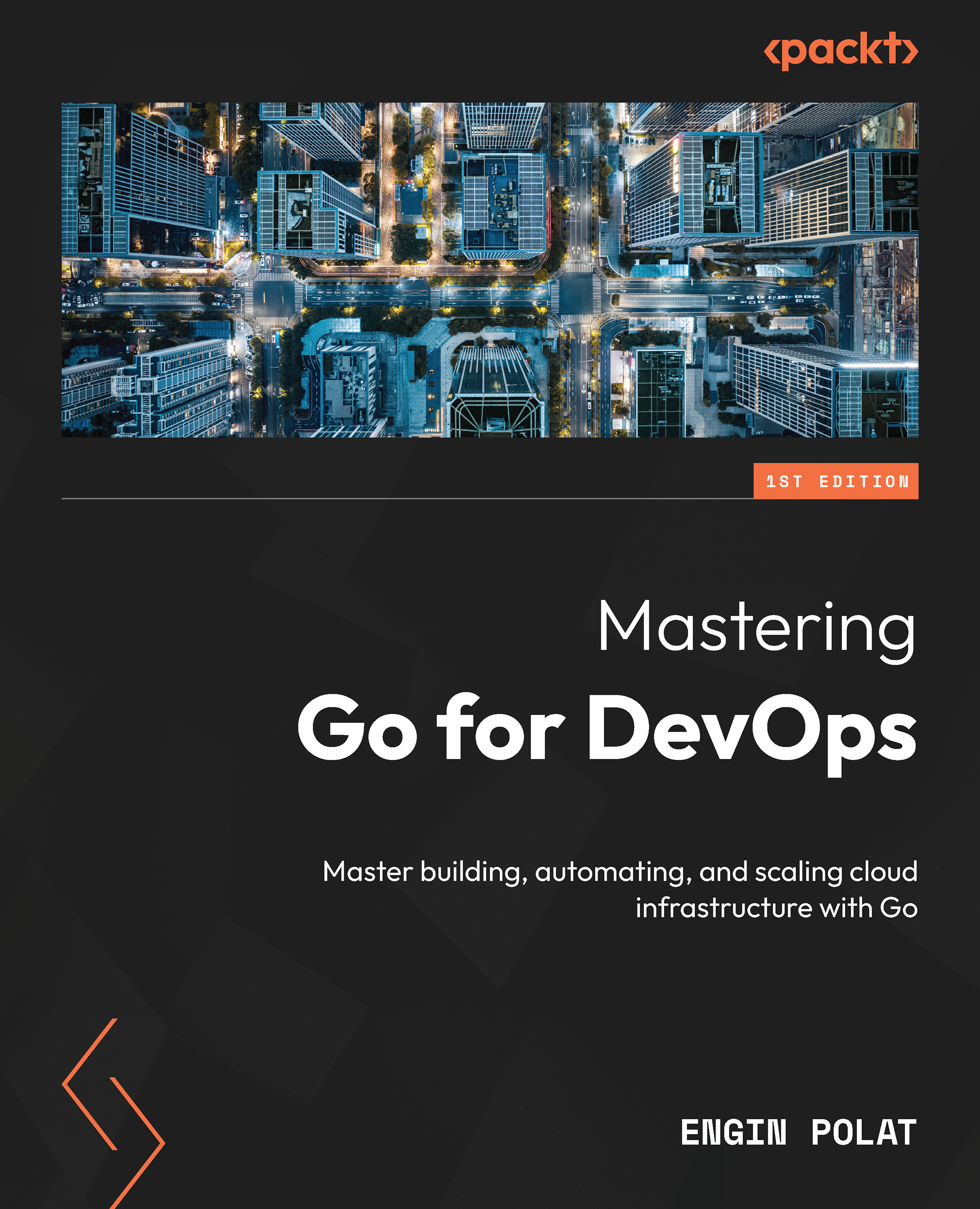
Mastering Go for DevOps

Mastering Go for DevOps: Master building, automating, and scaling cloud infrastructure with Go

Arrow left icon
Profile Icon Engin Polat
Arrow right icon
Mex$180 Mex$820.99
eBook Dec 2025 370 pages 1st Edition
eBook
Mex$180 Mex$820.99
Paperback
Mex$1025.99
Subscription
Free Trial
Arrow left icon
Profile Icon Engin Polat
Arrow right icon
Mex$180 Mex$820.99
eBook Dec 2025 370 pages 1st Edition
eBook
Mex$180 Mex$820.99
Paperback
Mex$1025.99
Subscription
Free Trial
eBook
Mex$180 Mex$820.99
Paperback
Mex$1025.99
Subscription
Free Trial

What do you get with eBook?

Product feature icon Instant access to your Digital eBook purchase
Product feature icon Download this book in EPUB and PDF formats
Product feature icon Access this title in our online reader with advanced features
Product feature icon DRM FREE - Read whenever, wherever and however you want
Product feature icon AI Assistant (beta) to help accelerate your learning
Modal Close icon
Payment Processing...
tick Completed

Billing Address

Table of content icon View table of contents Preview book icon Preview Book

Mastering Go for DevOps

Developing Command-Line Interfaces with Go

In today’s DevOps ecosystem, command-line interfaces (CLIs) are more than just helpful utilities; they’re core tools that empower engineers to streamline workflows, manage infrastructure, and orchestrate complex deployments with precision and speed.

A well-designed CLI tool enables seamless automation, giving DevOps teams the agility they need to handle everything from routine tasks to high-stakes production issues. For any DevOps professional, mastering the creation of CLI tools can open doors to greater efficiency, reliability, and control over infrastructure.

This chapter focuses on building robust and elegant CLI applications with Go, a language well suited for DevOps needs. Go brings specific strengths that make it an ideal choice for developing CLIs that need to perform reliably across diverse environments, scale with demands, and operate efficiently under heavy workloads.

In this chapter, we will cover the...

Join our book community on Discord!

https://packt.link/mqfS2

In today's DevOps ecosystem, command-line interfaces (CLIs) are more than just helpful utilities, they're core tools that empower engineers to streamline workflows, manage infrastructure, and orchestrate complex deployments with precision and speed.A well-designed CLI tool enables seamless automation, giving DevOps teams the agility they need to handle everything from routine tasks to high-stakes production issues. For any DevOps professional, mastering the creation of CLI tools can open doors to greater efficiency, reliability, and control over infrastructure.This chapter focuses on building robust and elegant CLI applications with Go, a language well-suited for DevOps needs. Go brings specific strengths that make it an ideal choice for developing CLIs that need to perform reliably across diverse environments, scale with demands, and operate efficiently under heavy workloads.

In this chapter, we will cover the following...

Why Go is the perfect match for CLI development in DevOps

Command-line interfaces (CLIs) play an important role in DevOps by helping teams automate tasks, interact with infrastructure, and manage systems more efficiently. Whether it's deploying services, configuring environments, or pulling logs, CLI tools give engineers precision and speed at the keyboard. In DevOps, where repeatability and automation are essential, building custom CLI tools allows teams to tailor workflows to their exact needs.Go is particularly well-suited for building CLI tools that meet these demands. It combines performance, portability, and simplicity in a way that supports the fast-paced and often complex nature of DevOps work.

  • Cross-compilation: Go's built-in cross-compilation capabilities allow developers to build executables for multiple operating systems, such as Linux, macOS, and Windows, from a single codebase. This flexibility is especially useful in DevOps, where tools must often work across...

Building reliable, user-friendly, and efficient CLI tools in Go

In this section, you will learn how to build a well-structured, practical CLI application in Go that meets the demands of real-world DevOps scenarios. You'll learn how to organize commands, handle arguments and flags, and output information in a way that's user-friendly and polished. We'll also cover CLI best practices, such as error handling, code organization, and maintaining consistent behavior across environments, ensuring your application is as robust as it is functional.Through hands-on examples and step-by-step guidance, this section aims to give you the skills to develop, test, and refine Go-based CLIs that are effective, efficient, and ready for deployment.

Command parsing and argument handling

Command parsing and argument handling are key parts of any command-line application. These features allow a CLI tool to understand what action the user wants to perform and what data they want to provide.Commands...

Summary

In this chapter, we explored the essentials of developing command-line interfaces (CLIs) using Go, a language well-suited for DevOps needs. We started by understanding the importance of CLIs in the DevOps ecosystem and why Go is an ideal choice for building these tools. We then delved into various methods for parsing commands and handling arguments, from basic approaches using the os and flag packages to more advanced techniques with the cobra package. Additionally, we covered the best practices for organizing commands, error handling, and providing user-friendly output.We also examined how to enhance CLI applications with effective output formatting, including the use of tables and color for better readability and user feedback. Networking best practices were discussed, emphasizing concurrency, error handling, secure connections, and rate limiting to build robust and reliable tools.Finally, we highlighted the importance of intuitive command structures, comprehensive documentation...

Left arrow icon Right arrow icon

Key benefits

  • Build scalable DevOps tools, APIs, and CLIs using Go
  • Develop custom Terraform providers and test them with the SDK
  • Integrate Prometheus metrics, AWS, and Azure cloud SDKs
  • Purchase of the print or Kindle book includes a free PDF eBook

Description

Mastering Go for DevOps shows you how to harness Go to build production-ready tools, from interactive CLIs to observability integrations and custom Terraform providers. Mastering Go for DevOps takes a hands-on approach, teaching you how to create robust CLI applications, develop RESTful APIs and gRPC services, and integrate monitoring solutions with Prometheus. You'll extend Terraform with custom providers, write comprehensive unit and integration tests using the Terraform SDK, and automate your testing in CI/CD pipelines with GitHub Actions. You'll also explore cloud-native development by integrating Go applications with AWS and Azure SDKs and deploying serverless functions with AWS Lambda and Azure Functions. Whether you're building automation scripts or distributed systems, this book equips you with the skills to streamline and scale your infrastructure operations. By the end of this book, you'll know how to build Go-based DevOps tools, automate infrastructure provisioning, and create cloud-native systems ready for real-world deployment.

Who is this book for?

This book is for DevOps engineers, cloud engineers, and infrastructure specialists who want to build scalable automation and tooling using Go. Prior knowledge of Go and DevOps concepts such as version control, pipelines, and YAML is recommended.

What you will learn

  • Develop interactive CLIs and package them for distribution
  • Implement RESTful APIs and gRPC services in Go
  • Integrate Prometheus metrics and build custom exporters
  • Build custom Terraform providers with CRUD support
  • Write unit and integration tests using the Terraform SDK
  • Automate testing workflows in GitHub Actions
  • Use Go to interact with AWS and Azure services programmatically
  • Create and deploy serverless functions using AWS Lambda and Azure Functions

Product Details

Country selected
Publication date, Length, Edition, Language, ISBN-13
Publication date : Dec 15, 2025
Length: 370 pages
Edition : 1st
Language : English
ISBN-13 : 9781837027323
Concepts :

What do you get with eBook?

Product feature icon Instant access to your Digital eBook purchase
Product feature icon Download this book in EPUB and PDF formats
Product feature icon Access this title in our online reader with advanced features
Product feature icon DRM FREE - Read whenever, wherever and however you want
Product feature icon AI Assistant (beta) to help accelerate your learning
Modal Close icon
Payment Processing...
tick Completed

Billing Address

Product Details

Publication date : Dec 15, 2025
Length: 370 pages
Edition : 1st
Language : English
ISBN-13 : 9781837027323
Concepts :

Packt Subscriptions

See our plans and pricing
Modal Close icon
$19.99 billed monthly
Feature tick icon Unlimited access to Packt's library of 7,000+ practical books and videos
Feature tick icon Constantly refreshed with 50+ new titles a month
Feature tick icon Exclusive Early access to books as they're written
Feature tick icon Solve problems while you work with advanced search and reference features
Feature tick icon Offline reading on the mobile app
Feature tick icon Simple pricing, no contract
$199.99 billed annually
Feature tick icon Unlimited access to Packt's library of 7,000+ practical books and videos
Feature tick icon Constantly refreshed with 50+ new titles a month
Feature tick icon Exclusive Early access to books as they're written
Feature tick icon Solve problems while you work with advanced search and reference features
Feature tick icon Offline reading on the mobile app
Feature tick icon Choose a DRM-free eBook or Video every month to keep
Feature tick icon PLUS own as many other DRM-free eBooks or Videos as you like for just Mex$85 each
Feature tick icon Exclusive print discounts
$279.99 billed in 18 months
Feature tick icon Unlimited access to Packt's library of 7,000+ practical books and videos
Feature tick icon Constantly refreshed with 50+ new titles a month
Feature tick icon Exclusive Early access to books as they're written
Feature tick icon Solve problems while you work with advanced search and reference features
Feature tick icon Offline reading on the mobile app
Feature tick icon Choose a DRM-free eBook or Video every month to keep
Feature tick icon PLUS own as many other DRM-free eBooks or Videos as you like for just Mex$85 each
Feature tick icon Exclusive print discounts

Table of Contents

20 Chapters
Part 1: Go Foundations - CLI, Monitoring, and APIs Chevron down icon Chevron up icon
Developing Command-Line Interfaces with Go Chevron down icon Chevron up icon
Packaging and Distributing Go CLIs Chevron down icon Chevron up icon
Integrating Go Applications with Prometheus Chevron down icon Chevron up icon
Writing Go Exporters for Prometheus Chevron down icon Chevron up icon
Building and Consuming RESTful APIs with Go Chevron down icon Chevron up icon
Working with gRPC and Microservices Architecture Chevron down icon Chevron up icon
Part 2: Build Custom Terraform Providers with Go Chevron down icon Chevron up icon
Using Go to Build Custom Terraform Providers Chevron down icon Chevron up icon
Writing Unit Tests and Integration Tests for Terraform Providers Chevron down icon Chevron up icon
Documenting and Publishing Terraform Providers Chevron down icon Chevron up icon
Automating Testing in Pipelines Chevron down icon Chevron up icon
Part 3: Go for Cloud Services Chevron down icon Chevron up icon
Integrating Go Applications with the AWS SDK Chevron down icon Chevron up icon
Integrating Go Applications with the Azure SDK Chevron down icon Chevron up icon
Serverless Computing Using AWS Lambda Chevron down icon Chevron up icon
Serverless Computing Using Azure Functions Chevron down icon Chevron up icon
Unlock Your Exclusive Benefits Chevron down icon Chevron up icon
Other Books You May Enjoy Chevron down icon Chevron up icon
Index Chevron down icon Chevron up icon
Get free access to Packt library with over 7500+ books and video courses for 7 days!
Start Free Trial

FAQs

How do I buy and download an eBook? Chevron down icon Chevron up icon

Where there is an eBook version of a title available, you can buy it from the book details for that title. Add either the standalone eBook or the eBook and print book bundle to your shopping cart. Your eBook will show in your cart as a product on its own. After completing checkout and payment in the normal way, you will receive your receipt on the screen containing a link to a personalised PDF download file. This link will remain active for 30 days. You can download backup copies of the file by logging in to your account at any time.

If you already have Adobe reader installed, then clicking on the link will download and open the PDF file directly. If you don't, then save the PDF file on your machine and download the Reader to view it.

Please Note: Packt eBooks are non-returnable and non-refundable.

Packt eBook and Licensing When you buy an eBook from Packt Publishing, completing your purchase means you accept the terms of our licence agreement. Please read the full text of the agreement. In it we have tried to balance the need for the ebook to be usable for you the reader with our needs to protect the rights of us as Publishers and of our authors. In summary, the agreement says:

  • You may make copies of your eBook for your own use onto any machine
  • You may not pass copies of the eBook on to anyone else
How can I make a purchase on your website? Chevron down icon Chevron up icon

If you want to purchase a video course, eBook or Bundle (Print+eBook) please follow below steps:

  1. Register on our website using your email address and the password.
  2. Search for the title by name or ISBN using the search option.
  3. Select the title you want to purchase.
  4. Choose the format you wish to purchase the title in; if you order the Print Book, you get a free eBook copy of the same title. 
  5. Proceed with the checkout process (payment to be made using Credit Card, Debit Cart, or PayPal)
Where can I access support around an eBook? Chevron down icon Chevron up icon
  • If you experience a problem with using or installing Adobe Reader, the contact Adobe directly.
  • To view the errata for the book, see www.packtpub.com/support and view the pages for the title you have.
  • To view your account details or to download a new copy of the book go to www.packtpub.com/account
  • To contact us directly if a problem is not resolved, use www.packtpub.com/contact-us
What eBook formats do Packt support? Chevron down icon Chevron up icon

Our eBooks are currently available in a variety of formats such as PDF and ePubs. In the future, this may well change with trends and development in technology, but please note that our PDFs are not Adobe eBook Reader format, which has greater restrictions on security.

You will need to use Adobe Reader v9 or later in order to read Packt's PDF eBooks.

What are the benefits of eBooks? Chevron down icon Chevron up icon
  • You can get the information you need immediately
  • You can easily take them with you on a laptop
  • You can download them an unlimited number of times
  • You can print them out
  • They are copy-paste enabled
  • They are searchable
  • There is no password protection
  • They are lower price than print
  • They save resources and space
What is an eBook? Chevron down icon Chevron up icon

Packt eBooks are a complete electronic version of the print edition, available in PDF and ePub formats. Every piece of content down to the page numbering is the same. Because we save the costs of printing and shipping the book to you, we are able to offer eBooks at a lower cost than print editions.

When you have purchased an eBook, simply login to your account and click on the link in Your Download Area. We recommend you saving the file to your hard drive before opening it.

For optimal viewing of our eBooks, we recommend you download and install the free Adobe Reader version 9.

Modal Close icon
Modal Close icon