Search icon CANCEL
Subscription
0
Cart icon
Your Cart (0 item)
Close icon
You have no products in your basket yet
Save more on your purchases! discount-offer-chevron-icon
Savings automatically calculated. No voucher code required.
Arrow left icon
Explore Products
Best Sellers
New Releases
Books
Events
Videos
Audiobooks
Packt Hub
Free Learning
Arrow right icon
timer SALE ENDS IN
0 Days
:
00 Hours
:
00 Minutes
:
00 Seconds
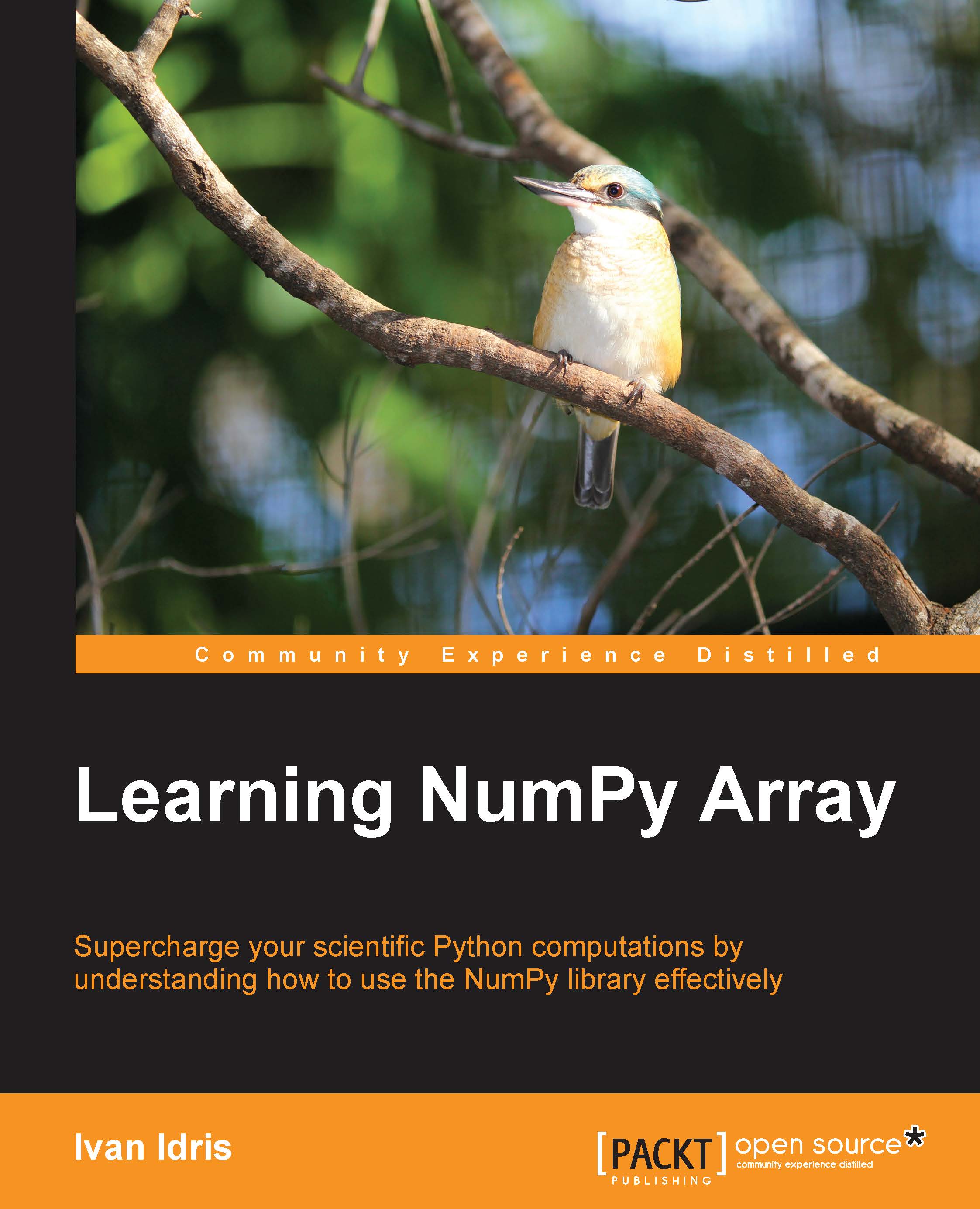
Learning NumPy Array

Learning NumPy Array: Supercharge your scientific Python computations by understanding how to use the NumPy library effectively

eBook
Mex$443.69 Mex$492.99
Paperback
Mex$615.99
Subscription
Free Trial

What do you get with a Packt Subscription?

Free for first 7 days. $19.99 p/m after that. Cancel any time!
Product feature icon Unlimited ad-free access to the largest independent learning library in tech. Access this title and thousands more!
Product feature icon 50+ new titles added per month, including many first-to-market concepts and exclusive early access to books as they are being written.
Product feature icon Innovative learning tools, including AI book assistants, code context explainers, and text-to-speech.
Product feature icon Thousands of reference materials covering every tech concept you need to stay up to date.
Subscribe now
View plans & pricing
Table of content icon View table of contents Preview book icon Preview Book

Learning NumPy Array

Left arrow icon Right arrow icon

Description

A step-by-step guide, packed with examples of practical numerical analysis that will give you a comprehensive, but concise overview of NumPy. This book is for programmers, scientists, or engineers, who have basic Python knowledge and would like to be able to do numerical computations with Python.

What you will learn

  • Install NumPy and discover its arrays and features
  • Perform data analysis and complex array operations with NumPy
  • Analyze time series and perform signal processing
  • Understand NumPy modules and explore the scientific Python ecosystem
  • Improve the performance of calculations with clean and efficient NumPy code
  • Analyze large data sets using statistical functions and execute complex linear algebra and mathematical computations

Product Details

Country selected
Publication date, Length, Edition, Language, ISBN-13
Publication date : Jun 13, 2014
Length: 164 pages
Edition : 1st
Language : English
ISBN-13 : 9781783983902
Category :
Languages :
Concepts :
Tools :

What do you get with a Packt Subscription?

Free for first 7 days. $19.99 p/m after that. Cancel any time!
Product feature icon Unlimited ad-free access to the largest independent learning library in tech. Access this title and thousands more!
Product feature icon 50+ new titles added per month, including many first-to-market concepts and exclusive early access to books as they are being written.
Product feature icon Innovative learning tools, including AI book assistants, code context explainers, and text-to-speech.
Product feature icon Thousands of reference materials covering every tech concept you need to stay up to date.
Subscribe now
View plans & pricing

Product Details

Publication date : Jun 13, 2014
Length: 164 pages
Edition : 1st
Language : English
ISBN-13 : 9781783983902
Category :
Languages :
Concepts :
Tools :

Packt Subscriptions

See our plans and pricing
Modal Close icon
$19.99 billed monthly
Feature tick icon Unlimited access to Packt's library of 7,000+ practical books and videos
Feature tick icon Constantly refreshed with 50+ new titles a month
Feature tick icon Exclusive Early access to books as they're written
Feature tick icon Solve problems while you work with advanced search and reference features
Feature tick icon Offline reading on the mobile app
Feature tick icon Simple pricing, no contract
$199.99 billed annually
Feature tick icon Unlimited access to Packt's library of 7,000+ practical books and videos
Feature tick icon Constantly refreshed with 50+ new titles a month
Feature tick icon Exclusive Early access to books as they're written
Feature tick icon Solve problems while you work with advanced search and reference features
Feature tick icon Offline reading on the mobile app
Feature tick icon Choose a DRM-free eBook or Video every month to keep
Feature tick icon PLUS own as many other DRM-free eBooks or Videos as you like for just Mex$85 each
Feature tick icon Exclusive print discounts
$279.99 billed in 18 months
Feature tick icon Unlimited access to Packt's library of 7,000+ practical books and videos
Feature tick icon Constantly refreshed with 50+ new titles a month
Feature tick icon Exclusive Early access to books as they're written
Feature tick icon Solve problems while you work with advanced search and reference features
Feature tick icon Offline reading on the mobile app
Feature tick icon Choose a DRM-free eBook or Video every month to keep
Feature tick icon PLUS own as many other DRM-free eBooks or Videos as you like for just Mex$85 each
Feature tick icon Exclusive print discounts

Frequently bought together


Stars icon
Total Mex$ 2,707.97
Learning NumPy Array
Mex$615.99
NumPy Beginner's Guide - Second Edition
Mex$1045.99
NumPy Cookbook
Mex$1045.99
Total Mex$ 2,707.97 Stars icon

Table of Contents

7 Chapters
Getting Started with NumPy Chevron down icon Chevron up icon
NumPy Basics Chevron down icon Chevron up icon
Basic Data Analysis with NumPy Chevron down icon Chevron up icon
Simple Predictive Analytics with NumPy Chevron down icon Chevron up icon
Signal Processing Techniques Chevron down icon Chevron up icon
Profiling, Debugging, and Testing Chevron down icon Chevron up icon
The Scientific Python Ecosystem Chevron down icon Chevron up icon

Customer reviews

Top Reviews
Rating distribution
Full star icon Full star icon Full star icon Full star icon Empty star icon 4
(9 Ratings)
5 star 55.6%
4 star 22.2%
3 star 0%
2 star 11.1%
1 star 11.1%
Filter icon Filter
Top Reviews

Filter reviews by


Edward Grefenstette Aug 07, 2014
Full star icon Full star icon Full star icon Full star icon Full star icon 5
The following review was produced after being sent a free copy of the book by Packt Publishing. I have endeavoured to be objective and state my view of the book, unaltered by this."Learning NumPy Array" by Ivan Idris is an excellent book which covers a range of use cases for the Python NumPy library across different aspects of scientific computing. It gives a short introduction to NumPy classes and core functions, discusses data analysis with NumPy data structures, and then using the pandas library (built on top of NumPy, amongst other libraries), provides a succinct overview of signal processing techniques with NumPy, followed by a short tutorial of profiling and debugging NumPy code with iPython, UnitTest, and Nose. The book ends with a helpful chapter on other tools scientific computing programmers may wish to consider alongside NumPy, most importantly cython and sklearn.While the book is entitled "Learning NumPy Array", it is not exactly aimed at a beginner audience. The reader is assumed to have a decent knowledge of linear algebra, statistics, and some cursory experience with similar statistics or matrix libraries/languages such as Matlab or R. While it does introduce NumPy basics, the reader should expect to have access to the NumPy documentation while reading the book to get the most out of it. Chapters 3 through 5 are quite dense, and readers without experience with the relevant areas (statistical analysis for chapters 3-4 and signal processing for chapter 5) will need to spend time and perhaps read third-party sources to get the most out of the material. All this is to say, this is a fairly technical book, but the examples are many, are well spelled-out, and coherently explained. Readers with a bit of experience in the domains it covers, or readers who are willing to put in the extra effort to read around the topics, will get a lot out of this book, and be able to implement solutions to similar problems quickly.In addition to the core material covered in chapters 3-5, I particularly enjoyed the fairly clear tutorials for profiling, debugging and testing in chapter six. Some of this material could easily have been excluded from the book in favour of expanding the explanations and giving some background in chapters 3-5, but I found the explanations to be well written and helpful, so the inclusion in this book is appreciated.Furthermore, the final chapter is a nice starting point for newcomers to the python scientific computing world, as it presents some helpful pointers (and use examples) to other resources available. Even as a researcher who has used these tools before once or twice, at least, this chapter was a good read and reminded me of how easily these libraries play with each other.Overall, this is a good read. It will take some small effort for most readers to get through the more technical sections of this book, but there is a lot to get out of reading it. While the same material can be found in several tutorials scattered around the web, it is good to see that someone took the effort to distil all the material into one volume, provide excellent example code, and enough explanation to feed intuitions as to how to best apply the knowledge presented in it.
Amazon Verified review Amazon
alan1955 Sep 17, 2014
Full star icon Full star icon Full star icon Full star icon Full star icon 5
This is an excellent book for learning NumPy. It is for someone who has experience with python and numerical coding. What I liked was chapter two where the book covers the basics of NumPy to get you quickly up and running. All in one chapter. So if you are already trying to do some basic things with NumPy, it will save you a lot of time. The rest of the book is filled with examples. The examples illustrate things you can do with NumPy, and are arranged topically. The topics cover basic data analysis, predictive analysis, smoothing, moving averages, and sifting. The other plus is that it introduces Scipy, the scientific python programming package. If you are not familiar with it, you will get to see what it can do in a few of the examples. It is also a short book. Being short it assumes you have a working knowledge of Python and some numerical experience. Too many computer books are so long, you can never get through them. Because of this you can quickly get up to speed. Also the code for examples can be downloaded, which is very helpful.
Amazon Verified review Amazon
Roberto Avilés Jul 30, 2014
Full star icon Full star icon Full star icon Full star icon Full star icon 5
This book is a 7 chapters, +140 page hands-on introduction to the power of Python’s Library, NumPy.In Chapter 1, we learn to install Python, SciPy, Matplotlib, IPython and NumPy on Windows, Linux and Macintosh machines and start writing NumPy code.Chapter 2 reviews the basics on NumPy: Data Types, Array Types, Type Conversions, Creating, Indexing, Slicing and Manipulating array Shapes. Advantages of NumPy arrays: we know items in the array are of the same type (example, dtype!) plus, NumPy arrays can perform vectorized operations on the whole array: better than using lists; NumPy uses an optimized C API for those operations which make them especially fast. We learn how to transform a multidimensional array into a one dimensional array, how to stack, split, convert, copy and view them by playing with images, doing tricks with Sudoku and audio arrays.In Chapter 3 we are ready to learn Basic Data Analysis by working on a genuine (and quite completely) data set by looking for evidence of planetary heating.Chapter 4 is about Predictive Analysis and the use of the ‘pandas’ library. Pandas have plotting subroutines and in this chapter data of previous chapter is re-examined and extended to correlating weather and stocks!Now, in Chapter 5 we focus on ‘Signal Processing Techniques’ and analyze time series. The example data set will be sunspot data which we sift and plot to show the extremes of Sun activity. Tools as ‘moving averages’ and smoothing functions are introduced and we are ready to do a forecasting using an ARMA (autoregressive moving average) model. Then we learn how to design and use a filter and the “cointegration”, a better metric to define the relatedness of two time series.In Chapter 6 the book moves into Profiling, Debugging and Testing. NumPy adds the numpy.testing package (and its utility functions) to help NumPy code the unit testing. Later we met Nose, a Python framework that eases unit testing by organizing it.Chapter 7 relates to the Scientific Python Ecosystem. Scipy is built on NumPy and adds functionality as numerical integration, interpolation, optimization, statistics, clustering with scikit-learn, the detection of corners (all with examples), the use of Cython with NumPy and compares NumPy to Blaze (a collection of libraries being built towards the goal of generalizing NumPy ‘s data model and working on distributed data.)This book is a complete hands-on guide on the use of NumPy, through worked examples and ideas, a must have for those interested in Data Analysis, Forecasting and Signal Processing Techniques.
Amazon Verified review Amazon
Sujit Pal Jun 21, 2014
Full star icon Full star icon Full star icon Full star icon Full star icon 5
Numpy is a fast matrix library that is at the core of scientific computing toolkits in Python - whether you are doing statistics, machine learning or signal processing (to name just a few possibilities), chances are you are using Numpy under the covers. Because Numpy is optimized for speed and because you are often dealing with large datasets, knowing the right function to call can mean the difference between run times of a few seconds or a few hours. This book can help you write cleaner and faster Numpy code.After a quick introduction to Numpy in Chapter 1, Chapter 2 takes the reader through a quick tour of Numpy functions, describing the major ones, including differently named functions which do the same thing, one updating in place and the other creating a copy. Chapter 3-5 on is all case studies, mostly about Time Series Analysis and Signal Processing, perhaps because they are good vehicles for demonstrating array handling techniques, but a nice side effect is that it gives the reader a quick introduction to these subjects as well. Chapter 6 describes Numpy's unit testing functionality, and also covers Python unit testing frameworks (unittest package as well as nose). It also describes how to profile and debug Python code from the IPython shell. Chapter 7 quickly covers various other players in the scientific Python ecosystem, and describes how to optimize Python code by rewriting them to Cython.I found the book immensely informative and relatively easy to read. It helps to actually work through the code in a Python shell as you are reading the book, in some cases the author condenses multiple steps into a single one, obviously expecting the reader to follow along, so being able to break the steps into smaller ones can help in understanding. Using the shell also gives you access to Python's help system, so you can read about new functions as you encounter them. One minor nit - it would have been more convenient if the data used for the analysis could have been packaged with the code for the book (for people reading the book offline) - but perhaps there are copyright restrictions on such distribution.DISCLAIMER: I didn't purchase this book, a PackT representative in my social network was offering free copies to review, and I asked for one because (a) I use Numpy and wanted to learn more and (b) as a Numpy user, I felt qualified to review the book objectively.
Amazon Verified review Amazon
Daniel R. Vallejo Sep 28, 2014
Full star icon Full star icon Full star icon Full star icon Full star icon 5
great
Amazon Verified review Amazon
Get free access to Packt library with over 7500+ books and video courses for 7 days!
Start Free Trial

FAQs

What is included in a Packt subscription? Chevron down icon Chevron up icon

A subscription provides you with full access to view all Packt and licnesed content online, this includes exclusive access to Early Access titles. Depending on the tier chosen you can also earn credits and discounts to use for owning content

How can I cancel my subscription? Chevron down icon Chevron up icon

To cancel your subscription with us simply go to the account page - found in the top right of the page or at https://subscription.packtpub.com/my-account/subscription - From here you will see the ‘cancel subscription’ button in the grey box with your subscription information in.

What are credits? Chevron down icon Chevron up icon

Credits can be earned from reading 40 section of any title within the payment cycle - a month starting from the day of subscription payment. You also earn a Credit every month if you subscribe to our annual or 18 month plans. Credits can be used to buy books DRM free, the same way that you would pay for a book. Your credits can be found in the subscription homepage - subscription.packtpub.com - clicking on ‘the my’ library dropdown and selecting ‘credits’.

What happens if an Early Access Course is cancelled? Chevron down icon Chevron up icon

Projects are rarely cancelled, but sometimes it's unavoidable. If an Early Access course is cancelled or excessively delayed, you can exchange your purchase for another course. For further details, please contact us here.

Where can I send feedback about an Early Access title? Chevron down icon Chevron up icon

If you have any feedback about the product you're reading, or Early Access in general, then please fill out a contact form here and we'll make sure the feedback gets to the right team. 

Can I download the code files for Early Access titles? Chevron down icon Chevron up icon

We try to ensure that all books in Early Access have code available to use, download, and fork on GitHub. This helps us be more agile in the development of the book, and helps keep the often changing code base of new versions and new technologies as up to date as possible. Unfortunately, however, there will be rare cases when it is not possible for us to have downloadable code samples available until publication.

When we publish the book, the code files will also be available to download from the Packt website.

How accurate is the publication date? Chevron down icon Chevron up icon

The publication date is as accurate as we can be at any point in the project. Unfortunately, delays can happen. Often those delays are out of our control, such as changes to the technology code base or delays in the tech release. We do our best to give you an accurate estimate of the publication date at any given time, and as more chapters are delivered, the more accurate the delivery date will become.

How will I know when new chapters are ready? Chevron down icon Chevron up icon

We'll let you know every time there has been an update to a course that you've bought in Early Access. You'll get an email to let you know there has been a new chapter, or a change to a previous chapter. The new chapters are automatically added to your account, so you can also check back there any time you're ready and download or read them online.

I am a Packt subscriber, do I get Early Access? Chevron down icon Chevron up icon

Yes, all Early Access content is fully available through your subscription. You will need to have a paid for or active trial subscription in order to access all titles.

How is Early Access delivered? Chevron down icon Chevron up icon

Early Access is currently only available as a PDF or through our online reader. As we make changes or add new chapters, the files in your Packt account will be updated so you can download them again or view them online immediately.

How do I buy Early Access content? Chevron down icon Chevron up icon

Early Access is a way of us getting our content to you quicker, but the method of buying the Early Access course is still the same. Just find the course you want to buy, go through the check-out steps, and you’ll get a confirmation email from us with information and a link to the relevant Early Access courses.

What is Early Access? Chevron down icon Chevron up icon

Keeping up to date with the latest technology is difficult; new versions, new frameworks, new techniques. This feature gives you a head-start to our content, as it's being created. With Early Access you'll receive each chapter as it's written, and get regular updates throughout the product's development, as well as the final course as soon as it's ready.We created Early Access as a means of giving you the information you need, as soon as it's available. As we go through the process of developing a course, 99% of it can be ready but we can't publish until that last 1% falls in to place. Early Access helps to unlock the potential of our content early, to help you start your learning when you need it most. You not only get access to every chapter as it's delivered, edited, and updated, but you'll also get the finalized, DRM-free product to download in any format you want when it's published. As a member of Packt, you'll also be eligible for our exclusive offers, including a free course every day, and discounts on new and popular titles.

Modal Close icon
Modal Close icon