Search icon CANCEL
Subscription
0
Cart icon
Your Cart (0 item)
Close icon
You have no products in your basket yet
Save more on your purchases! discount-offer-chevron-icon
Savings automatically calculated. No voucher code required.
Arrow left icon
Explore Products
Best Sellers
New Releases
Books
Videos
Audiobooks
Learning Hub
Newsletter Hub
Free Learning
Arrow right icon
timer SALE ENDS IN
0 Days
:
00 Hours
:
00 Minutes
:
00 Seconds
Arrow up icon
GO TO TOP
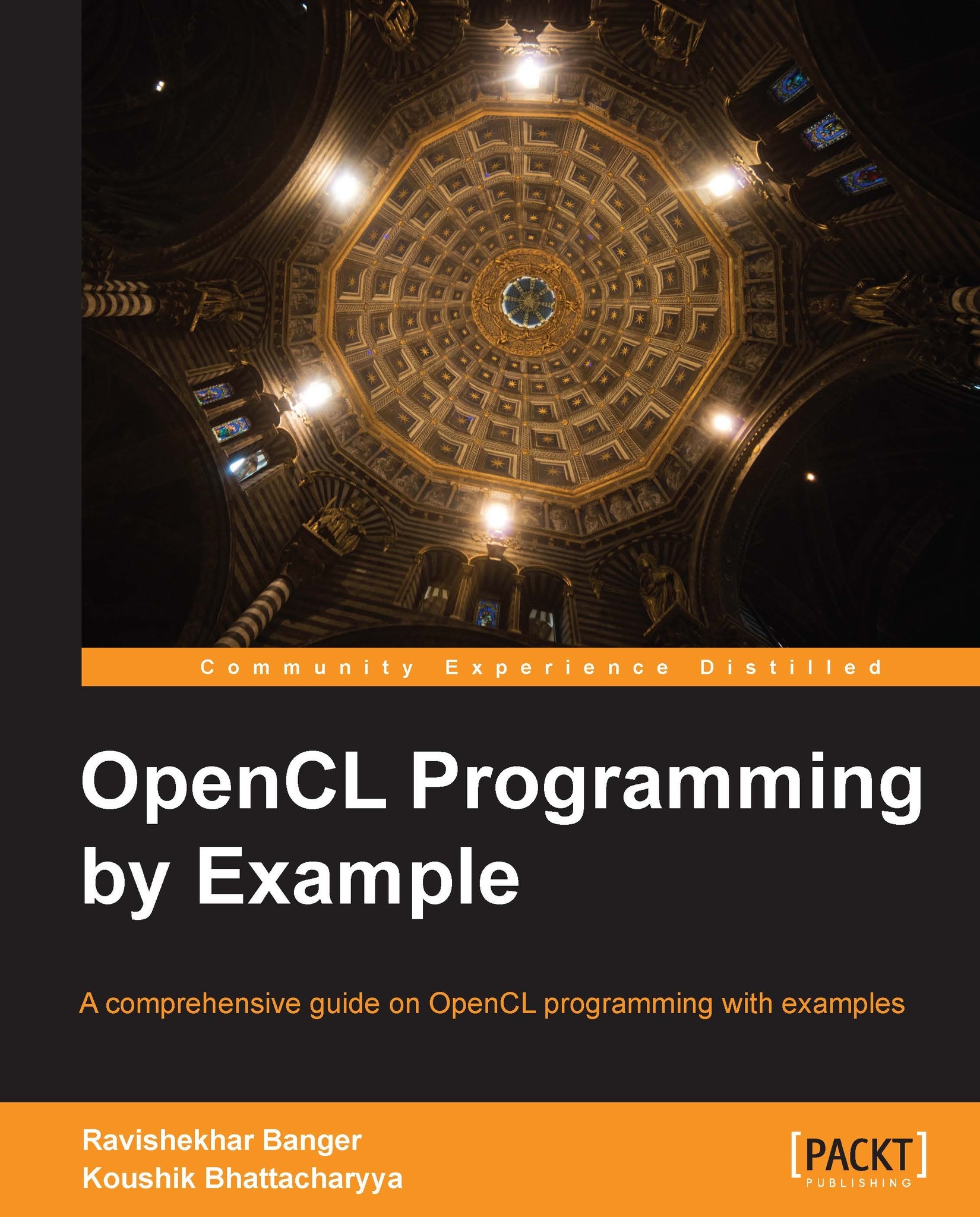
OpenCL Programming by Example

You're reading from   OpenCL Programming by Example A comprehensive guide on OpenCL programming with examples with this book and ebook

Arrow left icon
Product type Paperback
Published in Dec 2013
Publisher Packt
ISBN-13 9781849692342
Length 304 pages
Edition 1st Edition
Languages
Tools
Arrow right icon
Authors (2):
Arrow left icon
 Banger Banger
Author Profile Icon Banger
Banger
Koushik Bhattacharyya Koushik Bhattacharyya
Author Profile Icon Koushik Bhattacharyya
Koushik Bhattacharyya
Arrow right icon
View More author details
Toc

Table of Contents (13) Chapters Close

Preface 1. Hello OpenCL FREE CHAPTER 2. OpenCL Architecture 3. OpenCL Buffer Objects 4. OpenCL Images 5. OpenCL Program and Kernel Objects 6. Events and Synchronization 7. OpenCL C Programming 8. Basic Optimization Techniques with Case Studies 9. Image Processing and OpenCL 10. OpenCL-OpenGL Interoperation 11. Case studies – Regressions, Sort, and KNN Index

Finding the performance of your program?


In the ongoing process of optimization of an OpenCL program we need to find performance bottlenecks at each step so that we can improve on them. Here are some techniques for this investigation. In a Unix based system the time command provides user time, system time, and CPU time of a program-execution in detail. In Windows PowerShell, we use a built-in command called Measure-Command that gives total running time of a program. This is also similar to the linux time command. To get the execution time of a function or any part of code in C we can use either the clock_t clock (void); function or the time_t time (time_t* timer); and double difftime (time_t end, time_t beginning); functions from the standard header <time.h> or <ctime>. Those including several other techniques are good enough for measuring time of a CPU based program.

In OpenCL optimization, our area of interest is a bit different. As a part of optimization of the entire program...

lock icon The rest of the chapter is locked
CONTINUE READING
83
Tech Concepts
36
Programming languages
73
Tech Tools
Icon Unlimited access to the largest independent learning library in tech of over 8,000 expert-authored tech books and videos.
Icon Innovative learning tools, including AI book assistants, code context explainers, and text-to-speech.
Icon 50+ new titles added per month and exclusive early access to books as they are being written.
OpenCL Programming by Example
Register for a free Packt account to unlock a world of extra content!
A free Packt account unlocks extra newsletters, articles, discounted offers, and much more. Start advancing your knowledge today.
Unlock this book and the full library FREE for 7 days
Get unlimited access to 7000+ expert-authored eBooks and videos courses covering every tech area you can think of
Renews at €18.99/month. Cancel anytime
Modal Close icon
Modal Close icon