Search icon CANCEL
Subscription
0
Cart icon
Your Cart (0 item)
Close icon
You have no products in your basket yet
Save more on your purchases! discount-offer-chevron-icon
Savings automatically calculated. No voucher code required.
Arrow left icon
Explore Products
Best Sellers
New Releases
Books
Events
Videos
Audiobooks
Packt Hub
Free Learning
Arrow right icon
timer SALE ENDS IN
0 Days
:
00 Hours
:
00 Minutes
:
00 Seconds
Arrow up icon
GO TO TOP
Coffeescript Application Development Cookbook

You're reading from   Coffeescript Application Development Cookbook Over 90 hands-on recipes to help you develop engaging applications using CoffeeScript

Arrow left icon
Product type Paperback
Published in Mar 2015
Publisher
ISBN-13 9781783289691
Length 368 pages
Edition 1st Edition
Languages
Tools
Arrow right icon
Author (1):
Arrow left icon
Mike Hatfield Mike Hatfield
Author Profile Icon Mike Hatfield
Mike Hatfield
Arrow right icon
View More author details
Toc

Table of Contents (13) Chapters Close

Preface 1. Getting Ready 2. Starting with the Basics FREE CHAPTER 3. Creating Client Applications 4. Using Kendo UI for Desktop and Mobile Applications 5. Going Native with Cordova 6. Working with Databases 7. Building Application Services 8. Using External Services 9. Testing Our Applications 10. Hosting Our Web Applications 11. Scripting for DevOps Index

Debugging CoffeeScript using Node Inspector

Source maps and Chrome's developer tools can help troubleshoot our CoffeeScript that is destined for the Web. In this recipe, we will demonstrate how to debug CoffeeScript that is designed to run on the server.

Getting ready

Begin by installing the Node Inspector NPM module with the following command:

npm install -g node-inspector

How to do it...

To use Node Inspector, we will use the coffee command to compile the CoffeeScript code we wish to debug and generate the source map.

In our example, we will use the following simple source code in a file named counting.coffee:

for i in [1..10]
  if i % 2 is 0
    console.log "#{i} is even!"
  else
    console.log "#{i} is odd!"

To use Node Inspector, we will compile our file and use the source map parameter with the following command:

coffee -c -m counting.coffee

Next, we will launch Node Inspector with the following command:

node-debug counting.js

How it works...

When we run Node Inspector, it does two things.

First, it launches the Node debugger. This is a debugging service that allows us to step through code, hit line breaks, and evaluate variables. This is a built-in service that comes with Node. Second, it launches an HTTP handler and opens a browser that allows us to use Chrome's built-in debugging tools to use break points, step over and into code, and evaluate variables.

Node Inspector works well using source maps. This allows us to see our native CoffeeScript code and is an effective tool to debug server-side code.

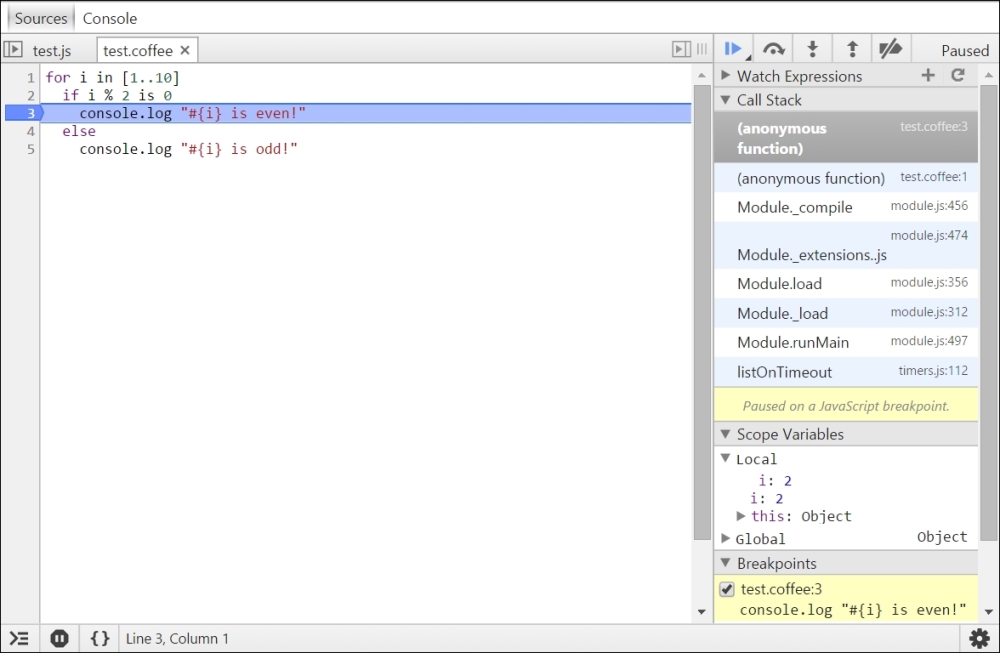
The following screenshot displays our Chrome window with an active break point. In the local variables tool window on the right-hand side, you can see that the current value of i is 2:
How it works...

The highlighted line in the preceding screenshot depicts the log message.

lock icon The rest of the chapter is locked
CONTINUE READING
83
Tech Concepts
36
Programming languages
73
Tech Tools
Icon Unlimited access to the largest independent learning library in tech of over 8,000 expert-authored tech books and videos.
Icon Innovative learning tools, including AI book assistants, code context explainers, and text-to-speech.
Icon 50+ new titles added per month and exclusive early access to books as they are being written.
Coffeescript Application Development Cookbook
Register for a free Packt account to unlock a world of extra content!
A free Packt account unlocks extra newsletters, articles, discounted offers, and much more. Start advancing your knowledge today.
Unlock this book and the full library FREE for 7 days
Get unlimited access to 7000+ expert-authored eBooks and videos courses covering every tech area you can think of
Renews at ₹800/month. Cancel anytime
Modal Close icon
Modal Close icon