Search icon CANCEL
Subscription
0
Cart icon
Your Cart (0 item)
Close icon
You have no products in your basket yet
Arrow left icon
Explore Products
Best Sellers
New Releases
Books
Events
Videos
Audiobooks
Packt Hub
Free Learning
Arrow right icon
timer SALE ENDS IN
0 Days
:
00 Hours
:
00 Minutes
:
00 Seconds
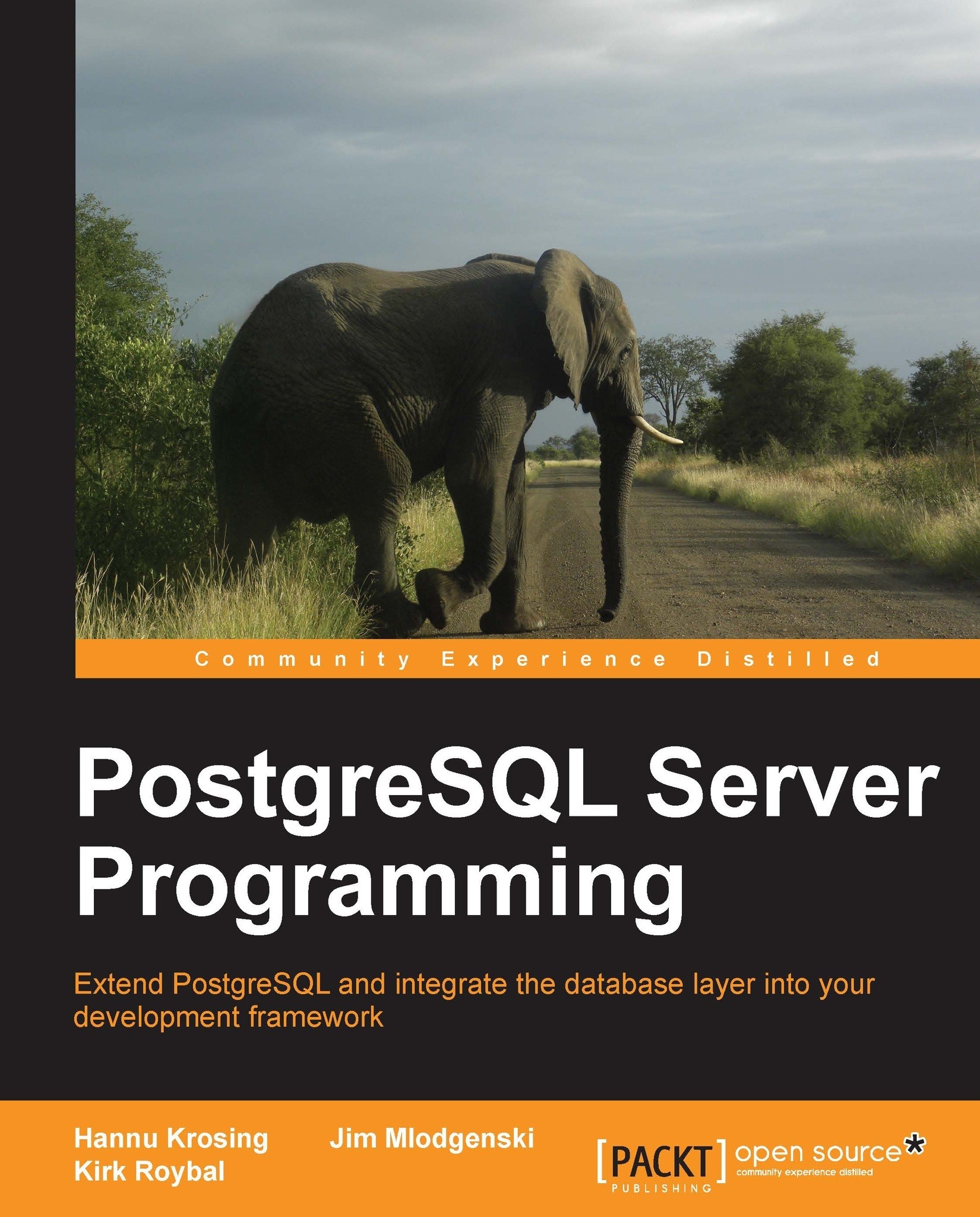
PostgreSQL Server Programming

PostgreSQL Server Programming: Take your skills with PostgreSQL to a whole new level with this fascinating guide to server programming. A step by step approach with illuminating examples will educate you in the full range of possibilities.

eBook
€29.69 €32.99
Paperback
€41.99
eBook + Subscription
€24.99 Monthly

What do you get with eBook?

Product feature icon Instant access to your Digital eBook purchase
Product feature icon Download this book in EPUB and PDF formats
Product feature icon Access this title in our online reader with advanced features
Product feature icon DRM FREE - Read whenever, wherever and however you want
Modal Close icon
Payment Processing...
tick Completed

Billing Address

Table of content icon View table of contents Preview book icon Preview Book

PostgreSQL Server Programming

Chapter 1. What Is a PostgreSQL Server?

If you think that a PostgreSQL server is just a storage system, and the only way to communicate with it is by executing SQL statements, you are limiting yourself tremendously. That is using just a tiny part of the database's features.

A PostgreSQL server is a powerful framework that can be used for all kinds of data processing, and even some non-data server tasks. It is a server platform that allows you to easily mix and match functions and libraries from several popular languages. Consider this complicated, multi-language sequence of work:

  1. Call a string parsing function in Perl.

  2. Convert the string to XSLT and process the result using JavaScript.

  3. Ask for a secure stamp from an external time-stamping service such as www.guardtime.com, using their SDK for C.

  4. Write a Python function to digitally sign the result.

This can be implemented as a series of simple function calls using several of the available server programming languages. The developer needing to accomplish all this work can just call a single PostgreSQL function without having to be aware of how the data is being passed between languages and libraries:

SELECT convert_to_xslt_and_sign(raw_data_string);

In this book, we will discuss several facets of PostgreSQL server programming. PostgreSQL has all of the native server-side programming features available in most larger database systems such as triggers, automated actions invoked automatically each time data is changed. But it has uniquely deep abilities to override the built-in behavior down to very basic operators. Examples of this customization include the following.

Writing User-defined functions (UDF) in C for carrying out complex computations:

  • Add complicated constraints to make sure that data in the server meets guidelines.

  • Create triggers in many languages to make related changes to other tables, log the actions, or forbid the action to happen if it does not meet certain criteria.

  • Define new data types and operators in the database.

  • Use the geography types defined in the PostGIS package.

  • Add your own index access methods for either existing or new data types, making some queries much more efficient.

What sort of things can you do with these features? There are limitless possibilities, such as the ones listed as follows:

  • Write data extractor functions to get just the interesting parts from structured data, such as XML or JSON, without needing to ship the whole, possibly huge, document to the client application.

  • Process events asynchronously, like sending mail without slowing down the main application. You could create a mail queue for changes to user info, populated by a trigger. A separate mail-sending process can consume this data whenever it's notified by an application process.

The rest of this chapter is presented as a series of descriptions of common data management tasks showing how they can be solved in a robust and elegant way via server programming.

The samples in this chapter are all tested to work, but they come with minimal commentary. They are here just to show you various things server programming can accomplish. The techniques described will be explained thoroughly in later chapters.

Custom sort orders

The last example in this chapter is about using functions for different ways of sorting.

Say we are given a task of sorting words by their vowels only, and in addition to that, make the last vowel the most significant one when sorting. While this task may seem really complicated at first, it is easy to solve with functions:

CREATE OR REPLACE FUNCTION reversed_vowels(word text) 
    RETURNS text AS $$
  vowels = [c for c in word.lower() if c in 'aeiou']
  vowels.reverse()
  return ''.join(vowels)
$$ LANGUAGE plpythonu IMMUTABLE;

postgres=# select word,reversed_vowels(word) from words order by reversed_vowels(word);
    word     | reversed_vowels
-------------+-----------------
 Abracadabra | aaaaa
 Great       | ae
 Barter      | ea
 Revolver    | eoe
(4 rows)

The best part is that you can use your new function in an index definition:

postgres=# CREATE INDEX reversed_vowels_index ON words (reversed_vowels(word));
CREATE INDEX

The system will automatically use this index whenever the function reversed_vowels(word) is used in the WHERE clause or ORDER BY.

Programming best practices

Developing application software is complicated. Some of the approaches to help manage that complexity are so popular that they've been given simple acronyms to remember them. Next, we'll introduce some of these principles and show how server programming helps make them easier to follow.

KISS – keep it simple stupid

One of the main techniques to successful programming is writing simple code. That is, writing code that you can easily understand three years from now, and that others can understand as well. It is not always achievable, but it almost always makes sense to write your code in the simplest way possible. You may rewrite parts of it later for various reasons such as speed, code compactness, to show off how clever you are, and so on. But always write the code first in a simple way, so you can absolutely be sure that it does what you want. Not only do you get working on code fast, you also have something to compare to when you try more advanced ways to do the same thing.

And remember, debugging is harder than writing code; so if you write the code in the most complex way you can, you will have a really hard time debugging it.

It is often easier to write a set returning function instead of a complex query. Yes, it will probably run slower than the same thing implemented as a single complex query due to the fact that the optimizer can do very little to code written as functions, but the speed may be sufficient for your needs. If more speed is needed, it's very likely to refactor the code piece by piece, joining parts of the function into larger queries where the optimizer has a better chance of discovering better query plans until the performance is acceptable again.

Remember that for most of the times, you don't need the absolutely fastest code. For your clients or bosses, the best code is the one that does the job well and arrives on time.

DRY – don't repeat yourself

This one means to try to implement any piece of business logic just once, and put the code for doing it in the right place.

It may sometimes be hard, for example you do want to do some checking of your web forms in the browser, but still do the final check in the database. But as a general guideline it is very much valid.

Server programming helps a lot here. If your data manipulation code is in the database near the data, all the data users have easy access to it, and you will not need to manage a similar code in a C++ Windows program, two PHP websites, and a bunch of Python scripts doing nightly management tasks. If any of them needs to do this thing to a customer's table, they just call:

SELECT * FROM  do_this_thing_to_customers(arg1, arg2, arg3);

And that's it!

If the logic behind the function needs changing, you just change the function with no downtime and no complicated orchestration of pushing database query updates to several clients. Once the function is changed in the database, it is changed for all users.

YAGNI – you ain't gonna need it

In other words, don't do more than you absolutely need to.

If you have a creepy feeling that your client is not yet well aware of what the final database will look like or what it will do, it's helpful to resist the urge to design "everything" into the database. A much better way is to do the minimal implementation that satisfies the current spec, but do it with extensibility in mind. It is much easier to "paint yourself into a corner" when implementing a big spec with large imaginary parts.

If you organize your access to the database through functions, it is often possible to do even large rewrites of business logic without touching the frontend application code. Your application still does SELECT * FROM do_this_thing_to_customers(arg1, arg2, arg3) even after you have rewritten the function five times and changed the whole table structure twice.

SOA – service-oriented architecture

Usually when you hear the acronym SOA, it comes from Enterprise Software people selling you a complex set of SOAP services. But the essence of the SOA is organizing your software platform as a set of services that clients and other services call for performing certain well-defined atomic tasks, such as:

  • Checking a user's password and credentials
  • Presenting him/her with a list of his/her favorite websites
  • Selling him/her a new red dog collar with complementary membership in the red-collared dog club

These services can be implemented as SOAP calls with corresponding WSDL definitions and Java servers with servlet containers, and complex management infrastructure. They can also be a set of PostgreSQL functions, taking a set of arguments and returning a set of values. If arguments or return values are complex, they can be passed as XML or JSON, but often a simple set of standard PostgreSQL data types is enough. In Chapter 9, Scaling Your Database with PL/Proxy, we will learn how to make such PostgreSQL-based SOA service infinitely scalable.

Type extensibility

Some of the preceding techniques are available in other databases, but PostgreSQL's extensibility does not stop here. In PostgreSQL, you can just write User-defined functions (UDFs) in any of the most popular scripting languages. You can also define your own types, not just domains, which are standard types with some extra constraints attached, but new full-fledged types too.

For example, a Dutch company MGRID has developed value with unit set of data types, so that you can divide 10 km by 0.2 hour and get the result in 50 km/h. Of course, you can also cast the same result to meters per second or any other unit of speed. And yes, you can get this as a fraction of c—the speed of light.

This kind of functionality needs both the types themselves and overloaded operands, which know that if you divide distance by time then the result is speed. You will also need user-defined casts, which are automatically- or manually-invoked conversion functions between types.

MGRID developed this for use in medical applications where the cost of error can be high—the difference between 10 ml and 10 cc can be vital. But using a similar system could also have averted many other disasters, where using wrong units has ended with producing bad computation results. If the unit is always there together with the amount, the possibility for these kinds of errors is very much diminished. You can also add your own index methods if you have some programming skills and your problem domain is not well served by the existing indexes. There is already a respectable set of index types included in the core PostgreSQL, as well as several others which are developed outside the core.

The latest index method which became officially included in PostgreSQL is KNN (K Nearest Neighbor)—a clever index, which can return K rows ordered by their distance from the desired search target. One use of KNN is in fuzzy text search, where this can be used for ranking full-text search results by how well they match the search terms. Before KNN, this kind of thing was done by querying all rows which matched even a little, and then sorting all these by the distance function and returning K top rows as the last step.

If done using KNN index, the index access can start returning the rows in the desired order; so a simple LIMIT K function will return you the K top matches.

The KNN index can also be used for real distances, for example answering the request "Give me the 10 nearest pizza places to central station."

As you see, index types are separate from the data types they index. As another example, the same GIN (General Inverted Index) can be used for full-text search (together with stemmers, thesauri, and other text processing stuff) as well as indexing elements of integer arrays.

On caching

Yet another place where server-side programming can be used is for caching values, which are expensive to compute. The basic pattern here is:

  1. Check if the value is cached.
  2. If not or the value is too old, compute and cache it.
  3. Return the cached value.

For example, calculating sales for a company is the perfect item to cache. Perhaps, a large retail company has 1,000 stores with potentially millions of individual sales transactions per day. If the corporate headquarters is looking for sales trends, it is much more efficient if the daily sales numbers were precalculated at the store level instead of summing up millions of daily transactions.

If the value is simple, like looking up a user's information from a single table based on the user ID, you don't need to do anything. The value becomes cached in PostgreSQL's internal page cache, and all lookups to it are so fast that even on a very fast network most of the time spent doing the lookups are in the network, not in the actual lookup. In such a case, getting data from a PostgreSQL database is as fast as getting it from any other in-memory cache (like memcached) but without any extra overhead in managing the cache.

Another use-case of caching is implementing materialized views. These are views which are precomputed only when needed, not each time one selects from that view. Some SQL databases have materialized views as a separate database object, but in PostgreSQL you have to do it all yourself, using other database features for automating the whole process.

Wrap up – why program in the server?

The main advantages of doing most data manipulation code server-side are the following.

Performance

Doing the computation near data is almost always a performance win, as the latencies for getting the data are minimal. In a typical data-intensive computation, most of the time tends to be spent in getting the data. Therefore, making data access inside the computation faster is the best way to make the whole thing fast. On my laptop it takes 2.2 ms to query one random row from a 1,00,000 row database into the client, but it takes only 0.12 ms to get the data inside the database. This is 20 times faster and this is inside the same machine over Unix sockets. The difference can be bigger if there is a network connection between client and server.

A small real-word story:

A friend of mine was called to help a large company (I'm sure you all know it, though I can't tell you which one) to try to make its e-mail sending application faster. They had implemented their e-mail generation system with all the latest Java EE technologies, first getting the data from the database, passing the data around between services, and serializing and de-serializing it several times before finally doing XSLT transform on the data to produce the e-mail text. The end result being that it produced only a few hundred e-mails per second and they were falling behind with their responses.

When he rewrote the process to use a PL/Perl function inside the database to format the data and the query returned already fully-formatted e-mails, it suddenly started spewing out tens of thousands of e-mails per second, and they had to add a second copy of sent mail to actually be able to send them out.

Ease of maintenance

If all data manipulation code is in a database, either as database functions or views, the actual upgrade process becomes very easy. All that is needed is running a DDL script that redefines the functions and all the clients automatically use the new code with no downtime, and no complicated coordination between several frontend systems and teams.

Simple ways to tighten security

If all access for some possibly insecure servers goes through functions, the database user of these servers use can be granted only the access to the needed functions and nothing else. They can't see the table data or even the fact that these tables exist. So even if that server becomes compromised, all it can do is continue to call the same functions. Also, there is no possibility to steal passwords, e-mails, or other sensitive information by issuing its own queries like SELECT * FROM users; and getting all the data there is in the database.

And the most important thing, programming in server is fun!

Summary

Programming inside the database server is not always the first thing that comes to mind to many developers, but it's unique placement inside the application stack gives it some powerful advantages. Your application can be faster, more secure, and more maintainable by pushing your logic into the database. With server-side programming in PostgreSQL, you can:

  • Secure your data using functions
  • Audit access to your data using triggers
  • Enrich your data using custom data types
  • Analyze your data using custom operators

And this is just the very start of what you can do inside PostgreSQL. Throughout the rest of this book, you will learn about many other ways to write powerful applications by programming inside PostgreSQL.

Data cleaning


We notice that employee names don't have consistent cases. It would be easy to enforce consistency by adding a constraint:

CHECK (emp_name = upper(emp_name))

However, it is even better to just make sure that it is stored as uppercase, and the simplest way to do it is by using trigger:

CREATE OR REPLACE FUNCTION uppercase_name () 
  RETURNS trigger AS $$
    BEGIN
        NEW.emp_name = upper(NEW.emp_name);
        RETURN NEW;
    END;
$$ LANGUAGE plpgsql;

CREATE TRIGGER uppercase_emp_name
BEFORE INSERT OR UPDATE OR DELETE ON salaries
    FOR EACH ROW EXECUTE PROCEDURE uppercase_name ();

The next set_salary() call for a new employee will now insert emp_name in uppercase:

postgres=# SELECT set_salary('arnold',80);
-[ RECORD 1 ]-------------------
set_salary | INSERTED USER arnold

As the uppercasing happened inside a trigger, the function response still shows a lowercase name, but in the database it is uppercase:

postgres=# SELECT * FROM salaries ;
-[ RECORD 1 ]---
emp_name | Bob
salary   | 1300
-[ RECORD 2 ]---
emp_name | Fred
salary   | 750
-[ RECORD 3 ]---
emp_name | frank
salary   | 100
-[ RECORD 4 ]---
emp_name |  ARNOLD
salary   | 80

After fixing the existing mixed-case emp_names, we can make sure that all emp_names will be in uppercase in the future by adding a constraint:

postgres=# update salaries set emp_name = upper(emp_name) where not emp_name = upper(emp_name);
UPDATE 3
postgres=# alter table salaries add constraint emp_name_must_be_uppercasepostgres-# CHECK (emp_name = upper(emp_name));
ALTER TABLE

If this behavior is needed in more places, it would make sense to define a new type – say u_text, which is always stored as uppercase. You will learn more about this approach in the chapter about defining user types.

Custom sort orders


The last example in this chapter is about using functions for different ways of sorting.

Say we are given a task of sorting words by their vowels only, and in addition to that, make the last vowel the most significant one when sorting. While this task may seem really complicated at first, it is easy to solve with functions:

CREATE OR REPLACE FUNCTION reversed_vowels(word text) 
    RETURNS text AS $$
  vowels = [c for c in word.lower() if c in 'aeiou']
  vowels.reverse()
  return ''.join(vowels)
$$ LANGUAGE plpythonu IMMUTABLE;

postgres=# select word,reversed_vowels(word) from words order by reversed_vowels(word);
    word     | reversed_vowels
-------------+-----------------
 Abracadabra | aaaaa
 Great       | ae
 Barter      | ea
 Revolver    | eoe
(4 rows)

The best part is that you can use your new function in an index definition:

postgres=# CREATE INDEX reversed_vowels_index ON words (reversed_vowels(word));
CREATE INDEX

The system will automatically use this index whenever the function reversed_vowels(word) is used in the WHERE clause or ORDER BY.

Programming best practices


Developing application software is complicated. Some of the approaches to help manage that complexity are so popular that they've been given simple acronyms to remember them. Next, we'll introduce some of these principles and show how server programming helps make them easier to follow.

KISS – keep it simple stupid

One of the main techniques to successful programming is writing simple code. That is, writing code that you can easily understand three years from now, and that others can understand as well. It is not always achievable, but it almost always makes sense to write your code in the simplest way possible. You may rewrite parts of it later for various reasons such as speed, code compactness, to show off how clever you are, and so on. But always write the code first in a simple way, so you can absolutely be sure that it does what you want. Not only do you get working on code fast, you also have something to compare to when you try more advanced ways to do the same thing.

And remember, debugging is harder than writing code; so if you write the code in the most complex way you can, you will have a really hard time debugging it.

It is often easier to write a set returning function instead of a complex query. Yes, it will probably run slower than the same thing implemented as a single complex query due to the fact that the optimizer can do very little to code written as functions, but the speed may be sufficient for your needs. If more speed is needed, it's very likely to refactor the code piece by piece, joining parts of the function into larger queries where the optimizer has a better chance of discovering better query plans until the performance is acceptable again.

Remember that for most of the times, you don't need the absolutely fastest code. For your clients or bosses, the best code is the one that does the job well and arrives on time.

DRY – don't repeat yourself

This one means to try to implement any piece of business logic just once, and put the code for doing it in the right place.

It may sometimes be hard, for example you do want to do some checking of your web forms in the browser, but still do the final check in the database. But as a general guideline it is very much valid.

Server programming helps a lot here. If your data manipulation code is in the database near the data, all the data users have easy access to it, and you will not need to manage a similar code in a C++ Windows program, two PHP websites, and a bunch of Python scripts doing nightly management tasks. If any of them needs to do this thing to a customer's table, they just call:

SELECT * FROM  do_this_thing_to_customers(arg1, arg2, arg3);

And that's it!

If the logic behind the function needs changing, you just change the function with no downtime and no complicated orchestration of pushing database query updates to several clients. Once the function is changed in the database, it is changed for all users.

YAGNI – you ain't gonna need it

In other words, don't do more than you absolutely need to.

If you have a creepy feeling that your client is not yet well aware of what the final database will look like or what it will do, it's helpful to resist the urge to design "everything" into the database. A much better way is to do the minimal implementation that satisfies the current spec, but do it with extensibility in mind. It is much easier to "paint yourself into a corner" when implementing a big spec with large imaginary parts.

If you organize your access to the database through functions, it is often possible to do even large rewrites of business logic without touching the frontend application code. Your application still does SELECT * FROM do_this_thing_to_customers(arg1, arg2, arg3) even after you have rewritten the function five times and changed the whole table structure twice.

SOA – service-oriented architecture

Usually when you hear the acronym SOA, it comes from Enterprise Software people selling you a complex set of SOAP services. But the essence of the SOA is organizing your software platform as a set of services that clients and other services call for performing certain well-defined atomic tasks, such as:

  • Checking a user's password and credentials

  • Presenting him/her with a list of his/her favorite websites

  • Selling him/her a new red dog collar with complementary membership in the red-collared dog club

These services can be implemented as SOAP calls with corresponding WSDL definitions and Java servers with servlet containers, and complex management infrastructure. They can also be a set of PostgreSQL functions, taking a set of arguments and returning a set of values. If arguments or return values are complex, they can be passed as XML or JSON, but often a simple set of standard PostgreSQL data types is enough. In Chapter 9, Scaling Your Database with PL/Proxy, we will learn how to make such PostgreSQL-based SOA service infinitely scalable.

Type extensibility

Some of the preceding techniques are available in other databases, but PostgreSQL's extensibility does not stop here. In PostgreSQL, you can just write User-defined functions (UDFs) in any of the most popular scripting languages. You can also define your own types, not just domains, which are standard types with some extra constraints attached, but new full-fledged types too.

For example, a Dutch company MGRID has developed value with unit set of data types, so that you can divide 10 km by 0.2 hour and get the result in 50 km/h. Of course, you can also cast the same result to meters per second or any other unit of speed. And yes, you can get this as a fraction of c—the speed of light.

This kind of functionality needs both the types themselves and overloaded operands, which know that if you divide distance by time then the result is speed. You will also need user-defined casts, which are automatically- or manually-invoked conversion functions between types.

MGRID developed this for use in medical applications where the cost of error can be high—the difference between 10 ml and 10 cc can be vital. But using a similar system could also have averted many other disasters, where using wrong units has ended with producing bad computation results. If the unit is always there together with the amount, the possibility for these kinds of errors is very much diminished. You can also add your own index methods if you have some programming skills and your problem domain is not well served by the existing indexes. There is already a respectable set of index types included in the core PostgreSQL, as well as several others which are developed outside the core.

The latest index method which became officially included in PostgreSQL is KNN (K Nearest Neighbor)—a clever index, which can return K rows ordered by their distance from the desired search target. One use of KNN is in fuzzy text search, where this can be used for ranking full-text search results by how well they match the search terms. Before KNN, this kind of thing was done by querying all rows which matched even a little, and then sorting all these by the distance function and returning K top rows as the last step.

If done using KNN index, the index access can start returning the rows in the desired order; so a simple LIMIT K function will return you the K top matches.

The KNN index can also be used for real distances, for example answering the request "Give me the 10 nearest pizza places to central station."

As you see, index types are separate from the data types they index. As another example, the same GIN (General Inverted Index) can be used for full-text search (together with stemmers, thesauri, and other text processing stuff) as well as indexing elements of integer arrays.

On caching


Yet another place where server-side programming can be used is for caching values, which are expensive to compute. The basic pattern here is:

  1. Check if the value is cached.

  2. If not or the value is too old, compute and cache it.

  3. Return the cached value.

For example, calculating sales for a company is the perfect item to cache. Perhaps, a large retail company has 1,000 stores with potentially millions of individual sales transactions per day. If the corporate headquarters is looking for sales trends, it is much more efficient if the daily sales numbers were precalculated at the store level instead of summing up millions of daily transactions.

If the value is simple, like looking up a user's information from a single table based on the user ID, you don't need to do anything. The value becomes cached in PostgreSQL's internal page cache, and all lookups to it are so fast that even on a very fast network most of the time spent doing the lookups are in the network, not in the actual lookup. In such a case, getting data from a PostgreSQL database is as fast as getting it from any other in-memory cache (like memcached) but without any extra overhead in managing the cache.

Another use-case of caching is implementing materialized views. These are views which are precomputed only when needed, not each time one selects from that view. Some SQL databases have materialized views as a separate database object, but in PostgreSQL you have to do it all yourself, using other database features for automating the whole process.

Wrap up – why program in the server?


The main advantages of doing most data manipulation code server-side are the following.

Performance

Doing the computation near data is almost always a performance win, as the latencies for getting the data are minimal. In a typical data-intensive computation, most of the time tends to be spent in getting the data. Therefore, making data access inside the computation faster is the best way to make the whole thing fast. On my laptop it takes 2.2 ms to query one random row from a 1,00,000 row database into the client, but it takes only 0.12 ms to get the data inside the database. This is 20 times faster and this is inside the same machine over Unix sockets. The difference can be bigger if there is a network connection between client and server.

A small real-word story:

A friend of mine was called to help a large company (I'm sure you all know it, though I can't tell you which one) to try to make its e-mail sending application faster. They had implemented their e-mail generation system with all the latest Java EE technologies, first getting the data from the database, passing the data around between services, and serializing and de-serializing it several times before finally doing XSLT transform on the data to produce the e-mail text. The end result being that it produced only a few hundred e-mails per second and they were falling behind with their responses.

When he rewrote the process to use a PL/Perl function inside the database to format the data and the query returned already fully-formatted e-mails, it suddenly started spewing out tens of thousands of e-mails per second, and they had to add a second copy of sent mail to actually be able to send them out.

Ease of maintenance

If all data manipulation code is in a database, either as database functions or views, the actual upgrade process becomes very easy. All that is needed is running a DDL script that redefines the functions and all the clients automatically use the new code with no downtime, and no complicated coordination between several frontend systems and teams.

Simple ways to tighten security

If all access for some possibly insecure servers goes through functions, the database user of these servers use can be granted only the access to the needed functions and nothing else. They can't see the table data or even the fact that these tables exist. So even if that server becomes compromised, all it can do is continue to call the same functions. Also, there is no possibility to steal passwords, e-mails, or other sensitive information by issuing its own queries like SELECT * FROM users; and getting all the data there is in the database.

And the most important thing, programming in server is fun!

Summary


Programming inside the database server is not always the first thing that comes to mind to many developers, but it's unique placement inside the application stack gives it some powerful advantages. Your application can be faster, more secure, and more maintainable by pushing your logic into the database. With server-side programming in PostgreSQL, you can:

  • Secure your data using functions

  • Audit access to your data using triggers

  • Enrich your data using custom data types

  • Analyze your data using custom operators

And this is just the very start of what you can do inside PostgreSQL. Throughout the rest of this book, you will learn about many other ways to write powerful applications by programming inside PostgreSQL.

Left arrow icon Right arrow icon

Key benefits

  • Understand the extension framework of PostgreSQL, and leverage it in ways that you haven't even invented yet
  • Write functions, create your own data types, all in your favourite programming language
  • Step-by-step tutorial with plenty of tips and tricks to kick-start server programming

Description

Learn how to work with PostgreSQL as if you spent the last decade working on it. PostgreSQL is capable of providing you with all of the options that you have in your favourite development language and then extending that right on to the database server. With this knowledge in hand, you will be able to respond to the current demand for advanced PostgreSQL skills in a lucrative and booming market."PostgreSQL Server Programming" will show you that PostgreSQL is so much more than a database server. In fact, it could even be seen as an application development framework, with the added bonuses of transaction support, massive data storage, journaling, recovery and a host of other features that the PostgreSQL engine provides. This book will take you from learning the basic parts of a PostgreSQL function, then writing them in languages other than the built-in PL/PgSQL. You will see how to create libraries of useful code, group them into even more useful components, and distribute them to the community. You will see how to extract data from a multitude of foreign data sources, and then extend PostgreSQL to do it natively. And you can do all of this in a nifty debugging interface that will allow you to do it efficiently and with reliability.

Who is this book for?

"PostgreSQL Server Programming" is for moderate to advanced PostgreSQL database professionals. To get the best understanding of this book, you should have general experience in writing SQL, a basic idea of query tuning, and some coding experience in a language of your choice.

What you will learn

  • Write functions in the built-in PL/PgSQL language or your language of choice
  • Extract data from foreign data sources
  • Add operators, data types, and other custom elements
  • Debug and code efficiently
  • Decide what machine resources your process will use
  • Create your own data types, operators, functions, aggregates, and even your own language
  • Fully integrate the database layer into your development

Product Details

Country selected
Publication date, Length, Edition, Language, ISBN-13
Publication date : Jun 25, 2013
Length: 264 pages
Edition : 1st
Language : English
ISBN-13 : 9781849516990
Category :
Tools :

What do you get with eBook?

Product feature icon Instant access to your Digital eBook purchase
Product feature icon Download this book in EPUB and PDF formats
Product feature icon Access this title in our online reader with advanced features
Product feature icon DRM FREE - Read whenever, wherever and however you want
Modal Close icon
Payment Processing...
tick Completed

Billing Address

Product Details

Publication date : Jun 25, 2013
Length: 264 pages
Edition : 1st
Language : English
ISBN-13 : 9781849516990
Category :
Tools :

Packt Subscriptions

See our plans and pricing
Modal Close icon
€18.99 billed monthly
Feature tick icon Unlimited access to Packt's library of 7,000+ practical books and videos
Feature tick icon Constantly refreshed with 50+ new titles a month
Feature tick icon Exclusive Early access to books as they're written
Feature tick icon Solve problems while you work with advanced search and reference features
Feature tick icon Offline reading on the mobile app
Feature tick icon Simple pricing, no contract
€189.99 billed annually
Feature tick icon Unlimited access to Packt's library of 7,000+ practical books and videos
Feature tick icon Constantly refreshed with 50+ new titles a month
Feature tick icon Exclusive Early access to books as they're written
Feature tick icon Solve problems while you work with advanced search and reference features
Feature tick icon Offline reading on the mobile app
Feature tick icon Choose a DRM-free eBook or Video every month to keep
Feature tick icon PLUS own as many other DRM-free eBooks or Videos as you like for just €5 each
Feature tick icon Exclusive print discounts
€264.99 billed in 18 months
Feature tick icon Unlimited access to Packt's library of 7,000+ practical books and videos
Feature tick icon Constantly refreshed with 50+ new titles a month
Feature tick icon Exclusive Early access to books as they're written
Feature tick icon Solve problems while you work with advanced search and reference features
Feature tick icon Offline reading on the mobile app
Feature tick icon Choose a DRM-free eBook or Video every month to keep
Feature tick icon PLUS own as many other DRM-free eBooks or Videos as you like for just €5 each
Feature tick icon Exclusive print discounts

Frequently bought together


Stars icon
Total 85.98
PostgreSQL Server Programming
€41.99
PostgreSQL 9.0 High Performance
€43.99
Total 85.98 Stars icon

Table of Contents

10 Chapters
What Is a PostgreSQL Server? Chevron down icon Chevron up icon
Server Programming Environment Chevron down icon Chevron up icon
Your First PL/pgSQL Function Chevron down icon Chevron up icon
Returning Structured Data Chevron down icon Chevron up icon
PL/pgSQL Trigger Functions Chevron down icon Chevron up icon
Debugging PL/pgSQL Chevron down icon Chevron up icon
Using Unrestricted Languages Chevron down icon Chevron up icon
Writing Advanced Functions in C Chevron down icon Chevron up icon
Scaling Your Database with PL/Proxy Chevron down icon Chevron up icon
Publishing Your Code as PostgreSQL Extensions Chevron down icon Chevron up icon

Customer reviews

Top Reviews
Rating distribution
Full star icon Full star icon Full star icon Full star icon Half star icon 4.7
(9 Ratings)
5 star 88.9%
4 star 0%
3 star 0%
2 star 11.1%
1 star 0%
Filter icon Filter
Top Reviews

Filter reviews by


David Lee Dec 27, 2014
Full star icon Full star icon Full star icon Full star icon Full star icon 5
This book is helpful for anyone that wants to learn PostgreSQL.
Amazon Verified review Amazon
Shaun Thomas Dec 12, 2013
Full star icon Full star icon Full star icon Full star icon Full star icon 5
There comes a time in every DBA's life, that he needs to add functionality to his database software. To most DBAs, and indeed for most databases, this amounts to writing a few stored procedures or triggers. In extremely advanced cases, the database may provide an API for direct C-language calls. PostgreSQL however, has gone above and beyond this for several years, and have continuously made the process easier with each iteration.So once again, I'm glad to review a book by three authors in the industry who either work directly on PostgreSQL internals, or use it extensively enough to contribute vastly important functionality. Hannu Krosing, Jim Mlodgenski, and Kirk Roybal collaborated to produce PostgreSQL Server Programming, a necessary and refreshing addition to the PostgreSQL compendium. I don't know who contributed each individual chapter, but I can make a fairly educated guess that anything PL/Proxy related came from Mr. Krosing, its original designer.As usual for a book of this type, things start off with relative simplicity. The authors make a very important note I try to convey to staff developers regularly: let the database do its job. The database is there to juggle data, handle set theory, and otherwise reduce traffic to and from the application to a minimum. This saves both network bandwidth and processing time on the front end, which can be combined with caching to service vastly larger infrastructures than otherwise possible.Beyond this, are the basics. Using stored procedures, taking advantage of triggers, writing functions that can return sets. The gamut of examples runs from data auditing and logging, to integrity control and a certain extent of business logic. One or more of the authors suggests that functions are the proper interface to the database, to reduce overhead, and provide an abstract API that can change without directly altering the application code. It is, after all, the common denominator in any library or tool dealing with the data. While I personally don't agree with this type of approach, the logical reasoning is sound, and can help simplify and prevent many future headaches.But then? Then comes the real nitty-gritty. PostgreSQL allows interfacing with the database through several languages, including Python, Perl, and even TCL/TK, and the authors want you to know it. Databases like Oracle have long allowed C-level calls to the database, and this has often included Java in later incarnations. PostgreSQL though, is the only RDBMS that acts almost like its own middle layer. It's a junction that allows JSON (a Javascript encapsulation) accessed via Python, to be filtered by a TCL trigger, on a table that matched data through an index produced by a Perl function. The authors provide Python and C examples for much of this scenario, including the JSON!And that's where this book really shines: examples. There's Python, C, PLPGSQL, triggers, procedures, compiled code, variants of several difficult techniques, and more. In the C case, things start with a simple "Hello World" type you might see in a beginning programming class, and the author steps through increasingly complex examples. Eventually, the C code is returning sets of sets of data per call, as if simulating several table rows.In the more concrete, the authors provide copious links to external documentation and Wiki pages for those who want to explore this territory in more depth. Beyond that, they want readers to know about major sources of contributed code and extensions, all to make the database more useful, and perhaps entice the reader join in the fun. Everything from installing, to details necessary for writing extensions is covered, so that is well within the realm of possibility!I already mentioned that at least one of the authors encourages functional database access instead of direct SQL. Well, there's more than the obvious reasons for this: PL/Proxy is a procedural language that uses functions to facilitate database sharding for horizontal scalability. Originally designed for Skype, PL/Proxy has been used by many other projects. While it might not apply to everyone, sharding is a very real technique with non-trivial implementation details that have stymied the efforts of many development teams.I actually would have liked a more extensive chapter or two regarding PL/Proxy. While several examples of functional access are outlined for a chat server, none of these functions are later modified in a way that would obviously leverage PL/Proxy. Further, Krosing doesn't address how sequences should be distributed so data on all the various servers get non-conflicting surrogate keys. It would have been nice to see an end-to-end implementation.All in all, anyone serious about their PostgreSQL database should take a look. Getting a server up and running is only half the story; making the database an integral component of an application instead of a mere junk drawer provides more functionality with fewer resources. It's good to see a book that not only emphasizes this, but conveys the knowledge in order to accomplish such a feat. Hannu, Jim, and Kirk have all done the community a great service. I hope to see revisions of this in the future as PostgreSQL matures.
Amazon Verified review Amazon
Pierre Jul 25, 2013
Full star icon Full star icon Full star icon Full star icon Full star icon 5
At long last, a PostgreSQL book. Why saying that with all the existing PostgreSQL books ? It's just that most of these books cover usual topics, that are not PostgreSQL specific. Replication, basic administration... Here, we are going straigh to some of the best features of PostgreSQL : its high extensibility with server-side programming.The book begins with explanations about why using server-side programming, and then a tutorial to guide you through PL/pgSQL.Warning : that tutorial, as the whole book, assumes you have previous PostgreSQL knowledge.Afterwards, you'll go through the triggers world, learn some stuff about debugging in case you are not a perfect developper, and then you'll travel to more exotic server programming choices. The language used for all examples is PL/python, but it works the same with Perl/Lua... And next language is C, to write extra low level extensions, accessing the whole server internals.And finally, you'll learn how to contribute to the extension network and use your functions to spread accross servers using PL/Proxy.It's really a great book, I was looking forward reading it, and it met my expectations. I needed a book to push me forward in my server side programming, giving general guidance and suggestions. It's not a SQL reference, it would require many many books while still being far from exhaustive. But it's a deep Server Programming introduction. And it is good. The introduction comes also handy to teach your collegues about that.
Amazon Verified review Amazon
Brian Wells Oct 05, 2019
Full star icon Full star icon Full star icon Full star icon Full star icon 5
Not something you'd want to pay top dollar for, as it does not cover newer developments, but for a newcomer it's a great intro to everything up through 2015, IMHO. Look for a used copy under $10 and you'll be pleased with the purchase. (I doubt the 2nd edition merits the prices I am seeing, but the 1st edition can be found cheaply)
Amazon Verified review Amazon
B. Walter Finn Jan 25, 2014
Full star icon Full star icon Full star icon Full star icon Full star icon 5
There seems to be more code than explanation... that's perfectly fine. I read "MySQL Stored Procedure Programming" by Guy Harrison as well as a few Python books before this one, so I was comfortable with the material and was able to study the code and make some sense of it. An essential reference for anyone who prefers a tutorial style over cryptic reference documentation. Has examples that can be adapted and applied. I would recommend to anyone before starting their next project. It's always good to know what options you have available to meet business requirements, and not all are at the application layer.
Amazon Verified review Amazon
Get free access to Packt library with over 7500+ books and video courses for 7 days!
Start Free Trial

FAQs

How do I buy and download an eBook? Chevron down icon Chevron up icon

Where there is an eBook version of a title available, you can buy it from the book details for that title. Add either the standalone eBook or the eBook and print book bundle to your shopping cart. Your eBook will show in your cart as a product on its own. After completing checkout and payment in the normal way, you will receive your receipt on the screen containing a link to a personalised PDF download file. This link will remain active for 30 days. You can download backup copies of the file by logging in to your account at any time.

If you already have Adobe reader installed, then clicking on the link will download and open the PDF file directly. If you don't, then save the PDF file on your machine and download the Reader to view it.

Please Note: Packt eBooks are non-returnable and non-refundable.

Packt eBook and Licensing When you buy an eBook from Packt Publishing, completing your purchase means you accept the terms of our licence agreement. Please read the full text of the agreement. In it we have tried to balance the need for the ebook to be usable for you the reader with our needs to protect the rights of us as Publishers and of our authors. In summary, the agreement says:

  • You may make copies of your eBook for your own use onto any machine
  • You may not pass copies of the eBook on to anyone else
How can I make a purchase on your website? Chevron down icon Chevron up icon

If you want to purchase a video course, eBook or Bundle (Print+eBook) please follow below steps:

  1. Register on our website using your email address and the password.
  2. Search for the title by name or ISBN using the search option.
  3. Select the title you want to purchase.
  4. Choose the format you wish to purchase the title in; if you order the Print Book, you get a free eBook copy of the same title. 
  5. Proceed with the checkout process (payment to be made using Credit Card, Debit Cart, or PayPal)
Where can I access support around an eBook? Chevron down icon Chevron up icon
  • If you experience a problem with using or installing Adobe Reader, the contact Adobe directly.
  • To view the errata for the book, see www.packtpub.com/support and view the pages for the title you have.
  • To view your account details or to download a new copy of the book go to www.packtpub.com/account
  • To contact us directly if a problem is not resolved, use www.packtpub.com/contact-us
What eBook formats do Packt support? Chevron down icon Chevron up icon

Our eBooks are currently available in a variety of formats such as PDF and ePubs. In the future, this may well change with trends and development in technology, but please note that our PDFs are not Adobe eBook Reader format, which has greater restrictions on security.

You will need to use Adobe Reader v9 or later in order to read Packt's PDF eBooks.

What are the benefits of eBooks? Chevron down icon Chevron up icon
  • You can get the information you need immediately
  • You can easily take them with you on a laptop
  • You can download them an unlimited number of times
  • You can print them out
  • They are copy-paste enabled
  • They are searchable
  • There is no password protection
  • They are lower price than print
  • They save resources and space
What is an eBook? Chevron down icon Chevron up icon

Packt eBooks are a complete electronic version of the print edition, available in PDF and ePub formats. Every piece of content down to the page numbering is the same. Because we save the costs of printing and shipping the book to you, we are able to offer eBooks at a lower cost than print editions.

When you have purchased an eBook, simply login to your account and click on the link in Your Download Area. We recommend you saving the file to your hard drive before opening it.

For optimal viewing of our eBooks, we recommend you download and install the free Adobe Reader version 9.

Modal Close icon
Modal Close icon