Search icon CANCEL
Subscription
0
Cart icon
Your Cart (0 item)
Close icon
You have no products in your basket yet
Save more on your purchases! discount-offer-chevron-icon
Savings automatically calculated. No voucher code required.
Arrow left icon
Explore Products
Best Sellers
New Releases
Books
Videos
Audiobooks
Learning Hub
Newsletter Hub
Free Learning
Arrow right icon
timer SALE ENDS IN
0 Days
:
00 Hours
:
00 Minutes
:
00 Seconds
JavaScript Security
JavaScript Security

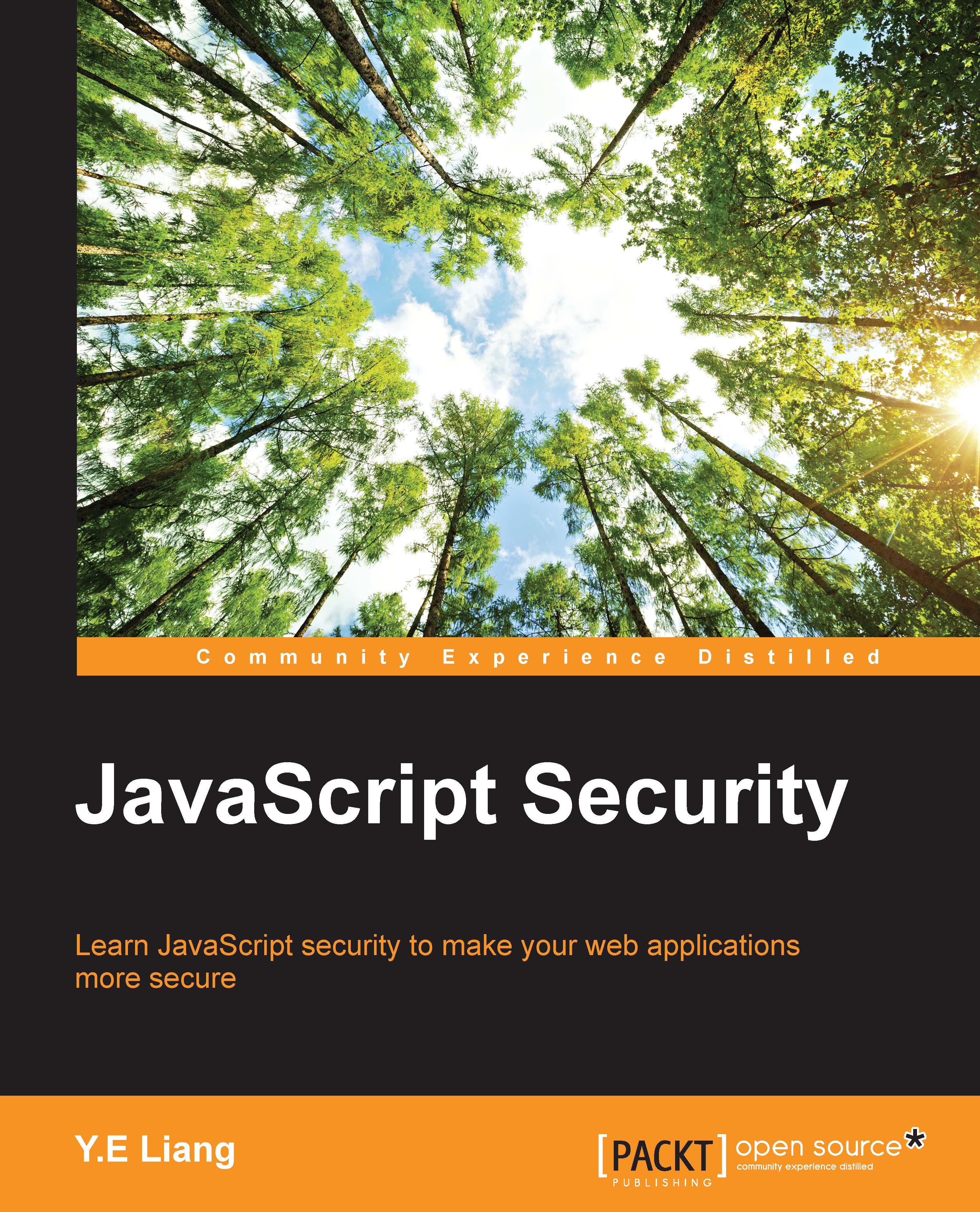
JavaScript Security: Learn JavaScript security to make your web applications more secure

eBook
€15.29 €16.99
Paperback
€20.99
Subscription
Free Trial
Renews at €18.99p/m

What do you get with a Packt Subscription?

Free for first 7 days. €18.99 p/m after that. Cancel any time!
Product feature icon Unlimited ad-free access to the largest independent learning library in tech. Access this title and thousands more!

Product feature icon 50+ new titles added per month, including many first-to-market concepts and exclusive early access to books as they are being written.
Product feature icon Innovative learning tools, including AI book assistants, code context explainers, and text-to-speech.
Product feature icon Thousands of reference materials covering every tech concept you need to stay up to date.
Subscribe now
View plans & pricing
Table of content icon View table of contents Preview book icon Preview Book

JavaScript Security

Chapter 2. Secure Ajax RESTful APIs

Welcome back to the book! In this chapter, we will walk through some code where we build a RESTful server, and write some frontend code on top of it so that we can create a simple to-do list app. The app is extremely simple: add and delete to-do items, after which we'll demonstrate one or two ways in which RESTful APIs can be laden with security flaws. So here we go!

Building a RESTful server

As mentioned in Chapter 1, JavaScript and the Web, JavaScript is used in the server side as well. In this example, we'll use Node.js and Express.js to build a simple RESTful server before we touch upon how we can secure our RESTful APIs.

Note

For the remainder of this book, you will require Node.js Version 0.10.2x or above, MongoDB Version 2.2 or above, and Express.js 4.x. To install them, feel free to refer to their respective installation instructions. For Node.js, refer to http://nodejs.org/, MongoDB at http://docs.mongodb.org/manual/installation/, and Express.js at http://expressjs.com/. To keep things simple, all modules installed will be installed globally.

A simple RESTful server in Node.js and Express.js

We'll build a RESTful server using Node.js and Express.js 4.x. This RESTful server contains a few endpoints:

  • /api/todos:
    • GET: This endpoint gets a full list of to-do items
    • POST: This creates a new to-do item
  • /api/todos/:id:
    • POST: This deletes a to-do...

Basic defense against similar attacks

First and foremost, we need to prevent cross-origin posting of form values unless we are absolutely sure that we have a way to control (or at least know who can do it) the POST. For a start, we can prevent cross-origin posting without permissions.

For instance, here's what we can do to prevent cross-origin posting: we first need to install cookie-session (https://github.com/expressjs/cookie-session) and CSRF (https://github.com/expressjs/csurf) and then apply them in our server.js file.

To install CSRF, simply run the command npm install –g csrf.

The settings of our server.js file now look like this:

var express    = require('express');
var bodyParser = require('body-parser');
var app        = express();
var session    = require('cookie-session');
var csrf    = require('csrf');

app.use(csrf());
app.use(bodyParser());

var port     = process.env.PORT || 8080; // set our port

var mongoose   = require(...

Summary

To summarize, we learned how to create a simple RESTful server using Express.js and Node.js. At the same time, we have seen how to effectively inject malicious JavaScript using very simple observation techniques. This chapter also demonstrates cross-origin requests that expose a CSRF vulnerability. Most importantly, you might have noticed that security loopholes are typically a combination of both frontend and server-side loopholes: both hands need to clap in order for security issues to occur.

Left arrow icon Right arrow icon

Description

This book is for JavaScript developers having basic web development knowledge and also for those who want to explore the security issues that arise from the use of JavaScript. Prior knowledge of how JavaScript is used, such as for DOM manipulation or to perform Ajax operations, is assumed.

What you will learn

  • Review the features of JavaScript and its vulnerabilities
  • Use JavaScript in tandem with Ajax RESTful APIs
  • Deal with crosssite scripting
  • Make basic GET and POST calls to an endpoint
  • Explore what crosssite forgery is and how to deal with it
  • Avoid misplaced trust in the client and explore various examples
  • Understand JavaScript phishing

Product Details

Country selected
Publication date, Length, Edition, Language, ISBN-13
Publication date : Nov 22, 2014
Length: 112 pages
Edition : 1st
Language : English
ISBN-13 : 9781783988006
Category :
Languages :
Tools :

What do you get with a Packt Subscription?

Free for first 7 days. €18.99 p/m after that. Cancel any time!
Product feature icon Unlimited ad-free access to the largest independent learning library in tech. Access this title and thousands more!
Product feature icon 50+ new titles added per month, including many first-to-market concepts and exclusive early access to books as they are being written.
Product feature icon Innovative learning tools, including AI book assistants, code context explainers, and text-to-speech.
Product feature icon Thousands of reference materials covering every tech concept you need to stay up to date.
Subscribe now
View plans & pricing

Product Details

Publication date : Nov 22, 2014
Length: 112 pages
Edition : 1st
Language : English
ISBN-13 : 9781783988006
Category :
Languages :
Tools :

Packt Subscriptions

See our plans and pricing
Modal Close icon
€18.99 billed monthly
Feature tick icon Unlimited access to Packt's library of 7,000+ practical books and videos
Feature tick icon Constantly refreshed with 50+ new titles a month
Feature tick icon Exclusive Early access to books as they're written
Feature tick icon Solve problems while you work with advanced search and reference features
Feature tick icon Offline reading on the mobile app
Feature tick icon Simple pricing, no contract
€189.99 billed annually
Feature tick icon Unlimited access to Packt's library of 7,000+ practical books and videos
Feature tick icon Constantly refreshed with 50+ new titles a month
Feature tick icon Exclusive Early access to books as they're written
Feature tick icon Solve problems while you work with advanced search and reference features
Feature tick icon Offline reading on the mobile app
Feature tick icon Choose a DRM-free eBook or Video every month to keep
Feature tick icon PLUS own as many other DRM-free eBooks or Videos as you like for just €5 each
Feature tick icon Exclusive print discounts
€264.99 billed in 18 months
Feature tick icon Unlimited access to Packt's library of 7,000+ practical books and videos
Feature tick icon Constantly refreshed with 50+ new titles a month
Feature tick icon Exclusive Early access to books as they're written
Feature tick icon Solve problems while you work with advanced search and reference features
Feature tick icon Offline reading on the mobile app
Feature tick icon Choose a DRM-free eBook or Video every month to keep
Feature tick icon PLUS own as many other DRM-free eBooks or Videos as you like for just €5 each
Feature tick icon Exclusive print discounts

Frequently bought together


Stars icon
Total 94.97
Learning JavaScript Data Structures and Algorithms
€36.99
JavaScript Security
€20.99
Mastering JavaScript Design Patterns
€36.99
Total 94.97 Stars icon

Table of Contents

7 Chapters
1. JavaScript and the Web Chevron down icon Chevron up icon
2. Secure Ajax RESTful APIs Chevron down icon Chevron up icon
3. Cross-site Scripting Chevron down icon Chevron up icon
4. Cross-site Request Forgery Chevron down icon Chevron up icon
5. Misplaced Trust in the Client Chevron down icon Chevron up icon
6. JavaScript Phishing Chevron down icon Chevron up icon
Index Chevron down icon Chevron up icon

Customer reviews

Rating distribution
Full star icon Full star icon Empty star icon Empty star icon Empty star icon 2
(1 Ratings)
5 star 0%
4 star 0%
3 star 0%
2 star 100%
1 star 0%
Guillermo Snipe May 07, 2015
Full star icon Full star icon Empty star icon Empty star icon Empty star icon 2
I didn't learn anything new. You can find almost all the content in the web. Fairly basic examples.
Amazon Verified review Amazon
Get free access to Packt library with over 7500+ books and video courses for 7 days!
Start Free Trial

FAQs

What is included in a Packt subscription? Chevron down icon Chevron up icon

A subscription provides you with full access to view all Packt and licnesed content online, this includes exclusive access to Early Access titles. Depending on the tier chosen you can also earn credits and discounts to use for owning content

How can I cancel my subscription? Chevron down icon Chevron up icon

To cancel your subscription with us simply go to the account page - found in the top right of the page or at https://subscription.packtpub.com/my-account/subscription - From here you will see the ‘cancel subscription’ button in the grey box with your subscription information in.

What are credits? Chevron down icon Chevron up icon

Credits can be earned from reading 40 section of any title within the payment cycle - a month starting from the day of subscription payment. You also earn a Credit every month if you subscribe to our annual or 18 month plans. Credits can be used to buy books DRM free, the same way that you would pay for a book. Your credits can be found in the subscription homepage - subscription.packtpub.com - clicking on ‘the my’ library dropdown and selecting ‘credits’.

What happens if an Early Access Course is cancelled? Chevron down icon Chevron up icon

Projects are rarely cancelled, but sometimes it's unavoidable. If an Early Access course is cancelled or excessively delayed, you can exchange your purchase for another course. For further details, please contact us here.

Where can I send feedback about an Early Access title? Chevron down icon Chevron up icon

If you have any feedback about the product you're reading, or Early Access in general, then please fill out a contact form here and we'll make sure the feedback gets to the right team. 

Can I download the code files for Early Access titles? Chevron down icon Chevron up icon

We try to ensure that all books in Early Access have code available to use, download, and fork on GitHub. This helps us be more agile in the development of the book, and helps keep the often changing code base of new versions and new technologies as up to date as possible. Unfortunately, however, there will be rare cases when it is not possible for us to have downloadable code samples available until publication.

When we publish the book, the code files will also be available to download from the Packt website.

How accurate is the publication date? Chevron down icon Chevron up icon

The publication date is as accurate as we can be at any point in the project. Unfortunately, delays can happen. Often those delays are out of our control, such as changes to the technology code base or delays in the tech release. We do our best to give you an accurate estimate of the publication date at any given time, and as more chapters are delivered, the more accurate the delivery date will become.

How will I know when new chapters are ready? Chevron down icon Chevron up icon

We'll let you know every time there has been an update to a course that you've bought in Early Access. You'll get an email to let you know there has been a new chapter, or a change to a previous chapter. The new chapters are automatically added to your account, so you can also check back there any time you're ready and download or read them online.

I am a Packt subscriber, do I get Early Access? Chevron down icon Chevron up icon

Yes, all Early Access content is fully available through your subscription. You will need to have a paid for or active trial subscription in order to access all titles.

How is Early Access delivered? Chevron down icon Chevron up icon

Early Access is currently only available as a PDF or through our online reader. As we make changes or add new chapters, the files in your Packt account will be updated so you can download them again or view them online immediately.

How do I buy Early Access content? Chevron down icon Chevron up icon

Early Access is a way of us getting our content to you quicker, but the method of buying the Early Access course is still the same. Just find the course you want to buy, go through the check-out steps, and you’ll get a confirmation email from us with information and a link to the relevant Early Access courses.

What is Early Access? Chevron down icon Chevron up icon

Keeping up to date with the latest technology is difficult; new versions, new frameworks, new techniques. This feature gives you a head-start to our content, as it's being created. With Early Access you'll receive each chapter as it's written, and get regular updates throughout the product's development, as well as the final course as soon as it's ready.We created Early Access as a means of giving you the information you need, as soon as it's available. As we go through the process of developing a course, 99% of it can be ready but we can't publish until that last 1% falls in to place. Early Access helps to unlock the potential of our content early, to help you start your learning when you need it most. You not only get access to every chapter as it's delivered, edited, and updated, but you'll also get the finalized, DRM-free product to download in any format you want when it's published. As a member of Packt, you'll also be eligible for our exclusive offers, including a free course every day, and discounts on new and popular titles.

Modal Close icon
Modal Close icon