Search icon CANCEL
Subscription
0
Cart icon
Your Cart (0 item)
Close icon
You have no products in your basket yet
Arrow left icon
Explore Products
Best Sellers
New Releases
Books
Events
Videos
Audiobooks
Packt Hub
Free Learning
Arrow right icon
timer SALE ENDS IN
0 Days
:
00 Hours
:
00 Minutes
:
00 Seconds
Getting started with Julia Programming Language

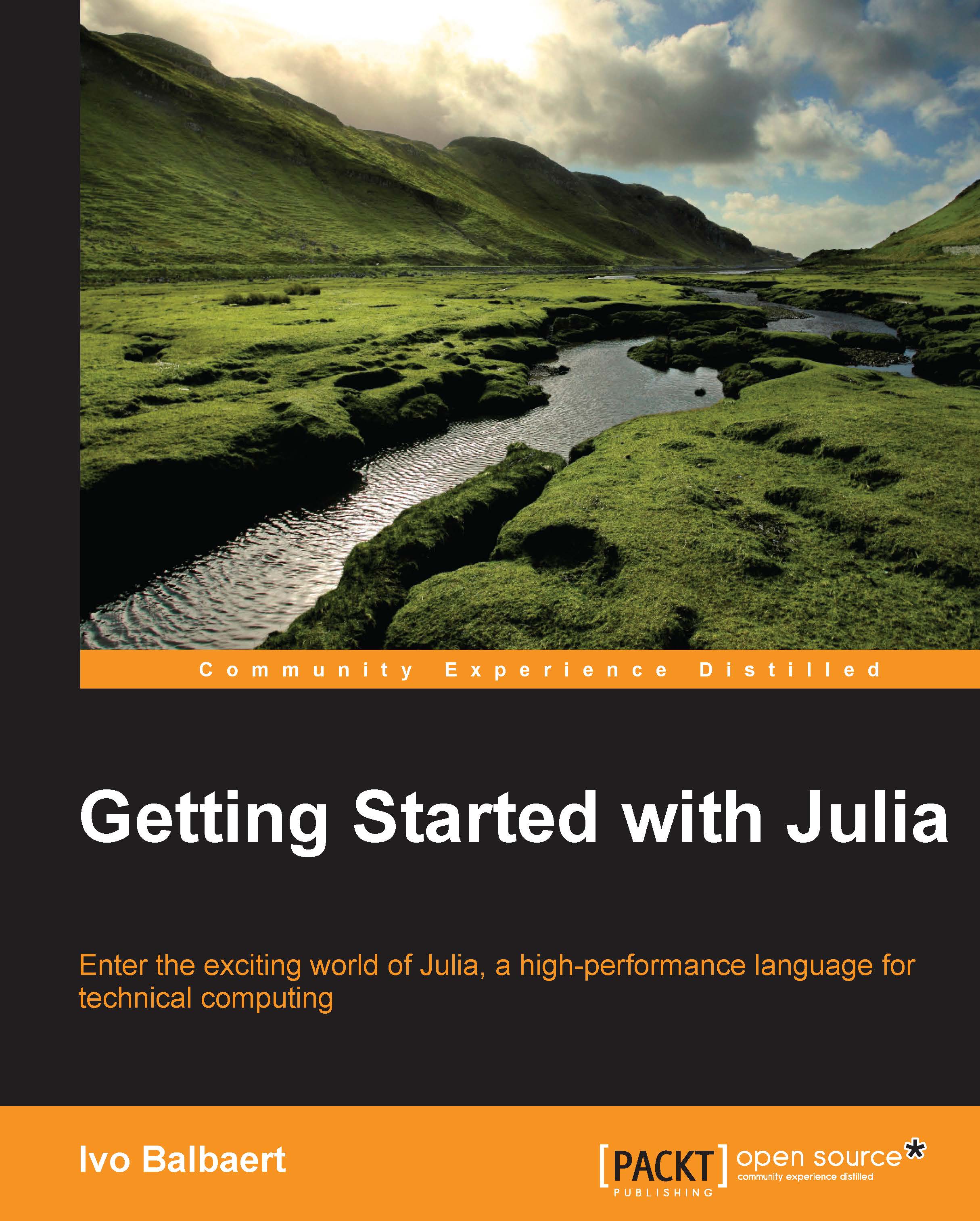
Getting started with Julia Programming Language: Enter the exciting world of Julia, a high-performance language for technical computing

eBook
€25.19 €27.99
Paperback
€34.99
eBook + Subscription
€21.99 Monthly

What do you get with eBook?

Product feature icon Instant access to your Digital eBook purchase
Product feature icon Download this book in EPUB and PDF formats
Product feature icon Access this title in our online reader with advanced features
Product feature icon DRM FREE - Read whenever, wherever and however you want
Product feature icon AI Assistant (beta) to help accelerate your learning
Modal Close icon
Payment Processing...
tick Completed

Billing Address

Description

This book is for you if you are a data scientist or working on any technical or scientific computation projects. The book assumes you have a basic working knowledge of high-level dynamic languages such as MATLAB, R, Python, or Ruby.

Who is this book for?

This book is for you if you are a data scientist or working on any technical or scientific computation projects. The book assumes you have a basic working knowledge of high-level dynamic languages such as MATLAB, R, Python, or Ruby.

What you will learn

  • Set up your Julia environment to achieve the highest productivity
  • Solve your tasks in a highlevel dynamic language and use types for your data only when needed
  • Create your own types to extend the builtin type system
  • Visualize your data in IJulia with plotting packages
  • Explore the use of builtin macros for testing, debugging, benchmarking, and more
  • Apply Julia to tackle problems concurrently and in a distributed environment
  • Integrate with other languages such as C, Python, and MATLAB

Product Details

Country selected
Publication date, Length, Edition, Language, ISBN-13
Publication date : Feb 26, 2015
Length: 214 pages
Edition : 1st
Language : English
ISBN-13 : 9781783284801
Category :
Languages :

What do you get with eBook?

Product feature icon Instant access to your Digital eBook purchase
Product feature icon Download this book in EPUB and PDF formats
Product feature icon Access this title in our online reader with advanced features
Product feature icon DRM FREE - Read whenever, wherever and however you want
Product feature icon AI Assistant (beta) to help accelerate your learning
Modal Close icon
Payment Processing...
tick Completed

Billing Address

Product Details

Publication date : Feb 26, 2015
Length: 214 pages
Edition : 1st
Language : English
ISBN-13 : 9781783284801
Category :
Languages :

Packt Subscriptions

See our plans and pricing
Modal Close icon
€18.99 billed monthly
Feature tick icon Unlimited access to Packt's library of 7,000+ practical books and videos
Feature tick icon Constantly refreshed with 50+ new titles a month
Feature tick icon Exclusive Early access to books as they're written
Feature tick icon Solve problems while you work with advanced search and reference features
Feature tick icon Offline reading on the mobile app
Feature tick icon Simple pricing, no contract
€189.99 billed annually
Feature tick icon Unlimited access to Packt's library of 7,000+ practical books and videos
Feature tick icon Constantly refreshed with 50+ new titles a month
Feature tick icon Exclusive Early access to books as they're written
Feature tick icon Solve problems while you work with advanced search and reference features
Feature tick icon Offline reading on the mobile app
Feature tick icon Choose a DRM-free eBook or Video every month to keep
Feature tick icon PLUS own as many other DRM-free eBooks or Videos as you like for just €5 each
Feature tick icon Exclusive print discounts
€264.99 billed in 18 months
Feature tick icon Unlimited access to Packt's library of 7,000+ practical books and videos
Feature tick icon Constantly refreshed with 50+ new titles a month
Feature tick icon Exclusive Early access to books as they're written
Feature tick icon Solve problems while you work with advanced search and reference features
Feature tick icon Offline reading on the mobile app
Feature tick icon Choose a DRM-free eBook or Video every month to keep
Feature tick icon PLUS own as many other DRM-free eBooks or Videos as you like for just €5 each
Feature tick icon Exclusive print discounts

Frequently bought together


Stars icon
Total 113.97
Julia High Performance
€30.99
Mastering Julia
€47.99
Getting started with Julia Programming Language
€34.99
Total 113.97 Stars icon

Customer reviews

Top Reviews
Rating distribution
Full star icon Full star icon Full star icon Full star icon Half star icon 4.1
(17 Ratings)
5 star 41.2%
4 star 47.1%
3 star 0%
2 star 0%
1 star 11.8%
Filter icon Filter
Top Reviews

Filter reviews by


adnan baloch Mar 26, 2015
Full star icon Full star icon Full star icon Full star icon Full star icon 5
Scientists and students dealing with technical computing problems have a real conundrum at their hands when it comes to solving their problems using programming. If they use a specialized language, they have to give up speed. If they turn to C or C++ for their programming needs, they have to look at a significant time investment most of which might be spent not solving their problem but wrestling with the quirky language design decisions of C/C++. The best of both these worlds was conceived at MIT in the form of the Julia programming language. Striving to keep the performance at most twice as slow as C/C++, the author shows how easy it is to use Julia as a one-stop solution for all our technical computing needs. Installation, Julia shell, Julia studio and Ijulia are introduced in the first chapter thus making the readers confident that they can get to work as soon as possible no matter their preference of development environment. The next chapter introduces the variables and types in Julia. The author dedicates an entire chapter to functions in Julia and shows why Julia deserves to be called a functional language. Control flow, exception handling and tasks (coroutines) form the subject of the next chapter. The author moves onto complex types consisting of many elements which are dubbed collection types in Julia. The author uses the example of a word frequency program in just a little over a dozen lines of code to demonstrate the power of Julia. Multiple dispatch and metaprogramming are strengths that set Julia apart and the author makes sure that the readers understand them thoroughly. Working with CSV files and the concept of dataframes is explained clearly. The fact that a dataframe is kind of an array with different types in its columns provides the user a lot of versatility in attacking common data problems. Connecting with databases, networking and parallel computation using Julia are also given ample explanation for the benefit of the readers. Interfacing with the command line, C, Fortran and Python are touched upon in a chapter that ends with valuable performance tips to get the most out of Julia. The final chapter leaves the readers with the opportunity to explore Julia's rich standard library and shows a plotting example using Gadfly. Julia's excellent package manager and almost 400 packages mean that the readers will find themselves busy with Julia long after they have finished this comprehensive introduction to one of the rising stars of the technical computing scene.
Amazon Verified review Amazon
Dirk Harms-Merbtiz Nov 25, 2016
Full star icon Full star icon Full star icon Full star icon Full star icon 5
Quick read and to the point. Took a couple hours to go through. Amazon, don't require so many words in reviews.
Amazon Verified review Amazon
Jordi C May 10, 2015
Full star icon Full star icon Full star icon Full star icon Full star icon 5
Great introduction to Julia. In the past I tried to learn Julia several times, using online documentation and tutorials, but I never found the right help that caught my attention, so I never learnt. On the other hand, this book guided me smoothly and easily through the Julia language, so I really recommend it.The book is well structured, from the syntax basics to useful features as error handling, tasks, running shell commands and python libraries, parallel computing and metaprogramming, features that also seem easy to use with Julia.I found the level of the book adequate to start with the language (I am already fluent in Python and Fortran, which I use for scientific computing).
Amazon Verified review Amazon
ruben Apr 11, 2015
Full star icon Full star icon Full star icon Full star icon Full star icon 5
I would like to thank the author because I have seen this book as a great opportunity area where we have to work.I want to say that I am teacher in engineering like mechatronics, electromechanic, industrial and we have been working with this new technologies to solve practical problems in the industry I could say that the problems that we have to teach we apply the content of the book to solve themThanks.
Amazon Verified review Amazon
Oleg Okun Apr 19, 2015
Full star icon Full star icon Full star icon Full star icon Full star icon 5
What is Julia? Julia is a fairly new programming language (borne in 2012) that aims at reaching two objectives: 1) quick solution prototyping like in MATLAB, R or Python and 2) fast computational time and efficient memory management like in FORTRAN, C or C++. Thus, one could say that Julia tries to bridge the gap between programming languages of two types - high-level but slow and fast but low-level.As such, Julia is a primal competitor to MATLAB, R, and Python. However, competition does not completely exclude collaboration; this is the case for Julia that has packages for calling code written in these and some other languages like Java. Needless to say, Julia is open source and free with a liberal MIT license, which is important for wide adoption. To date, there are 549 external packages that can be found at http://pkg.julialang.org/ .Chapter 1 explains how to install Julia for Windows, Ubuntu and OS X, shows example of work in Julia shell, and lists IDEs like Juno that can be used. Chapter 2 describes Julia's types of variables (numbers, characters, strings, ranges, arrays) that are the key for its performance, while Chapter 3 discusses functions (their definition and types). Control flow operators (if, for, while, break, continue) and exception handling are introduced in Chapter 3. As the extensions of Chapter 2, Chapter 5 talks about matrices (multidimensional arrays), tuples, sets and dictionaries, while Chapter 6 goes into detail of type annotation and conversion, type hierarchy, abstract, parametric, and user-defined types. The concept of metaprogramming (which can even generate code) is explained in Chapter 7. Chapter 8 explores I/O (file reading from and writing to several formats such as CSV, JSON, XML, HDF5, DataFrames for tabular data representation), networking, interacting with databases, and parallel computing. How to call from within Julia the code written in another programming language like C, FORTRAN and Python as well as performance recommendations are explained in Chapter 9. Chapter 10 looks at the standard library of functions and packages and provides guidelines how to use a package manager and visualize data.One may say that everything abovementioned can be found in Julia's documentation, but to have these topics in one place such as this book is certainly a must for new converts and seasonable experts alike.
Amazon Verified review Amazon
Get free access to Packt library with over 7500+ books and video courses for 7 days!
Start Free Trial

FAQs

How do I buy and download an eBook? Chevron down icon Chevron up icon

Where there is an eBook version of a title available, you can buy it from the book details for that title. Add either the standalone eBook or the eBook and print book bundle to your shopping cart. Your eBook will show in your cart as a product on its own. After completing checkout and payment in the normal way, you will receive your receipt on the screen containing a link to a personalised PDF download file. This link will remain active for 30 days. You can download backup copies of the file by logging in to your account at any time.

If you already have Adobe reader installed, then clicking on the link will download and open the PDF file directly. If you don't, then save the PDF file on your machine and download the Reader to view it.

Please Note: Packt eBooks are non-returnable and non-refundable.

Packt eBook and Licensing When you buy an eBook from Packt Publishing, completing your purchase means you accept the terms of our licence agreement. Please read the full text of the agreement. In it we have tried to balance the need for the ebook to be usable for you the reader with our needs to protect the rights of us as Publishers and of our authors. In summary, the agreement says:

  • You may make copies of your eBook for your own use onto any machine
  • You may not pass copies of the eBook on to anyone else
How can I make a purchase on your website? Chevron down icon Chevron up icon

If you want to purchase a video course, eBook or Bundle (Print+eBook) please follow below steps:

  1. Register on our website using your email address and the password.
  2. Search for the title by name or ISBN using the search option.
  3. Select the title you want to purchase.
  4. Choose the format you wish to purchase the title in; if you order the Print Book, you get a free eBook copy of the same title. 
  5. Proceed with the checkout process (payment to be made using Credit Card, Debit Cart, or PayPal)
Where can I access support around an eBook? Chevron down icon Chevron up icon
  • If you experience a problem with using or installing Adobe Reader, the contact Adobe directly.
  • To view the errata for the book, see www.packtpub.com/support and view the pages for the title you have.
  • To view your account details or to download a new copy of the book go to www.packtpub.com/account
  • To contact us directly if a problem is not resolved, use www.packtpub.com/contact-us
What eBook formats do Packt support? Chevron down icon Chevron up icon

Our eBooks are currently available in a variety of formats such as PDF and ePubs. In the future, this may well change with trends and development in technology, but please note that our PDFs are not Adobe eBook Reader format, which has greater restrictions on security.

You will need to use Adobe Reader v9 or later in order to read Packt's PDF eBooks.

What are the benefits of eBooks? Chevron down icon Chevron up icon
  • You can get the information you need immediately
  • You can easily take them with you on a laptop
  • You can download them an unlimited number of times
  • You can print them out
  • They are copy-paste enabled
  • They are searchable
  • There is no password protection
  • They are lower price than print
  • They save resources and space
What is an eBook? Chevron down icon Chevron up icon

Packt eBooks are a complete electronic version of the print edition, available in PDF and ePub formats. Every piece of content down to the page numbering is the same. Because we save the costs of printing and shipping the book to you, we are able to offer eBooks at a lower cost than print editions.

When you have purchased an eBook, simply login to your account and click on the link in Your Download Area. We recommend you saving the file to your hard drive before opening it.

For optimal viewing of our eBooks, we recommend you download and install the free Adobe Reader version 9.

Modal Close icon
Modal Close icon