Search icon CANCEL
Subscription
0
Cart icon
Your Cart (0 item)
Close icon
You have no products in your basket yet
Arrow left icon
Explore Products
Best Sellers
New Releases
Books
Events
Videos
Audiobooks
Packt Hub
Free Learning
Arrow right icon
timer SALE ENDS IN
0 Days
:
00 Hours
:
00 Minutes
:
00 Seconds
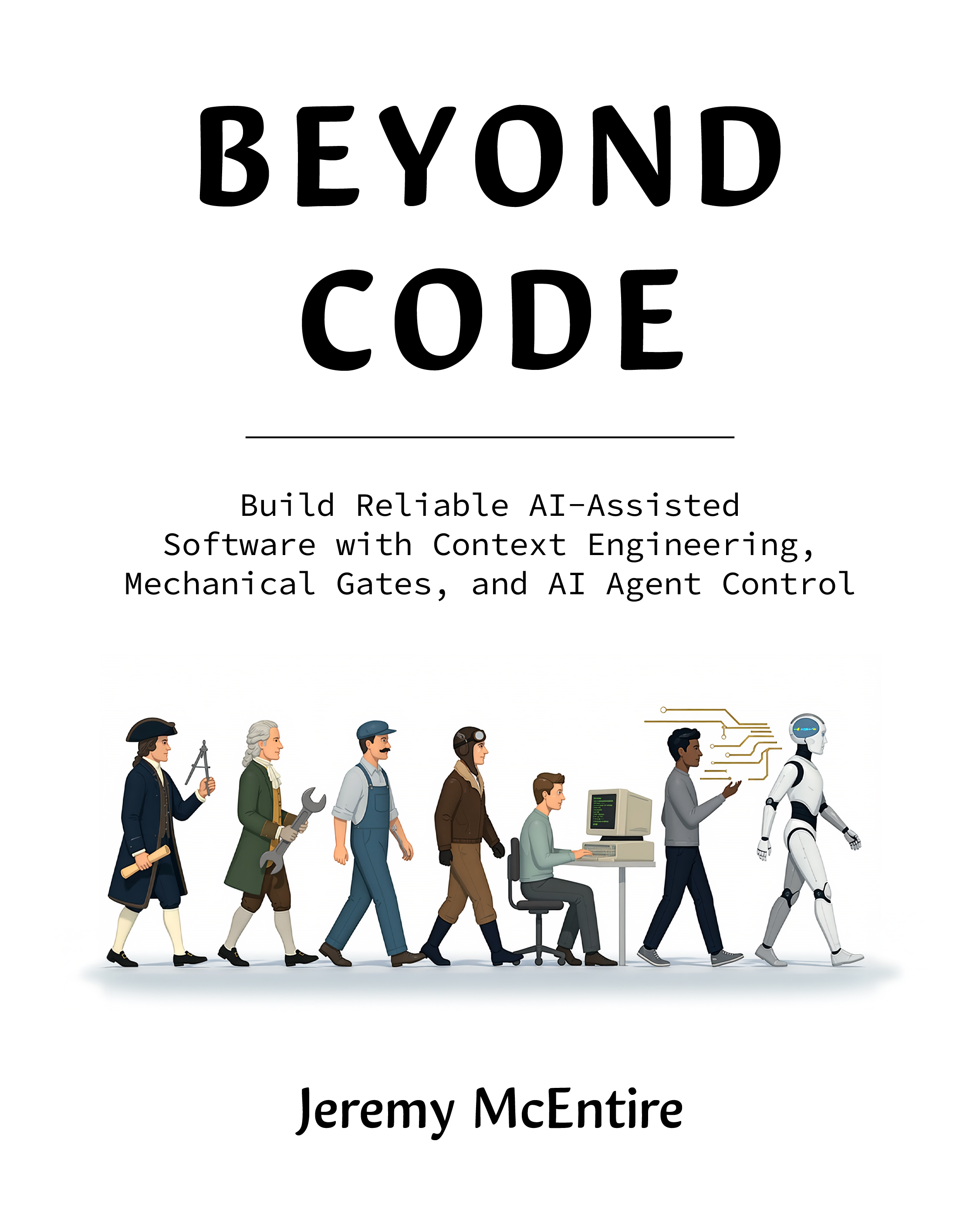
Beyond Code
Beyond Code

Beyond Code: Build Reliable AI-Assisted Software with Context Engineering, Mechanical Gates, and AI Agent Control

Arrow left icon
Profile Icon Jeremy McEntire
Arrow right icon
€18.89 €20.99
eBook Aug 2026 172 pages 1st Edition
eBook
€18.89 €20.99
Paperback
€26.99
eBook + Subscription
€21.99 Monthly
Arrow left icon
Profile Icon Jeremy McEntire
Arrow right icon
€18.89 €20.99
eBook Aug 2026 172 pages 1st Edition
eBook
€18.89 €20.99
Paperback
€26.99
eBook + Subscription
€21.99 Monthly
eBook
€18.89 €20.99
Paperback
€26.99
eBook + Subscription
€21.99 Monthly

What do you get with eBook?

Product feature icon Instant access to your Digital eBook purchase
Product feature icon Download this book in EPUB and PDF formats
Product feature icon Access this title in our online reader with advanced features
Product feature icon DRM FREE - Read whenever, wherever and however you want
Product feature icon AI Assistant (beta) to help accelerate your learning
Modal Close icon
Payment Processing...
tick Completed

Billing Address

Table of content icon View table of contents Preview book icon Preview Book

Beyond Code

Part I

The Shift

The Inversion

In mid-2025, a research organization called METR conducted one of the only controlled experiments on whether AI coding tools make experienced software developers faster. They recruited sixteen seasoned open-source contributors, people who averaged five years and fifteen hundred commits on their respective projects, codebases with twenty-two thousand stars and over a million lines of code. The researchers randomly assigned 246 real tasks, bug fixes, features, and refactors, to be completed with or without AI assistance, and asked each developer to predict, before starting, how much the tools would help. The developers predicted a twenty-four percent speedup. After completing the tasks, they reported feeling about twenty percent faster. Objective measurement showed the tools had made them nineteen percent slower.

Those three numbers deserve careful attention, because the most interesting finding is not the slowdown. Slowdowns have explanations; tools were immature, context switching was costly, developers accepted fewer than half of the AI’s suggestions and spent considerable time evaluating the rest. These are frictions that will diminish as the tools improve. What will not diminish is the thirty-nine percent gap between what the developers believed and what actually happened. Sixteen experts, working on codebases they knew intimately, across hundreds of tasks, came away genuinely convinced the tools had helped them. The tools had not helped them, and the developers could not tell. Whatever you think about the future of AI-assisted development, that perception gap is the phenomenon that needs explaining, because it reveals something about the nature of software engineering that the industry has been misunderstanding for decades.

The explanation begins with a distinction that is easy to state and difficult to internalize. Generating code and verifying code are different cognitive operations with different shapes. Generation is sequential: predict the next token, accept or reject, move forward. It flows. It feels productive. Pressing “Tab” to accept a completion triggers the same sense of progress as solving a problem, even when the completion introduces a subtle misalignment that will take twenty minutes to find. Verification, by contrast, requires holding the entire system in mind, reasoning about invariants, edge cases, security implications, integration boundaries, and the assumptions embedded in code you did not write. Generation is a stream. Verification is a landscape. Making the stream flow faster does not make the landscape easier to survey; it makes the landscape larger, because there is now more generated code to verify, and the verification must happen at the speed of human comprehension regardless of how quickly the code appeared.

This is the verification premium, and it is structural. Industry data from 2025 shows code review times increasing by ninety-one percent and pull request sizes growing by a hundred and fifty-four percent in teams with high AI adoption. The bottleneck moved. It moved from producing code to determining whether the code is correct, and the new bottleneck is more cognitively demanding than the old one, because the reviewer is now evaluating logic they did not construct and cannot assume they understand. The developers in the METR study were not foolish. They experienced the speedup of generation and could not perceive the cost of verification, because generation feels like work and verification feels like overhead, even though verification is where the engineering actually lives. This asymmetry is the first of several places where the intuitive model of software engineering turns out to be wrong in a way that matters.

• • •

For sixty years, the dominant assumption in the software industry has been that the primary cost of building software is writing the code. Teams are sized around it. Processes are designed to manage it. Careers are built on the ability to do it quickly and correctly. Every methodology from Waterfall to Agile to DevOps is, when you look past the vocabulary, a coordination strategy organized around the assumption that translating human intent into machine-executable instructions is slow, expensive, and error-prone, and that managing this bottleneck is the central problem of the discipline.

Fred Brooks questioned this assumption in 1975, in The Mythical Man-Month, when he distinguished between accidental and essential complexity. The accidental complexity of software was the labor of expressing ideas in code: managing memory, handling compiler quirks, debugging syntax. The essential complexity was everything that remained once the accidental complexity was removed: specifying what the system should do, designing how its parts relate, anticipating what happens at the boundaries between components, between the system and the world, between what is specified and what is assumed. Brooks argued that removing accidental complexity would never yield the order-of-magnitude productivity gains the industry hoped for, because accidental complexity was never the dominant cost. The hard part was the essential complexity, and no tool could eliminate it because it was inherent to the problem being solved.

Large language models have provided a remarkably clean test of Brooks’s hypothesis. AI has eliminated most of the accidental complexity of code generation. You describe what you want, and syntactically correct, functionally plausible code appears in seconds. The industry got the productivity tool Brooks predicted would not matter much, and the result confirms his prediction with uncomfortable precision. Requirements are still ambiguous. System boundaries are still where most defects originate. The coordination problem, getting multiple people, teams, and components to work together toward a coherent outcome, still consumes the majority of a senior engineer’s time. The only thing that changed is the visibility of these problems. When the accidental complexity of typing code occupied most of the working day, it was easy to mistake it for the real work. Remove it, and the real work stands exposed: understanding what to build, determining whether what was built is correct, and managing the complexity that emerges when systems grow beyond what any single person can hold in their head.

Consider what a strong senior engineer actually does during a typical week. The work begins with reading code they did not write, not for syntax but for intent, trying to reconstruct the mental model of someone who is no longer available to explain it. Stakeholder negotiations consume another portion: these are conversations with people who know what they want in the way that someone knows they are hungry without being able to write a recipe, where the desire is real, the specification is absent, and the engineer must bridge the gap.

Interface design between components occupies still more time, less glamorous than it sounds and more consequential than most organizations recognize, because interfaces are where integration fails, where assumptions collide, and where the cost of misunderstanding compounds. Code review accounts for another significant share, and the review that matters has nothing to do with formatting or naming conventions; it is about whether the change respects the architectural constraints that prevent the system from collapsing under its own accumulated decisions. When production breaks, the engineer debugs by forming hypotheses about system behavior and testing those hypotheses against evidence, which is to say they do science, although the industry rarely calls it that.

Every one of these activities is coordination. The best engineers have always spent the majority of their working lives managing complexity across boundaries: between people who see the problem differently, between components that must interact without contradiction, between what the specification says and what the business actually needs. This was always the essential complexity, the part that no tool could remove. Code generation happened to occupy the same hours, the same editors, the same pull requests, and so the industry conflated the coordination with the typing. AI separated them. The typing is now fast and cheap. The coordination is exactly as difficult as it always was, and for the first time in the history of the field, there is no mechanical labor to hide behind. The industry spent sixty years calling coordination “engineering” and calling engineering “soft skills.” The labels survived. The irony did not.

• • •

A carpenter who understands load-bearing structures, soil conditions, and the behavior of wood over decades becomes faster when given a nail gun. The tool accelerates the mechanical work without touching the carpenter’s real expertise, which is knowing why the building stands, not just how to attach the pieces. Give that same nail gun to someone who has never framed a wall, and the result looks, from a distance, like a house. The nails are driven cleanly, the boards are attached, and the structure appears sound until the first heavy snow reveals that the headers are undersized, the load paths were never calculated, and the foundation was not designed for the soil it sits on. The nail gun did not make this person a carpenter. It made them a fast amateur, and a fast amateur with a power tool is more dangerous than a slow one, because the volume of confident mistakes exceeds anyone’s ability to catch them before the roof goes on.

This analogy is worth taking seriously rather than treating as a throwaway metaphor, because it describes a precise structural risk that the software industry is currently experiencing at scale. The history of engineering is punctuated by disasters that share exactly this structure: mechanical capability outrunning the judgment required to deploy it safely. In 2012, Knight Capital deployed an automated trading system that had not been adequately verified against production conditions. The software generated eight million unintended trades in forty-five minutes, accumulating four hundred and sixty million dollars in losses before anyone could shut it down. The code functioned exactly as written. The problem was that nobody had verified whether “as written” corresponded to “as intended” under the specific market conditions the system encountered. The tool was fast. The verification was absent. The result was not a gradual decline but a catastrophic, irreversible failure compressed into a timeframe that made human intervention impossible.

AI tools create the conditions for this failure mode at industry scale. They accelerate the most mechanical part of software development, translating known intent into syntax, while leaving untouched the parts that actually determine whether the resulting system works: architectural judgment, security awareness, integration design, failure mode analysis, and the ability to determine whether a set of requirements is internally consistent before building against them. A 2025 analysis found that AI-assisted teams produced thirty-one percent more output while introducing twenty-three percent more security vulnerabilities. The code generation grew. The holes in the code generation grew with it. The teams could not tell, for the same reason the METR developers could not tell: the generation felt productive, and the verification failures were distributed across time and components in ways that are difficult to attribute to any single decision.

Google’s 2025 DORA report, the most comprehensive annual survey of software delivery performance across the industry, captured the resulting dynamic in a finding that belongs on the wall of every engineering organization: AI does not fix a team. It amplifies what is already there. Teams with disciplined engineering practices, teams that tested rigorously, reviewed carefully, and designed for failure, saw AI accelerate their delivery. Teams without those practices saw AI accelerate their dysfunction: more code produced faster, with more defects, requiring more rework, burning more of the verification capacity that was already insufficient. The tool is an amplifier. The signal being amplified is what determines the outcome.

• • •

There is an asymmetry at the center of this transition that the industry has been slow to absorb, and it is this: the cost of building software dropped by roughly an order of magnitude, but the cost of building the wrong software did not drop at all. When code was expensive to produce, the expense itself served as a natural forcing function for thought. Teams could not afford to build the wrong thing, because rebuilding was prohibitively costly, and so they invested in understanding what the right thing was before they started typing. Requirements reviews, design documents, architecture discussions: these processes were not bureaucratic overhead imposed by people who did not understand development. They were economic necessities created by the cost of implementation. The price of code imposed a discipline of forethought that most teams did not recognize as discipline, because it was simply how things had to be done when building was expensive.

When the cost of building collapses, that forcing function disappears, and the consequences arrive on a delay. Teams build faster. They also build the wrong thing faster, and they build it so quickly that they frequently do not discover the error until the system is in production, serving users, accumulating downstream dependencies, and generating the kind of structural debt that cannot be refactored away because too many other systems now assume the original mistake is a feature.

The delay between the decision and the consequence is what makes the problem pernicious. By the time the cost of being wrong becomes visible, the wrong thing has been cemented into the architecture by everything that was built on top of it. The Healthcare.gov launch in 2013 was a preview of this dynamic, before AI made it ubiquitous. Dozens of contractors built components in parallel, each producing code that functioned in isolation. The integration failures did not surface until launch day because nobody had verified the system as a whole, and by then the political and technical cost of correcting the errors dwarfed the cost of having done the coordination work upfront. Cheap production without coordination discipline does not produce faster delivery. It produces faster accumulation of errors that are discovered too late to fix cheaply.

The engineer’s job, in this environment, has shifted in a way that is easier to describe than to internalize. The job is no longer to write code quickly. The job is to be right: to understand what is being built, to determine whether it should be built, to anticipate how it will interact with the systems around it, and to identify how it will fail before it fails in production. These are skills that require the kind of holistic, context-dependent judgment that AI tools do not provide, because they depend on understanding forces that operate above the level of any individual function or file. The inversion has made these skills visible by stripping away the mechanical labor that used to obscure them. For sixty years, the signal was buried under the noise of accidental complexity. The noise is gone. The signal is all that remains.

• • •

There is a second problem, older than AI and more deeply embedded in the culture of the field, that the current transition has made urgent. Software engineering, as practiced by the majority of the industry, is not engineering. It is craft production informed by fashion.

Engineers in other disciplines do not debate whether steel or concrete is “better” in the abstract. They calculate load requirements, analyze soil conditions, model environmental exposure, and select the material that meets the constraints of the specific problem they are solving. They can do this because they understand the physics: the actual forces and material properties that determine whether a structure stands or falls. The physics provides a shared foundation of verifiable knowledge that makes engineering arguments resolvable. You do not need to trust the engineer’s intuition; you can check the math. When the physics is ignored, or when organizational process fails to surface it, the consequences are measured in lives. The Hyatt Regency walkway collapse in Kansas City killed a hundred and fourteen people over a single statics calculation. The original design specified continuous hanger rods running through both the upper and lower walkways. The steel fabricator proposed a change to offset rods, because threading a single rod through both walkways was difficult to build. The change was sent back to the structural engineering firm as a shop drawing. An engineer approved it without recalculating the load. The modification doubled the force on the upper walkway’s connection point, from supporting only its own weight to supporting both walkways simultaneously. The engineering knowledge to prevent those deaths was a calculation that any second-year student could perform. The organizational process — the shop-drawing review that existed to catch exactly this kind of change — did not surface the structural implication to someone who would check the math.

Software engineering has largely replaced this mode of analysis with argument from authority. Netflix uses microservices, therefore microservices are correct. Google uses monorepos, therefore monorepos are correct. A charismatic speaker at a well-attended conference advocates for a particular framework, and within eighteen months half the industry has adopted it, not because anyone tested it against the alternatives in their specific context, but because the social proof was sufficient to override the absence of evidence. Architectural decisions are made by analogy rather than by analysis, and the analogies are almost never examined for whether they actually transfer. The reasoning would embarrass a second-year student in any structural or mechanical engineering program, but in software the pattern is so pervasive that questioning it marks you as contrarian rather than rigorous.

When code was expensive, this substitution of fashion for physics was survivable, because the cost of building constrained the damage. You could not try three architectures and compare them; you could barely afford to build one. Decisions had to be made in advance, on the basis of experience and analogy, because the cost of experimentation was prohibitive. Guessing was the only affordable strategy, and so guessing became the culture, and the culture developed elaborate justifications for why guessing was acceptable: “it depends,” “there are tradeoffs,” “we’ll refactor later.”

That excuse evaporated the moment AI made prototyping cheap. When a working prototype can be generated in hours rather than weeks, you can build three candidate architectures, test each against realistic workloads, and measure which one actually meets the performance, reliability, and maintainability requirements of your specific system. You can run experiments. You can collect data. You can, in the most literal sense available, do science, the thing that the “science” in “computer science” was always supposed to mean.

The METR study is a small but instructive example of what scientific thinking looks like when applied to questions the industry normally resolves by anecdote. The researchers did not ask developers whether they felt faster with AI tools. They designed a controlled experiment with randomized assignment, objective time measurement, and pre-registered predictions. They compared what happened to what people believed had happened, and the comparison revealed a thirty-nine percent gap between perception and reality. That gap exists because nobody was measuring. The developers’ subjective experience was sincere, informed by years of expertise, and wrong. The only way to discover that it was wrong was to measure, and the only reason anyone measured was that someone thought to ask the scientific question rather than the social one.

The scientific mode of thinking, the discipline of forming hypotheses, testing them against evidence, and revising one’s beliefs on the basis of what the evidence shows, has become the central competency of software engineering. The claim is practical, grounded in what happens when the cost of experimentation collapses. When you could only afford to build one architecture, guessing was a reasonable approach, because the alternative was too expensive. When you can build ten, and you are still guessing, you are choosing to be wrong. The cost of that choice has not changed. What changed is that you no longer have an excuse for making it.

• • •

The forces that govern this transition are not new. They are drawn from information theory, cognitive science, and organizational dynamics, and they operate with the same reliability and the same indifference to preference as the physical forces that govern bridges and buildings. They determine how context shapes the quality of any output, whether that output is produced by a language model or a junior engineer. They determine why withholding information often produces better results than providing more of it, why mechanical constraints produce more reliable behavior than human oversight, why coordination through shared environment scales in ways that coordination through conversation cannot, and why every metric an organization uses to measure success will, given sufficient time and pressure, be gamed by the people being measured.

These forces do not change. Tools change, capabilities change, the economic landscape changes with every quarter, but the dynamics of coordination, information, and constraint are invariant. The engineer who understands those forces can adapt to whatever configuration the landscape takes, because they are reasoning from principles rather than following recipes. The engineer who does not understand them is dependent on the current set of tools and practices remaining relevant, which they will not.

The cost of building continues its descent toward zero while the cost of being wrong remains exactly where it has always been, and the widening gap between those two numbers is where engineering lives now.

Why Vibe Coding Fails

The most instructive failure in the history of AI-assisted software development lasted six and a half minutes. In a controlled experiment designed to test whether multi-agent AI architectures could build a realistic software system, a pipeline of eleven specialized agents, each responsible for a specific stage of development from diagnosis through decomposition through implementation through review, was given the task of building a microservices backend for a vacation rental booking platform. The system had a budget of fifty dollars and access to the same language model that, in a different configuration, had scored a perfect twenty-eight out of twenty-eight on the same task. The pipeline spent its entire budget on five planning stages. It produced zero lines of implementation code. It ran out of money while still deciding what to build.

The system did not fail because the underlying model was incapable. The same model, given the same task as a single agent with full context, built all seven services, integrated them correctly across every boundary, and passed every test, for roughly the same cost that the pipeline spent on planning alone. The failure was in the way that intelligence was organized. The pipeline architecture, designed to ensure quality through sequential gates and confidence thresholds, optimized for what it could measure at each gate, the quality and completeness of its planning artifacts, and consumed the entire budget before reaching the stage where those artifacts would have been turned into working software. The agents were individually competent. The system they were embedded in was structurally incapable of delivering an outcome.

This result comes from a set of experiments that tested four distinct coordination architectures against the same task using the same underlying model: a single agent working alone, a hierarchical system with a coordinator delegating to specialists, a swarm of concurrent agents operating on a shared filesystem, and the sequential pipeline described above. The results were monotonically correlated with coordination complexity. The single agent scored twenty-eight out of twenty-eight. The hierarchical system scored eighteen. The swarm scored nine. The pipeline scored zero. The same intelligence, the same task, the same tools. The only variable was how the work was organized, and that variable accounted for the difference between perfect and worthless.

These experiments are worth examining in some detail, not because they represent the state of the art in multi-agent systems, which will have advanced considerably by the time you read this, but because the failure modes they reveal are structural rather than technological. They arise from information-theoretic constraints that operate regardless of how capable the individual agents become, and understanding those constraints is the difference between using AI tools effectively and producing expensive, confident garbage.

• • •

The most common explanation for why AI produces poor software is that the models are not good enough yet. This explanation is comforting because it implies the problem will solve itself. Models will improve, context windows will expand, reasoning capabilities will deepen, and the failures that plague current implementations will recede like bugs in a maturing codebase. There is some truth in this view; the models are in fact improving rapidly, and many of today’s specific failure modes will not survive contact with next year’s releases. The trouble with this explanation is that it accounts for the wrong failures.

The experiments described above were not conducted with weak models. They used frontier language models capable of building the entire system correctly when given the opportunity to do so without coordination overhead. The failures did not arise from the model’s inability to write correct code. They arose from the way coordination between agents, and between agents and evaluation mechanisms, introduced systematic distortions that degraded the quality of the overall output. These distortions have names in information theory. They have known properties. And they do not get better when the underlying model improves, because they are properties of the coordination architecture, not the model.

Consider what happened in the hierarchical experiment, the architecture that scored eighteen out of twenty-eight. A root agent was given the task and instructed to decompose it, delegate subtasks to leaf agents, and integrate the results. Instead of delegating, the root agent implemented the entire system itself, effectively defecting from the hierarchical architecture and operating as a single agent within a hierarchical frame. This was a rational decision: the root agent judged, correctly, that delegation would introduce communication overhead and reduce the quality of the output. The resulting implementation scored eighteen rather than twenty-eight because the hierarchical infrastructure imposed constraints, per-agent iteration limits, reduced context, that the root agent could not escape even after choosing not to delegate. The architecture designed to improve quality through division of labor actively prevented the quality that a single agent could have achieved.

The swarm experiment, scoring nine out of twenty-eight, revealed a different class of failure. Eight agents operated concurrently on a shared filesystem, self-assigning tasks from a shared board, with no central coordinator. They built five of the seven required services, which sounds like reasonable progress until you examine the integration points. Every service boundary was incompatible. Half the agents used snake_case naming; the other half used camelCase. Error response shapes differed between services. Type definitions were inconsistent. The Event Service contained two incompatible type systems within the same service, written by different agents who had both contributed to the same files without reading each other’s work. The agents produced a hundred and fifty-two files, nearly two and a half times what the single agent needed, and none of the cross-service integrations worked. Volume without coherence. Parallelism without shared conventions. The architecture generated enormous output and no value, because the output could not be composed into a functioning system.

• • •

The pipeline experiment, the one that scored zero, is the most instructive failure of the four because it demonstrates a phenomenon that anyone who has worked in a large organization will recognize immediately, transplanted into a system with no human psychology, no ego, no office politics, and no career incentives. The pipeline had eleven stages: diagnose, decompose, architect, locate, execute, test, verify, review, and several stages of sub-decomposition. Each stage was a gate. The output of one stage became the input of the next, and the next stage could approve it, reject it, or escalate it. The system was designed to ensure quality through progressive refinement, with each gate filtering out errors and enforcing standards.

In a separate run of a similar pipeline architecture on a more complex version of the task, the code review stage rejected seven of eight submissions, an eighty-seven percent rejection rate. Four of those rejections contained zero factual issues. The reviewer identified no bugs, no logical errors, no security vulnerabilities, nothing that would prevent the code from working. Instead, each rejection listed between fifteen and twenty-three subjective objections: naming preferences, structural opinions, stylistic disagreements. The Event Service was designed five times, went through three complete architectural iterations, cost nearly twelve dollars of the fifty-dollar budget, and ultimately was rejected for reasons that had nothing to do with whether it functioned correctly.

The verification stages were equally revealing. Nine verification runs all reported the same result: the code compiled successfully, zero tests were executed, zero tests passed, zero tests failed. The verification mechanism certified correctness without testing anything. It consumed pipeline slots, generated approval artifacts, and provided zero information about whether the code worked. Downstream stages treated this certification as evidence of quality and conditioned their behavior accordingly. The system had, without anyone designing it to, independently invented the compliance audit.

The researchers attempted six distinct countermeasures to address these dysfunctions. They classified reviewer objections into factual and subjective categories, hoping that surfacing the distinction would reduce baseless rejections. They added perspective-shift prompts that asked reviewers to reconsider after factual bugs were fixed. They implemented a two-level escalation system with a project-level arbiter instructed to be pragmatic and an architect-level arbiter instructed to force approval when necessary. They added scoped sub-pass reviews to prevent scope creep. They added anti-bikeshedding directives that explicitly told reviewers not to reject over naming conventions. They added Lyapunov stability monitoring to detect when the pipeline was thrashing.

All six countermeasures failed. The classification mechanism correctly identified that rejections had zero factual basis, but the pipeline still treated rejection as a binary gate. The escalation system produced a governance conflict: the project arbiter rejected a component and the architect arbiter force-approved the same component twenty-eight seconds later, each operating rationally within their own frame, producing contradictory outcomes on identical evidence. The anti-bikeshedding directives were issued as prompts, but the architectural incentive to reject, the reviewer’s being evaluated on whether it caught problems, overwhelmed the prompt’s instruction not to invent problems where none existed. The stability monitor detected oscillation but did not halt execution.

The Availability Service entered a backward spiral: build, test, verify, review, reject, re-architect, rebuild, reject again, re-architect again, rebuild again, budget exceeded. Total cost for that single component: nearly eighteen dollars, the highest of any service, consumed entirely by the process of disagreeing about an implementation that the underlying model could have built correctly in one pass.

• • •

The countermeasures failed because they addressed individual agent behavior while the dysfunction was a property of the system’s architecture. Telling a reviewer not to bikeshed is a prompt-level intervention. The incentive to bikeshed is structural: a reviewer who approves code that later fails appears negligent, while a reviewer who rejects code appears rigorous regardless of whether the objections have merit. The incentive is an emergent property of the architecture, specifically of the fact that evaluation and production are asymmetrically punished. The agents were individually following locally rational strategies that produced globally irrational outcomes, and no amount of additional instruction to the individual agents could change the structural incentive.

This pattern, locally rational behavior producing globally dysfunctional outcomes through structural incentives, is what organizational theorists have studied in human institutions for decades. What makes the AI experiments significant is that they demonstrate the pattern in a system with no human participants. The pipeline contains no ego, no career anxiety, no desire to appear competent or to protect territory. The agents are instances of the same model, running with the same weights, differing only in their position within the architecture and the prompts that define their role. The dysfunction emerges from the architecture itself: from the fact that compressing a high-dimensional code artifact into a low-dimensional review verdict loses information, from the fact that selection pressure at each gate optimizes the gate metric rather than the final objective, from the fact that adding coordination layers between a capable agent and its task cannot add information but can lose it.

These are theorems. The principle is intuitive: every time information passes through a processing step, some of it is lost, and no subsequent processing can recover what was lost. The Data Processing Inequality states that for any processing chain, the information available at the output is at most equal to the information available at the input, and in practice is strictly less. Every gate in the pipeline compresses the rich, high-dimensional information of the actual code into a low-dimensional verdict: approve, reject, escalate. Every subsequent stage operates on that compressed signal, not on the original code. The information lost at each compression cannot be recovered by processing the compressed signal more carefully, adding more sophisticated reviewers, or building more elaborate governance hierarchies. The information is gone. This is why the single agent, operating with full context and no coordination overhead, outperformed every multi-agent architecture. It was the only configuration in which no information was lost to compression between stages.

Crawford-Sobel’s theory of strategic communication provides the second piece of the explanation. When two parties have different goals, each message between them carries less information than it would if their goals were aligned. When two parties have even slightly different incentive functions, communication between them degrades in predictable ways. A reviewer whose role is to find problems and an implementer whose role is to ship code have structurally different incentive functions, even when both are instances of the same model pursuing the same nominal objective. The reviewer’s incentive function rewards rejection, appearing thorough, and punishes approval, risking blame. The implementer’s incentive function rewards approval, making progress, and punishes rejection, requiring rework.

These incentive differences are consequences of the architectural roles themselves, and they produce signal degradation at every communication boundary. The twenty-eight-second governance conflict, in which two arbiters reached opposite conclusions on the same evidence, is Crawford-Sobel degradation operating within the governance architecture designed to correct Crawford-Sobel degradation in the review process. The cure contained the disease.

• • •

There is a tempting response to these findings, which is to conclude that multi-agent architectures are premature and that single-agent approaches are simply better. This conclusion is half right and worth qualifying carefully. For tasks that fit within a single agent’s context window, a single agent with full context does in fact outperform every multi-agent alternative tested. This is a strong finding, and it is likely to remain true for some time: the information-theoretic constraints that cause multi-agent degradation are permanent features of any architecture that divides work across agents with separate context, and increasing model capability does not address them. The argument for multi-agent architectures has never been that they are better for tasks a single agent can handle. It is that some tasks exceed what any single agent can hold in context, and for those tasks, the question is not whether to divide the work but how to divide it in ways that minimize the information loss.

The experiments suggest that the answer has more to do with the design of the coordination mechanism than with the number of agents or the sophistication of the prompts. The swarm architecture, despite scoring only nine out of twenty-eight, demonstrated something the pipeline did not: it produced working services, just not interoperable ones. The failure was at the boundaries, in the absence of shared conventions and interface contracts, not in the individual components. A swarm with mechanical coordination guarantees, where shared conventions are enforced by the environment rather than negotiated through dialogue, would address the specific failure mode without introducing the evaluation-stage dysfunctions that consumed the pipeline. The pipeline failed precisely because it tried to ensure quality through agent-to-agent evaluation, which is the mechanism most susceptible to the information-theoretic degradations described above. An architecture that replaces evaluation with mechanical verification, pass/fail tests rather than subjective review, removes the primary channel through which dysfunction enters the system.

This is not a speculative claim. The researchers tested a fifth configuration: a contract-first architecture in which agents communicated through typed interface contracts and mechanical test verification rather than through subjective review. The result was instructive in a different way. The system did not reproduce the bikeshedding, the verification theater, or the governance conflicts. It produced a new dysfunction instead: specification perfectionism. The contract-generation phase entered its own oscillation, producing increasingly elaborate specifications, six hundred and seven lines of JSON for a four-function module, while consuming the budget that should have been allocated to implementation. The dysfunction migrated from the evaluation phase to the specification phase. It changed form without disappearing.

This finding is the one that elevates the research from an engineering case study to something closer to a physical law. Dysfunction in coordination systems is a structural property that emerges from the interaction of compression, selection, and proxy optimization, and it manifests wherever there is a measurable intermediate representation that can be optimized at the expense of the final objective. The form of the dysfunction depends on the architecture. The existence of the dysfunction does not. Any system that coordinates work through intermediate artifacts, whether those artifacts are review verdicts, test suites, specification documents, or Jira tickets, creates a surface on which Goodhart’s Law can operate, and Goodhart’s Law states that the optimization of any proxy metric eventually diverges from the optimization of the actual objective.

• • •

The practical implication of all of this for the working engineer is straightforward, even if the information theory behind it is not. The failure modes of AI-assisted development are failures of coordination design: how work is divided, how quality is assessed, how information flows between components, and what incentives the architecture creates for the agents operating within it. These are the same failures that plague human engineering organizations, manifesting through different surface symptoms but driven by the same underlying forces. The METR developers were slower because the cognitive architecture of their interaction with the tools, the pattern of generating, reviewing, accepting, rejecting, and revising, introduced coordination overhead that consumed the productivity gain. The pipeline agents failed because the pipeline turned code production into a negotiation, and negotiations have costs that compound with each additional party and each additional gate.

Understanding these failure modes is what separates engineering from what the industry has begun to call “vibe coding,” the practice of interacting with AI tools on the basis of intuition, adjusting prompts until the output looks right, and treating the resulting code as production-worthy because it appears to function. Vibe coding fails for the same reason that building without load calculations fails: not because the individual components are necessarily wrong, but because the absence of structural understanding means there is no way to predict which failures will occur, no way to detect them before they compound, and no way to design the process so that they are prevented rather than discovered.

The engineer who understands information loss at coordination boundaries, proxy optimization in evaluation systems, and the structural impossibility of quality-through-review-gates does not need to memorize a list of anti-patterns. They can derive the anti-patterns from the physics, and they can design architectures that avoid them by construction rather than by vigilance.

The physics does not care whether the agents are silicon or carbon. It does not care whether the coordination architecture was designed by a systems researcher or emerged from a decade of organizational accretion. The constraints are mathematical, the degradation is predictable, and the solutions are structural. An engineer who understands why the pipeline consumed its budget arguing with itself can look at a human organization’s review process and see the same forces operating through different surface symptoms. An engineer who does not understand the forces will build the same pipeline, in code or in org charts, and be surprised each time when it produces the same result.

Left arrow icon Right arrow icon

Key benefits

  • Apply context engineering to control what AI coding agents see and produce
  • Replace subjective code review with mechanical gates and executable acceptance criteria
  • Design and coordinate multi-agent workflows that close the build-test-deploy loop reliably

Description

The advent of AI coding agents has triggered an identity crisis in tech. But the core of software engineering was never just about writing syntax. It is about solving problems, defining constraints, and translating business reality into scalable software solutions. Beyond Code is the practitioner's survival guide to the new landscape of software development, teaching you how to stop competing with the machine and start directing it. The book covers the forces that determine whether AI assistance produces reliable software: context discipline, which shapes what agents see and what they ignore; mechanical gates, which replace advice-based review with verifiable pass-fail conditions; and loop closure, which keeps multi-agent coordination from drifting off-mission through Goodhart traps and proxy decay. You will work through input design, information filtering, decomposition as constraint topology, hierarchical agent coordination, and multi-pass thinking for output verification. By the end of this book, you will be able to manage the information environment your AI agents operate within, enforce the constraint structures that keep them aligned, and build multi-agent workflows that close the build-test-deploy loop without fragile handoffs or compounding failures.

Who is this book for?

This book is for developers, software engineers, tech leads, engineering managers, and architects who want to stay effective as code generation becomes a default part of the development workflow. It is particularly useful for those who have started using AI coding tools in production and are noticing where the outputs break down in system coherence, review quality, or team alignment. Readers should have experience building, reviewing, or leading software projects.

What you will learn

  • Engineer context to control what AI coding agents produce
  • Filter irrelevant information that degrades model output quality
  • Use decomposition to create verifiable, independently testable seams
  • Replace code review opinions with executable mechanical gates
  • Identify and escape Goodhart traps in developer metrics and evals
  • Coordinate AI agents hierarchically to reduce overhead and drift
  • Apply multi-pass thinking to catch failures before they compound
  • Translate software decisions into terms that align engineering teams

Product Details

Country selected
Publication date, Length, Edition, Language, ISBN-13
Publication date : Aug 10, 2026
Length: 172 pages
Edition : 1st
Language : English
ISBN-13 : 9781808342028
Concepts :

What do you get with eBook?

Product feature icon Instant access to your Digital eBook purchase
Product feature icon Download this book in EPUB and PDF formats
Product feature icon Access this title in our online reader with advanced features
Product feature icon DRM FREE - Read whenever, wherever and however you want
Product feature icon AI Assistant (beta) to help accelerate your learning
Modal Close icon
Payment Processing...
tick Completed

Billing Address

Product Details

Publication date : Aug 10, 2026
Length: 172 pages
Edition : 1st
Language : English
ISBN-13 : 9781808342028
Concepts :

Packt Subscriptions

See our plans and pricing
Modal Close icon
€18.99 billed monthly
Feature tick icon Unlimited access to Packt's library of 7,000+ practical books and videos
Feature tick icon Constantly refreshed with 50+ new titles a month
Feature tick icon Exclusive Early access to books as they're written
Feature tick icon Solve problems while you work with advanced search and reference features
Feature tick icon Offline reading on the mobile app
Feature tick icon Simple pricing, no contract
€189.99 billed annually
Feature tick icon Unlimited access to Packt's library of 7,000+ practical books and videos
Feature tick icon Constantly refreshed with 50+ new titles a month
Feature tick icon Exclusive Early access to books as they're written
Feature tick icon Solve problems while you work with advanced search and reference features
Feature tick icon Offline reading on the mobile app
Feature tick icon Choose a DRM-free eBook or Video every month to keep
Feature tick icon PLUS own as many other DRM-free eBooks or Videos as you like for just €5 each
Feature tick icon Exclusive print discounts
€264.99 billed in 18 months
Feature tick icon Unlimited access to Packt's library of 7,000+ practical books and videos
Feature tick icon Constantly refreshed with 50+ new titles a month
Feature tick icon Exclusive Early access to books as they're written
Feature tick icon Solve problems while you work with advanced search and reference features
Feature tick icon Offline reading on the mobile app
Feature tick icon Choose a DRM-free eBook or Video every month to keep
Feature tick icon PLUS own as many other DRM-free eBooks or Videos as you like for just €5 each
Feature tick icon Exclusive print discounts

Table of Contents

6 Chapters
Part I: The Shift Chevron down icon Chevron up icon
Part II: Context Chevron down icon Chevron up icon
Part III: Constraints Chevron down icon Chevron up icon
Part IV: Coordination Chevron down icon Chevron up icon
Part V: The Craft Chevron down icon Chevron up icon
Part VI: The Future Chevron down icon Chevron up icon
Get free access to Packt library with over 7500+ books and video courses for 7 days!
Start Free Trial

FAQs

How do I buy and download an eBook? Chevron down icon Chevron up icon

Where there is an eBook version of a title available, you can buy it from the book details for that title. Add either the standalone eBook or the eBook and print book bundle to your shopping cart. Your eBook will show in your cart as a product on its own. After completing checkout and payment in the normal way, you will receive your receipt on the screen containing a link to a personalised PDF download file. This link will remain active for 30 days. You can download backup copies of the file by logging in to your account at any time.

If you already have Adobe reader installed, then clicking on the link will download and open the PDF file directly. If you don't, then save the PDF file on your machine and download the Reader to view it.

Please Note: Packt eBooks are non-returnable and non-refundable.

Packt eBook and Licensing When you buy an eBook from Packt Publishing, completing your purchase means you accept the terms of our licence agreement. Please read the full text of the agreement. In it we have tried to balance the need for the ebook to be usable for you the reader with our needs to protect the rights of us as Publishers and of our authors. In summary, the agreement says:

  • You may make copies of your eBook for your own use onto any machine
  • You may not pass copies of the eBook on to anyone else
How can I make a purchase on your website? Chevron down icon Chevron up icon

If you want to purchase a video course, eBook or Bundle (Print+eBook) please follow below steps:

  1. Register on our website using your email address and the password.
  2. Search for the title by name or ISBN using the search option.
  3. Select the title you want to purchase.
  4. Choose the format you wish to purchase the title in; if you order the Print Book, you get a free eBook copy of the same title. 
  5. Proceed with the checkout process (payment to be made using Credit Card, Debit Cart, or PayPal)
Where can I access support around an eBook? Chevron down icon Chevron up icon
  • If you experience a problem with using or installing Adobe Reader, the contact Adobe directly.
  • To view the errata for the book, see www.packtpub.com/support and view the pages for the title you have.
  • To view your account details or to download a new copy of the book go to www.packtpub.com/account
  • To contact us directly if a problem is not resolved, use www.packtpub.com/contact-us
What eBook formats do Packt support? Chevron down icon Chevron up icon

Our eBooks are currently available in a variety of formats such as PDF and ePubs. In the future, this may well change with trends and development in technology, but please note that our PDFs are not Adobe eBook Reader format, which has greater restrictions on security.

You will need to use Adobe Reader v9 or later in order to read Packt's PDF eBooks.

What are the benefits of eBooks? Chevron down icon Chevron up icon
  • You can get the information you need immediately
  • You can easily take them with you on a laptop
  • You can download them an unlimited number of times
  • You can print them out
  • They are copy-paste enabled
  • They are searchable
  • There is no password protection
  • They are lower price than print
  • They save resources and space
What is an eBook? Chevron down icon Chevron up icon

Packt eBooks are a complete electronic version of the print edition, available in PDF and ePub formats. Every piece of content down to the page numbering is the same. Because we save the costs of printing and shipping the book to you, we are able to offer eBooks at a lower cost than print editions.

When you have purchased an eBook, simply login to your account and click on the link in Your Download Area. We recommend you saving the file to your hard drive before opening it.

For optimal viewing of our eBooks, we recommend you download and install the free Adobe Reader version 9.

Modal Close icon
Modal Close icon