Search icon CANCEL
Subscription
0
Cart icon
Your Cart (0 item)
Close icon
You have no products in your basket yet
Save more on your purchases! discount-offer-chevron-icon
Savings automatically calculated. No voucher code required.
Arrow left icon
Explore Products
Best Sellers
New Releases
Books
Events
Videos
Audiobooks
Packt Hub
Free Learning
Arrow right icon
timer SALE ENDS IN
0 Days
:
00 Hours
:
00 Minutes
:
00 Seconds
Arrow up icon
GO TO TOP
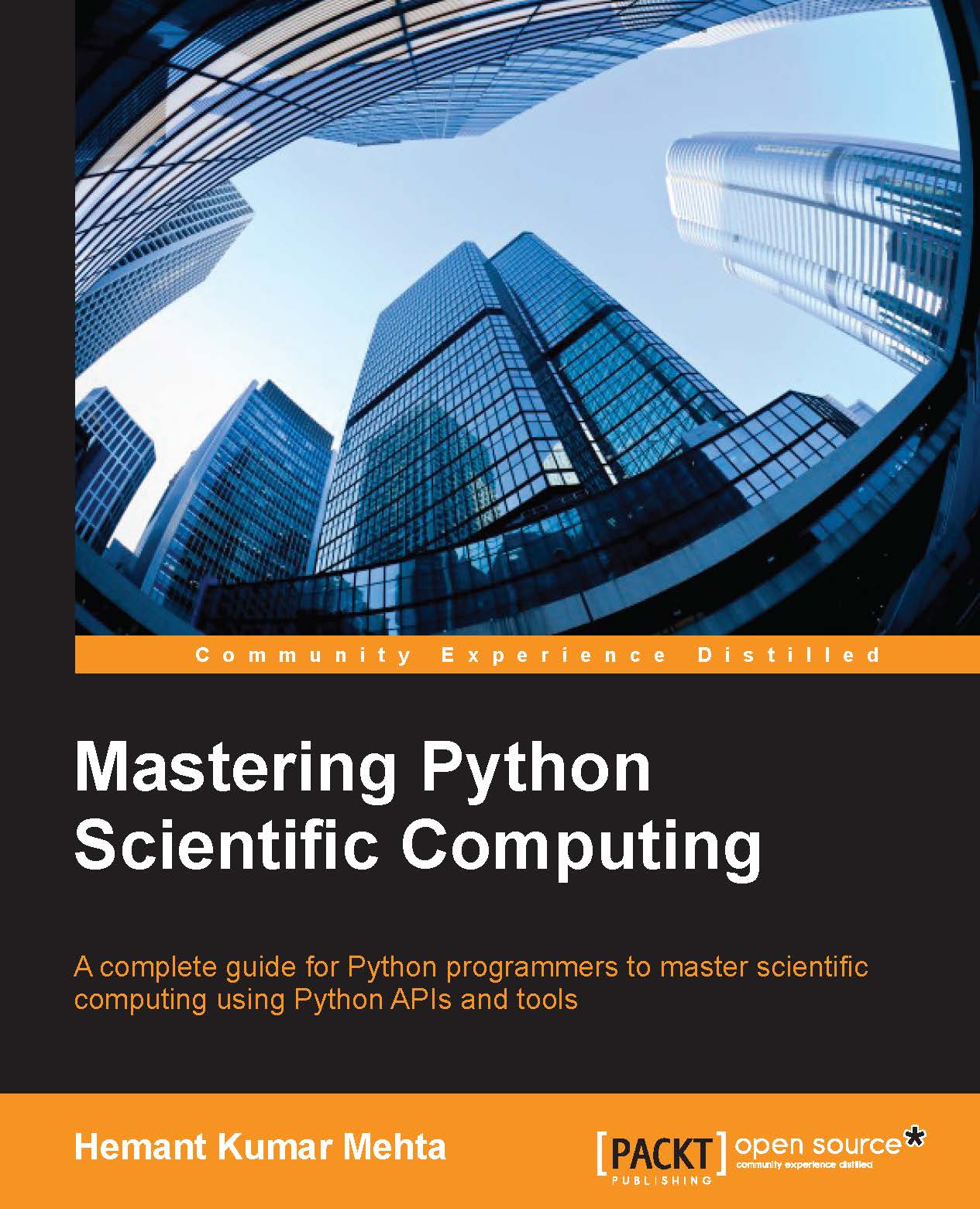
Mastering Python Scientific Computing

You're reading from   Mastering Python Scientific Computing A complete guide for Python programmers to master scientific computing using Python APIs and tools

Arrow left icon
Product type Paperback
Published in Sep 2015
Publisher
ISBN-13 9781783288823
Length 300 pages
Edition 1st Edition
Languages
Tools
Arrow right icon
Author (1):
Arrow left icon
Hemant Kumar Mehta Hemant Kumar Mehta
Author Profile Icon Hemant Kumar Mehta
Hemant Kumar Mehta
Arrow right icon
View More author details
Toc

Table of Contents (12) Chapters Close

Preface 1. The Landscape of Scientific Computing – and Why Python? FREE CHAPTER 2. A Deeper Dive into Scientific Workflows and the Ingredients of Scientific Computing Recipes 3. Efficiently Fabricating and Managing Scientific Data 4. Scientific Computing APIs for Python 5. Performing Numerical Computing 6. Applying Python for Symbolic Computing 7. Data Analysis and Visualization 8. Parallel and Large-scale Scientific Computing 9. Revisiting Real-life Case Studies 10. Best Practices for Scientific Computing Index

Calculus


Calculus involves operations that are performed to study the various properties of any function, including rates of change, the limit behavior of a function, and calculation of the area under a function graph. In this section, you will learn the concepts of limits, derivatives, summation of series, and integrals. The following program uses limit functions to solve simple limit problems:

from sympy import limit, oo, symbols,exp, cos

oo+5
67000 < oo
10/oo

x , n = symbols ('x n')
limit( ((x**n - 1)/ (x - 1) ), x, 1)

limit( 1/x**2, x, 0)
limit( 1/x, x, 0, dir="-")

limit(cos(x)/x, x, 0)
limit(sin(x)**2/x, x, 0)
limit(exp(x)/x,x,oo)

Any SymPy expression can be differentiated using the diff function with the diff(func_to_be_differentiated, variable) prototype. The following program uses the diff function to compute the differentiation of various SymPy expressions:

from sympy import diff, symbols, Symbol, exp, dsolve, subs, Function

diff(x**4, x)
diff( x**3*cos(x), x )
diff( cos(x...
lock icon The rest of the chapter is locked
CONTINUE READING
83
Tech Concepts
36
Programming languages
73
Tech Tools
Icon Unlimited access to the largest independent learning library in tech of over 8,000 expert-authored tech books and videos.
Icon Innovative learning tools, including AI book assistants, code context explainers, and text-to-speech.
Icon 50+ new titles added per month and exclusive early access to books as they are being written.
Mastering Python Scientific Computing
Register for a free Packt account to unlock a world of extra content!
A free Packt account unlocks extra newsletters, articles, discounted offers, and much more. Start advancing your knowledge today.
Unlock this book and the full library FREE for 7 days
Get unlimited access to 7000+ expert-authored eBooks and videos courses covering every tech area you can think of
Renews at $19.99/month. Cancel anytime
Modal Close icon
Modal Close icon