Search icon CANCEL
Subscription
0
Cart icon
Your Cart (0 item)
Close icon
You have no products in your basket yet
Save more on your purchases! discount-offer-chevron-icon
Savings automatically calculated. No voucher code required.
Arrow left icon
Explore Products
Best Sellers
New Releases
Books
Events
Videos
Audiobooks
Packt Hub
Free Learning
Arrow right icon
timer SALE ENDS IN
0 Days
:
00 Hours
:
00 Minutes
:
00 Seconds
Arrow up icon
GO TO TOP
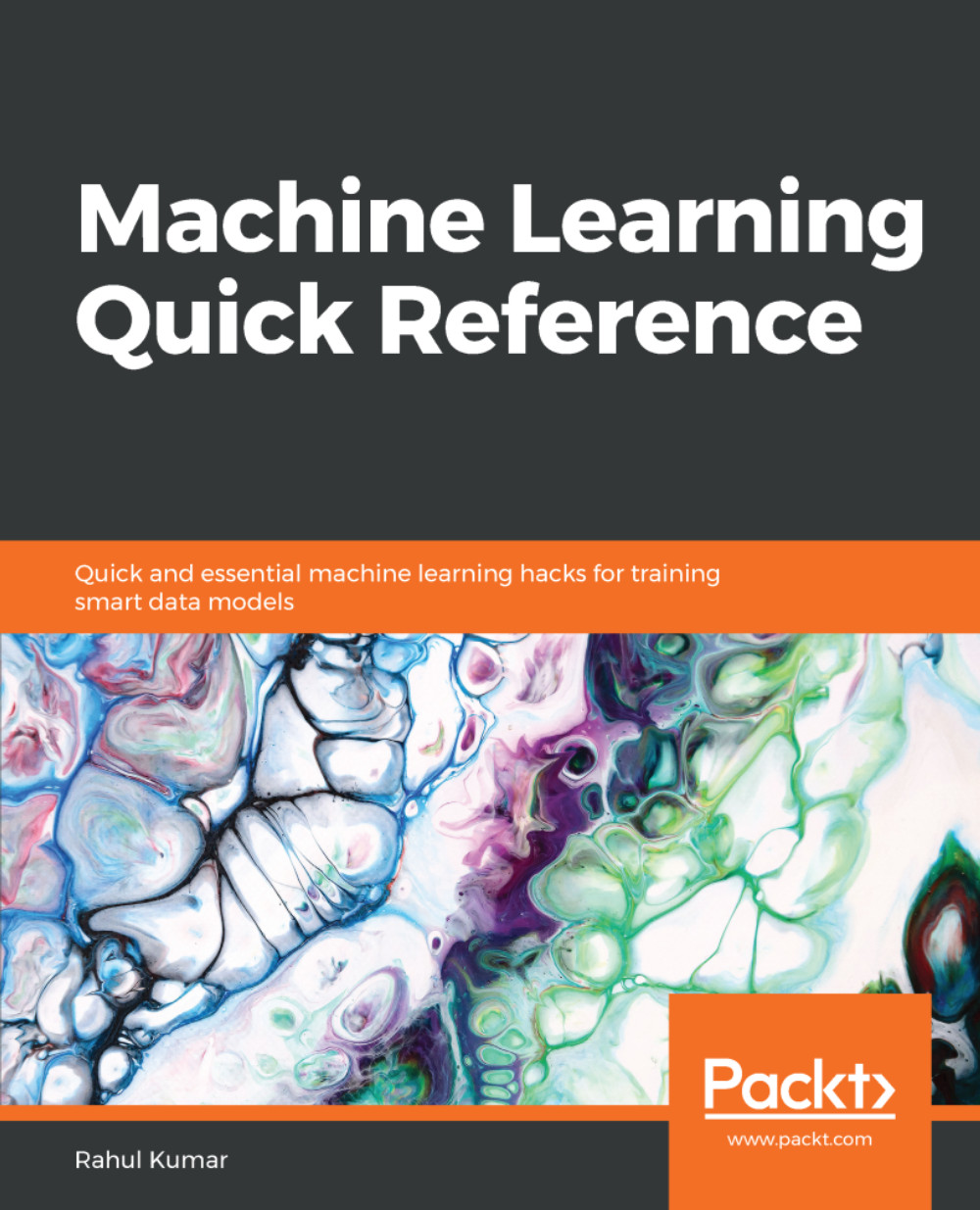
Machine Learning Quick Reference

You're reading from   Machine Learning Quick Reference Quick and essential machine learning hacks for training smart data models

Arrow left icon
Product type Paperback
Published in Jan 2019
Publisher Packt
ISBN-13 9781788830577
Length 294 pages
Edition 1st Edition
Languages
Arrow right icon
Author (1):
Arrow left icon
Rahul Kumar Rahul Kumar
Author Profile Icon Rahul Kumar
Rahul Kumar
Arrow right icon
View More author details
Toc

Table of Contents (13) Chapters Close

Preface 1. Quantifying Learning Algorithms 2. Evaluating Kernel Learning FREE CHAPTER 3. Performance in Ensemble Learning 4. Training Neural Networks 5. Time Series Analysis 6. Natural Language Processing 7. Temporal and Sequential Pattern Discovery 8. Probabilistic Graphical Models 9. Selected Topics in Deep Learning 10. Causal Inference 11. Advanced Methods 12. Other Books You May Enjoy

Hyperplanes 

Many of you will have guessed it right. We use hyperplanes when it comes to more than 3D. We will define it using a bit of mathematics.

A linear equation looks like this: y = ax + b has got two variables, x and y, and a y-intercept, which is b. If we rename y as x2 and x as x1, the equation comes out as x2=ax1 + b which implies ax1 - x2 + b=0. If we define 2D vectors as x= (x1,x2) and w=(a,-1) and if we make use of the dot product, then the equation becomes w.x + b = 0. 

Remember, x.y = x1y1 + x2y2.

So, a hyperplane is a set of points that satisfies the preceding equation. But how do we classify with the help of hyperplane?

We define a hypothesis function h:

h(xi) = +1 if w.xi + b ≥ 0

-1 if w.xi + b < 0

This could be equivalent to the following:

h(xi)= sign(w.xi + b) 

It could also be equivalent to the following...

CONTINUE READING
83
Tech Concepts
36
Programming languages
73
Tech Tools
Icon Unlimited access to the largest independent learning library in tech of over 8,000 expert-authored tech books and videos.
Icon Innovative learning tools, including AI book assistants, code context explainers, and text-to-speech.
Icon 50+ new titles added per month and exclusive early access to books as they are being written.
Machine Learning Quick Reference
You have been reading a chapter from
Machine Learning Quick Reference
Published in: Jan 2019
Publisher: Packt
ISBN-13: 9781788830577
Register for a free Packt account to unlock a world of extra content!
A free Packt account unlocks extra newsletters, articles, discounted offers, and much more. Start advancing your knowledge today.
Unlock this book and the full library FREE for 7 days
Get unlimited access to 7000+ expert-authored eBooks and videos courses covering every tech area you can think of
Renews at $19.99/month. Cancel anytime
Modal Close icon
Modal Close icon