Search icon CANCEL
Subscription
0
Cart icon
Your Cart (0 item)
Close icon
You have no products in your basket yet
Arrow left icon
Explore Products
Best Sellers
New Releases
Books
Events
Videos
Audiobooks
Packt Hub
Free Learning
Arrow right icon
timer SALE ENDS IN
0 Days
:
00 Hours
:
00 Minutes
:
00 Seconds
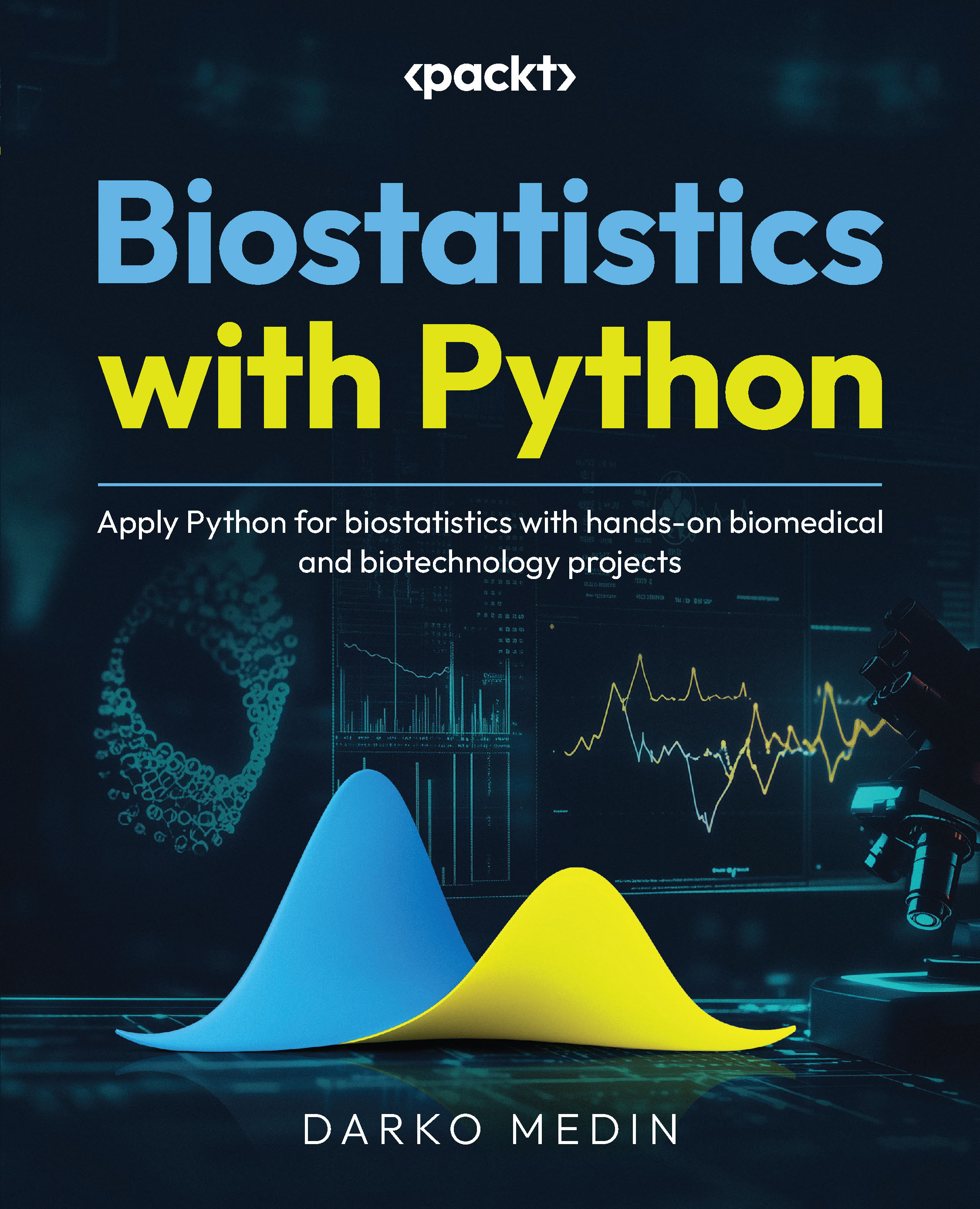
Biostatistics with Python

Biostatistics with Python: Apply Python for biostatistics with hands-on biomedical and biotechnology projects

Arrow left icon
Profile Icon Darko Medin
Arrow right icon
R$99.99 R$155.99
Full star icon Full star icon Full star icon Full star icon Half star icon 4.5 (4 Ratings)
eBook Nov 2024 374 pages 1st Edition
eBook
R$99.99 R$155.99
Paperback
R$194.99
eBook + Subscription
Free Trial
Arrow left icon
Profile Icon Darko Medin
Arrow right icon
R$99.99 R$155.99
Full star icon Full star icon Full star icon Full star icon Half star icon 4.5 (4 Ratings)
eBook Nov 2024 374 pages 1st Edition
eBook
R$99.99 R$155.99
Paperback
R$194.99
eBook + Subscription
Free Trial
eBook
R$99.99 R$155.99
Paperback
R$194.99
eBook + Subscription
Free Trial

What do you get with eBook?

Product feature icon Instant access to your Digital eBook purchase
Product feature icon Download this book in EPUB and PDF formats
Product feature icon Access this title in our online reader with advanced features
Product feature icon DRM FREE - Read whenever, wherever and however you want
Product feature icon AI Assistant (beta) to help accelerate your learning
Modal Close icon
Payment Processing...
tick Completed

Billing Address

Table of content icon View table of contents Preview book icon Preview Book

Biostatistics with Python

Introduction to Biostatistics

Welcome to the world of biostatistics. This book will guide you through the principles and practical examples of biostatistics and you will go through a portfolio of exemplar projects with real-world data and learn how to use one of the most advanced programming languages today: Python.

Biostatistics is one of the most important science disciplines today; it enables research, is the foundation of most life sciences, and is growing as a key factor in many industries today, from pharmaceuticals to medicine, biology, and many other life sciences. This chapter explains why biostatistics is important for different areas of biomedicine, clinical trials, biology, and life science areas.

In this chapter, we’re going to cover the following main topics:

  • Understanding the need for biostatistics in life sciences
  • Formulating the scientific questions in life sciences and research
  • How statistics and computation can help answer different questions in life sciences

At the end of this chapter, you will have a better understanding of the principles that make biostatistics the foundation of life science and what the advantages of using Python exemplar projects for biostatistics are.

Why do we need biostatistics in life sciences?

Life sciences are some of the most important fields of science today. Throughout the disciplines of biology, biomedicine, and pharmaceutical sciences in pharmaceutical and biotech companies, biostatistics plays a key role. We use it to analyze the data from experiments, improve study designs, interpret the results of studies, and make decisions within all these areas of life science. Biostatistics is applicable in all of these areas, and more, because it allows us to understand the underlying processes that you may be investigating.

While biostatisticians are essential in many areas, from biology and medicine to public health, understanding biostatistics is critical for other professionals in these areas, too.

If you are performing an experiment, conducting a study, or are interested in life science analytics, you will need to analyze the data to make conclusions or get insights from it. Biology and biomedical professionals will encounter biostatistics in most areas of their careers.

When reading almost any life science research publication, you will need to understand how to read biostatistics to understand the results. This is essential for both biologists and biomedical professionals who want to stay current with the latest research statistics for the pharmaceutical industry to discover biomarkers or therapies for patients.

Biostatistics enables us to understand and analyze the data or results we get from experiments, research, or observations. This is one of the reasons why the biostatistical field is important not only for biostatisticians, but also for doctors, biologists, epidemiologists, public health decision-makers, bioinformaticians, health data scientists, and other professionals from most life science branches.

The next subsection will help you understand the specific areas of life science where biostatistics is used. This is very important as every life science area is different and requires a different approach to resolve the research problems

Biostatistics in human life sciences

Biostatistics is essential in many human life sciences. Epidemiologists heavily rely on different types of data to infer their insights. Understanding statistical concepts is essential to understanding population-level biological events and helps both doctors and public health professionals in their work. One such example is the past SARS-CoV-2 pandemic. You must have heard about concepts such as reproductive number (R) or SARS-CoV-2 cumulative incidence of infections, mortality, lethality, excess deaths, and other similar terms. All these concepts are derived using biostatistical concepts and formulas.

Epidemiology is predominantly used in biomedical science areas by public health professionals to make decisions for disease response and to keep the population as safe as possible.

Figure 1.1 – Areas of human life science where biostatistics is used

Figure 1.1 – Areas of human life science where biostatistics is used

Medical doctors need biostatistics, not only for their everyday work but also for publishing their academic work, which generally utilizes statistics to summarize and analyze the data of studies and to understand novel discoveries in their profession by interpreting study results from novel publications.

Biomedical research is one of the areas which is heavily reliant on biostatistics and knowing biostatistics is important, not only for statisticians but also for biomedical researchers. Even with access to expert biostatisticians, it is helpful to understand biostatistical thinking and analysis methodology to help with discussions on study design, analysis, and interpretation.

Pharmaceuticals, research, and the development of medications are among the largest industries today. The majority of advanced research in these areas is vital for the biomedical industry.

Biostatistics for biology

While statistics itself is used in many different areas of science, its application in biology has evolved in a specific way due to the nature of different biological domains. Statistics cannot be effectively applied without knowing the basic principles of these biological disciplines.

The following figure shows biostatistics applications in different areas of biology:

Figure 1.2 – Areas of biology where biostatistics is used

Figure 1.2 – Areas of biology where biostatistics is used

Bioinformatics relies on different statistical methods and algorithms combined with computational tools to process and analyze large amounts of biological data, such as RNA (ribonucleic acid) sequencing data (transcriptomics), DNA (deoxyribonucleic acid) data (genomics), and many other data types. Bioinformatics is specifically focused on genetics and molecular biology but implements methods such as biostatistics and machine learning.

Ecological studies are one of the examples where biostatistics is one of the main biological research drivers. Analyzing plant and animal populations, trends, dynamics, and relations between organisms and their environments would not be possible without biostatistics. Next, we will discuss biostatistics applications in different fields in more detail.

Biostatistics in epidemiology and public health

Epidemiologists and public health professionals answer some of the most important public health questions but also make decisions in different communities. They investigate diseases and events in smaller groups of people, cities, and countries, or even worldwide phenomena, such as pandemics. All this would not be possible without the use of biostatistics facilitating the process of analyzing the biomedical and population data.

Epidemiologists often create different statistical models to try to relate infectious outbreaks to causes and then prevent future infections and isolate the infection source. One such example is studying types of food ingested by infected individuals and identifying a potential bacterial or viral food source, or a location, such as a hotel or restaurant, as a source. Biostatistical models are often used in identifying the sources of infectious agents, which will be discussed in more detail in later chapters.

A few biostatistical concepts used in epidemiology and public health are as follows:

  • Prevalence
  • Cumulative incidence
  • Identifying causes for infectious outbreaks
  • Characteristics of microorganisms causing outbreaks in a population
  • Epidemiological monitoring of populations
  • Decision-making based on biostatistics

Biostatistics in medicine and biomedical research

Medicine and biomedical research are very active sciences today, as they directly or indirectly impact almost everyone’s life today. These two disciplines rely heavily on the use of biostatistics. It is of the essence not only for medical doctors but also for biomedical researchers.

Medical doctors’ understanding of the probability of different diseases or outcomes is highly dependent on understanding the statistical concepts and how these apply to groups of patients.

Here are some of the most important concepts used in biomedical research:

  • Understanding of incidence of safety for treatments
  • Making conclusions about the symptom and disease relations
  • Creating biomedical studies
  • Analyzing biomedical data
  • Interpreting novel research
  • Becoming specialized in biomedical data analysis

Biostatics in zoology and botany

A significant portion of the research in biological disciplines, such as zoology and botany, depends on quantifying different aspects of their behavior, life cycles, relations with their environmental factors, and many other aspects.

Some examples of areas in zoology and botany that apply biostatistical methods are as follows:

  • Animal behaviors
  • Plant growth
  • Relations between animals and their environment
  • Relations between plants and their environment
  • Biochemical composition of different tissues in animals
  • Biochemical composition of different tissues in plants
  • Identifying feeding patterns in animals

Biostatistics in ecology

Ecology is one of the life science disciplines significantly based on biostatistics. Understanding the population’s diversity and the relationships between organisms, as well as the relationships between organisms and their environments, is facilitated using different biostatistical methods.

Some important areas of the use of biostatistics in ecology are as follows:

  • Relationships between animals and their environment
  • Relationships between plants and their environment
  • Studying biochemical and molecular aspects in zoology and botany
  • Studying relations between humans, ecology, and environmental protection

Biostatistics in pharmaceutical research and design

The pharmaceutical industry is one of the main drivers of research and innovation today. Biostatistical analyses enable pharmaceutical companies to design, conduct, and make decisions based on different analyses and insights. In fact, almost any high-quality research project in the pharmaceutical industry consults biostatisticians to make sure that the design is statistically sound and that it can answer the research questions to drive forward the development of assets and to conform with regulatory requirements. Biostatistics is also the key to analyzing adverse events from the data collected during a study, which is essential for any pharmaceutical product. All medications are required to have a list of adverse effects and this is something that can be seen in everyday life. Biostatistical calculation of incidence rates is one of the ways to assess those adverse effects.

Biostatistics is used to assess the efficacy of different therapies and, as such, is a key element in selecting the candidate drugs for diseases such as diabetes or cancer, which are then further evaluated in clinical trials using different biostatistical methods.

Calculating required sample sizes for pharmaceutical studies is a common task of biostatisticians within the pharmaceutical industry, but this is also intertwined with trial design and endpoint selection.

Here is a summary of the uses of biostatistics in pharmaceutical R&D:

  • Creating R&D studies
  • Evaluating drug safety
  • Selecting drug candidates through biostatistical screening
  • Designing clinical trials
  • Evaluating results
  • Research publications
  • Meta-analyses of therapy effects
  • Regulatory submission

Biostatistics in bioinformatics and genetics

Molecular biology is one of the biological branches that is very specific in terms of using statistical analyses. From structural biology to analyzing gene expression, biostatistics plays one of the most important roles in bioinformatics. Statistical bases form many genetics areas, such as inheritance genetics and population genetics. Here are some of the areas of bioinformatics and genetics where biostatistics plays a pivotal role:

  • Differential gene expression
  • Structural biology
  • Mutation biology
  • DNA analytics
  • Mendelian inheritance
  • Mendelian randomization studies
  • Population genetics

Formulating the scientific questions in life sciences and research

To be able to perform statistical analyses in life science and research, you will first need to learn how to address scientific questions in these areas. Scientific questions are a way to define what it is that we are trying to understand or what goal to achieve. In this chapter, you will learn by example how to formulate scientific questions related to various fields related to biostatistics, such as biomedical research, before any relevant statistical analysis is made. One of the first questions to answer is, “What is the goal of a statistical analysis?” This goal is closely related to different life science aspects, therapies, biological processes, or genetic characteristics, and in this section, those will be covered in more detail.

Once scientific questions are made, they are then used to formulate different scientific hypotheses. The main characteristic of any hypothesis is that it can be tested and there is an alternative (opposite) hypothesis to the main one. So, the baseline scenario assumption can be that there is no statistically significant result, and we can test the alternate scenario: that there is a significant result against the baseline or null scenario. We can call the null hypothesis H0 and the alternate hypothesis Ha.

How to formulate scientific questions related to diabetes

The effect of different lifestyles on the outcomes of type 2 diabetes mellitus has been debated for decades.

Let’s pose a couple of scientific questions about diabetes. We will use the letter Q for scientific questions:

  • Q1. Is body weight related to type 2 diabetes mellitus?
  • Q2. Are there other risk factors for type 2 diabetes mellitus among those studies?
  • Q3. Which of the lifestyle factors is the most important risk factor in type 2 diabetes mellitus?

Now, let’s formulate these questions even better. We will mark formulations using the letter F:

  • F1. Null hypothesis (H0): Body weight is not related to type 2 diabetes mellitus.

    Alternate hypothesis (Ha): Body weight is related to type 2 diabetes mellitus.

  • F2. Null hypothesis (H0): There are no other risk factors for type 2 diabetes mellitus among those studied.

    Alternate hypothesis (Ha): There are other risk factors for type 2 diabetes mellitus among those studied.

  • F3. This question will not have a null hypothesis as it is already assumed there are risk factors in the questions. So, the goal of answering this question is to compare the risk factors and identify the most important one. This would be an observational scientific question.

So, why do we usually formulate the null hypothesis as a negation of what’s being tested? Well, we want to know the following: Can I show evidence that contradicts that baseline negative assumption? If I can, then I can reject the null hypothesis. If there isn’t enough evidence to negate the null hypothesis, I can say that I cannot reject the null hypothesis (avoid the mistake of saying that no evidence is evidence of a null hypothesis).

How to formulate scientific questions related to cardiovascular disease

Is ST (the last wave on the electrocardiogram of the heartbeat) elevation closely related to heart disease? With this, we move to the following questions:

  • Q4. Do cigarettes increase the risk of cardiovascular diseases?
  • Q5. Is an ECG closely related to cardiovascular disease?
  • Q6. Are there any other risk factors for cardiovascular disease among the studied parameters?

    Let us make a more structured formulation as follows:

  • F4. Null hypothesis (H0): Cigarettes do not increase the risk of cardiovascular diseases.
  • Alternate hypothesis (Ha): Cigarettes increase the risk of cardiovascular diseases.
  • F5. Null hypothesis (H0): ECG is not closely related to cardiovascular disease.
  • Alternate hypothesis (Ha): ECG is not closely related to cardiovascular disease.
  • F6. Practice yourself!

How to formulate scientific questions in biology

Here are a few examples for formulating questions in biology:

  • Q7. Learn to explore which genes are highly suppressed in lung cancer.
  • Q8. How similar are the genomes of mice and humans?
  • Q9. What are the differences in plants and minerals collected from localities A and B (Ca, Mg, K)?
  • Q10. Does water temperature affect plankton?

Practice formulating these questions as hypotheses or concrete study questions!

You may find the answers at the end of Chapter 1.

How computation can help answer different questions in life sciences

It is generally believed that biostatistics is mostly about numbers and graphs. The reality is quite different. Biostatistics is also about understanding life science problems and finding ways to resolve those using statistical methods. There are six main problem-solving skills in biostatistics:

  • Helping life science professionals resolve research problems in these domains through the use of data
  • Helping life science professionals interpret the results of their research
  • Making sure the published research is both statistically and biologically valid
  • Helping R&D professionals make decisions in the projects
  • Revealing objective truths about different phenomena through the use of data
  • Explaining the abstract features of mathematics and biology in an intuitive and easy-to-understand way

One of the most important impacts of biostatistics is transitioning from statistical knowledge to actual problem solutions in life sciences. This will be discussed in more detail in the rest of this chapter.

Biostatistics is needed to derive insights from life science experiments and convert measurements and observations to life science solutions.

Professionals in life science and biostatisticians, working together, design different types of experiments, measurements, and observations. All these can be written or stored as data. Data is a source of information from those experiments, measurements, and observations.

Data can originate from observations, too. One example of observation is the diagnosis by a dermatologist or the identification of species by biologists.

Biostatisticians are there to help make sure this data is valid and make it meaningful. Further, data should be organized and structured, often presented in the form of tables to be prepared for further analysis and interpretation.

To make the data useful, we must understand all the details about the data and how these are related to domains where biostatistics is applied. One of the most important aspects of biostatistics is the context around the data. This context can significantly affect the results and is one of the reasons why biostatisticians are more specialized in life science domains than general statisticians.

One of the main goals of biostatistics is to take all available inputs in the form of data and process them in such a way as to produce meaningful insights, answers, and conclusions and provide information to make decisions in life science.

Here is the biostatistics workflow:

Figure 1.3 – Biostatistics workflow

Figure 1.3 – Biostatistics workflow

There are two main types of data: numerical (for example, the measurement of the hemoglobin level in blood in which we are using numerical values such as grams per liter or g/L) and categorical, such as a doctor’s diagnoses of their patients in a form; “Yes” for a positive diagnosis or “No” for a negative diagnosis. These types of data can be further divided into subcategories, which will be discussed in detail in the next chapters.

Understanding data sources is essential for biostatistics. Biostatistics is focused on statistical models but also on domain knowledge and, as such, has evolved as a separate branch of both statistics and life sciences.

This book will provide many different examples that will show you how to use biostatistics specifically for different domains, such as diabetes research, cardiology, and biostatistical studies. Further, in this chapter, we will discuss how the Python programming language can facilitate the implementation of biostatistical methods.

Biostatistics and Python

Most biostatistical analyses today are implemented in some form of software or a programming language. I chose Python as a programming language for this book for several reasons. Python is one of the most advanced languages for data science and biostatistics. As programmers today are moving toward using Python, keep in mind that it is one of the most wanted skills in most areas that have to do with analytics. Libraries such as Biopython and SciPy are among the more than 100,000 libraries that make Python so versatile, meaning that almost any biostatistical analysis can be performed using this programming language. It is open source, meaning it is transparent and free for anyone to use.

The following figure is an example of using Python for biostatistics:

Figure 1.4 – Biostatistics and Python

Figure 1.4 – Biostatistics and Python

Its integration with advanced machine learning and bioinformatics algorithms gives a biostatistician a whole new spectrum of approaches and provides the most advanced frameworks for using biostatistical algorithms at this time.

Finally, the most important part – learning Python through a portfolio of practical projects provides you, as a reader, with two important qualities: being able to use one of the most wanted programming languages out there can be beneficial for your career, and having a portfolio of more than 10 practical projects using biostatistics and Python provides significant resources for your portfolio as someone who plans to use or advance your career by using biostatistics.

Answers for Chapter 1

(A stands for answer)

  • A6. Null hypothesis (H0): There are no risk factors for cardiovascular disease among the studied parameters.

    Alternate hypothesis (Ha): Risk factors are present among the studied parameters.

  • A7. This question would have no concrete hypothesis. Instead, the overall goal of the study is to identify the genes that are highly expressed in lung cancer tissues..
  • A8. We can re-formulate this question into three potential options based on different levels of similarity:
    • The mouse-human genome similarity is low (0-50%).
    • The mouse-human genome similarity is medium (50-90%).
    • The mouse-human genome similarity is high (>90%).
  • A9. To answer this research question, we can formulate it as follows:

    Are Ca, Mg, and K concentrations higher in locality A compared to locality B?

  • A10. Null hypothesis (H0): Water temperature does not affect plankton.

    Alternate hypothesis (Ha): Water temperature affects plankton organisms.

Keep practicing yourself!

Summary

In this chapter, you learned about the needs and uses of biostatistics in life sciences, how to formulate the research questions, and how the Python programming language can help you with that. You also learned about the specific applications of biostatistics in biology, clinical research, and the pharmaceutical industry.

In the next chapter, you will learn in detail how to install and get started using the Python programming language.

Left arrow icon Right arrow icon
Download code icon Download Code

Key benefits

  • Bridge the gap between biostatistics and life sciences with Python
  • Work with practical exercises for real-world data analysis in biology and medicine
  • Access a portfolio of exemplar projects in the domains of biomedicine, biotechnology, and biology
  • Purchase of the print or Kindle book includes a free PDF eBook

Description

This book leverages the author’s decade-long experience in biostatistics and data science to simplify the practical use of biostatistics with Python. The chapters show you how to clean and describe your data effectively, setting a solid foundation for accurate analysis and proficiency in biostatistical inference to help you draw meaningful conclusions from your data through hypothesis testing and effect size analysis. The book walks you through predictive modeling to harness the power of Python to create robust predictive analytics that can drive your research and professional projects forward. You'll explore clinical biostatistics, learn how to design studies, conduct survival analysis, and synthesize evidence from multiple studies with meta-analysis – skills that are crucial for making informed decisions based on comprehensive data reviews. The concluding chapters will enhance your ability to analyze biological variables, enabling you to perform detailed and accurate data analysis for biological research. This book's unique blend of biostatistics and Python helps you find practical solutions that make complex concepts easy to grasp and apply. By the end of this biostatistics book, you’ll have moved from theoretical knowledge to practical experience, allowing you to perform biostatistical analysis confidently and accurately.

Who is this book for?

This book is for life science professionals, researchers, biomedical professionals, and aspiring biostatisticians who want to integrate biostatistics into their work or research. A basic understanding of life sciences, biology, or medicine is recommended to fully benefit from this book.

What you will learn

  • Get to grips with the basics of biostatistics and Python programming
  • Clean and describe data using Python
  • Familiarize yourself with hypothesis testing and effect size analysis
  • Explore predictive modeling in biostatistics
  • Understand clinical study design and survival analysis
  • Gain a clear understanding of the meta-analysis of clinical research data
  • Analyze biological variables with Python
  • Discover practical data analysis for biological research

Product Details

Country selected
Publication date, Length, Edition, Language, ISBN-13
Publication date : Nov 29, 2024
Length: 374 pages
Edition : 1st
Language : English
ISBN-13 : 9781837631834
Category :
Languages :
Concepts :

What do you get with eBook?

Product feature icon Instant access to your Digital eBook purchase
Product feature icon Download this book in EPUB and PDF formats
Product feature icon Access this title in our online reader with advanced features
Product feature icon DRM FREE - Read whenever, wherever and however you want
Product feature icon AI Assistant (beta) to help accelerate your learning
Modal Close icon
Payment Processing...
tick Completed

Billing Address

Product Details

Publication date : Nov 29, 2024
Length: 374 pages
Edition : 1st
Language : English
ISBN-13 : 9781837631834
Category :
Languages :
Concepts :

Packt Subscriptions

See our plans and pricing
Modal Close icon
R$50 billed monthly
Feature tick icon Unlimited access to Packt's library of 7,000+ practical books and videos
Feature tick icon Constantly refreshed with 50+ new titles a month
Feature tick icon Exclusive Early access to books as they're written
Feature tick icon Solve problems while you work with advanced search and reference features
Feature tick icon Offline reading on the mobile app
Feature tick icon Simple pricing, no contract
R$500 billed annually
Feature tick icon Unlimited access to Packt's library of 7,000+ practical books and videos
Feature tick icon Constantly refreshed with 50+ new titles a month
Feature tick icon Exclusive Early access to books as they're written
Feature tick icon Solve problems while you work with advanced search and reference features
Feature tick icon Offline reading on the mobile app
Feature tick icon Choose a DRM-free eBook or Video every month to keep
Feature tick icon PLUS own as many other DRM-free eBooks or Videos as you like for just R$25 each
Feature tick icon Exclusive print discounts
R$800 billed in 18 months
Feature tick icon Unlimited access to Packt's library of 7,000+ practical books and videos
Feature tick icon Constantly refreshed with 50+ new titles a month
Feature tick icon Exclusive Early access to books as they're written
Feature tick icon Solve problems while you work with advanced search and reference features
Feature tick icon Offline reading on the mobile app
Feature tick icon Choose a DRM-free eBook or Video every month to keep
Feature tick icon PLUS own as many other DRM-free eBooks or Videos as you like for just R$25 each
Feature tick icon Exclusive print discounts

Table of Contents

23 Chapters
Part 1:Introduction to Biostatistics and Getting Started with Python Chevron down icon Chevron up icon
Chapter 1: Introduction to Biostatistics Chevron down icon Chevron up icon
Chapter 2: Getting Started with Python for Biostatistics Chevron down icon Chevron up icon
Chapter 3: Exercise 1 – Cleaning and Describing Data Using Python Chevron down icon Chevron up icon
Chapter 4: Part 1 Exemplar Project – Load, Clean, and Describe Diabetes Data in Python Chevron down icon Chevron up icon
Part 2:Introduction to Python for Biostatistics – Methodology and Examples Chevron down icon Chevron up icon
Chapter 5: Introduction to Python for Biostatistics Chevron down icon Chevron up icon
Chapter 6: Biostatistical Inference Using Hypothesis Tests and Effect Sizes Chevron down icon Chevron up icon
Chapter 7: Predictive Biostatistics Using Python Chevron down icon Chevron up icon
Chapter 8: Part 2 Exercise – T-Test, ANOVA, and Linear and Logistic Regression Chevron down icon Chevron up icon
Chapter 9: Biostatistical Inference and Predictive Analytics Using Cardiovascular Study Data Chevron down icon Chevron up icon
Part 3:Clinical Study Design, Analysis, and Synthesizing Evidence Chevron down icon Chevron up icon
Chapter 10: Clinical Study Design Chevron down icon Chevron up icon
Chapter 11: Survival Analysis in Biomedical Research Chevron down icon Chevron up icon
Chapter 12: Meta-Analysis – Synthesizing Evidence from Multiple Studies Chevron down icon Chevron up icon
Chapter 13: Survival Predictive Analysis and Meta-Analysis Practice Chevron down icon Chevron up icon
Chapter 14: Part 3 Exemplar Project – Meta-Analysis of Survival Data in Clinical Research Chevron down icon Chevron up icon
Part 4:Biological and Statistical Variables and Frameworks, and a Final Practical Project from the Field of Biology Chevron down icon Chevron up icon
Chapter 15: Understanding Biological Variables Chevron down icon Chevron up icon
Chapter 16: Data Analysis Frameworks and Performance for Life Sciences Research Chevron down icon Chevron up icon
Chapter 17: Part 4 Exercise – Performing Statistics for Biology Studies in Python Chevron down icon Chevron up icon
Index Chevron down icon Chevron up icon
Other Books You May Enjoy Chevron down icon Chevron up icon

Customer reviews

Rating distribution
Full star icon Full star icon Full star icon Full star icon Half star icon 4.5
(4 Ratings)
5 star 50%
4 star 50%
3 star 0%
2 star 0%
1 star 0%
Tiny Jan 09, 2025
Full star icon Full star icon Full star icon Full star icon Full star icon 5
An excellent practical guide for an intro to statistics with Python. Preferred application here was Anaconda and the Jupyter Notebook integration, sensible when one considers statistical analysis. The book clearly demonstrates how clinical studies and biology ties into the demonstrated functions. Full cases provided which start with the basics of loading and cleaning data, moves into linear regression testing, meta-analysis, and finally an end-to-end approach. Each chapter includes clear definitions, practical examples, and then the coding for Python. The latter sections discuss a great deal about important clinical design aspects, showing the reader how to consider the applications, and then build the coding representation. For me, one missing element was any connection to ML design or use in statistical applications, however, given the book’s basic nature, one can understand that element. Overall, a great guide to statistics, blending those statistics into Python, and using a biological studies format to demonstrate those elements. Read more
Amazon Verified review Amazon
Paul Pollock Dec 13, 2024
Full star icon Full star icon Full star icon Full star icon Full star icon 5
This book is a gem for anyone looking to bridge the gap between biostatistics and Python programming. As a professional in data science, I found its approach to explaining statistical concepts alongside Python implementation both clear and practical. The inclusion of real-world projects in biomedical and biotechnology domains makes it stand out as an applied learning resource.The author seamlessly introduces biostatistics concepts and methodically builds on Python's role in solving these problems. Each chapter is packed with hands-on exercises, from basic data cleaning to advanced topics like survival analysis and meta-analysis. The detailed examples using libraries like Pandas, SciPy, and Matplotlib are invaluable for both beginners and experienced programmers.I particularly appreciated the exemplar projects in cardiology and diabetes research, which are thoughtfully designed to reinforce learning. The book also provides step-by-step guidance on using tools like Jupyter Notebook and Spyder IDE, making it beginner-friendly.Overall, this book is an excellent resource for biologists, statisticians, and Python enthusiasts aiming to excel in biostatistics. Highly recommended! Read more
Amazon Verified review Amazon
ivan Dec 15, 2024
Full star icon Full star icon Full star icon Full star icon Empty star icon 4
Darko Medin's book Python for Biostatistics is designed to help readers easily understand how to use Python's ecosystem for biostatistical analysis. The author includes practical programming examples that cover exploratory data analysis, ANOVA, Student's t-test, and linear and logistic regression. Furthermore, the book features biotechnology projects introducing key concepts such as survival analysis with meta-analysis and causal inference. Overall, this book provides a solid introduction for anyone interested in utilizing Python for biostatistics. Read more
Amazon Verified review Amazon
Om S Dec 22, 2024
Full star icon Full star icon Full star icon Full star icon Empty star icon 4
I’m not directly in the biostatistics field, but this book showed me how Python can be used to solve real-world problems in biology and medicine. The examples are clear and easy to follow, from cleaning data to advanced topics like survival analysis. The hands-on projects helped me understand how to apply these techniques practically. It’s a good resource for anyone curious about using Python in life sciences! Read more
Amazon Verified review Amazon
Get free access to Packt library with over 7500+ books and video courses for 7 days!
Start Free Trial

FAQs

How do I buy and download an eBook? Chevron down icon Chevron up icon

Where there is an eBook version of a title available, you can buy it from the book details for that title. Add either the standalone eBook or the eBook and print book bundle to your shopping cart. Your eBook will show in your cart as a product on its own. After completing checkout and payment in the normal way, you will receive your receipt on the screen containing a link to a personalised PDF download file. This link will remain active for 30 days. You can download backup copies of the file by logging in to your account at any time.

If you already have Adobe reader installed, then clicking on the link will download and open the PDF file directly. If you don't, then save the PDF file on your machine and download the Reader to view it.

Please Note: Packt eBooks are non-returnable and non-refundable.

Packt eBook and Licensing When you buy an eBook from Packt Publishing, completing your purchase means you accept the terms of our licence agreement. Please read the full text of the agreement. In it we have tried to balance the need for the ebook to be usable for you the reader with our needs to protect the rights of us as Publishers and of our authors. In summary, the agreement says:

  • You may make copies of your eBook for your own use onto any machine
  • You may not pass copies of the eBook on to anyone else
How can I make a purchase on your website? Chevron down icon Chevron up icon

If you want to purchase a video course, eBook or Bundle (Print+eBook) please follow below steps:

  1. Register on our website using your email address and the password.
  2. Search for the title by name or ISBN using the search option.
  3. Select the title you want to purchase.
  4. Choose the format you wish to purchase the title in; if you order the Print Book, you get a free eBook copy of the same title. 
  5. Proceed with the checkout process (payment to be made using Credit Card, Debit Cart, or PayPal)
Where can I access support around an eBook? Chevron down icon Chevron up icon
  • If you experience a problem with using or installing Adobe Reader, the contact Adobe directly.
  • To view the errata for the book, see www.packtpub.com/support and view the pages for the title you have.
  • To view your account details or to download a new copy of the book go to www.packtpub.com/account
  • To contact us directly if a problem is not resolved, use www.packtpub.com/contact-us
What eBook formats do Packt support? Chevron down icon Chevron up icon

Our eBooks are currently available in a variety of formats such as PDF and ePubs. In the future, this may well change with trends and development in technology, but please note that our PDFs are not Adobe eBook Reader format, which has greater restrictions on security.

You will need to use Adobe Reader v9 or later in order to read Packt's PDF eBooks.

What are the benefits of eBooks? Chevron down icon Chevron up icon
  • You can get the information you need immediately
  • You can easily take them with you on a laptop
  • You can download them an unlimited number of times
  • You can print them out
  • They are copy-paste enabled
  • They are searchable
  • There is no password protection
  • They are lower price than print
  • They save resources and space
What is an eBook? Chevron down icon Chevron up icon

Packt eBooks are a complete electronic version of the print edition, available in PDF and ePub formats. Every piece of content down to the page numbering is the same. Because we save the costs of printing and shipping the book to you, we are able to offer eBooks at a lower cost than print editions.

When you have purchased an eBook, simply login to your account and click on the link in Your Download Area. We recommend you saving the file to your hard drive before opening it.

For optimal viewing of our eBooks, we recommend you download and install the free Adobe Reader version 9.

Modal Close icon
Modal Close icon