Search icon CANCEL
Subscription
0
Cart icon
Your Cart (0 item)
Close icon
You have no products in your basket yet
Save more on your purchases! discount-offer-chevron-icon
Savings automatically calculated. No voucher code required.
Arrow left icon
Explore Products
Best Sellers
New Releases
Books
Events
Videos
Audiobooks
Packt Hub
Free Learning
Arrow right icon
timer SALE ENDS IN
0 Days
:
00 Hours
:
00 Minutes
:
00 Seconds
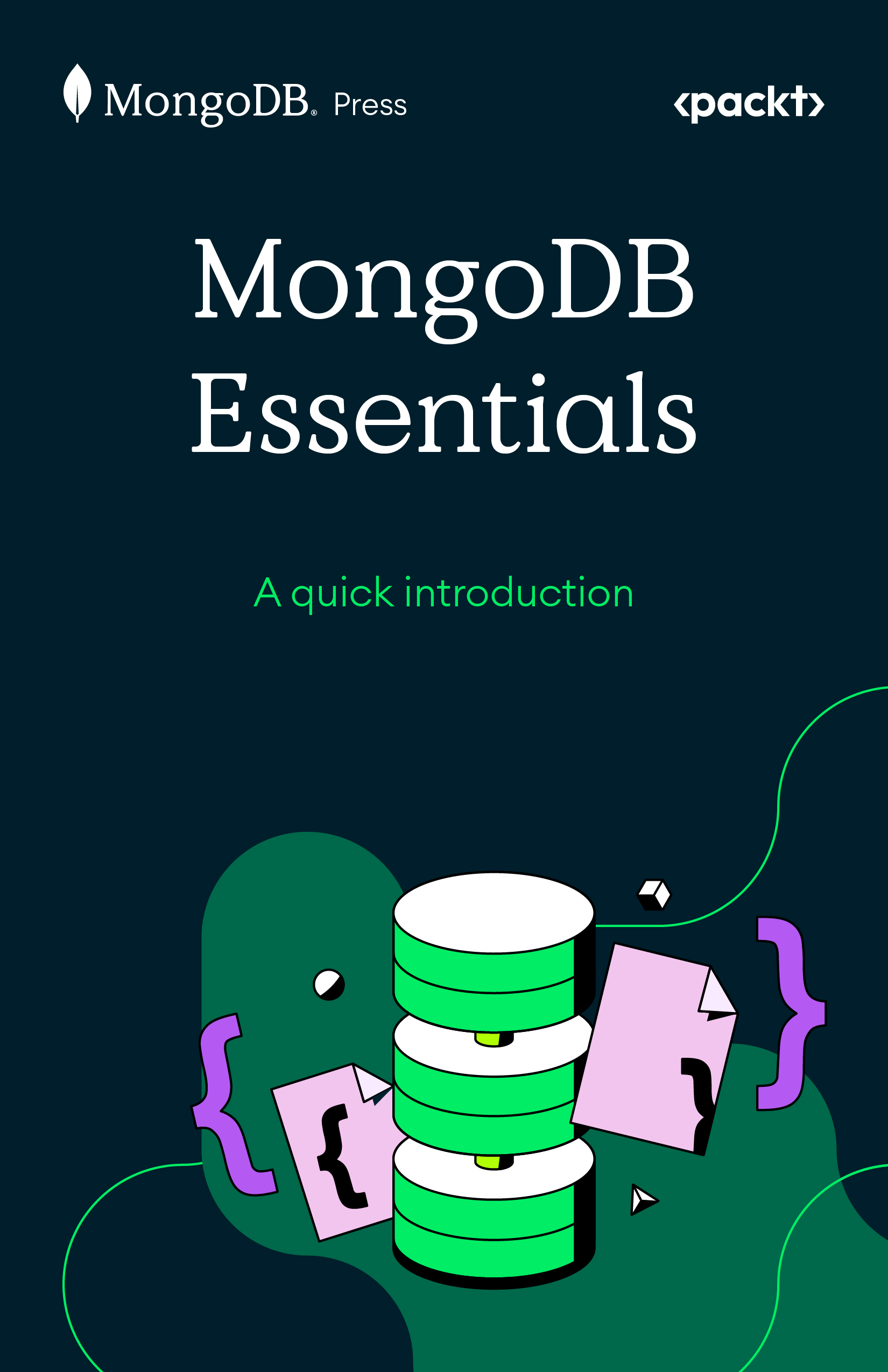
MongoDB Essentials
MongoDB Essentials

MongoDB Essentials: A quick introduction

Arrow left icon
Profile Icon The MongoDB Team
Arrow right icon
€21.99
Full star icon Full star icon Full star icon Full star icon Full star icon 5 (1 Ratings)
Paperback Sep 2025 84 pages 1st Edition
eBook
€16.19 €17.99
Paperback
€21.99
Arrow left icon
Profile Icon The MongoDB Team
Arrow right icon
€21.99
Full star icon Full star icon Full star icon Full star icon Full star icon 5 (1 Ratings)
Paperback Sep 2025 84 pages 1st Edition
eBook
€16.19 €17.99
Paperback
€21.99
eBook
€16.19 €17.99
Paperback
€21.99

What do you get with Print?

Product feature icon Instant access to your digital copy whilst your Print order is Shipped
Product feature icon Colour book shipped to your preferred address
Product feature icon Redeem a companion digital copy on all Print orders
Product feature icon Access this title in our online reader with advanced features
Product feature icon DRM FREE - Read whenever, wherever and however you want
Product feature icon AI Assistant (beta) to help accelerate your learning
Modal Close icon
Payment Processing...
tick Completed

Shipping Address

Billing Address

Shipping Methods
Table of content icon View table of contents Preview book icon Preview Book

MongoDB Essentials

MongoDB Architecture

To use MongoDB effectively, it helps to first understand how it works under the hood. This chapter introduces the core components that make MongoDB a flexible, powerful, and developer-friendly database. Whether you’re building a small app or scaling a large distributed system, the concepts covered here will form the foundation of your understanding.

This chapter will cover the following topics:

  • How MongoDB stores and organizes data using documents instead of rows
  • How MongoDB stores documents in collections instead of tables
  • The importance of indexes to support fast, efficient queries
  • MongoDB’s storage engine and query execution architecture
  • MongoDB’s JSON-based query language
  • The distributed design on MongoDB, including replica sets and sharding
  • An overview of client libraries and drivers for interacting with the database

By the end of this chapter, you’ll have a solid grasp of MongoDB’s core building blocks and be better equipped to make informed decisions about how to design and interact with your data.

Building blocks of MongoDB

Before we dive into queries, documents, or code, it’s worth taking a moment to step back and ask a bigger question: “What is MongoDB?

If you’ve worked with relational database management systems (RDBMSs), many of the core ideas will feel familiar, such as rows, tables, and columns. But in MongoDB, these go by different names: documents, collections, and fields. However, MongoDB doesn’t just rename the parts, it redefines how data is stored and accessed, based on how modern applications operate. MongoDB emphasizes flexibility, scalability, and developer experience.

At its core, MongoDB offers a flexible alternative to traditional relational databases, while standing apart from other types of NoSQL systems. Key-value databases are often praised for their speed and simplicity, while relational databases offer powerful querying and transactional integrity. MongoDB brings the best of both: you get performance and a flexible schema with the querying depth and indexing power of traditional RDBMSs. This isn’t just about convenience, but architectural alignment with how developers build applications today.

Documents, not rows

Let’s start with the most important concept for understanding MongoDB: documents.

In MongoDB, data lives in JSON-like structures called documents, which are stored internally in a format known as Binary JSON (BSON). Documents are self-contained units of information, often representing a single object or entity in your app. You can think of documents as rows in a table, but with nested fields, arrays, and varying structures.

Here’s a simple example of a document representing a book in a bookstore catalog:

{
  "title": "Designing APIs with MongoDB",
  "author": "Alex Smith",
  "genres": ["Technology", "Databases"],
  "inStock": true,
  "publisher": {
    "name": "MongoDB Press",
    "location": "New York"
  }
}

This isn’t a collection of references to other tables. It’s the entire book, with everything you need to render it in your app, all in one place.

Collections and indexes

In MongoDB, a collection is the next organizational structure after documents. Collections group related documents, much like a table in a relational database, but with an optional schema. You’re free to store documents of similar shapes in the same collection, which means MongoDB is ideal for evolving data structures. Collections live inside databases, which provide logical separation. A single MongoDB deployment can contain multiple databases, each isolated from the other.

While collections organize related documents, indexes optimize how efficiently MongoDB can retrieve those documents.

MongoDB supports powerful indexing capabilities, including the following:

  • A default _id index on every collection
  • Support for indexing any field, including nested fields and array values
  • A specialized B-tree-like structure for storing indexes, enabling fast lookups and efficient range queries, similar to relational systems

Behind the scenes, MongoDB’s ability to put indexes to work relies on the underlying architecture of the mongod process, which includes a sophisticated query engine and a high-performance storage engine. In the next section, we’ll take a look at those components.

Storage engine and query execution

Every MongoDB deployment is powered by a mongod process, the core server that stores your data, handles queries, and keeps the whole system running smoothly. Whether it’s running on your laptop or in a distributed production cluster, every mongod instance includes three critical architectural layers: the query planner, the execution engine, and the storage engine.

Let’s say your bookstore app needs to find all users based in California. When your app sends that query, rather than scanning the entire collection at random, MongoDB takes a more strategic approach. It first consults its query planner, which acts as an internal strategist. The query planner examines your query, checks what indexes are available, and picks the most efficient execution path. That path might use a single index, merge multiple indexes, or, in less ideal cases, scan the entire collection.

Once the plan is in place, MongoDB’s execution engine takes over. It scans through documents or index entries, applies filters, performs sorting if needed, and returns only the matching documents: nothing more, nothing less.

Underneath it all lies the storage engine. By default, MongoDB uses the WiredTiger storage engine, a high-performance engine tailored for modern workloads. WiredTiger is responsible for how data is written to and retrieved from a disk. It takes care of the following:

  • Compression to reduce storage size
  • Encryption at rest to keep data secure
  • A memory cache to speed up access to frequently used data
  • Journaling (via a write-ahead log) to ensure data isn’t lost during a crash or unexpected shutdown

This layered system, that is, the query planner, execution engine, and storage engine, means MongoDB can handle everything from simple reads to complex analytics. It gives you performance, reliability, and flexibility, whether you’re building a small bookstore app or a high-traffic global platform.

Distributed by design

MongoDB wasn’t retrofitted for scale; it was built for it from the start. From its earliest versions, MongoDB was designed to handle large volumes of data and the realities of distributed computing. That’s why features such as high availability and horizontal scaling aren’t optional add-ons, but rather baked into the architecture via replica sets and sharding.

Replica sets: Built-in high availability

At the core of MongoDB’s resilience is the replica set. Picture a small team of servers working in harmony. One server, the primary, takes the lead, handling all write operations. The others, secondaries, continuously replicate their data, standing by in case something goes wrong.

Figure 1.1: A MongoDB replica set

If the primary server fails, MongoDB automatically promotes one of the secondary servers to take over. This process takes place without manual intervention, ensuring your application continues to run and your data remains protected. This automatic failover capability means your database cluster can recover independently, reducing the need for constant monitoring.

Sharding: Scaling horizontally

Imagine your bookstore app grows considerably. It’s no longer just a local favorite; it’s a global hit. Your catalog has ballooned to billions of books, reviews, orders, and users. At some point, one server simply won’t be able to keep up. That’s where sharding comes in.

Sharding is MongoDB’s approach to horizontal scaling. It splits your data across multiple machines based on a shard key, a field that determines how documents are distributed. Each shard operates as its own replica set, giving you both scalability and redundancy in a single architecture.

Figure 1.2 highlights the main components of the sharding architecture: the application, the mongos router, the config server, and the shards. The application interacts with a sharded cluster through mongos, which receives queries and routes them to the appropriate shard(s). The config server stores the metadata about the sharded cluster, such as the shard key.

Figure 1.2: High-level architecture of a sharded MongoDB cluster

Your application interacts with MongoDB through a single, unified interface. MongoDB handles the complexity behind the scenes, routing queries, distributing data, and balancing the load.

Working with data in MongoDB

Working with data is at the core of nearly every application, and MongoDB is built to make that experience intuitive, flexible, and powerful. Whether you’re querying documents, writing code in your favorite language, or deploying in the cloud, MongoDB offers a developer-friendly approach to interacting with data. In this section, we’ll walk through how querying works, how client libraries simplify integration, and how Atlas brings MongoDB to the cloud with ease.

Operators: Expressive, JSON-based queries

At the heart of working with data is the simple act of retrieving the information you need.

If you’re familiar with SQL, you might think of queries as the MongoDB equivalent of SELECT ... WHERE. But in MongoDB, queries are expressed using JSON-style syntax, making them feel more like expressions in a programming language than traditional SQL clauses.

At the core of every MongoDB query is an operator, a JSON object that describes what you’re looking for.

Let’s say your books collection contains the following two documents:

{
  title: "Learning MongoDB",
  author: "Alice",
  pages: 320,
  inStock: true,
  genres: ["Tech", "Database"]
}
{
  title: "Advanced Database Design",
  author: "Alice",
  pages: 450,
  inStock: false,
  genres: ["Tech", "Design"]
}

To find all books, regardless of their content, you can use an empty filter by running the following query:

db.books.find({})

To find only the books that are currently in stock, use this query:

db.books.find({ inStock: true })

In this case, the filter criteria { inStock: true } is telling MongoDB, “Give me every document where the inStock field is true.” Based on the sample data, the query will return the following document:

{
  title: "Learning MongoDB",
  author: "Alice",
  pages: 320,
  inStock: true,
  genres: ["Tech", "Database"]
}

You can also query based on any other field. For example, to find all books written by Alice, you can run the following:

db.books.find({ author: "Alice" })

This query returns both documents, since they share the same author value.

We’ll dive into the full power of query operators in Chapter 4, CRUD Operations. For now, it’s enough to understand that MongoDB uses JSON-style syntax to express your intent, and that makes querying in MongoDB both powerful and intuitive.

Developer experience: Client libraries that speak your language

MongoDB provides official drivers for almost every language: Python, JavaScript, Go, Java, C#, Rust, and more. These drivers handle BSON encoding and decoding, manage connection pools and retry logic, and translate native syntax into the MongoDB wire protocol.

Here’s an example of using the Python driver to connect to the MongoDB server, access the books collection in a bookstore database, and insert a new book document:

from pymongo import MongoClient
client = MongoClient("mongodb://localhost:27017/")
db = client["bookstore"]
books = db["books"]
books.insert_one({
    "title": "Designing with Documents",
    "authors": [{"name": "Alex Kim"}],
    "publishedYear": 2024,
    "genres": ["Database", "Design"],
    "reviews": [
        {"reviewer": "Jamie", "rating": 5, "comment": "Clear and practical."}
    ]
})

MongoDB returns the document as a native Python dictionary; no object relational mapper (ORM) is required. For example, the query for retrieving a book might look like this:

result = books.find_one({"title": "Designing with Documents"})
print(result)

The query will return the following document:

{
    "_id": ObjectId("60f7e7a4e1b4f9b1c8fcb5b2"),
    "title": "Designing with Documents",
    "authors": [{"name": "Alex Kim"}],
    "publishedYear": 2024,
    "genres": ["Database", "Design"],
    "reviews": [
        {"reviewer": "Jamie", "rating": 5, "comment": "Clear and practical."}
    ]
}

To learn more about all available client libraries, visit the MongoDB documentation: https://www.mongodb.com/docs/drivers/.

MongoDB fully managed in the cloud: Atlas

Everything you’ve read so far applies whether you’re running MongoDB locally or in the cloud. Atlas is MongoDB’s fully managed database service, designed to simplify deployment, scaling, and security. It also unlocks advanced capabilities such as Atlas Search and Atlas Vector Search.

Atlas makes it easy to spin up clusters, monitor performance, and manage backups without manual setup. For developers working locally or in automation workflows, the Atlas CLI provides full control of your cloud environments from the terminal, which is ideal for scripting and CI/CD pipelines.

We’ll explore Atlas-specific features and tools throughout this book.

Summary

In this chapter, you learned the fundamentals of MongoDB’s architecture, including the document model, indexes, mongod, operators, replica sets, and sharding. MongoDB doesn’t try to reinvent databases from scratch. Instead, it reimagines them to fit the realities of cloud-native, high-scale, iterative application development. MongoDB’s architecture makes it a unique hybrid offering: as powerful as relational systems, as flexible as NoSQL, and as intuitive as your application model.

In the next chapter, you’ll set up your local environment, connect to MongoDB using the shell, and run your first real commands.

To learn more about topics covered in this chapter, check out our relevant Skill Badges at MongoDB University and earn a credential:

Relational to Document Model

Understand the shift from relational databases to MongoDB’s document model.

https://mdb.link/badge-relational-to-document

Indexing Design Fundamentals

Apply indexing strategies, optimize indexes for performance, and measure index performance.

https://mdb.link/badge-indexing

Sharding Strategies

Explore shard keys, balancing, and distributed systems design.

https://mdb.link/badge-sharding

Left arrow icon Right arrow icon

Key benefits

  • Quickly grasp the MongoDB architecture and distributed design principles
  • Learn practical data modeling, CRUD operations, and aggregation techniques
  • Explore AI-enabled tools for building intelligent applications with MongoDB
  • Purchase of the print or Kindle book includes a free PDF eBook

Description

Modern applications demand flexibility, speed, and intelligence, and MongoDB delivers all three. This mini guide wastes no time, offering a concise, practical introduction to handling data flexibly and efficiently with MongoDB. MongoDB Essentials helps developers, architects, database administrators, and decision makers get started quickly and confidently. The book introduces MongoDB’s core principles, from the document data model to its distributed architecture, including replica sets and sharding. It then helps you build hands-on skills such as installing MongoDB, designing effective data schemas, performing CRUD operations, and working with the aggregation pipeline. You’ll discover performance tips along the way and learn how AI-enhanced tools like Atlas Search and Atlas Vector Search power intelligent application development. With clear explanations and a practical approach, this book gives you the foundation and skills you need to start working with MongoDB right away. *Email sign-up and proof of purchase required

Who is this book for?

This book is for anyone looking to explore MongoDB, including students, developers, system architects, managers, database administrators, and decision makers who want to familiarize themselves with what a modern database can offer. Whether you're building your first application or exploring what MongoDB can do for you, this book is the idea starting point for your MongoDB journey.

What you will learn

  • Understand MongoDB's document model and architecture
  • Set up local MongoDB deployments quickly
  • Design schemas tailored to application access patterns
  • Perform CRUD and aggregation operations efficiently
  • Use tools to optimize query performance and scalability
  • Explore AI-powered features such as Atlas Search and Atlas Vector Search
Estimated delivery fee Deliver to Belgium

Premium delivery 7 - 10 business days

€17.95
(Includes tracking information)

Product Details

Country selected
Publication date, Length, Edition, Language, ISBN-13
Publication date : Sep 05, 2025
Length: 84 pages
Edition : 1st
Language : English
ISBN-13 : 9781806706099
Vendor :
MongoDB
Category :
Languages :
Concepts :
Tools :

What do you get with Print?

Product feature icon Instant access to your digital copy whilst your Print order is Shipped
Product feature icon Colour book shipped to your preferred address
Product feature icon Redeem a companion digital copy on all Print orders
Product feature icon Access this title in our online reader with advanced features
Product feature icon DRM FREE - Read whenever, wherever and however you want
Product feature icon AI Assistant (beta) to help accelerate your learning
Modal Close icon
Payment Processing...
tick Completed

Shipping Address

Billing Address

Shipping Methods
Estimated delivery fee Deliver to Belgium

Premium delivery 7 - 10 business days

€17.95
(Includes tracking information)

Product Details

Publication date : Sep 05, 2025
Length: 84 pages
Edition : 1st
Language : English
ISBN-13 : 9781806706099
Vendor :
MongoDB
Category :
Languages :
Concepts :
Tools :

Packt Subscriptions

See our plans and pricing
Modal Close icon
€18.99 billed monthly
Feature tick icon Unlimited access to Packt's library of 7,000+ practical books and videos
Feature tick icon Constantly refreshed with 50+ new titles a month
Feature tick icon Exclusive Early access to books as they're written
Feature tick icon Solve problems while you work with advanced search and reference features
Feature tick icon Offline reading on the mobile app
Feature tick icon Simple pricing, no contract
€189.99 billed annually
Feature tick icon Unlimited access to Packt's library of 7,000+ practical books and videos
Feature tick icon Constantly refreshed with 50+ new titles a month
Feature tick icon Exclusive Early access to books as they're written
Feature tick icon Solve problems while you work with advanced search and reference features
Feature tick icon Offline reading on the mobile app
Feature tick icon Choose a DRM-free eBook or Video every month to keep
Feature tick icon PLUS own as many other DRM-free eBooks or Videos as you like for just €5 each
Feature tick icon Exclusive print discounts
€264.99 billed in 18 months
Feature tick icon Unlimited access to Packt's library of 7,000+ practical books and videos
Feature tick icon Constantly refreshed with 50+ new titles a month
Feature tick icon Exclusive Early access to books as they're written
Feature tick icon Solve problems while you work with advanced search and reference features
Feature tick icon Offline reading on the mobile app
Feature tick icon Choose a DRM-free eBook or Video every month to keep
Feature tick icon PLUS own as many other DRM-free eBooks or Videos as you like for just €5 each
Feature tick icon Exclusive print discounts

Table of Contents

8 Chapters
MongoDB Architecture Chevron down icon Chevron up icon
Getting Started with MongoDB Chevron down icon Chevron up icon
Data Modeling Chevron down icon Chevron up icon
CRUD Operations Chevron down icon Chevron up icon
Aggregation Chevron down icon Chevron up icon
Performance Strategies and Tools Chevron down icon Chevron up icon
Intelligent Applications with MongoDB Chevron down icon Chevron up icon
Conclusion Chevron down icon Chevron up icon

Customer reviews

Rating distribution
Full star icon Full star icon Full star icon Full star icon Full star icon 5
(1 Ratings)
5 star 100%
4 star 0%
3 star 0%
2 star 0%
1 star 0%
Christian Hunn Mar 25, 2026
Full star icon Full star icon Full star icon Full star icon Full star icon 5
Feefo Verified review Feefo
Get free access to Packt library with over 7500+ books and video courses for 7 days!
Start Free Trial

FAQs

What is the digital copy I get with my Print order? Chevron down icon Chevron up icon

When you buy any Print edition of our Books, you can redeem (for free) the eBook edition of the Print Book you’ve purchased. This gives you instant access to your book when you make an order via PDF, EPUB or our online Reader experience.

What is the delivery time and cost of print book? Chevron down icon Chevron up icon

Shipping Details

USA:

'

Economy: Delivery to most addresses in the US within 10-15 business days

Premium: Trackable Delivery to most addresses in the US within 3-8 business days

UK:

Economy: Delivery to most addresses in the U.K. within 7-9 business days.
Shipments are not trackable

Premium: Trackable delivery to most addresses in the U.K. within 3-4 business days!
Add one extra business day for deliveries to Northern Ireland and Scottish Highlands and islands

EU:

Premium: Trackable delivery to most EU destinations within 4-9 business days.

Australia:

Economy: Can deliver to P. O. Boxes and private residences.
Trackable service with delivery to addresses in Australia only.
Delivery time ranges from 7-9 business days for VIC and 8-10 business days for Interstate metro
Delivery time is up to 15 business days for remote areas of WA, NT & QLD.

Premium: Delivery to addresses in Australia only
Trackable delivery to most P. O. Boxes and private residences in Australia within 4-5 days based on the distance to a destination following dispatch.

India:

Premium: Delivery to most Indian addresses within 5-6 business days

Rest of the World:

Premium: Countries in the American continent: Trackable delivery to most countries within 4-7 business days

Asia:

Premium: Delivery to most Asian addresses within 5-9 business days

Disclaimer:
All orders received before 5 PM U.K time would start printing from the next business day. So the estimated delivery times start from the next day as well. Orders received after 5 PM U.K time (in our internal systems) on a business day or anytime on the weekend will begin printing the second to next business day. For example, an order placed at 11 AM today will begin printing tomorrow, whereas an order placed at 9 PM tonight will begin printing the day after tomorrow.


Unfortunately, due to several restrictions, we are unable to ship to the following countries:

  1. Afghanistan
  2. American Samoa
  3. Belarus
  4. Brunei Darussalam
  5. Central African Republic
  6. The Democratic Republic of Congo
  7. Eritrea
  8. Guinea-bissau
  9. Iran
  10. Lebanon
  11. Libiya Arab Jamahriya
  12. Somalia
  13. Sudan
  14. Russian Federation
  15. Syrian Arab Republic
  16. Ukraine
  17. Venezuela
What is custom duty/charge? Chevron down icon Chevron up icon

Customs duty are charges levied on goods when they cross international borders. It is a tax that is imposed on imported goods. These duties are charged by special authorities and bodies created by local governments and are meant to protect local industries, economies, and businesses.

Do I have to pay customs charges for the print book order? Chevron down icon Chevron up icon

The orders shipped to the countries that are listed under EU27 will not bear custom charges. They are paid by Packt as part of the order.

List of EU27 countries: www.gov.uk/eu-eea:

A custom duty or localized taxes may be applicable on the shipment and would be charged by the recipient country outside of the EU27 which should be paid by the customer and these duties are not included in the shipping charges been charged on the order.

How do I know my custom duty charges? Chevron down icon Chevron up icon

The amount of duty payable varies greatly depending on the imported goods, the country of origin and several other factors like the total invoice amount or dimensions like weight, and other such criteria applicable in your country.

For example:

  • If you live in Mexico, and the declared value of your ordered items is over $ 50, for you to receive a package, you will have to pay additional import tax of 19% which will be $ 9.50 to the courier service.
  • Whereas if you live in Turkey, and the declared value of your ordered items is over € 22, for you to receive a package, you will have to pay additional import tax of 18% which will be € 3.96 to the courier service.
How can I cancel my order? Chevron down icon Chevron up icon

Cancellation Policy for Published Printed Books:

You can cancel any order within 1 hour of placing the order. Simply contact customercare@packt.com with your order details or payment transaction id. If your order has already started the shipment process, we will do our best to stop it. However, if it is already on the way to you then when you receive it, you can contact us at customercare@packt.com using the returns and refund process.

Please understand that Packt Publishing cannot provide refunds or cancel any order except for the cases described in our Return Policy (i.e. Packt Publishing agrees to replace your printed book because it arrives damaged or material defect in book), Packt Publishing will not accept returns.

What is your returns and refunds policy? Chevron down icon Chevron up icon

Return Policy:

We want you to be happy with your purchase from Packtpub.com. We will not hassle you with returning print books to us. If the print book you receive from us is incorrect, damaged, doesn't work or is unacceptably late, please contact Customer Relations Team on customercare@packt.com with the order number and issue details as explained below:

  1. If you ordered (eBook, Video or Print Book) incorrectly or accidentally, please contact Customer Relations Team on customercare@packt.com within one hour of placing the order and we will replace/refund you the item cost.
  2. Sadly, if your eBook or Video file is faulty or a fault occurs during the eBook or Video being made available to you, i.e. during download then you should contact Customer Relations Team within 14 days of purchase on customercare@packt.com who will be able to resolve this issue for you.
  3. You will have a choice of replacement or refund of the problem items.(damaged, defective or incorrect)
  4. Once Customer Care Team confirms that you will be refunded, you should receive the refund within 10 to 12 working days.
  5. If you are only requesting a refund of one book from a multiple order, then we will refund you the appropriate single item.
  6. Where the items were shipped under a free shipping offer, there will be no shipping costs to refund.

On the off chance your printed book arrives damaged, with book material defect, contact our Customer Relation Team on customercare@packt.com within 14 days of receipt of the book with appropriate evidence of damage and we will work with you to secure a replacement copy, if necessary. Please note that each printed book you order from us is individually made by Packt's professional book-printing partner which is on a print-on-demand basis.

What tax is charged? Chevron down icon Chevron up icon

Currently, no tax is charged on the purchase of any print book (subject to change based on the laws and regulations). A localized VAT fee is charged only to our European and UK customers on eBooks, Video and subscriptions that they buy. GST is charged to Indian customers for eBooks and video purchases.

What payment methods can I use? Chevron down icon Chevron up icon

You can pay with the following card types:

  1. Visa Debit
  2. Visa Credit
  3. MasterCard
  4. PayPal
What is the delivery time and cost of print books? Chevron down icon Chevron up icon

Shipping Details

USA:

'

Economy: Delivery to most addresses in the US within 10-15 business days

Premium: Trackable Delivery to most addresses in the US within 3-8 business days

UK:

Economy: Delivery to most addresses in the U.K. within 7-9 business days.
Shipments are not trackable

Premium: Trackable delivery to most addresses in the U.K. within 3-4 business days!
Add one extra business day for deliveries to Northern Ireland and Scottish Highlands and islands

EU:

Premium: Trackable delivery to most EU destinations within 4-9 business days.

Australia:

Economy: Can deliver to P. O. Boxes and private residences.
Trackable service with delivery to addresses in Australia only.
Delivery time ranges from 7-9 business days for VIC and 8-10 business days for Interstate metro
Delivery time is up to 15 business days for remote areas of WA, NT & QLD.

Premium: Delivery to addresses in Australia only
Trackable delivery to most P. O. Boxes and private residences in Australia within 4-5 days based on the distance to a destination following dispatch.

India:

Premium: Delivery to most Indian addresses within 5-6 business days

Rest of the World:

Premium: Countries in the American continent: Trackable delivery to most countries within 4-7 business days

Asia:

Premium: Delivery to most Asian addresses within 5-9 business days

Disclaimer:
All orders received before 5 PM U.K time would start printing from the next business day. So the estimated delivery times start from the next day as well. Orders received after 5 PM U.K time (in our internal systems) on a business day or anytime on the weekend will begin printing the second to next business day. For example, an order placed at 11 AM today will begin printing tomorrow, whereas an order placed at 9 PM tonight will begin printing the day after tomorrow.


Unfortunately, due to several restrictions, we are unable to ship to the following countries:

  1. Afghanistan
  2. American Samoa
  3. Belarus
  4. Brunei Darussalam
  5. Central African Republic
  6. The Democratic Republic of Congo
  7. Eritrea
  8. Guinea-bissau
  9. Iran
  10. Lebanon
  11. Libiya Arab Jamahriya
  12. Somalia
  13. Sudan
  14. Russian Federation
  15. Syrian Arab Republic
  16. Ukraine
  17. Venezuela
Modal Close icon
Modal Close icon