Search icon CANCEL
Subscription
0
Cart icon
Your Cart (0 item)
Close icon
You have no products in your basket yet
Save more on your purchases! discount-offer-chevron-icon
Savings automatically calculated. No voucher code required.
Arrow left icon
Explore Products
Best Sellers
New Releases
Books
Videos
Audiobooks
Learning Hub
Newsletter Hub
Free Learning
Arrow right icon
timer SALE ENDS IN
0 Days
:
00 Hours
:
00 Minutes
:
00 Seconds
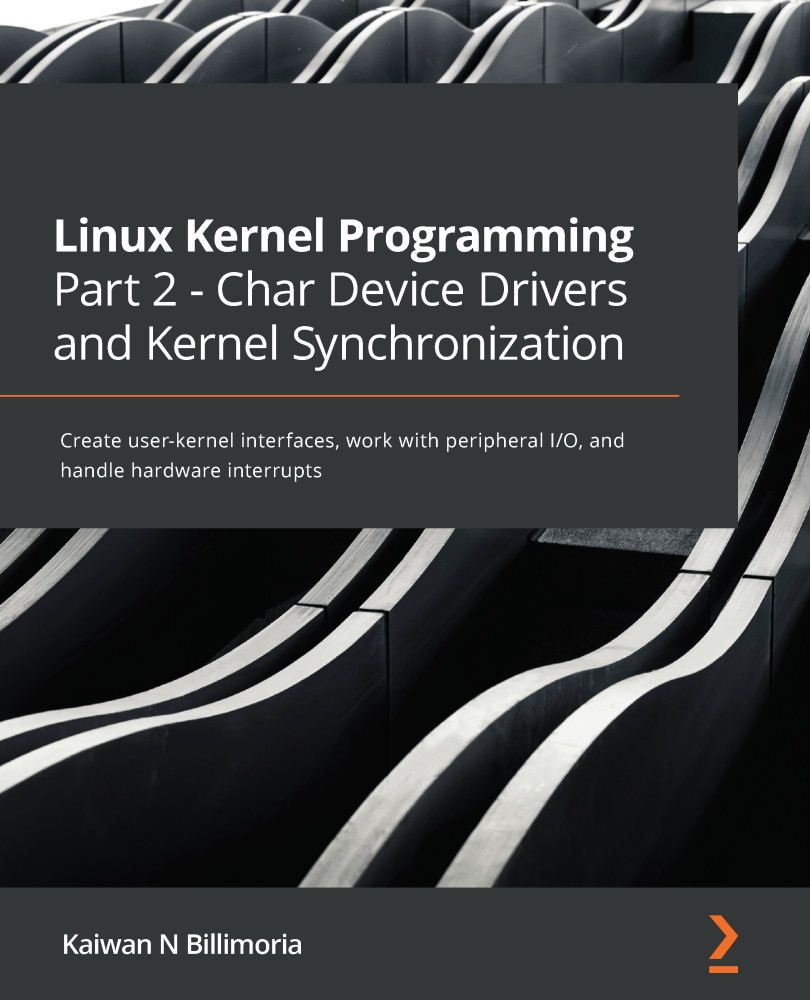
Linux Kernel Programming Part 2 - Char Device Drivers and Kernel Synchronization

Linux Kernel Programming Part 2 - Char Device Drivers and Kernel Synchronization: Create user-kernel interfaces, work with peripheral I/O, and handle hardware interrupts

eBook
€16.79 €23.99
Paperback
€29.99
Hardcover
€74.99
Subscription
Free Trial
Renews at €18.99p/m

What do you get with eBook?

Product feature icon Instant access to your Digital eBook purchase
Product feature icon Download this book in EPUB and PDF formats
Product feature icon Access this title in our online reader with advanced features
Product feature icon DRM FREE - Read whenever, wherever and however you want
Product feature icon AI Assistant (beta) to help accelerate your learning
Modal Close icon
Payment Processing...
tick Completed

Billing Address

Table of content icon View table of contents Preview book icon Preview Book

Linux Kernel Programming Part 2 - Char Device Drivers and Kernel Synchronization

Left arrow icon Right arrow icon
Download code icon Download Code

Key benefits

  • Delve into hardware interrupt handling, threaded IRQs, tasklets, softirqs, and understand which to use when
  • Explore powerful techniques to perform user-kernel interfacing, peripheral I/O and use kernel mechanisms
  • Work with key kernel synchronization primitives to solve kernel concurrency issues

Description

Linux Kernel Programming Part 2 - Char Device Drivers and Kernel Synchronization is an ideal companion guide to the Linux Kernel Programming book. This book provides a comprehensive introduction for those new to Linux device driver development and will have you up and running with writing misc class character device driver code (on the 5.4 LTS Linux kernel) in next to no time. You'll begin by learning how to write a simple and complete misc class character driver before interfacing your driver with user-mode processes via procfs, sysfs, debugfs, netlink sockets, and ioctl. You'll then find out how to work with hardware I/O memory. The book covers working with hardware interrupts in depth and helps you understand interrupt request (IRQ) allocation, threaded IRQ handlers, tasklets, and softirqs. You'll also explore the practical usage of useful kernel mechanisms, setting up delays, timers, kernel threads, and workqueues. Finally, you'll discover how to deal with the complexity of kernel synchronization with locking technologies (mutexes, spinlocks, and atomic/refcount operators), including more advanced topics such as cache effects, a primer on lock-free techniques, deadlock avoidance (with lockdep), and kernel lock debugging techniques. By the end of this Linux kernel book, you'll have learned the fundamentals of writing Linux character device driver code for real-world projects and products.

Who is this book for?

An understanding of the topics covered in the Linux Kernel Programming book is highly recommended to make the most of this book. This book is for Linux programmers beginning to find their way with device driver development. Linux device driver developers looking to overcome frequent and common kernel/driver development issues, as well as perform common driver tasks such as user-kernel interfaces, performing peripheral I/O, handling hardware interrupts, and dealing with concurrency will benefit from this book. A basic understanding of Linux kernel internals (and common APIs), kernel module development, and C programming is required.

What you will learn

  • Get to grips with the basics of the modern Linux Device Model (LDM)
  • Write a simple yet complete misc class character device driver
  • Perform user-kernel interfacing using popular methods
  • Understand and handle hardware interrupts confidently
  • Perform I/O on peripheral hardware chip memory
  • Explore kernel APIs to work with delays, timers, kthreads, and workqueues
  • Understand kernel concurrency issues
  • Work with key kernel synchronization primitives and discover how to detect and avoid deadlock

Product Details

Country selected
Publication date, Length, Edition, Language, ISBN-13
Publication date : Mar 19, 2021
Length: 452 pages
Edition : 1st
Language : English
ISBN-13 : 9781801070829
Tools :

What do you get with eBook?

Product feature icon Instant access to your Digital eBook purchase
Product feature icon Download this book in EPUB and PDF formats
Product feature icon Access this title in our online reader with advanced features
Product feature icon DRM FREE - Read whenever, wherever and however you want
Product feature icon AI Assistant (beta) to help accelerate your learning
Modal Close icon
Payment Processing...
tick Completed

Billing Address

Product Details

Publication date : Mar 19, 2021
Length: 452 pages
Edition : 1st
Language : English
ISBN-13 : 9781801070829
Tools :

Packt Subscriptions

See our plans and pricing
Modal Close icon
€18.99 billed monthly
Feature tick icon Unlimited access to Packt's library of 7,000+ practical books and videos
Feature tick icon Constantly refreshed with 50+ new titles a month
Feature tick icon Exclusive Early access to books as they're written
Feature tick icon Solve problems while you work with advanced search and reference features
Feature tick icon Offline reading on the mobile app
Feature tick icon Simple pricing, no contract
€189.99 billed annually
Feature tick icon Unlimited access to Packt's library of 7,000+ practical books and videos
Feature tick icon Constantly refreshed with 50+ new titles a month
Feature tick icon Exclusive Early access to books as they're written
Feature tick icon Solve problems while you work with advanced search and reference features
Feature tick icon Offline reading on the mobile app
Feature tick icon Choose a DRM-free eBook or Video every month to keep
Feature tick icon PLUS own as many other DRM-free eBooks or Videos as you like for just €5 each
Feature tick icon Exclusive print discounts
€264.99 billed in 18 months
Feature tick icon Unlimited access to Packt's library of 7,000+ practical books and videos
Feature tick icon Constantly refreshed with 50+ new titles a month
Feature tick icon Exclusive Early access to books as they're written
Feature tick icon Solve problems while you work with advanced search and reference features
Feature tick icon Offline reading on the mobile app
Feature tick icon Choose a DRM-free eBook or Video every month to keep
Feature tick icon PLUS own as many other DRM-free eBooks or Videos as you like for just €5 each
Feature tick icon Exclusive print discounts

Frequently bought together


Stars icon
Total 124.97
Mastering Embedded Linux Programming
€52.99
Linux Kernel Programming
€41.99
Linux Kernel Programming Part 2 - Char Device Drivers and Kernel Synchronization
€29.99
Total 124.97 Stars icon

Table of Contents

10 Chapters
Section 1: Character Device Driver Basics Chevron down icon Chevron up icon
Writing a Simple misc Character Device Driver Chevron down icon Chevron up icon
User-Kernel Communication Pathways Chevron down icon Chevron up icon
User-Kernel Communication Pathways
Technical requirements
Approaches to communicating/interfacing a kernel driver with a user space C app
Interfacing via the proc filesystem (procfs)
Understanding the proc filesystem
Directories under /proc
The purpose behind the proc filesystem
procfs is off-bounds to driver authors
Using procfs to interface with the user space
Basic procfs APIs
The four procfs files we will create
Trying out the dynamic debug_level procfs control
Dynamically controlling debug_level via procfs
A few misc procfs APIs
Interfacing via the sys filesystem (sysfs)
Creating a sysfs (pseudo) file in code
Creating a simple platform device
Platform devices
Tying it all together – setting up the device attributes and creating the sysfs file
The code for implementing our sysfs file and its callbacks
The "one value per sysfs file" rule
Interfacing via the debug filesystem (debugfs)
Checking for the presence of debugfs
Looking up the debugfs API documentation
An interfacing example with debugfs
Creating and using the first debugfs file
Creating and using the second debugfs file
Helper debugfs APIs for working on numeric globals
Removing the debugfs pseudo file(s)
Seeing a kernel bug – an Oops!
Debugfs – actual users
Interfacing via netlink sockets
Advantages using sockets
Understanding what a netlink socket is
Writing the user space netlink socket application
Writing the kernel-space netlink socket code as a kernel module
Trying out our netlink interfacing project
Interfacing via the ioctl system call
Using ioctl in the user and kernel space
User space – using the ioctl system call
Kernel space – using the ioctl system call
ioctl as a debug interface
Comparing the interfacing methods – a table
Summary
Questions
Further reading
Working with Hardware I/O Memory Chevron down icon Chevron up icon
Handling Hardware Interrupts Chevron down icon Chevron up icon
Handling Hardware Interrupts
Technical requirements
Hardware interrupts and how the kernel handles them
Allocating the hardware IRQ
Allocating your interrupt handler with request_irq()
Freeing the IRQ line
Setting interrupt flags
Understanding level- and edge-triggered interrupts – a brief note
Code view 1 – the IXGB network driver
Implementing the interrupt handler routine
Interrupt context guidelines – what to do and what not to do
Don't block – spotting possibly blocking code paths
Interrupt masking – the defaults and controlling it
Keep it fast
Writing the interrupt handler routine itself
Code view 2 – the i8042 driver's interrupt handler
Code view 3 – the IXGB network driver's interrupt handler
IRQ allocation – the modern way – the managed interrupt facility
Working with the threaded interrupts model
Employing the threaded interrupt model – the API
Employing the managed threaded interrupt model – the recommended way
Code view 4 – the STM32 F7 microcontroller's threaded interrupt handler
Internally implementing the threaded interrupt
Why use threaded interrupts?
Threaded interrupts – to really make it real time
Constraints when using a threaded handler
Working with either hardirq or threaded handlers
Enabling and disabling IRQs
The NMI
Viewing all allocated interrupt (IRQ) lines
Understanding and using top and bottom halves
Specifying and using a tasklet
Initializing the tasklet
Running the tasklet
Understanding the kernel softirq mechanism
Available softirqs and what they are for
Understanding how the kernel runs softirqs
Running tasklets
Employing the ksoftirqd kernel threads
Softirqs and concurrency
Hardirqs, tasklets, and threaded handlers – what to use when
Fully figuring out the context
Viewing the context – examples
How Linux prioritizes activities
A few remaining FAQs answered
Load balancing interrupts and IRQ affinity
Does the kernel maintain separate IRQ stacks?
Measuring metrics and latency
Measuring interrupts with [e]BPF
Measuring time servicing individual hardirqs
Measuring time servicing individual softirqs
Using Ftrace to get a handle on system latencies
Finding the interrupts disabled worst-case time latency with Ftrace
Other tools
Summary
Questions
Further reading
Working with Kernel Timers, Threads, and Workqueues Chevron down icon Chevron up icon
Working with Kernel Timers, Threads, and Workqueues
Technical requirements
Delaying for a given time in the kernel
Understanding how to use the *delay() atomic APIs
Understanding how to use the *sleep() blocking APIs
Taking timestamps within kernel code
Let's try it – how long do delays and sleeps really take?
The "sed" drivers – to demo kernel timers, kthreads, and workqueues
Setting up and using kernel timers
Using kernel timers
Our simple kernel timer module – code view 1
Our simple kernel timer module – code view 2
Our simple kernel timer module – running it
sed1 – implementing timeouts with our demo sed1 driver
Deliberately missing the bus
Creating and working with kernel threads
A simple demo – creating a kernel thread
Running the kthread_simple kernel thread demo
The sed2 driver – design and implementation
sed2 – the design
sed2 driver – code implementation
sed2 – trying it out
Querying and setting the scheduling policy/priority of a kernel thread
Using kernel workqueues
The bare minimum workqueue internals
Using the kernel-global workqueue
Initializing the kernel-global workqueue for your task – INIT_WORK()
Having your work task execute – schedule_work()
Variations of scheduling your work task
Cleaning up – canceling or flushing your work task
A quick summary of the workflow
Our simple work queue kernel module – code view
Our simple work queue kernel module – running it
The sed3 mini project – a very brief look
Summary
Questions
Further reading
Section 2: Delving Deeper Chevron down icon Chevron up icon
Kernel Synchronization - Part 1 Chevron down icon Chevron up icon
Kernel Synchronization - Part 2 Chevron down icon Chevron up icon
Other Books You May Enjoy Chevron down icon Chevron up icon

Customer reviews

Top Reviews
Rating distribution
Full star icon Full star icon Full star icon Full star icon Half star icon 4.5
(6 Ratings)
5 star 83.3%
4 star 0%
3 star 0%
2 star 16.7%
1 star 0%
Filter icon Filter
Top Reviews

Filter reviews by


Amazon Customer Aug 20, 2021
Full star icon Full star icon Full star icon Full star icon Full star icon 5
the interesting part I like in this book is that the author has made it self-contained and the words used are easy to understand. this book has used the latest kernel release which gave a good understanding of both the concepts and source code, the author also pointed some good websites where you can start your contribution and the challenges conducted by the Linux Foundation. Some other book is also available which gives a good understanding of the concepts about Linux kernel but those books are written during kernel 2.6 release and the source code are outdated which is really a headache when you want to understand both the high-level concepts and the source code written
Amazon Verified review Amazon
Gautham Kantharaju Jun 05, 2021
Full star icon Full star icon Full star icon Full star icon Full star icon 5
Book is very well structured and lots of information with examples. Foundation is laid out in the "Linux Kernel Programming" Part-1 book and is must to read the first book in order to understand the concepts explained in this (Part-2) book. Off topics information/link are provided which is great. Book is good for both freshers and experienced. I would really recommend this book!!
Amazon Verified review Amazon
Ashwin Murali Feb 13, 2023
Full star icon Full star icon Full star icon Full star icon Full star icon 5
I recommend reading part 1 of Linux Kernel Programming before starting this book. Even if you start off with this book directly, there is a lot to be gained.
Amazon Verified review Amazon
BSagar Oct 14, 2022
Full star icon Full star icon Full star icon Full star icon Full star icon 5
Glad to read this book. I recommand this book. I continue to read it to learn more things. He is great trainer and author too. I always recommend to read his books and blogs.
Amazon Verified review Amazon
Bhavagna May 14, 2025
Full star icon Full star icon Full star icon Full star icon Full star icon 5
noice. tasty. this is how you write books everybody. golden
Subscriber review Packt
Get free access to Packt library with over 7500+ books and video courses for 7 days!
Start Free Trial

FAQs

How do I buy and download an eBook? Chevron down icon Chevron up icon

Where there is an eBook version of a title available, you can buy it from the book details for that title. Add either the standalone eBook or the eBook and print book bundle to your shopping cart. Your eBook will show in your cart as a product on its own. After completing checkout and payment in the normal way, you will receive your receipt on the screen containing a link to a personalised PDF download file. This link will remain active for 30 days. You can download backup copies of the file by logging in to your account at any time.

If you already have Adobe reader installed, then clicking on the link will download and open the PDF file directly. If you don't, then save the PDF file on your machine and download the Reader to view it.

Please Note: Packt eBooks are non-returnable and non-refundable.

Packt eBook and Licensing When you buy an eBook from Packt Publishing, completing your purchase means you accept the terms of our licence agreement. Please read the full text of the agreement. In it we have tried to balance the need for the ebook to be usable for you the reader with our needs to protect the rights of us as Publishers and of our authors. In summary, the agreement says:

  • You may make copies of your eBook for your own use onto any machine
  • You may not pass copies of the eBook on to anyone else
How can I make a purchase on your website? Chevron down icon Chevron up icon

If you want to purchase a video course, eBook or Bundle (Print+eBook) please follow below steps:

  1. Register on our website using your email address and the password.
  2. Search for the title by name or ISBN using the search option.
  3. Select the title you want to purchase.
  4. Choose the format you wish to purchase the title in; if you order the Print Book, you get a free eBook copy of the same title. 
  5. Proceed with the checkout process (payment to be made using Credit Card, Debit Cart, or PayPal)
Where can I access support around an eBook? Chevron down icon Chevron up icon
  • If you experience a problem with using or installing Adobe Reader, the contact Adobe directly.
  • To view the errata for the book, see www.packtpub.com/support and view the pages for the title you have.
  • To view your account details or to download a new copy of the book go to www.packtpub.com/account
  • To contact us directly if a problem is not resolved, use www.packtpub.com/contact-us
What eBook formats do Packt support? Chevron down icon Chevron up icon

Our eBooks are currently available in a variety of formats such as PDF and ePubs. In the future, this may well change with trends and development in technology, but please note that our PDFs are not Adobe eBook Reader format, which has greater restrictions on security.

You will need to use Adobe Reader v9 or later in order to read Packt's PDF eBooks.

What are the benefits of eBooks? Chevron down icon Chevron up icon
  • You can get the information you need immediately
  • You can easily take them with you on a laptop
  • You can download them an unlimited number of times
  • You can print them out
  • They are copy-paste enabled
  • They are searchable
  • There is no password protection
  • They are lower price than print
  • They save resources and space
What is an eBook? Chevron down icon Chevron up icon

Packt eBooks are a complete electronic version of the print edition, available in PDF and ePub formats. Every piece of content down to the page numbering is the same. Because we save the costs of printing and shipping the book to you, we are able to offer eBooks at a lower cost than print editions.

When you have purchased an eBook, simply login to your account and click on the link in Your Download Area. We recommend you saving the file to your hard drive before opening it.

For optimal viewing of our eBooks, we recommend you download and install the free Adobe Reader version 9.

Modal Close icon
Modal Close icon