Search icon CANCEL
Subscription
0
Cart icon
Your Cart (0 item)
Close icon
You have no products in your basket yet
Save more on your purchases! discount-offer-chevron-icon
Savings automatically calculated. No voucher code required.
Arrow left icon
Explore Products
Best Sellers
New Releases
Books
Videos
Audiobooks
Learning Hub
Newsletter Hub
Free Learning
Arrow right icon
timer SALE ENDS IN
0 Days
:
00 Hours
:
00 Minutes
:
00 Seconds
Arrow up icon
GO TO TOP
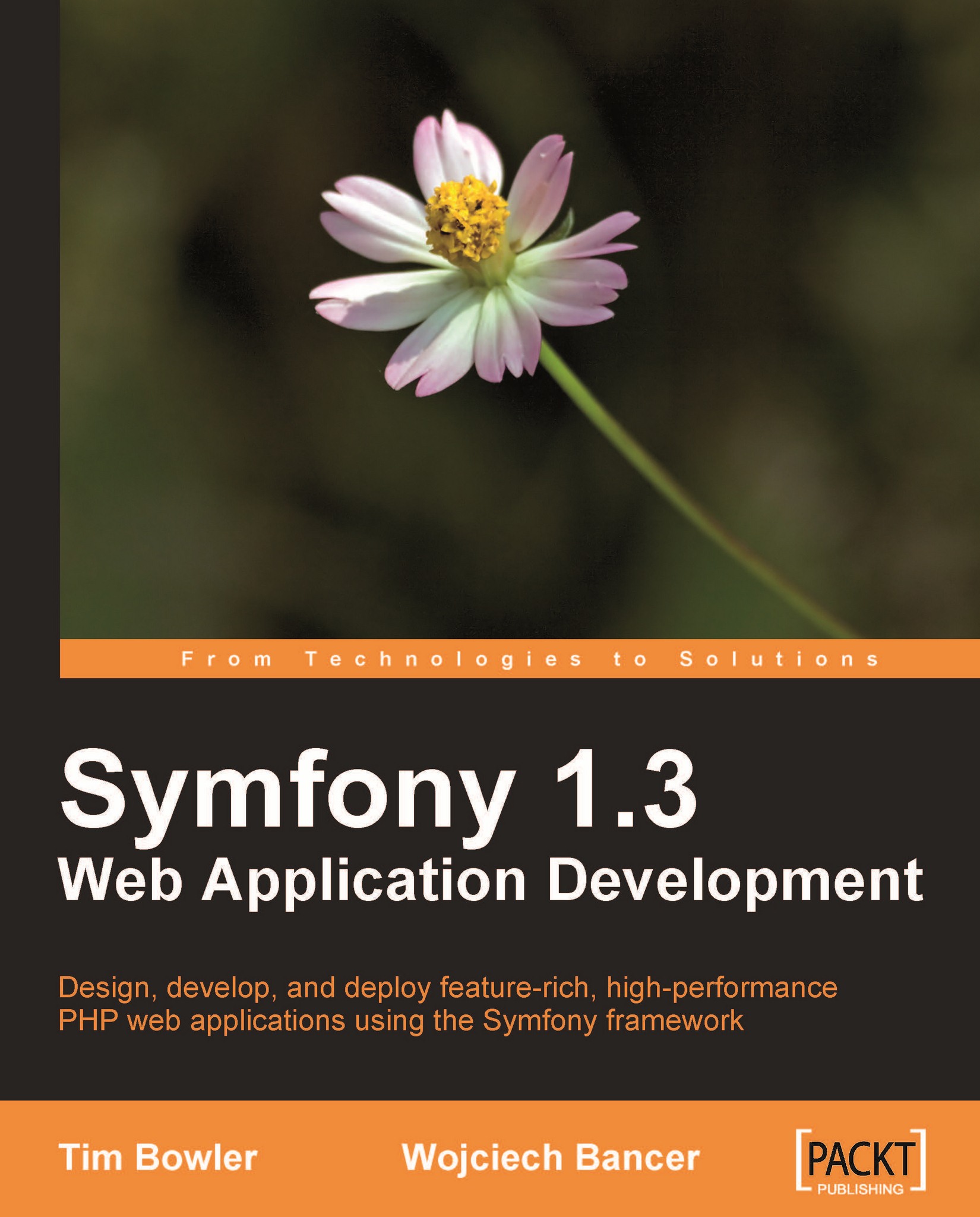
Symfony 1.3 Web Application Development

You're reading from   Symfony 1.3 Web Application Development Design, develop, and deploy feature-rich, high-performance PHP web applications using the Symfony framework

Arrow left icon
Product type Paperback
Published in Sep 2009
Publisher Packt
ISBN-13 9781847194565
Length 228 pages
Edition 1st Edition
Languages
Tools
Arrow right icon
Toc

Table of Contents (15) Chapters Close

Symfony 1.3 Web Application Development
Credits
About the Authors
About the Reviewer
1. Preface
1. Getting Started with Symfony 2. Developing Our Application FREE CHAPTER 3. Adding the Business Logic and Complex Application Logic 4. User Interaction and Email Automation 5. Generating the Admin Area 6. Advanced Forms and JavaScript 7. Internationalizing our Global Positions 8. Extending Symfony 9. Optimizing for Performance 10. Final Tweaks and Deployment

The generated models


Although we have only created five tables, looking in the lib/model folder, and the subfolders of om/ and map/ reveals that there are a total of 25 files. The files that we are interested in are located in the lib/model and lib/model/om folders. The files generated in the lib/model/om folder contain all of the base classes, and the files in the lib/model folder contain the custom classes that extend the base classes.

You will also notice that for each class there is also a corresponding peer class. The peer classes are what we use to query the database, and are referred to as the Data Access Objects (DAOs). Within these classes, there are numerous methods created for us. The non-peer counterpart represents the rows of the table in the result set and provides us with methods to access the data in each row.

The custom classes are where we add our methods to query the database. It is important that we add all our code to the custom classes, and if need be extend the base...


lock icon The rest of the chapter is locked
Visually different images
CONTINUE READING
83
Tech Concepts
36
Programming languages
73
Tech Tools
Icon Unlimited access to the largest independent learning library in tech of over 8,000 expert-authored tech books and videos.
Icon Innovative learning tools, including AI book assistants, code context explainers, and text-to-speech.
Icon 50+ new titles added per month and exclusive early access to books as they are being written.
Symfony 1.3 Web Application Development
Register for a free Packt account to unlock a world of extra content!
A free Packt account unlocks extra newsletters, articles, discounted offers, and much more. Start advancing your knowledge today.
Unlock this book and the full library FREE for 7 days
Get unlimited access to 7000+ expert-authored eBooks and videos courses covering every tech area you can think of
Renews at AU $24.99/month. Cancel anytime
Modal Close icon
Modal Close icon