Search icon CANCEL
Subscription
0
Cart icon
Your Cart (0 item)
Close icon
You have no products in your basket yet
Save more on your purchases! discount-offer-chevron-icon
Savings automatically calculated. No voucher code required.
Arrow left icon
Explore Products
Best Sellers
New Releases
Books
Videos
Audiobooks
Learning Hub
Newsletter Hub
Free Learning
Arrow right icon
timer SALE ENDS IN
0 Days
:
00 Hours
:
00 Minutes
:
00 Seconds
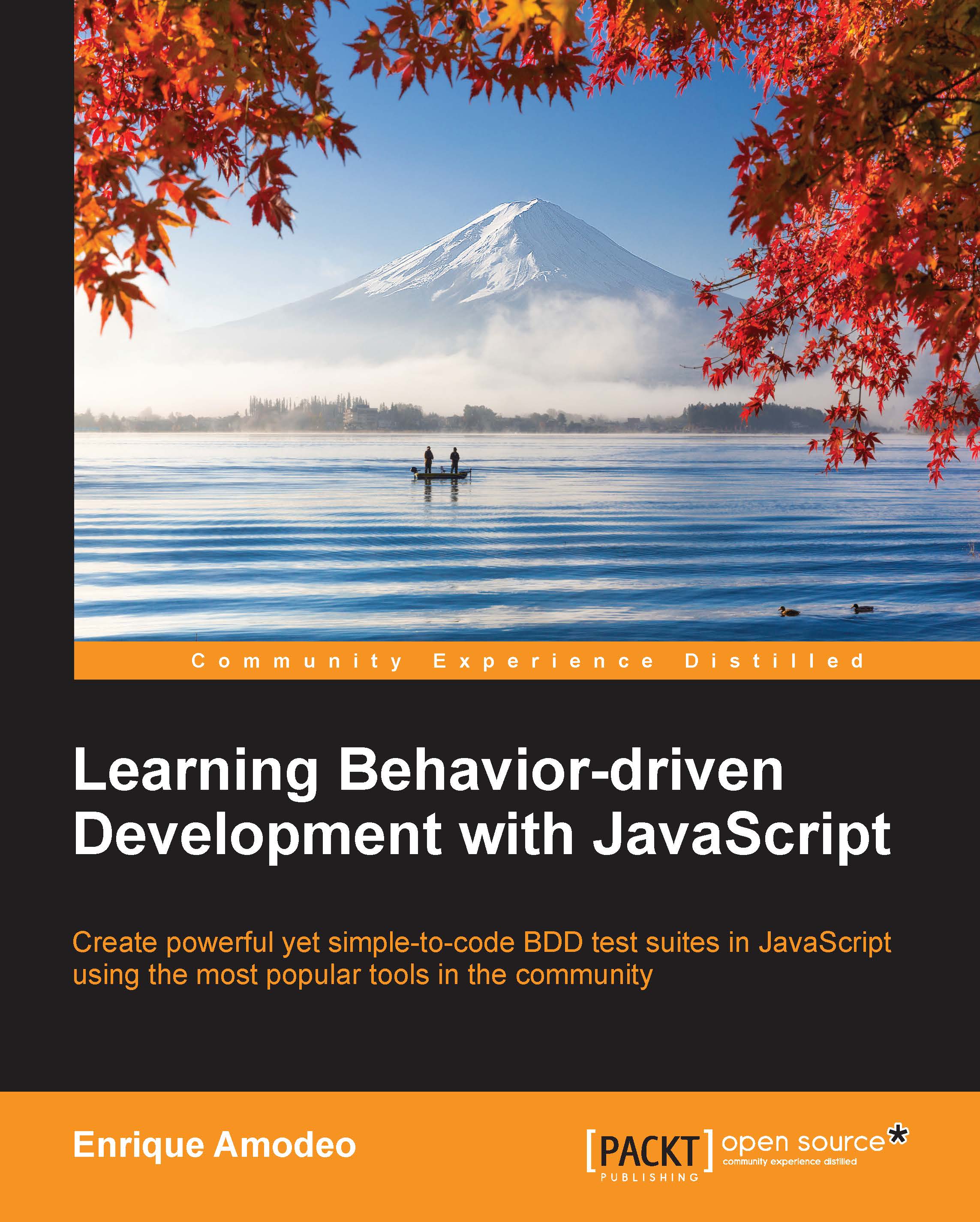
Learning Behavior-driven development with Javascript

Learning Behavior-driven development with Javascript: Create powerful yet simple-to-code BDD test suites in JavaScript using the most popular tools in the community

Arrow left icon
Profile Icon Enrique Javier A Rubio
Arrow right icon
AU$14.99 AU$60.99
Full star icon Full star icon Full star icon Full star icon Half star icon 4.9 (7 Ratings)
eBook Feb 2015 392 pages 1st Edition
eBook
AU$14.99 AU$60.99
Paperback
AU$75.99
Subscription
Free Trial
Renews at AU$24.99p/m
Arrow left icon
Profile Icon Enrique Javier A Rubio
Arrow right icon
AU$14.99 AU$60.99
Full star icon Full star icon Full star icon Full star icon Half star icon 4.9 (7 Ratings)
eBook Feb 2015 392 pages 1st Edition
eBook
AU$14.99 AU$60.99
Paperback
AU$75.99
Subscription
Free Trial
Renews at AU$24.99p/m
eBook
AU$14.99 AU$60.99
Paperback
AU$75.99
Subscription
Free Trial
Renews at AU$24.99p/m

What do you get with eBook?

Product feature icon Instant access to your Digital eBook purchase
Product feature icon Download this book in EPUB and PDF formats
Product feature icon Access this title in our online reader with advanced features
Product feature icon DRM FREE - Read whenever, wherever and however you want
Modal Close icon
Payment Processing...
tick Completed

Billing Address

Table of content icon View table of contents Preview book icon Preview Book

Learning Behavior-driven development with Javascript

Chapter 2. Automating Tests with Mocha, Chai, and Sinon

Before we start making some BDD, let's familiarize ourselves with the basic tools available in JavaScript to write and execute a test. In this chapter, we will explore the main capabilities of Mocha, the most popular test runner in JavaScript. We will perform the following tasks:

  • Writing expressive assertions using the Chai package
  • Creating test doubles using the Sinon and sinon-chai packages
  • Exploring the basic techniques for organizing our test codebase

To achieve these goals, we will perform a small code kata, or coding exercise, where we will be able to practice not only the tools, but also the test-first cycle explained in the previous chapter.

Node and NPM as development platforms

All the tools that we will use are written in JavaScript. A long time ago, the only way to execute JavaScript was to use a browser, but those days are long gone. Nowadays, we can execute our development tools from the command line during our normal development cycle or from a Continuous Integration (CI) server whenever we commit our changes to a source code repository.

The most easy and productive way to run our test tools is to use Node. Node is a lightweight and highly-scalable platform for JavaScript, written on top of the excellent V8 JavaScript virtual machine. Node is especially good for applications that perform high-volume IO, but it can also be used as a development platform, as we will see in a moment.

Installing Node and NPM

The examples in this book will work with Node Version 0.10.x or above. If you don't have it installed already, you must do so to follow the code examples.

Tip

It is recommended that you do not install a version of Node...

Configuring your project with NPM

With the installation of Node, the Node Package Manager (NPM) is also installed. NPM is actually the utility that we will use for our normal development cycle.

NPM allows you to install libraries, manage the dependencies of your projects, and define a set of commands to build your code.

To start, just create a new folder for your project and initialize it from there:

$ me@~> mkdir validator
$ me@~> cd validator
$ me@~/validator> npm init

The last command, npm init, will invoke NPM to generate package.json inside the current directory; during the process, it will ask you some questions. Most of them are self-explanatory, but if you do not know what to answer just press ENTER. Do not worry; you will be able to edit the package.json file later. This is my package.json file:

{
  "name": "validator",
  "version": "0.1.0",
  "description": "A validation service for Weird LTD.",
  "main&quot...

Introducing Mocha

Mocha is a modern test runner that can be executed from Node as well as inside a browser. As we saw earlier, our main approach is to use Node. In this book, I am using Mocha Version 1.20.1, but any 1.x version should be OK.

We have already installed Mocha using NPM, so we can run it with the following command:

$ me@~/validator> ./node_modules/.bin/mocha -u bdd -R spec -t 500 --recursive

It fails because we do not have any test yet; we will fix it later. I will explain the exact meaning of these parameters in a moment. For now, note that, to execute Mocha, we need to find out where NPM has installed the executable of the tool. A package can be a simple library, or it can also contain an executable command-line tool, as is the case with Mocha. NPM always will install this executable in the node_modules/.bin/ folder; hence, we need to execute ./node_modules/.bin/mocha in order to invoke Mocha.

This would not have been necessary if we had installed Mocha as a global package...

More expressive assertions with Chai

We have already installed chai as a dependency of our project, but we have not yet used it. Specifically, I am using version 1.9.1, but any 1.x version should be OK.

Until now, we have been using the standard assert package to create our assertions. The assert package is not bad, but it is limited to a few assertions. It is not extensible, and some people found it a bit difficult to read. I personally always find myself wondering, "Is the first parameter the actual value or the expected one?" Actually, the first parameter is the actual value, and the second one is the expected value. This is important because the report message depends on distinguishing the actual value from the expected one. Let's change the code of our test to use chai:

var chai = require('chai'),
    expect = chai.expect,
    validator = require('../lib/validator');

describe('A Validator', function() {
  it('will return error.nonpositive...

Red/Green/Refactor

Now that we have a basic knowledge of Chai, we can continue with our coding. The code we already have in place is clearly not correct, so we need to add another test that forces us to make the code right.

Currently, we are implementing the rule about errors for nonpositive numbers, so we should finish it before continuing. Which test could we add to make our implementation fail? We can try testing the validator with valid numbers. Let's see the result:

describe('A Validator', function() {
  it('will return no errors for valid numbers', function() {
    expect(validator(3)).to.be.empty;
  });

  it('will return error.nonpositive for not strictly positive numbers', function() {
    expect(validator(0)).to.be.deep.equal(['error.nonpositive']);
  });
});

Note that we have added a new test for valid numbers that is failing. So now we fix it in a very simple way in lib/validator.js:

module.exports = function (n) {
  if(n === 0)
    return...

Test doubles with Sinon

A few weeks after going to production, our validator is a complete success but it also happens that potential new customers would like to have different sets of validation rules. Fortunately, our validator is configurable, but we somehow need to specify a different configuration for each customer.

The act of configuring a different set of rules for each customer is clearly another operation of the system and, hence, a different feature, so we are not really interested in testing it in the validator tests. We would like to isolate the tests about the validator feature and the configuration feature. To do so, we need to create an interface in a way that allows the validator to ask for the correct set of rules for the configuration. Then we can create a test double for such an interface in our tests. The test double will impersonate the real configuration and allow us to isolate our tests.

When creating these test doubles we need to design the shape of the interfaces...

Node and NPM as development platforms


All the tools that we will use are written in JavaScript. A long time ago, the only way to execute JavaScript was to use a browser, but those days are long gone. Nowadays, we can execute our development tools from the command line during our normal development cycle or from a Continuous Integration (CI) server whenever we commit our changes to a source code repository.

The most easy and productive way to run our test tools is to use Node. Node is a lightweight and highly-scalable platform for JavaScript, written on top of the excellent V8 JavaScript virtual machine. Node is especially good for applications that perform high-volume IO, but it can also be used as a development platform, as we will see in a moment.

Installing Node and NPM

The examples in this book will work with Node Version 0.10.x or above. If you don't have it installed already, you must do so to follow the code examples.

Tip

It is recommended that you do not install a version of Node whose...

Left arrow icon Right arrow icon

Description

This book is ideal for any JavaScript developer who is interested in producing well-tested code. If you have no prior experience with testing, Node.js, or any other tool, do not worry, as they will be explained from scratch.

Who is this book for?

TThis book is ideal for any JavaScript developer who is interested in producing well-tested code. If you have no prior experience with testing, Node.js, or any other tool, do not worry, as they will be explained from scratch.

What you will learn

  • Understand the basic concepts of BDD and how it is different from classic unit testing
  • Divide your system into different modules that can be tested separately, but at the same time not falling into the trap of unit testing
  • Use Mocha, Sinon.JS, and Chai to write expressive BDD features
  • Implement Cucumber.js to automate tests written in Gherkin so that your stakeholders can understand them
  • Discover how to test asynchronous systems, either based on callbacks or promises
  • Test a RESTful web API and a rich UI using WebDriverJS and Protractor
  • Refactor and keep your test code base maintainable using best practices and patterns such as PageObject

Product Details

Country selected
Publication date, Length, Edition, Language, ISBN-13
Publication date : Feb 19, 2015
Length: 392 pages
Edition : 1st
Language : English
ISBN-13 : 9781784390174
Languages :
Tools :

What do you get with eBook?

Product feature icon Instant access to your Digital eBook purchase
Product feature icon Download this book in EPUB and PDF formats
Product feature icon Access this title in our online reader with advanced features
Product feature icon DRM FREE - Read whenever, wherever and however you want
Modal Close icon
Payment Processing...
tick Completed

Billing Address

Product Details

Publication date : Feb 19, 2015
Length: 392 pages
Edition : 1st
Language : English
ISBN-13 : 9781784390174
Languages :
Tools :

Packt Subscriptions

See our plans and pricing
Modal Close icon
AU$24.99 billed monthly
Feature tick icon Unlimited access to Packt's library of 7,000+ practical books and videos
Feature tick icon Constantly refreshed with 50+ new titles a month
Feature tick icon Exclusive Early access to books as they're written
Feature tick icon Solve problems while you work with advanced search and reference features
Feature tick icon Offline reading on the mobile app
Feature tick icon Simple pricing, no contract
AU$249.99 billed annually
Feature tick icon Unlimited access to Packt's library of 7,000+ practical books and videos
Feature tick icon Constantly refreshed with 50+ new titles a month
Feature tick icon Exclusive Early access to books as they're written
Feature tick icon Solve problems while you work with advanced search and reference features
Feature tick icon Offline reading on the mobile app
Feature tick icon Choose a DRM-free eBook or Video every month to keep
Feature tick icon PLUS own as many other DRM-free eBooks or Videos as you like for just AU$5 each
Feature tick icon Exclusive print discounts
AU$349.99 billed in 18 months
Feature tick icon Unlimited access to Packt's library of 7,000+ practical books and videos
Feature tick icon Constantly refreshed with 50+ new titles a month
Feature tick icon Exclusive Early access to books as they're written
Feature tick icon Solve problems while you work with advanced search and reference features
Feature tick icon Offline reading on the mobile app
Feature tick icon Choose a DRM-free eBook or Video every month to keep
Feature tick icon PLUS own as many other DRM-free eBooks or Videos as you like for just AU$5 each
Feature tick icon Exclusive print discounts

Frequently bought together


Stars icon
Total AU$ 211.97
Learning JavaScript Data Structures and Algorithms
AU$67.99
Mastering JavaScript Design Patterns
AU$67.99
Learning Behavior-driven development with Javascript
AU$75.99
Total AU$ 211.97 Stars icon

Table of Contents

11 Chapters
1. Welcome to BDD Chevron down icon Chevron up icon
2. Automating Tests with Mocha, Chai, and Sinon Chevron down icon Chevron up icon
3. Writing BDD Features Chevron down icon Chevron up icon
4. Cucumber.js and Gherkin Chevron down icon Chevron up icon
5. Testing a REST Web API Chevron down icon Chevron up icon
6. Testing a UI Using WebDriverJS Chevron down icon Chevron up icon
7. The Page Object Pattern Chevron down icon Chevron up icon
8. Testing in Several Browsers with Protractor and WebDriver Chevron down icon Chevron up icon
9. Testing Against External Systems Chevron down icon Chevron up icon
10. Final Thoughts Chevron down icon Chevron up icon
Index Chevron down icon Chevron up icon

Customer reviews

Top Reviews
Rating distribution
Full star icon Full star icon Full star icon Full star icon Half star icon 4.9
(7 Ratings)
5 star 85.7%
4 star 14.3%
3 star 0%
2 star 0%
1 star 0%
Filter icon Filter
Top Reviews

Filter reviews by


Mike Ludemann Jul 18, 2019
Full star icon Full star icon Full star icon Full star icon Full star icon 5
Alle wichtigen Information und mehr sind vorhanden.
Amazon Verified review Amazon
SoftMil Jakub Milkiewicz PL7851665795 May 22, 2015
Full star icon Full star icon Full star icon Full star icon Full star icon 5
I am a pretty experienced developer (8-9 years mostly Java and other JVM-languages) who thought was pretty familiar with TDD, BDD and code design concepts. Unfortunately i was totally wrong ! The book really allowed me to open my eyes and see how much i was missing in these topics. It allowed me to finally understand the blurry line between TDD and BDD, write better tests, design in a more loose-coupled way and finally run-away from unit-tests (class/method-level unit tests) obsession and focus on features-testing as the right level of granularity for tests. The book (i haven't reached the last page yet) really reminds me Growing Object-Oriented Software, Guided by Tests book but i find it way more easy to read (written by non-native speaker), with complex concepts expressed clearly (always with an example ! ) and with a slightly different test-scope: building "logic/business" layer using BDD (my 2 favorite chapters), then REST API (with business layer being test double/stubbed) and finally UI all developed using test-first approach. That kind of approach seems to match with "Integration Tests Are a Scam" by J.B. Rainsberger.Although I am not js programmer and all examples and tools used in the book are javascript based, I didn't have any problem to read/use them (the author even drives you on installing all tools and shares his best practices on using them) so the book is a really good choice for non-javascript developers who would like to make a deep dive into modern way of building software using tests.I only wish the book was not a softcover...
Amazon Verified review Amazon
souidi sofian Jul 12, 2015
Full star icon Full star icon Full star icon Full star icon Full star icon 5
This book is very well done. He first explains what a test can be the difference in bdd and tdd. It teaches us to structure our tests with a practical case. You learn to test multiple browser using Protractor and WebDriver and even a rest web api. This book is to read for those who want to master the tests.
Amazon Verified review Amazon
Juanfe Mar 26, 2016
Full star icon Full star icon Full star icon Full star icon Full star icon 5
Enrique Amodeo has been so far one of the best tech writers I have found. Neither BDD or TDD was familiar to me, yet in the first chapters of the book I started to understand a lot, even to the point of being myself able to explain to others who also want to learn BDD and have some experience with TDD.This book is a must have if you want to become a better javascript developer. So far my experience has been great, but this doesn't mean that I haven't had my challenges. This is not easy, so keep the good spirits up and trust Amodeo, he is simply the best.
Amazon Verified review Amazon
M. Chowdhury Jul 13, 2015
Full star icon Full star icon Full star icon Full star icon Full star icon 5
Pretty comprehensive coverage on BDD. I have limited experience in JavaScript, and but it's not difficult to follow at all. The startup example was interesting for me to follow the BDD concepts. Chapters four, five and six on CucumberJS, REST API testing and WebDriverJS were the best for me. Highly recommend to any one interested in BDD in JS or other languages.
Amazon Verified review Amazon
Get free access to Packt library with over 7500+ books and video courses for 7 days!
Start Free Trial

FAQs

How do I buy and download an eBook? Chevron down icon Chevron up icon

Where there is an eBook version of a title available, you can buy it from the book details for that title. Add either the standalone eBook or the eBook and print book bundle to your shopping cart. Your eBook will show in your cart as a product on its own. After completing checkout and payment in the normal way, you will receive your receipt on the screen containing a link to a personalised PDF download file. This link will remain active for 30 days. You can download backup copies of the file by logging in to your account at any time.

If you already have Adobe reader installed, then clicking on the link will download and open the PDF file directly. If you don't, then save the PDF file on your machine and download the Reader to view it.

Please Note: Packt eBooks are non-returnable and non-refundable.

Packt eBook and Licensing When you buy an eBook from Packt Publishing, completing your purchase means you accept the terms of our licence agreement. Please read the full text of the agreement. In it we have tried to balance the need for the ebook to be usable for you the reader with our needs to protect the rights of us as Publishers and of our authors. In summary, the agreement says:

  • You may make copies of your eBook for your own use onto any machine
  • You may not pass copies of the eBook on to anyone else
How can I make a purchase on your website? Chevron down icon Chevron up icon

If you want to purchase a video course, eBook or Bundle (Print+eBook) please follow below steps:

  1. Register on our website using your email address and the password.
  2. Search for the title by name or ISBN using the search option.
  3. Select the title you want to purchase.
  4. Choose the format you wish to purchase the title in; if you order the Print Book, you get a free eBook copy of the same title. 
  5. Proceed with the checkout process (payment to be made using Credit Card, Debit Cart, or PayPal)
Where can I access support around an eBook? Chevron down icon Chevron up icon
  • If you experience a problem with using or installing Adobe Reader, the contact Adobe directly.
  • To view the errata for the book, see www.packtpub.com/support and view the pages for the title you have.
  • To view your account details or to download a new copy of the book go to www.packtpub.com/account
  • To contact us directly if a problem is not resolved, use www.packtpub.com/contact-us
What eBook formats do Packt support? Chevron down icon Chevron up icon

Our eBooks are currently available in a variety of formats such as PDF and ePubs. In the future, this may well change with trends and development in technology, but please note that our PDFs are not Adobe eBook Reader format, which has greater restrictions on security.

You will need to use Adobe Reader v9 or later in order to read Packt's PDF eBooks.

What are the benefits of eBooks? Chevron down icon Chevron up icon
  • You can get the information you need immediately
  • You can easily take them with you on a laptop
  • You can download them an unlimited number of times
  • You can print them out
  • They are copy-paste enabled
  • They are searchable
  • There is no password protection
  • They are lower price than print
  • They save resources and space
What is an eBook? Chevron down icon Chevron up icon

Packt eBooks are a complete electronic version of the print edition, available in PDF and ePub formats. Every piece of content down to the page numbering is the same. Because we save the costs of printing and shipping the book to you, we are able to offer eBooks at a lower cost than print editions.

When you have purchased an eBook, simply login to your account and click on the link in Your Download Area. We recommend you saving the file to your hard drive before opening it.

For optimal viewing of our eBooks, we recommend you download and install the free Adobe Reader version 9.

Modal Close icon
Modal Close icon