Search icon CANCEL
Subscription
0
Cart icon
Your Cart (0 item)
Close icon
You have no products in your basket yet
Save more on your purchases! discount-offer-chevron-icon
Savings automatically calculated. No voucher code required.
Arrow left icon
Explore Products
Best Sellers
New Releases
Books
Videos
Audiobooks
Learning Hub
Newsletter Hub
Free Learning
Arrow right icon
timer SALE ENDS IN
0 Days
:
00 Hours
:
00 Minutes
:
00 Seconds
Arrow up icon
GO TO TOP
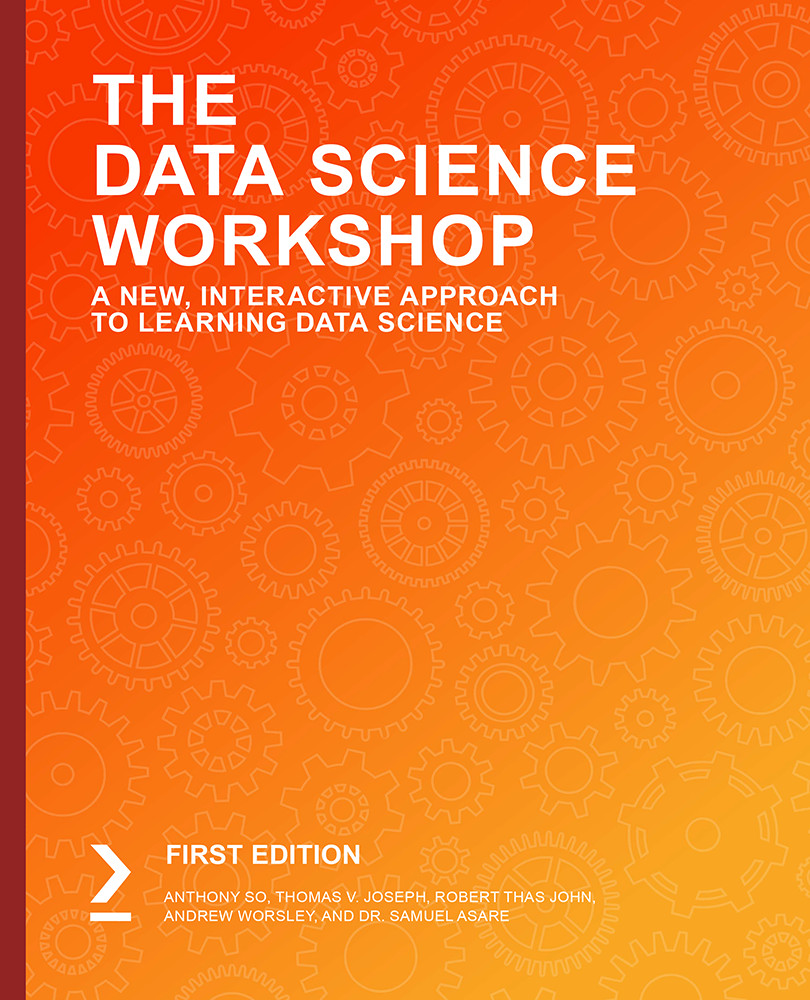
The Data Science Workshop

You're reading from   The Data Science Workshop A New, Interactive Approach to Learning Data Science

Arrow left icon
Product type Paperback
Published in Jan 2020
Publisher
ISBN-13 9781838981266
Length 818 pages
Edition 1st Edition
Languages
Arrow right icon
Authors (9):
Arrow left icon
Anthony So Anthony So
Author Profile Icon Anthony So
Anthony So
Barbora stetinova Barbora stetinova
Author Profile Icon Barbora stetinova
Barbora stetinova
Pritesh Tiwari Pritesh Tiwari
Author Profile Icon Pritesh Tiwari
Pritesh Tiwari
Thomas Joseph Thomas Joseph
Author Profile Icon Thomas Joseph
Thomas Joseph
Robert Thas John Robert Thas John
Author Profile Icon Robert Thas John
Robert Thas John
Andrew Worsley Andrew Worsley
Author Profile Icon Andrew Worsley
Andrew Worsley
Dr. Samuel Asare Dr. Samuel Asare
Author Profile Icon Dr. Samuel Asare
Dr. Samuel Asare
Ivan Liu Ivan Liu
Author Profile Icon Ivan Liu
Ivan Liu
Tiffany Ford Tiffany Ford
Author Profile Icon Tiffany Ford
Tiffany Ford
+5 more Show less
Arrow right icon
View More author details
Toc

Table of Contents (18) Chapters Close

Preface 1. Introduction to Data Science in Python 2. Regression FREE CHAPTER 3. Binary Classification 4. Multiclass Classification with RandomForest 5. Performing Your First Cluster Analysis 6. How to Assess Performance 7. The Generalization of Machine Learning Models 8. Hyperparameter Tuning 9. Interpreting a Machine Learning Model 10. Analyzing a Dataset 11. Data Preparation 12. Feature Engineering 13. Imbalanced Datasets 14. Dimensionality Reduction 15. Ensemble Learning 16. Machine Learning Pipelines 17. Automated Feature Engineering

Data-Driven Feature Engineering

The previous section dealt with business-driven feature engineering. In addition to features we can derive from the business perspective, it would also be imperative to transform data through feature engineering from the perspective of data structures. We will look into different methods of identifying data structures and take a peek into some data transformation techniques.

A Quick Peek at Data Types and a Descriptive Summary

Looking at the data types such as categorical or numeric and then deriving summary statistics is a good way to take a quick peek into data before you do some of the downstream feature engineering steps. Let's take a look at an example from our dataset:

# Looking at Data types
print(bankData.dtypes)
# Looking at descriptive statistics
print(bankData.describe())

You should get the following output:

Figure 3.26: Output showing the different data types in the dataset

In the preceding output...

lock icon The rest of the chapter is locked
Visually different images
CONTINUE READING
83
Tech Concepts
36
Programming languages
73
Tech Tools
Icon Unlimited access to the largest independent learning library in tech of over 8,000 expert-authored tech books and videos.
Icon Innovative learning tools, including AI book assistants, code context explainers, and text-to-speech.
Icon 50+ new titles added per month and exclusive early access to books as they are being written.
The Data Science Workshop
Register for a free Packt account to unlock a world of extra content!
A free Packt account unlocks extra newsletters, articles, discounted offers, and much more. Start advancing your knowledge today.
Unlock this book and the full library FREE for 7 days
Get unlimited access to 7000+ expert-authored eBooks and videos courses covering every tech area you can think of
Renews at €18.99/month. Cancel anytime
Modal Close icon
Modal Close icon