Search icon CANCEL
Subscription
0
Cart icon
Your Cart (0 item)
Close icon
You have no products in your basket yet
Save more on your purchases! discount-offer-chevron-icon
Savings automatically calculated. No voucher code required.
Arrow left icon
Explore Products
Best Sellers
New Releases
Books
Videos
Audiobooks
Learning Hub
Newsletter Hub
Free Learning
Arrow right icon
timer SALE ENDS IN
0 Days
:
00 Hours
:
00 Minutes
:
00 Seconds
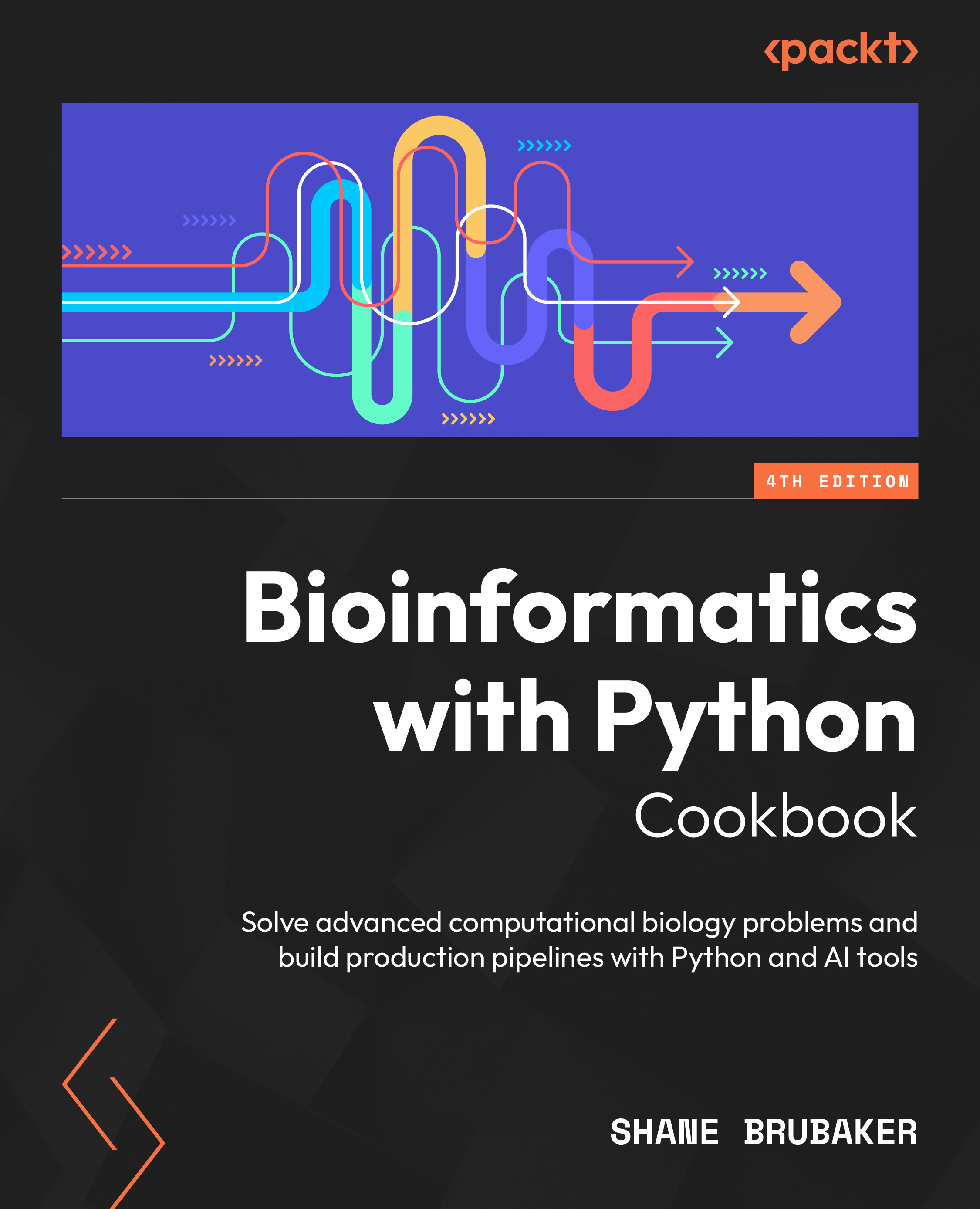
Bioinformatics with Python Cookbook

Bioinformatics with Python Cookbook: Solve advanced computational biology problems and build production pipelines with Python and AI tools , Fourth Edition

Arrow left icon
Profile Icon Shane Brubaker
Arrow right icon
€18.99 per month
Paperback Dec 2025 618 pages 4th Edition
eBook
€8.98 €29.99
Paperback
€37.99
Subscription
Free Trial
Renews at €18.99p/m
Arrow left icon
Profile Icon Shane Brubaker
Arrow right icon
€18.99 per month
Paperback Dec 2025 618 pages 4th Edition
eBook
€8.98 €29.99
Paperback
€37.99
Subscription
Free Trial
Renews at €18.99p/m
eBook
€8.98 €29.99
Paperback
€37.99
Subscription
Free Trial
Renews at €18.99p/m

What do you get with a Packt Subscription?

Free for first 7 days. $19.99 p/m after that. Cancel any time!
Product feature icon Unlimited ad-free access to the largest independent learning library in tech. Access this title and thousands more!
Product feature icon 50+ new titles added per month, including many first-to-market concepts and exclusive early access to books as they are being written.
Product feature icon Innovative learning tools, including AI book assistants, code context explainers, and text-to-speech.
Product feature icon Thousands of reference materials covering every tech concept you need to stay up to date.
Subscribe now
View plans & pricing
Table of content icon View table of contents Preview book icon Preview Book

Bioinformatics with Python Cookbook

Installing the required software with Docker

Docker is the most widely used framework for implementing operating system-level virtualization. This technology allows you to have an independent container: a layer that is lighter than a virtual machine but still allows you to compartmentalize software. This mostly isolates all processes, making it feel like each container is a virtual machine. Containers will be discussed in more detail in Chapter 14, Cloud Basics.Docker works quite well at both extremes of the development spectrum: it’s an expedient way to set up the content of this book for learning purposes and could become your platform of choice for deploying your applications in complex environments.Conda and Docker are key tools to help maintain software compatibility and reproducibility across different systems and libraries. We’ll discuss reproducibility more in Chapter 15, Workflow Systems.

Note

This recipe is an alternative to the previous recipe. Normally, if...

Introduction to Jupyter Notebook

All of our work will be developed inside Jupyter Notebook. Jupyter has become the de facto standard for writing interactive data analysis scripts. Unfortunately, the default format for Jupyter notebooks is based on JSON. JSON is JavaScript Object Notation (https://www.json.org/json-en.html). This format is difficult to read, difficult to compare, and needs exporting to be fed into a normal Python interpreter. To obviate that problem, we will extend Jupyter with jupytext (https://jupytext.readthedocs.io/), which allows us to save Jupyter notebooks as normal Python programs. We will start with an overview of Jupyter Notebook, and then look into jupytext. Recall that we installed Jupyter Notebook in the first recipe of this chapter, when we installed the jupyterlab package using conda.

How to do it…

  1. To run Jupyter, on the Terminal, type the following:
jupyter notebook

This will open the Jupyter browser, and you will see a home page that looks...

Dealing with the pitfalls of joining pandas DataFrames

The previous recipe was a whirlwind tour that introduced pandas and exposed most of the features that we will use in this book. While an exhaustive discussion about pandas would require a complete book, in this recipe – and in the next one – we are going to discuss topics that impact data analysis and are seldom discussed in the literature but are very important.

In this recipe, we are going to discuss some pitfalls that deal with relating DataFrames through joins: it turns out that many data analysis errors are introduced by carelessly joining data. We will introduce techniques to reduce such problems here.

Getting ready

We will be using the same data as in the previous recipe, but we will jumble it a bit so that we can discuss typical data analysis pitfalls. Once again, we will be joining the main adverse events table with the vaccination table, but we will randomly sample 90% of the data from each. This...

Reducing the memory usage of pandas DataFrames

When you are dealing with lots of information – for example, when analyzing whole genome sequencing data – memory usage may become a limitation for your analysis. It turns out that naïve pandas is not very efficient from a memory perspective, and we can substantially reduce its consumption. One major reason is that pandas tends to assign data types that are larger than are really needed. For more background on pandas memory usage, see https://medium.com/@gautamrajotya/how-to-reduce-memory-usage-in-python-pandas-158427a99001.

In this recipe, we are going to revisit our VAERS data and look at several ways to reduce pandas’ memory usage. The impact of these changes can be massive: in many cases, reducing memory consumption may mean the difference between being able to use pandas or requiring a more alternative and complex approach, such as Dask or Spark.

Getting ready

We will be using the data from the first...

Left arrow icon Right arrow icon
Download code icon Download Code

Key benefits

  • Perform sequence analysis at primary, secondary, and tertiary levels using Python libraries
  • Solve real-world problems in the fields of phylogenetics, protein design, and annotation
  • Use language models and other AI techniques to work with multimodal bioinformatics data
  • Purchase of the print or Kindle book includes a free PDF eBook

Description

If you've ever felt overwhelmed by the vast number of Python tools available for bioinformatics, you're not alone. The Bioinformatics with Python Cookbook is a recipe-based guide that explores practical approaches for solving classic bioinformatics challenges, showing you which Python packages work best for each task. You’ll start with the essential Python libraries for data science and bioinformatics, then move through key workflows in sequencing analysis, quality control, alignment, and variant calling. Along the way, you’ll pick up modern coding practices, explore recent advances in bioinformatics research, and gain hands-on experience with libraries such as NumPy, pandas, and sci-kit learn. This book walks you through core bioinformatics tasks such as phylogenetic analysis and population genomics while familiarizing you with the wealth of modern public bioinformatics databases. You’ll learn cloud computing approaches used by researchers, set up workflow orchestration systems for controlling bioinformatics pipelines, and see how AI and the use of large language models (LLMs) are reshaping the field–right down to designing proteins and DNA. By the end of this book, you’ll be ready to apply Python for real bioinformatics work and launch bioinformatics pipelines for your research.

Who is this book for?

This book is for early- to mid-level practitioners in bioinformatics, data science, and software engineering who want to improve their skills and apply practical solutions to real-world problems. You should have a basic understanding of biology, including DNA, proteins, and cell structure, as well as Python programming and software engineering techniques. While prior exposure to machine learning with Python is not essential, experience with a cloud computing platform (AWS, GCP, or Azure) will be helpful.

What you will learn

  • Process, analyze, and align sequencing data
  • Call variants and interpret their biological meaning
  • Use modern cloud infrastructure to launch bioinformatics workflows
  • Ingest, clean, and transform data efficiently
  • Explore how AI is shaping the future of bioinformatics
  • Leverage imaging data for biological insights
  • Apply single-cell sequencing to cluster and compare gene expression

Product Details

Country selected
Publication date, Length, Edition, Language, ISBN-13
Publication date : Dec 19, 2025
Length: 618 pages
Edition : 4th
Language : English
ISBN-13 : 9781836642756
Vendor :
Anaconda
Category :
Languages :
Concepts :
Tools :

What do you get with a Packt Subscription?

Free for first 7 days. $19.99 p/m after that. Cancel any time!
Product feature icon Unlimited ad-free access to the largest independent learning library in tech. Access this title and thousands more!
Product feature icon 50+ new titles added per month, including many first-to-market concepts and exclusive early access to books as they are being written.
Product feature icon Innovative learning tools, including AI book assistants, code context explainers, and text-to-speech.
Product feature icon Thousands of reference materials covering every tech concept you need to stay up to date.
Subscribe now
View plans & pricing

Product Details

Publication date : Dec 19, 2025
Length: 618 pages
Edition : 4th
Language : English
ISBN-13 : 9781836642756
Vendor :
Anaconda
Category :
Languages :
Concepts :
Tools :

Packt Subscriptions

See our plans and pricing
Modal Close icon
€18.99 billed monthly
Feature tick icon Unlimited access to Packt's library of 7,000+ practical books and videos
Feature tick icon Constantly refreshed with 50+ new titles a month
Feature tick icon Exclusive Early access to books as they're written
Feature tick icon Solve problems while you work with advanced search and reference features
Feature tick icon Offline reading on the mobile app
Feature tick icon Simple pricing, no contract
€189.99 billed annually
Feature tick icon Unlimited access to Packt's library of 7,000+ practical books and videos
Feature tick icon Constantly refreshed with 50+ new titles a month
Feature tick icon Exclusive Early access to books as they're written
Feature tick icon Solve problems while you work with advanced search and reference features
Feature tick icon Offline reading on the mobile app
Feature tick icon Choose a DRM-free eBook or Video every month to keep
Feature tick icon PLUS own as many other DRM-free eBooks or Videos as you like for just €5 each
Feature tick icon Exclusive print discounts
€264.99 billed in 18 months
Feature tick icon Unlimited access to Packt's library of 7,000+ practical books and videos
Feature tick icon Constantly refreshed with 50+ new titles a month
Feature tick icon Exclusive Early access to books as they're written
Feature tick icon Solve problems while you work with advanced search and reference features
Feature tick icon Offline reading on the mobile app
Feature tick icon Choose a DRM-free eBook or Video every month to keep
Feature tick icon PLUS own as many other DRM-free eBooks or Videos as you like for just €5 each
Feature tick icon Exclusive print discounts

Table of Contents

21 Chapters
Chapter 1: Computer Specifications and Python Setup Chevron down icon Chevron up icon
Chapter 2: Basics of Data Manipulation Chevron down icon Chevron up icon
Chapter 3: Modern Coding Practices and AI-Generated Coding Chevron down icon Chevron up icon
Chapter 4: Data Science and Graphing Chevron down icon Chevron up icon
Chapter 5: Alignment and Variant Calling Chevron down icon Chevron up icon
Chapter 6: Annotation and Biological Interpretation Chevron down icon Chevron up icon
Chapter 7: Genomes and Genome Assembly Chevron down icon Chevron up icon
Chapter 8: Accessing Public Databases Chevron down icon Chevron up icon
Chapter 9: Protein Structure and Proteomics Chevron down icon Chevron up icon
Chapter 10: Phylogenetics Chevron down icon Chevron up icon
Chapter 11: Population Genetics Chevron down icon Chevron up icon
Chapter 12: Metabolic Modeling and Other Applications Chevron down icon Chevron up icon
Chapter 13: Genome Editing Chevron down icon Chevron up icon
Chapter 14: Cloud Basics Chevron down icon Chevron up icon
Chapter 15: Workflow Systems Chevron down icon Chevron up icon
Chapter 16: More Workflow Systems Chevron down icon Chevron up icon
Chapter 17: Deep Learning and LLMs for Nucleic Acid and Protein Design Chevron down icon Chevron up icon
Chapter 18: Single-Cell Technology and Imaging Chevron down icon Chevron up icon
Chapter 19: Unlock Your Exclusive Benefits Chevron down icon Chevron up icon
Index Chevron down icon Chevron up icon
Other Books You May Enjoy Chevron down icon Chevron up icon
Get free access to Packt library with over 7500+ books and video courses for 7 days!
Start Free Trial

FAQs

What is included in a Packt subscription? Chevron down icon Chevron up icon

A subscription provides you with full access to view all Packt and licnesed content online, this includes exclusive access to Early Access titles. Depending on the tier chosen you can also earn credits and discounts to use for owning content

How can I cancel my subscription? Chevron down icon Chevron up icon

To cancel your subscription with us simply go to the account page - found in the top right of the page or at https://subscription.packtpub.com/my-account/subscription - From here you will see the ‘cancel subscription’ button in the grey box with your subscription information in.

What are credits? Chevron down icon Chevron up icon

Credits can be earned from reading 40 section of any title within the payment cycle - a month starting from the day of subscription payment. You also earn a Credit every month if you subscribe to our annual or 18 month plans. Credits can be used to buy books DRM free, the same way that you would pay for a book. Your credits can be found in the subscription homepage - subscription.packtpub.com - clicking on ‘the my’ library dropdown and selecting ‘credits’.

What happens if an Early Access Course is cancelled? Chevron down icon Chevron up icon

Projects are rarely cancelled, but sometimes it's unavoidable. If an Early Access course is cancelled or excessively delayed, you can exchange your purchase for another course. For further details, please contact us here.

Where can I send feedback about an Early Access title? Chevron down icon Chevron up icon

If you have any feedback about the product you're reading, or Early Access in general, then please fill out a contact form here and we'll make sure the feedback gets to the right team. 

Can I download the code files for Early Access titles? Chevron down icon Chevron up icon

We try to ensure that all books in Early Access have code available to use, download, and fork on GitHub. This helps us be more agile in the development of the book, and helps keep the often changing code base of new versions and new technologies as up to date as possible. Unfortunately, however, there will be rare cases when it is not possible for us to have downloadable code samples available until publication.

When we publish the book, the code files will also be available to download from the Packt website.

How accurate is the publication date? Chevron down icon Chevron up icon

The publication date is as accurate as we can be at any point in the project. Unfortunately, delays can happen. Often those delays are out of our control, such as changes to the technology code base or delays in the tech release. We do our best to give you an accurate estimate of the publication date at any given time, and as more chapters are delivered, the more accurate the delivery date will become.

How will I know when new chapters are ready? Chevron down icon Chevron up icon

We'll let you know every time there has been an update to a course that you've bought in Early Access. You'll get an email to let you know there has been a new chapter, or a change to a previous chapter. The new chapters are automatically added to your account, so you can also check back there any time you're ready and download or read them online.

I am a Packt subscriber, do I get Early Access? Chevron down icon Chevron up icon

Yes, all Early Access content is fully available through your subscription. You will need to have a paid for or active trial subscription in order to access all titles.

How is Early Access delivered? Chevron down icon Chevron up icon

Early Access is currently only available as a PDF or through our online reader. As we make changes or add new chapters, the files in your Packt account will be updated so you can download them again or view them online immediately.

How do I buy Early Access content? Chevron down icon Chevron up icon

Early Access is a way of us getting our content to you quicker, but the method of buying the Early Access course is still the same. Just find the course you want to buy, go through the check-out steps, and you’ll get a confirmation email from us with information and a link to the relevant Early Access courses.

What is Early Access? Chevron down icon Chevron up icon

Keeping up to date with the latest technology is difficult; new versions, new frameworks, new techniques. This feature gives you a head-start to our content, as it's being created. With Early Access you'll receive each chapter as it's written, and get regular updates throughout the product's development, as well as the final course as soon as it's ready.We created Early Access as a means of giving you the information you need, as soon as it's available. As we go through the process of developing a course, 99% of it can be ready but we can't publish until that last 1% falls in to place. Early Access helps to unlock the potential of our content early, to help you start your learning when you need it most. You not only get access to every chapter as it's delivered, edited, and updated, but you'll also get the finalized, DRM-free product to download in any format you want when it's published. As a member of Packt, you'll also be eligible for our exclusive offers, including a free course every day, and discounts on new and popular titles.

Modal Close icon
Modal Close icon