Search icon CANCEL
Subscription
0
Cart icon
Your Cart (0 item)
Close icon
You have no products in your basket yet
Arrow left icon
Explore Products
Best Sellers
New Releases
Books
Events
Videos
Audiobooks
Packt Hub
Free Learning
Arrow right icon
timer SALE ENDS IN
0 Days
:
00 Hours
:
00 Minutes
:
00 Seconds
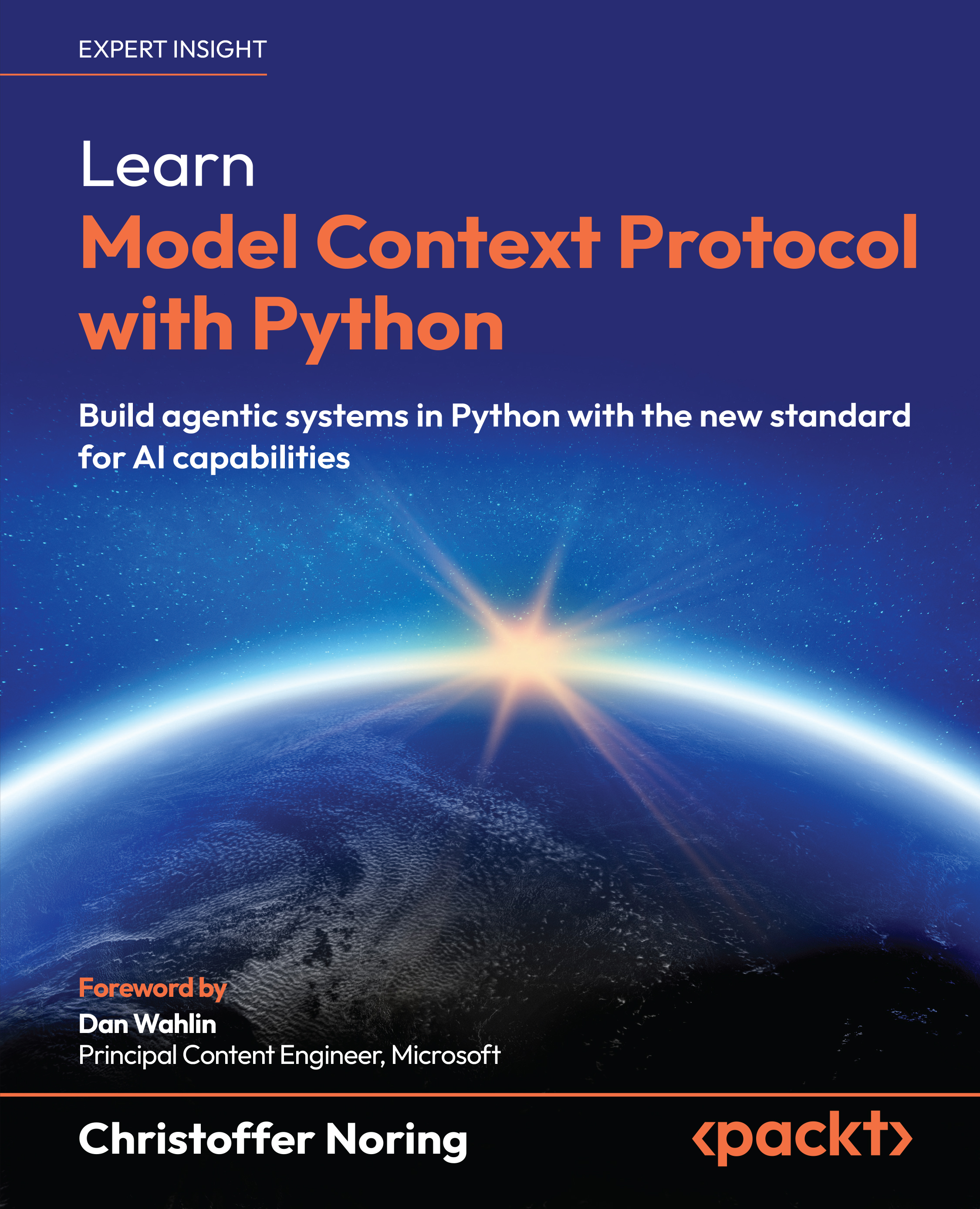
Learn Model Context Protocol with Python

Learn Model Context Protocol with Python: Build agentic systems in Python with the new standard for AI capabilities

Arrow left icon
Profile Icon Christoffer Noring
Arrow right icon
€24.29 €26.99
Full star icon Full star icon Full star icon Full star icon Half star icon 4.7 (3 Ratings)
eBook Oct 2025 304 pages 1st Edition
eBook
€24.29 €26.99
Paperback
€33.99
eBook + Subscription
€21.99 Monthly
Arrow left icon
Profile Icon Christoffer Noring
Arrow right icon
€24.29 €26.99
Full star icon Full star icon Full star icon Full star icon Half star icon 4.7 (3 Ratings)
eBook Oct 2025 304 pages 1st Edition
eBook
€24.29 €26.99
Paperback
€33.99
eBook + Subscription
€21.99 Monthly
eBook
€24.29 €26.99
Paperback
€33.99
eBook + Subscription
€21.99 Monthly

What do you get with eBook?

Product feature icon Instant access to your Digital eBook purchase
Product feature icon Download this book in EPUB and PDF formats
Product feature icon Access this title in our online reader with advanced features
Product feature icon DRM FREE - Read whenever, wherever and however you want
Product feature icon AI Assistant (beta) to help accelerate your learning
Modal Close icon
Payment Processing...
tick Completed

Billing Address

Key benefits

  • The only resource you'll need to build, test, and deploy MCP servers and clients
  • Take a modern approach toward building, testing, and securing distributed agentic AI apps
  • Get clear, professional guidance on developing for both LLM and non-LLM clients
  • Purchase of the print or Kindle book includes a free PDF eBook

Description

Learn Model Context Protocol with Python introduces developers, architects, and AI practitioners to the transformative capabilities of Model Context Protocol (MCP), an emerging protocol designed to standardize, distribute, and scale AI-driven applications. Through the lens of a practical project, the book tackles the modern challenges of resource management, client-server interaction, and deployment at scale. Drawing from Christoffer's expertise as a published author and tutor at the University of Oxford, you’ll explore the components of MCP and how they streamline server and client development. Next, you’ll progress from building robust backends and integrating LLMs into intelligent clients to interacting with servers via tools such as Claude for desktop and Visual Studio Code agents. The chapters help you understand how to describe the capabilities of hosts, clients, and servers, facilitating better interoperability, easier integration, and clearer communication between different components. The book also covers security best practices and building for the cloud, ensuring that you're ready to deploy your MCP-based apps. Each chapter enables you to develop hands-on skills for building and operating MCP-based agentic apps. The Python primer at the end rounds out the practical toolkit, making this book essential for any team building AI-native applications today.

Who is this book for?

This book is ideal for web developers, software architects, AI practitioners, and tech leads looking to build scalable AI-integrated applications using MCP. Product managers overseeing AI initiatives will also find this book valuable. A basic understanding of web development and AI concepts is needed to make the most of this book.

What you will learn

  • Understand the MCP protocol and its core components
  • Build MCP servers that expose tools and resources to a variety of clients
  • Test and debug servers using the interactive inspector tools
  • Consume servers using Claude Desktop and Visual Studio Code Agents
  • Secure MCP apps, as well as managing and mitigating common threats
  • Build and deploy MCP apps using cloud-based strategies

Product Details

Country selected
Publication date, Length, Edition, Language, ISBN-13
Publication date : Oct 27, 2025
Length: 304 pages
Edition : 1st
Language : English
ISBN-13 : 9781806103225
Category :
Languages :
Tools :

What do you get with eBook?

Product feature icon Instant access to your Digital eBook purchase
Product feature icon Download this book in EPUB and PDF formats
Product feature icon Access this title in our online reader with advanced features
Product feature icon DRM FREE - Read whenever, wherever and however you want
Product feature icon AI Assistant (beta) to help accelerate your learning
Modal Close icon
Payment Processing...
tick Completed

Billing Address

Product Details

Publication date : Oct 27, 2025
Length: 304 pages
Edition : 1st
Language : English
ISBN-13 : 9781806103225
Category :
Languages :
Tools :

Packt Subscriptions

See our plans and pricing
Modal Close icon
€18.99 billed monthly
Feature tick icon Unlimited access to Packt's library of 7,000+ practical books and videos
Feature tick icon Constantly refreshed with 50+ new titles a month
Feature tick icon Exclusive Early access to books as they're written
Feature tick icon Solve problems while you work with advanced search and reference features
Feature tick icon Offline reading on the mobile app
Feature tick icon Simple pricing, no contract
€189.99 billed annually
Feature tick icon Unlimited access to Packt's library of 7,000+ practical books and videos
Feature tick icon Constantly refreshed with 50+ new titles a month
Feature tick icon Exclusive Early access to books as they're written
Feature tick icon Solve problems while you work with advanced search and reference features
Feature tick icon Offline reading on the mobile app
Feature tick icon Choose a DRM-free eBook or Video every month to keep
Feature tick icon PLUS own as many other DRM-free eBooks or Videos as you like for just €5 each
Feature tick icon Exclusive print discounts
€264.99 billed in 18 months
Feature tick icon Unlimited access to Packt's library of 7,000+ practical books and videos
Feature tick icon Constantly refreshed with 50+ new titles a month
Feature tick icon Exclusive Early access to books as they're written
Feature tick icon Solve problems while you work with advanced search and reference features
Feature tick icon Offline reading on the mobile app
Feature tick icon Choose a DRM-free eBook or Video every month to keep
Feature tick icon PLUS own as many other DRM-free eBooks or Videos as you like for just €5 each
Feature tick icon Exclusive print discounts

Customer reviews

Rating distribution
Full star icon Full star icon Full star icon Full star icon Half star icon 4.7
(3 Ratings)
5 star 66.7%
4 star 33.3%
3 star 0%
2 star 0%
1 star 0%
Alfonso Cruz Feb 18, 2026
Full star icon Full star icon Full star icon Full star icon Full star icon 5
Feefo Verified review Feefo
Leszek Jul 08, 2026
Full star icon Full star icon Full star icon Full star icon Full star icon 5
Review of Learn Model Context Protocol with Python by Christoffer Noring Learn Model Context Protocol with Python, published by Packt, is one of the first books that attempts to organize the topic of MCP — Model Context Protocol — from the perspective of a Python developer. It is a practical guide to building agentic systems in Python using MCP, and it focuses less on abstract theory and more on implementation. The strongest aspect of the book is its hands-on approach. The author does not stop at explaining what MCP is. Instead, he guides the reader through building MCP servers, testing them, working with different transports, creating clients, integrating with tools such as Claude Desktop and VS Code agents, and thinking about sampling, elicitation, security, and production deployment. For someone who already knows Python, understands the basics of HTTP, JSON, command-line work, and has some interest in LLMs, RAG, or AI agents, this book can be a very useful starting point. It is not, however, a beginner’s introduction to artificial intelligence. It is better described as a book for a developer who wants to understand how to build MCP servers, expose tools to language models, and connect those servers with clients. A particularly valuable feature of the book is that it presents MCP not merely as a technical curiosity, but as an integration layer between language models, tools, resources, and prompts. This is important because MCP is becoming one of the key ways to structure interactions between LLM-based applications and external systems. The book therefore fits well into the broader context of modern agentic application development: not just sending prompts to a model, but designing an environment in which the model can safely and predictably use external capabilities. The main weakness of the book is not necessarily the author’s fault. MCP is a young and rapidly evolving standard, so parts of the book may age quickly. For example, the book discusses both SSE and Streamable HTTP, but the current direction of MCP development clearly favors Streamable HTTP for new implementations. This means that some chapters should be read with caution, especially when they concern transport mechanisms or implementation details that may have changed since publication. Another point worth noting is the Python version and tooling. Even if some examples may work with older Python versions, a reader starting today should use a modern Python environment — preferably Python 3.12 or newer, a virtual environment, and current versions of the MCP SDK. Reading the book while also checking the latest official MCP documentation and Python SDK repository is strongly recommended. The most useful chapters are likely to be those on building and testing servers, Streamable HTTP, advanced server design, client implementation, consuming MCP servers, and security. The chapters on production deployment and observability are also important, although a book of this size cannot fully exhaust topics such as authentication, authorization, auditability, prompt injection, tool isolation, and data-access control. Overall, I would rate the book 7.5 out of 10. I would recommend buying or reading it if you want a practical entry point into MCP with Python. I would not treat it as the final authority on the subject. The best way to use this book is to read a chapter, run the code, experiment with the examples, and then immediately compare the approach with the current official MCP specification and SDK documentation. For a reader interested in RAG, AI agents, developer tools, or private knowledge-base integrations, the book can be especially useful. The best reading order would be: first the basic concepts of the protocol, then STDIO and Streamable HTTP, then client implementation, and only later security and production deployment. The material on SSE is still worth reading, but mainly to understand older examples and compatibility issues rather than as the preferred approach for new projects. In summary, Learn Model Context Protocol with Python is a good practical introduction to MCP for Python developers. It is not a definitive textbook, and it should not be read in isolation. Its real value appears when it is used as a guided workshop alongside the official MCP documentation. If you plan to build your own MCP servers for RAG, automation, developer tooling, or integration with personal or enterprise data, this book is worth considering — especially if it is available through Packt Subscription or at a discounted price.
Feefo Verified review Feefo
N/A Jan 29, 2026
Full star icon Full star icon Full star icon Full star icon Empty star icon 4
“Good overall, but somewhat long-winded and unnecessarily elaborate.”
Feefo Verified review Feefo
Get free access to Packt library with over 7500+ books and video courses for 7 days!
Start Free Trial

FAQs

How do I buy and download an eBook? Chevron down icon Chevron up icon

Where there is an eBook version of a title available, you can buy it from the book details for that title. Add either the standalone eBook or the eBook and print book bundle to your shopping cart. Your eBook will show in your cart as a product on its own. After completing checkout and payment in the normal way, you will receive your receipt on the screen containing a link to a personalised PDF download file. This link will remain active for 30 days. You can download backup copies of the file by logging in to your account at any time.

If you already have Adobe reader installed, then clicking on the link will download and open the PDF file directly. If you don't, then save the PDF file on your machine and download the Reader to view it.

Please Note: Packt eBooks are non-returnable and non-refundable.

Packt eBook and Licensing When you buy an eBook from Packt Publishing, completing your purchase means you accept the terms of our licence agreement. Please read the full text of the agreement. In it we have tried to balance the need for the ebook to be usable for you the reader with our needs to protect the rights of us as Publishers and of our authors. In summary, the agreement says:

  • You may make copies of your eBook for your own use onto any machine
  • You may not pass copies of the eBook on to anyone else
How can I make a purchase on your website? Chevron down icon Chevron up icon

If you want to purchase a video course, eBook or Bundle (Print+eBook) please follow below steps:

  1. Register on our website using your email address and the password.
  2. Search for the title by name or ISBN using the search option.
  3. Select the title you want to purchase.
  4. Choose the format you wish to purchase the title in; if you order the Print Book, you get a free eBook copy of the same title. 
  5. Proceed with the checkout process (payment to be made using Credit Card, Debit Cart, or PayPal)
Where can I access support around an eBook? Chevron down icon Chevron up icon
  • If you experience a problem with using or installing Adobe Reader, the contact Adobe directly.
  • To view the errata for the book, see www.packtpub.com/support and view the pages for the title you have.
  • To view your account details or to download a new copy of the book go to www.packtpub.com/account
  • To contact us directly if a problem is not resolved, use www.packtpub.com/contact-us
What eBook formats do Packt support? Chevron down icon Chevron up icon

Our eBooks are currently available in a variety of formats such as PDF and ePubs. In the future, this may well change with trends and development in technology, but please note that our PDFs are not Adobe eBook Reader format, which has greater restrictions on security.

You will need to use Adobe Reader v9 or later in order to read Packt's PDF eBooks.

What are the benefits of eBooks? Chevron down icon Chevron up icon
  • You can get the information you need immediately
  • You can easily take them with you on a laptop
  • You can download them an unlimited number of times
  • You can print them out
  • They are copy-paste enabled
  • They are searchable
  • There is no password protection
  • They are lower price than print
  • They save resources and space
What is an eBook? Chevron down icon Chevron up icon

Packt eBooks are a complete electronic version of the print edition, available in PDF and ePub formats. Every piece of content down to the page numbering is the same. Because we save the costs of printing and shipping the book to you, we are able to offer eBooks at a lower cost than print editions.

When you have purchased an eBook, simply login to your account and click on the link in Your Download Area. We recommend you saving the file to your hard drive before opening it.

For optimal viewing of our eBooks, we recommend you download and install the free Adobe Reader version 9.

Modal Close icon
Modal Close icon