Search icon CANCEL
Subscription
0
Cart icon
Your Cart (0 item)
Close icon
You have no products in your basket yet
Save more on your purchases! discount-offer-chevron-icon
Savings automatically calculated. No voucher code required.
Arrow left icon
Explore Products
Best Sellers
New Releases
Books
Events
Videos
Audiobooks
Packt Hub
Free Learning
Arrow right icon
timer SALE ENDS IN
0 Days
:
00 Hours
:
00 Minutes
:
00 Seconds
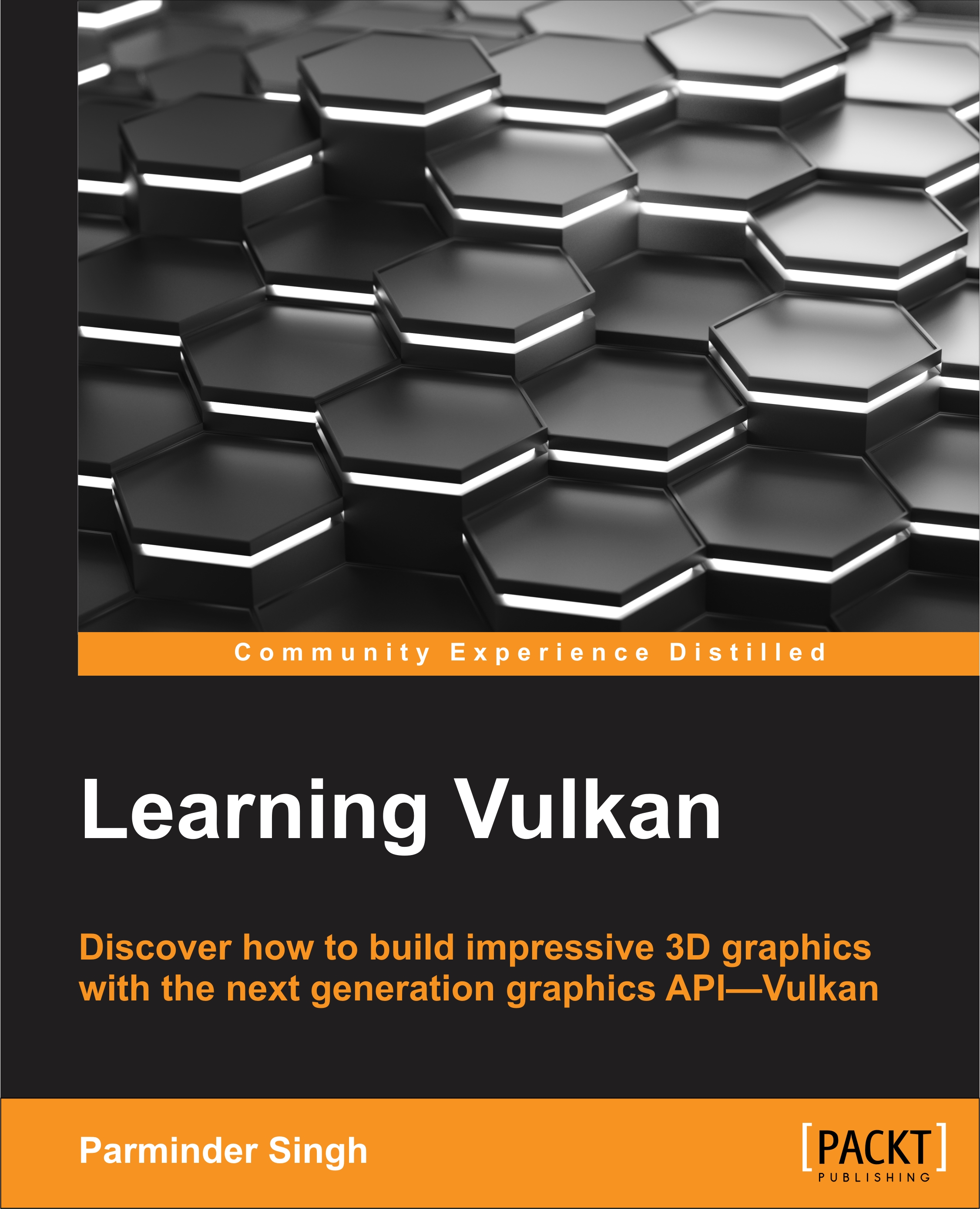
Learning Vulkan
Learning Vulkan

Learning Vulkan: Discover how to build impressive 3D graphics with the next-generation graphics API—Vulkan

eBook
$30.59 $33.99
Paperback
$41.99
Paperback + Subscription
$29.99 Monthly

What do you get with a Packt Premium Subscription?

Subscribe today for full access to all titles. After checkout, you’ll receive an eBook credit that you can manually redeem on any title — including this one.
Product feature icon Access to the largest independent learning library in tech. Access this title and thousands more!
Product feature icon Weekly additions on emerging tech and exclusive early access to books as they are being written.
Product feature icon Innovative learning tools, including AI book assistants, code context explainers, and text-to-speech.
Product feature icon A monthly credit and 50% off any future digital purchases.
Table of content icon View table of contents Preview book icon Preview Book

Learning Vulkan

Left arrow icon Right arrow icon
Download code icon Download Code

Key benefits

  • Get started with the Vulkan API and its programming techniques using the easy-to-follow examples to create stunning 3D graphics
  • Understand memory management in Vulkan and implement image and buffer resources
  • Get hands-on with the drawing process and synchronization, and render a 3D graphics scene with the Vulkan graphics pipeline

Description

Vulkan, the next generation graphics and compute API, is the latest offering by Khronos. This API is the successor of OpenGL and unlike OpenGL, it offers great flexibility and high performance capabilities to control modern GPU devices. With this book, you'll get great insights into the workings of Vulkan and how you can make stunning graphics run with minimum hardware requirements. We begin with a brief introduction to the Vulkan system and show you its distinct features with the successor to the OpenGL API. First, you will see how to establish a connection with hardware devices to query the available queues, memory types, and capabilities offered. Vulkan is verbose, so before diving deep into programing, you’ll get to grips with debugging techniques so even first-timers can overcome error traps using Vulkan’s layer and extension features. You’ll get a grip on command buffers and acquire the knowledge to record various operation commands into command buffer and submit it to a proper queue for GPU processing. We’ll take a detailed look at memory management and demonstrate the use of buffer and image resources to create drawing textures and image views for the presentation engine and vertex buffers to store geometry information. You'll get a brief overview of SPIR-V, the new way to manage shaders, and you'll define the drawing operations as a single unit of work in the Render pass with the help of attachments and subpasses. You'll also create frame buffers and build a solid graphics pipeline, as well as making use of the synchronizing mechanism to manage GPU and CPU hand-shaking. By the end, you’ll know everything you need to know to get your hands dirty with the coolest Graphics API on the block.

Who is this book for?

This book is ideal for graphic programmers who want to get up and running with Vulkan. It’s also great for programmers who have experience with OpenGL and other graphic APIs who want to take advantage of next generation APIs. A good knowledge of C/C++ is expected.

What you will learn

  • Implement device, command buffer and queues to get connected with the physical hardware
  • Get a grip on memory management to control host and device memory operations
  • Understand and implement buffer and image resource types in Vulkan
  • Define drawing operations in the Render pass and implement graphics pipeline
  • Learn the drawing process, manage resources with synchronization objects and render 3D scene output on screen with Swapchain
  • Bring realism to your rendered 3D scene with textures, and implement linear and optimal textures

Product Details

Country selected
Publication date, Length, Edition, Language, ISBN-13
Publication date : Dec 15, 2016
Length: 466 pages
Edition : 1st
Language : English
ISBN-13 : 9781786469809
Languages :
Tools :

What do you get with a Packt Premium Subscription?

Subscribe today for full access to all titles. After checkout, you’ll receive an eBook credit that you can manually redeem on any title — including this one.
Product feature icon Access to the largest independent learning library in tech. Access this title and thousands more!
Product feature icon Weekly additions on emerging tech and exclusive early access to books as they are being written.
Product feature icon Innovative learning tools, including AI book assistants, code context explainers, and text-to-speech.
Product feature icon A monthly credit and 50% off any future digital purchases.

Product Details

Publication date : Dec 15, 2016
Length: 466 pages
Edition : 1st
Language : English
ISBN-13 : 9781786469809
Languages :
Tools :

Packt Subscriptions

See our plans and pricing
Modal Close icon
$19.99 billed monthly
Feature tick icon Unlimited access to Packt's library of 7,000+ practical books and videos
Feature tick icon Constantly refreshed with 50+ new titles a month
Feature tick icon Exclusive Early access to books as they're written
Feature tick icon Solve problems while you work with advanced search and reference features
Feature tick icon Offline reading on the mobile app
Feature tick icon Simple pricing, no contract
$199.99 billed annually
Feature tick icon Unlimited access to Packt's library of 7,000+ practical books and videos
Feature tick icon Constantly refreshed with 50+ new titles a month
Feature tick icon Exclusive Early access to books as they're written
Feature tick icon Solve problems while you work with advanced search and reference features
Feature tick icon Offline reading on the mobile app
Feature tick icon Choose a DRM-free eBook or Video every month to keep
Feature tick icon PLUS own as many other DRM-free eBooks or Videos as you like for just $5 each
Feature tick icon Exclusive print discounts
$279.99 billed in 18 months
Feature tick icon Unlimited access to Packt's library of 7,000+ practical books and videos
Feature tick icon Constantly refreshed with 50+ new titles a month
Feature tick icon Exclusive Early access to books as they're written
Feature tick icon Solve problems while you work with advanced search and reference features
Feature tick icon Offline reading on the mobile app
Feature tick icon Choose a DRM-free eBook or Video every month to keep
Feature tick icon PLUS own as many other DRM-free eBooks or Videos as you like for just $5 each
Feature tick icon Exclusive print discounts

Frequently bought together


Stars icon
Total $ 134.97
Vulkan Cookbook
$41.99
Mastering Qt 5
$50.99
Learning Vulkan
$41.99
Total $ 134.97 Stars icon

Table of Contents

11 Chapters
1. Getting Started with the NextGen 3D Graphics API Chevron down icon Chevron up icon
2. Your First Vulkan Pseudo Program Chevron down icon Chevron up icon
3. Shaking Hands with the Device Chevron down icon Chevron up icon
4. Debugging in Vulkan Chevron down icon Chevron up icon
5. Command Buffer and Memory Management in Vulkan Chevron down icon Chevron up icon
6. Allocating Image Resources and Building a Swapchain with WSI Chevron down icon Chevron up icon
7. Buffer Resource, Render Pass, Framebuffer, and Shaders with SPIR-V Chevron down icon Chevron up icon
8. Pipelines and Pipeline State Management Chevron down icon Chevron up icon
9. Drawing Objects Chevron down icon Chevron up icon
10. Descriptors and Push Constant Chevron down icon Chevron up icon
11. Drawing Textures Chevron down icon Chevron up icon

Customer reviews

Top Reviews
Rating distribution
Full star icon Full star icon Half star icon Empty star icon Empty star icon 2.9
(12 Ratings)
5 star 33.3%
4 star 8.3%
3 star 8.3%
2 star 16.7%
1 star 33.3%
Filter icon Filter
Top Reviews

Filter reviews by


Amazon Customer Feb 20, 2017
Full star icon Full star icon Full star icon Full star icon Full star icon 5
A very good, informative and easy to approach book for a beginner. Just finished reading it and learnt a lot.
Amazon Verified review Amazon
Hurricane san Jan 02, 2017
Full star icon Full star icon Full star icon Full star icon Full star icon 5
This the best book on Vulkan so far, in my opinion of course. I felt my understanding on Vulkan improving a lot reading this. (Before this I had the Vulkan Programming Guide that for some reason felt like barely an improvement over the public API documents).It may help you too.
Amazon Verified review Amazon
Cliente Amazon Jun 02, 2020
Full star icon Full star icon Full star icon Full star icon Full star icon 5
Perfect book to start to learn Vulkan.
Amazon Verified review Amazon
cybereality Mar 02, 2017
Full star icon Full star icon Full star icon Full star icon Full star icon 5
Learning Vulkan by Parminder Singh is an excellent foray into the Vulkan graphics API and quite a competent book. The text is a reasonable 466 pages, and packs a lot in there. Singh covers all the basics of using Vulkan and goes into great detail at each step of the way. Not only is there actual C++ code shown (a lot of it), but he explains each API call and what objects to pass it, a breakdown of each object structure and what it does, what’s valid (or invalid) for data you can put in, and so forth. I have not read the official Vulkan Programming Guide yet (that’s coming next) so I’m not able to compare them here. However, this book is an absolute treasure trove of information, and presented with clear context, not just a copy and paste of API docs.While the book is not particularly long, the author does manage to cover a good amount of ground. Of the topics included are: getting started with the LunarG SDK, initializing the API, debugging, command buffers and memory management, allocating image resources and the swapchain, buffers, render passes, framebuffers, working with SPIR-V shaders, pipelines and pipeline state management, descriptors and push constants, and finally drawing a textured polygon. I’m still getting acquainted with Vulkan myself, but this does seem to touch on all the fundamental topics to get started with the API. It really seems like Parminder Singh knows what he is talking about and feel I learned a lot finishing this text.One thing to keep in mind, this is not really a book about graphics programming techniques, but rather a survey of the API. Meaning, unlike Frank Luna’s DirectX books, you won’t have any cool demos to showcase at the end. Through the whole book you’re basically just working with the initialization of the Vulkan API, though you do end up with a colored triangle and finally a textured cube. This is honestly fine, and just what is needed at this point in the life of Vulkan. Flashy demos are cool, sure, but once you have the fundamentals down, it shouldn’t be hard to apply that knowledge, or port techniques from other APIs.I will note, however, that I wish there was more discussion into the performance cost or characteristics of parts of the Vulkan API. For example, sometimes there are multiple ways to perform an action (like with uniform buffers or push constants getting data into a shader) and there wasn’t much explanation as to when to do one thing over the other. This is not a huge concern, as there are lots of articles online covering these types of things and it seems the book is there to get you familiar with the concepts and data structures to allow you to do your own research later. Certainly, I still have a lot of questions but I can’t imagine a more thorough book as an introduction to this relatively new API.Some familiarity with older graphics APIs will probably help, but I don’t think it’s absolutely needed. In my opinion, if you are wanting to learn graphics programming today, you might as well just jump into Vulkan (or DirectX12, if you prefer) as the industry will quickly adopt these new, lower-level APIs and you will be setting yourself up for the future. Do understand, though, that Vulkan is extremely verbose and needs something like 1,000 lines of code just to get a triangle on the screen. So stark beginners may be put off by that complexity. And you should definitely have good working knowledge of C++ before getting into this. With that in mind, however, I think that Learning Vulkan by Parminder Singh is a great place to start to delve into this exciting new world of Vulkan. Well worth reading.
Amazon Verified review Amazon
David Eberly May 19, 2026
Full star icon Full star icon Full star icon Full star icon Empty star icon 4
The author talks more about syntax, less about semantics. I found that your book Mastering Graphics Programming with Vulkan more advanced and helpful.
Feefo Verified review Feefo
Get free access to Packt library with over 7500+ books and video courses for 7 days!
Start Free Trial

FAQs

What is included in a Packt Premium subscription? Chevron down icon Chevron up icon

A subscription provides you with full access to view all Packt and licnesed content online, this includes exclusive access to Early Access titles. Depending on the tier chosen you can also earn credits and discounts to use for owning content

What are credits? Chevron down icon Chevron up icon

Credits can be used to buy books DRM free, the same way that you would pay for a book. Your credits can be found in the subscription homepage - subscription.packtpub.com - clicking on ‘the my’ library dropdown and selecting ‘credits’. You'll get one to use immediately after checkout, and then every time you renew. You require an active subscription to use your credits, once used you keep the title forever.

How can I cancel my subscription? Chevron down icon Chevron up icon

To cancel your subscription with us simply go to the account page - found in the top right of the page or at https://subscription.packtpub.com/my-account/subscription - From here you will see the ‘cancel subscription’ button in the grey box with your subscription information in. You can cancel at anytime, you will keep access for the remaining period you have paid for. On the date of cancellation you will lose all access to online content, along with any unused credits.

What happens if an Early Access Course is cancelled? Chevron down icon Chevron up icon

Projects are rarely cancelled, but sometimes it's unavoidable. If an Early Access course is cancelled or excessively delayed, you can exchange your purchase for another course. For further details, please contact us here.

Where can I send feedback about an Early Access title? Chevron down icon Chevron up icon

If you have any feedback about the product you're reading, or Early Access in general, then please fill out a contact form here and we'll make sure the feedback gets to the right team. 

Can I download the code files for Early Access titles? Chevron down icon Chevron up icon

We try to ensure that all books in Early Access have code available to use, download, and fork on GitHub. This helps us be more agile in the development of the book, and helps keep the often changing code base of new versions and new technologies as up to date as possible. Unfortunately, however, there will be rare cases when it is not possible for us to have downloadable code samples available until publication.

When we publish the book, the code files will also be available to download from the Packt website.

How accurate is the publication date? Chevron down icon Chevron up icon

The publication date is as accurate as we can be at any point in the project. Unfortunately, delays can happen. Often those delays are out of our control, such as changes to the technology code base or delays in the tech release. We do our best to give you an accurate estimate of the publication date at any given time, and as more chapters are delivered, the more accurate the delivery date will become.

How will I know when new chapters are ready? Chevron down icon Chevron up icon

We'll let you know every time there has been an update to a course that you've bought in Early Access. You'll get an email to let you know there has been a new chapter, or a change to a previous chapter. The new chapters are automatically added to your account, so you can also check back there any time you're ready and download or read them online.

I am a Packt subscriber, do I get Early Access? Chevron down icon Chevron up icon

Yes, all Early Access content is fully available through your subscription. You will need to have a paid for or active trial subscription in order to access all titles.

How is Early Access delivered? Chevron down icon Chevron up icon

Early Access is currently only available as a PDF or through our online reader. As we make changes or add new chapters, the files in your Packt account will be updated so you can download them again or view them online immediately.

How do I buy Early Access content? Chevron down icon Chevron up icon

Early Access is a way of us getting our content to you quicker, but the method of buying the Early Access course is still the same. Just find the course you want to buy, go through the check-out steps, and you’ll get a confirmation email from us with information and a link to the relevant Early Access courses.

What is Early Access? Chevron down icon Chevron up icon

Keeping up to date with the latest technology is difficult; new versions, new frameworks, new techniques. This feature gives you a head-start to our content, as it's being created. With Early Access you'll receive each chapter as it's written, and get regular updates throughout the product's development, as well as the final course as soon as it's ready.We created Early Access as a means of giving you the information you need, as soon as it's available. As we go through the process of developing a course, 99% of it can be ready but we can't publish until that last 1% falls in to place. Early Access helps to unlock the potential of our content early, to help you start your learning when you need it most. You not only get access to every chapter as it's delivered, edited, and updated, but you'll also get the finalized, DRM-free product to download in any format you want when it's published. As a member of Packt, you'll also be eligible for our exclusive offers, including a free course every day, and discounts on new and popular titles.

Modal Close icon
Modal Close icon