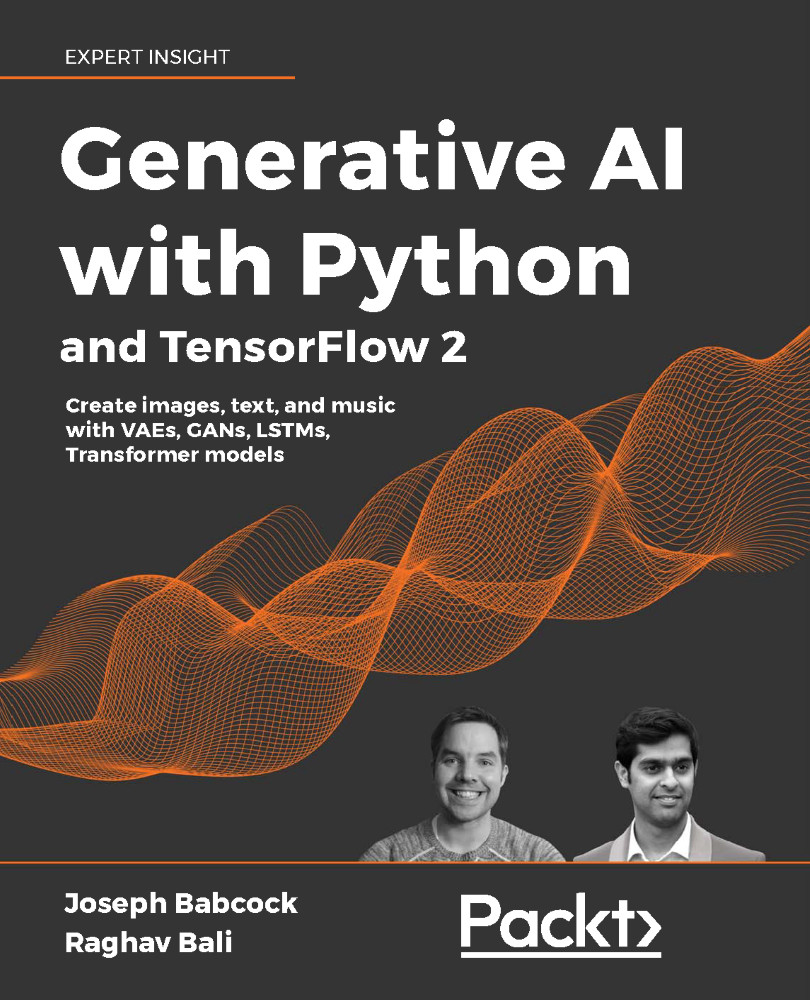
Code examples are in TensorFlow 2, which make it easy for PyTorch users to follow along
Look inside the most famous deep generative models, from GPT to MuseGAN
Learn to build and adapt your own models in TensorFlow 2.x
Explore exciting, cutting-edge use cases for deep generative AI
Description
Machines are excelling at creative human skills such as painting, writing, and composing music. Could you be more creative than generative AI?
In this book, you’ll explore the evolution of generative models, from restricted Boltzmann machines and deep belief networks to VAEs and GANs. You’ll learn how to implement models yourself in TensorFlow and get to grips with the latest research on deep neural networks.
There’s been an explosion in potential use cases for generative models. You’ll look at Open AI’s news generator, deepfakes, and training deep learning agents to navigate a simulated environment.
Recreate the code that’s under the hood and uncover surprising links between text, image, and music generation.
Who is this book for?
This is a book for Python programmers who are keen to create and have some fun using generative models. To make the most out of this book, you should have a basic familiarity with math and statistics for machine learning.
What you will learn
Export the code from GitHub into Google Colab to see how everything works for yourself
Compose music using LSTM models, simple GANs, and MuseGAN
Create deepfakes using facial landmarks, autoencoders, and pix2pix GAN
Learn how attention and transformers have changed NLP
Build several text generation pipelines based on LSTMs, BERT, and GPT-2
Implement paired and unpaired style transfer with networks like StyleGAN
Discover emerging applications of generative AI like folding proteins and creating videos from images
This book is a masterpiece! As someone actively working in AI, I can confidently say Generative AI with Python and PyTorch (Second Edition) is one of the most comprehensive and engaging resources on the subject. Whether you're exploring generative models for the first time or looking to deepen your expertise in LLMs, VAEs, GANs, or diffusion models, this book delivers with clarity, hands-on depth, and authority.
Joseph Babcock and Raghav Bali do an outstanding job of walking readers through the foundational concepts of generative AI—from the math of probability and Bayes’ theorem to the latest advancements in large language models (LLMs) and Stable Diffusion. Each chapter builds logically on the previous one, with lucid explanations and real-world code examples using PyTorch and Hugging Face that make even complex topics approachable.
Feefo Verified review
About the authors
Joseph Babcock
Joseph Babcock
Joseph Babcock has spent over a decade working with big data and AI in the e-commerce, digital streaming, and quantitative finance domains. Throughout his career, he has worked on recommender systems, petabyte-scale cloud data pipelines, A/B testing, causal inference, and time series analysis. He completed his PhD studies at Johns Hopkins University, applying machine learning to drug discovery and genomics.
Raghav Bali is a Staff Data Scientist at Delivery Hero, a leading food delivery service headquartered in Berlin, Germany. With 12+ years of expertise, he specializes in research and development of enterprise-level solutions leveraging Machine Learning, Deep Learning, Natural Language Processing, and Recommendation Engines for practical business applications.
Besides his professional endeavors, Raghav is an esteemed mentor and an accomplished public speaker. He has contributed to multiple peer-reviewed papers and authored multiple well received books. Additionally, he holds co-inventor credits on multiple patents in healthcare, machine learning, deep learning, and natural language processing.
Where there is an eBook version of a title available, you can buy it from the book details for that title. Add either the standalone eBook or the eBook and print book bundle to your shopping cart. Your eBook will show in your cart as a product on its own. After completing checkout and payment in the normal way, you will receive your receipt on the screen containing a link to a personalised PDF download file. This link will remain active for 30 days. You can download backup copies of the file by logging in to your account at any time.
If you already have Adobe reader installed, then clicking on the link will download and open the PDF file directly. If you don't, then save the PDF file on your machine and download the Reader to view it.
Please Note: Packt eBooks are non-returnable and non-refundable.
Packt eBook and Licensing When you buy an eBook from Packt Publishing, completing your purchase means you accept the terms of our licence agreement. Please read the full text of the agreement. In it we have tried to balance the need for the ebook to be usable for you the reader with our needs to protect the rights of us as Publishers and of our authors. In summary, the agreement says:
You may make copies of your eBook for your own use onto any machine
You may not pass copies of the eBook on to anyone else
How can I make a purchase on your website?
If you want to purchase a video course, eBook or Bundle (Print+eBook) please follow below steps:
Register on our website using your email address and the password.
Search for the title by name or ISBN using the search option.
Select the title you want to purchase.
Choose the format you wish to purchase the title in; if you order the Print Book, you get a free eBook copy of the same title.
Proceed with the checkout process (payment to be made using Credit Card, Debit Cart, or PayPal)
Where can I access support around an eBook?
If you experience a problem with using or installing Adobe Reader, the contact Adobe directly.
To view the errata for the book, see www.packtpub.com/support and view the pages for the title you have.
To view your account details or to download a new copy of the book go to www.packtpub.com/account
Our eBooks are currently available in a variety of formats such as PDF and ePubs. In the future, this may well change with trends and development in technology, but please note that our PDFs are not Adobe eBook Reader format, which has greater restrictions on security.
You will need to use Adobe Reader v9 or later in order to read Packt's PDF eBooks.
What are the benefits of eBooks?
You can get the information you need immediately
You can easily take them with you on a laptop
You can download them an unlimited number of times
You can print them out
They are copy-paste enabled
They are searchable
There is no password protection
They are lower price than print
They save resources and space
What is an eBook?
Packt eBooks are a complete electronic version of the print edition, available in PDF and ePub formats. Every piece of content down to the page numbering is the same. Because we save the costs of printing and shipping the book to you, we are able to offer eBooks at a lower cost than print editions.
When you have purchased an eBook, simply login to your account and click on the link in Your Download Area. We recommend you saving the file to your hard drive before opening it.
For optimal viewing of our eBooks, we recommend you download and install the free Adobe Reader version 9.