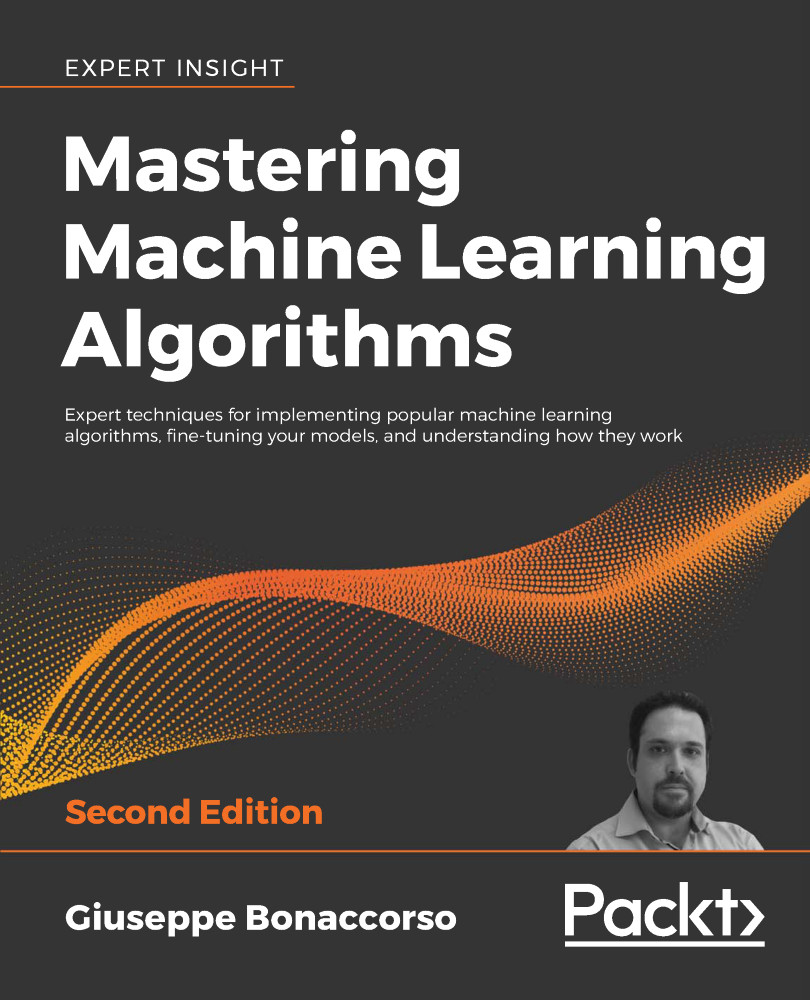
Mastering Machine Learning Algorithms: Expert techniques for implementing popular machine learning algorithms, fine-tuning your models, and understanding how they work
, Second Edition
New coverage of regression analysis, time series analysis, deep learning models, and cutting-edge applications
Description
Mastering Machine Learning Algorithms, Second Edition helps you harness the real power of machine learning algorithms in order to implement smarter ways of meeting today's overwhelming data needs. This newly updated and revised guide will help you master algorithms used widely in semi-supervised learning, reinforcement learning, supervised learning, and unsupervised learning domains.
You will use all the modern libraries from the Python ecosystem – including NumPy and Keras – to extract features from varied complexities of data. Ranging from Bayesian models to the Markov chain Monte Carlo algorithm to Hidden Markov models, this machine learning book teaches you how to extract features from your dataset, perform complex dimensionality reduction, and train supervised and semi-supervised models by making use of Python-based libraries such as scikit-learn. You will also discover practical applications for complex techniques such as maximum likelihood estimation, Hebbian learning, and ensemble learning, and how to use TensorFlow 2.x to train effective deep neural networks.
By the end of this book, you will be ready to implement and solve end-to-end machine learning problems and use case scenarios.
Who is this book for?
This book is for data science professionals who want to delve into complex ML algorithms to understand how various machine learning models can be built. Knowledge of Python programming is required.
What you will learn
Understand the characteristics of a machine learning algorithm
Implement algorithms from supervised, semi-supervised, unsupervised, and RL domains
Learn how regression works in time-series analysis and risk prediction
Create, model, and train complex probabilistic models
Cluster high-dimensional data and evaluate model accuracy
Discover how artificial neural networks work – train, optimize, and validate them
Work with autoencoders, Hebbian networks, and GANs
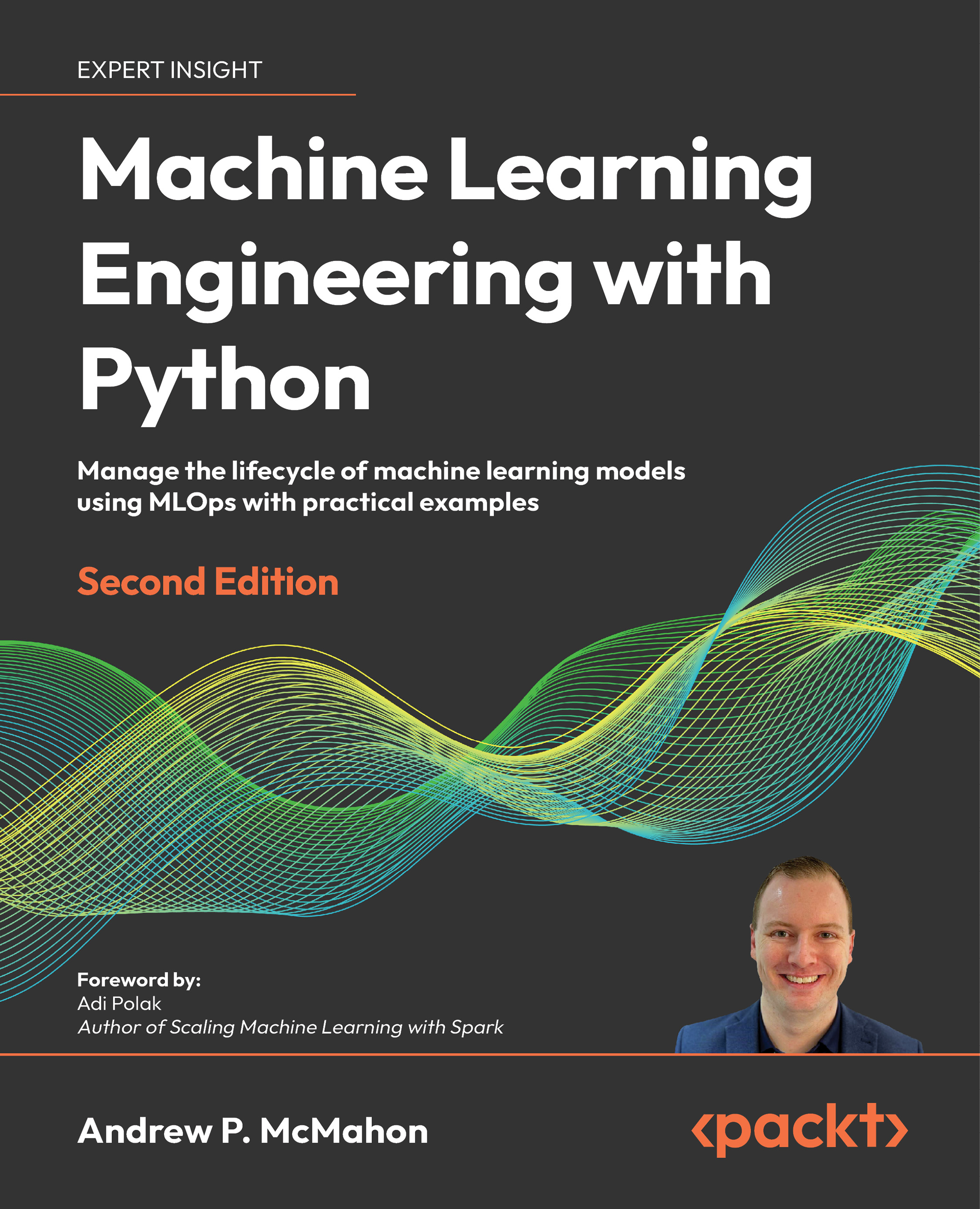
The book covers a lot of methods, as can be seen in the table of contents. This provides a nice breadth. What is really nice, is that before getting into any of the methods, the author starts with a chapter on ML Model Fundamentals. In this chapter, he presents not just the how's but also the why's of scaling data before modeling. He also talks about model capacity, bias and variance of an estimator, and how these relate to under or over fitting a model. Recently, I have heard two things during presentations: 1) "I won't go over scaling, because I think we all know when to apply these transformations" 2) "I don't even know what you're talking about" when asked about a bias/variance trade-off. I think it's great to have the opportunity to read a practitioner's explanation of these matters. He also talks about the options for splitting a data set into portions: 1) training, validation, and test portions, or 2) just into training and test portions, or 3) using a cross-validation approach. I have taken an ML class on Coursera where the first option was used, and the others weren't mentioned. It's nice to see all three here. He helps the reader by noting that some topics he's introducing will be discussed in more detail in the next few chapters. That's nice because questions start arising in your head, and then you read that and know there's more detail and answers coming, so just relax, and look forward.There are nice plots and Python code snippets throughout. It's helpful that each chapter ends with a summary and list of references.A lot of times we hear "supervised" or "unsupervised". It's nice that the book has three chapters on "semi-supervised" learning. In the Graph-Based Semi-Supervised Learning chapter, there is a "t-distributed stochastic neighbor embedding" (t-SNE) example, which is a topic I was curious about.
Amazon Verified review
Alfred H.Mar 06, 2020
5
I look at algorithms like appliances in a department store. Each has a particular use-case and purpose. For instance, depending on your individual needs while shopping for appliances most often stop to glance at the specs then at the cost to see if a particular unit suits their needs.Few ever think to build the appliance from scratch but rather by one already made to serve their needs progressively adopting it as an augmentation to everyday life. Even easier is when these items can be cataloged in one place, shopped, and put into use immediately (think Sears catalog of 1888). In its first catalog, Sears sold jewelry and watches. The directories grew in popularity, and with time different products were added and tested, even whole houses!While algorithms are not a new thing, thanks to the father of algebra: Abdullah Muhammad bin Musa al-Khwarizmi, it should NOT be challenging to catalog them. This book one of the best, like it, does that facilitating faster solutioning to get to the point of solving problems using built appliances (machine intelligence: algorithms).
Amazon Verified review
Thom Ives, Ph.D.May 26, 2020
5
Our exciting field of data science (DS) is exploding, and it’s hard to keep up with all of it. We each become extremely focused on our specific work in our current roles, and we are each funneled into specialized areas to solve specific challenges. After a long battle to deliver your great DS tool to production, your next challenge arrives. It seems this problem will require a DS method that you haven’t used since college. Maybe you’re not even sure, which DS method will best address your problem. Regardless, once you decide on a method of modeling, you have limited time to master it. You still need to collect, refine, and condition your data for that method. You must also master how to fight through the training of your chosen model. You’d seek help from your fellow DS’s, but they’re in the situation you just left.Now enters Giuseppe Bonaccorso - a DS friend with a corpus of DS methods that provide adequate mathematical overviews, explanations, and python code applied to substantial examples to get you up to speed quickly. I believe in keeping multiple sources at hand for learning / reviewing any methods. In that spirit, I'm relieved to have Giuseppe's book in my library. In a mere 750+ pages, he takes you on a tour of important methods that, while they won't make you an expert in the foundational mathematics for each method, they won't leave you blind in those respects either. I especially appreciate the references to foundational papers for each method following every group of methods for when we might need or want to go deeper. If you estimate that your library could be enhanced by such a substantial book as I've described, I believe you'd be well benefited by Giuseppe's book. He even manages to provide a good review of reinforced learning that, in my opinion, is extremely challenging to teach clearly.An important note is that this book does not cover natural language processing. In my experience, NLP would require another 750+ pages if it were to be covered as well as the methods that Giuseppe has covered. However, this is the only major field that he skips, and he does relate areas of that field to the techniques that he covers.
Amazon Verified review
TD59Jun 13, 2021
5
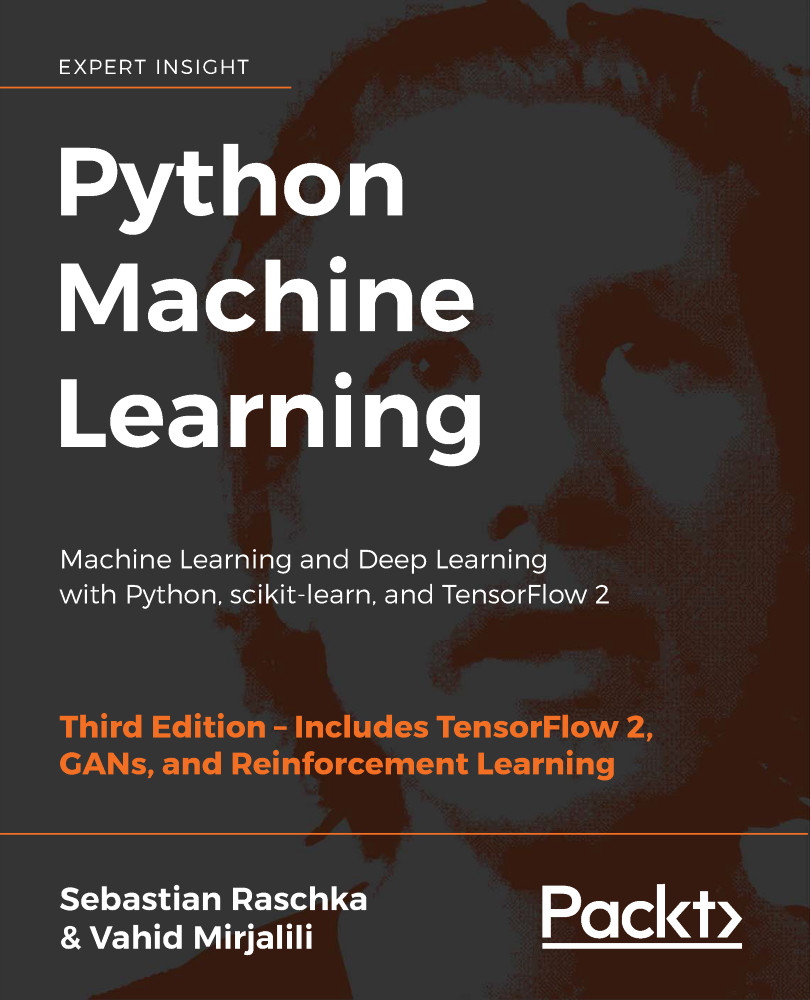
I have used this book (1st and 2nd edition) in my Machine Learning class for a couple of years. Together with the Raschka and Mirjalili book (Python Machine Learning), Bonnacorso's provides a solid foundation for understanding the key algorithms, how they work, and how to fine-tune them. Both amanuals re required in my class and my students have only had positive feedback about both books. They are complementary as Bonnacorso does not cover some topics such as Natural Language Processing compared with Raschka, for instance.
Amazon Verified review
Duubar VillalobosFeb 19, 2020
5
As Giuseppe Bonaccorso expresses in this book, "It's always possible to join scientific rigor with an artistic approach." This book offers a great resource to dust off those concepts for the advance practitioners or to learn the fundamentals for those willing to master their ML algorithms artistically.I've been reading this book for over a week by now, and I like how Giuseppe explains important theoretical concepts related to machine learning models, bias, variance, overfitting, underfitting, data normalization, scaling, and so on.Even though this book requires a solid knowledge of essential machine learning topics and familiarity with Python programming language, don't be discouraged. I found out that this book provides the best first-hand experiential advice that someone can provide for someone willing to learn. Moreover, given the complexity of some subjects, proper mathematical training is desirable, but the willingness to learn outweighs it.If you are looking to get great advice and insights from an expert, this book is for you. My recommendation is not to rush over the concepts. As I am reading --still not finished since it's 800 pages, it makes me reflect on my problem-solving styles and helps me identify areas of opportunity for improvement.I have to thank Giuseppe for taking his time to think, sort his thoughts, write, and for sharing his knowledge and experiences for us to become better practitioners.
Giuseppe Bonaccorso is an experienced manager in the fields of AI, data science, and machine learning. He has been involved in solution design, management, and delivery in different business contexts. He got his M.Sc.Eng in electronics in 2005 from the University of Catania, Italy, and continued his studies at the University of Rome Tor Vergata, Italy, and the University of Essex, UK. His main interests include machine/deep learning, reinforcement learning, big data, bio-inspired adaptive systems, neuroscience, and natural language processing.
Where there is an eBook version of a title available, you can buy it from the book details for that title. Add either the standalone eBook or the eBook and print book bundle to your shopping cart. Your eBook will show in your cart as a product on its own. After completing checkout and payment in the normal way, you will receive your receipt on the screen containing a link to a personalised PDF download file. This link will remain active for 30 days. You can download backup copies of the file by logging in to your account at any time.
If you already have Adobe reader installed, then clicking on the link will download and open the PDF file directly. If you don't, then save the PDF file on your machine and download the Reader to view it.
Please Note: Packt eBooks are non-returnable and non-refundable.
Packt eBook and Licensing When you buy an eBook from Packt Publishing, completing your purchase means you accept the terms of our licence agreement. Please read the full text of the agreement. In it we have tried to balance the need for the ebook to be usable for you the reader with our needs to protect the rights of us as Publishers and of our authors. In summary, the agreement says:
You may make copies of your eBook for your own use onto any machine
You may not pass copies of the eBook on to anyone else
How can I make a purchase on your website?
If you want to purchase a video course, eBook or Bundle (Print+eBook) please follow below steps:
Register on our website using your email address and the password.
Search for the title by name or ISBN using the search option.
Select the title you want to purchase.
Choose the format you wish to purchase the title in; if you order the Print Book, you get a free eBook copy of the same title.
Proceed with the checkout process (payment to be made using Credit Card, Debit Cart, or PayPal)
Where can I access support around an eBook?
If you experience a problem with using or installing Adobe Reader, the contact Adobe directly.
To view the errata for the book, see www.packtpub.com/support and view the pages for the title you have.
To view your account details or to download a new copy of the book go to www.packtpub.com/account
Our eBooks are currently available in a variety of formats such as PDF and ePubs. In the future, this may well change with trends and development in technology, but please note that our PDFs are not Adobe eBook Reader format, which has greater restrictions on security.
You will need to use Adobe Reader v9 or later in order to read Packt's PDF eBooks.
What are the benefits of eBooks?
You can get the information you need immediately
You can easily take them with you on a laptop
You can download them an unlimited number of times
You can print them out
They are copy-paste enabled
They are searchable
There is no password protection
They are lower price than print
They save resources and space
What is an eBook?
Packt eBooks are a complete electronic version of the print edition, available in PDF and ePub formats. Every piece of content down to the page numbering is the same. Because we save the costs of printing and shipping the book to you, we are able to offer eBooks at a lower cost than print editions.
When you have purchased an eBook, simply login to your account and click on the link in Your Download Area. We recommend you saving the file to your hard drive before opening it.
For optimal viewing of our eBooks, we recommend you download and install the free Adobe Reader version 9.


 United States

 Great Britain
 India
India
 Germany
 France
 Canada
 Russia
 Spain
Spain
 Brazil
 Australia
 Singapore
 Canary Islands
 Hungary
 Ukraine
 Luxembourg
 Estonia
 Lithuania
 South Korea
 Turkey
 Switzerland
 Colombia
 Taiwan
 Chile
Chile
 Norway
 Ecuador
 Indonesia
 New Zealand
 Cyprus
 Denmark
 Finland
 Poland
 Malta
Malta
 Czechia
 Austria
 Sweden
 Italy
Italy
 Egypt
Egypt
 Belgium
 Portugal
 Slovenia
 Ireland
 Romania
 Greece
 Argentina
 Netherlands
 Bulgaria
 Latvia
 South Africa
 Malaysia
 Japan
Japan
 Slovakia
 Philippines
 Mexico
 Thailand








 Filter