Search icon CANCEL
Subscription
0
Cart icon
Your Cart (0 item)
Close icon
You have no products in your basket yet
Save more on your purchases! discount-offer-chevron-icon
Savings automatically calculated. No voucher code required.
Arrow left icon
Explore Products
Best Sellers
New Releases
Books
Videos
Audiobooks
Learning Hub
Newsletter Hub
Free Learning
Arrow right icon
timer SALE ENDS IN
0 Days
:
00 Hours
:
00 Minutes
:
00 Seconds
Arrow up icon
GO TO TOP
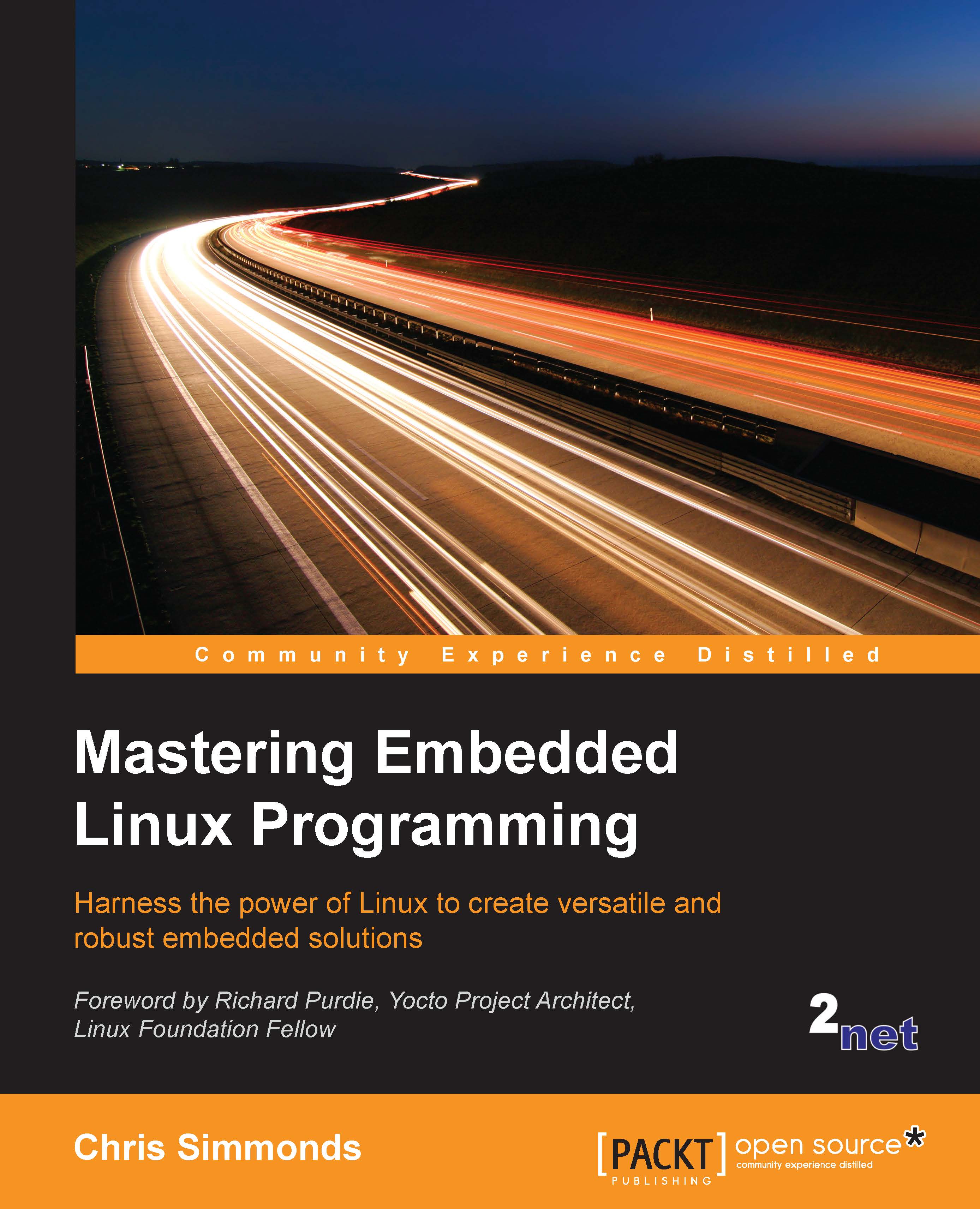
Mastering Embedded Linux Programming

You're reading from   Mastering Embedded Linux Programming Harness the power of Linux to create versatile and robust embedded solutions

Arrow left icon
Product type Paperback
Published in Dec 2015
Publisher Packt
ISBN-13 9781784392536
Length 418 pages
Edition 1st Edition
Tools
Arrow right icon
Author (1):
Arrow left icon
Chris Simmonds Chris Simmonds
Author Profile Icon Chris Simmonds
Chris Simmonds
Arrow right icon
View More author details
Toc

Table of Contents (16) Chapters Close

Preface 1. Starting Out FREE CHAPTER 2. Learning About Toolchains 3. All About Bootloaders 4. Porting and Configuring the Kernel 5. Building a Root Filesystem 6. Selecting a Build System 7. Creating a Storage Strategy 8. Introducing Device Drivers 9. Starting up - the init Program 10. Learning About Processes and Threads 11. Managing Memory 12. Debugging with GDB 13. Profiling and Tracing 14. Real-time Programming Index

Summary

The term real-time is meaningless unless you qualify it with a deadline and an acceptable miss rate. When you know that you can determine whether or not Linux is a suitable candidate for the operating system and, if so, begin to tune your system to meet the requirements. Tuning Linux and your application to handle real-time events means making it more deterministic so that it can process data reliably inside deadlines. Determinism usually comes at the price of total throughput so a real-time system is not going to be able to process as much data as a non-real-time system.

It is not possible to provide mathematical proof that a complex operating system like Linux will always meet a given deadline, so the only approach is through extensive testing using tools such as cyclictest and Ftrace, and, more importantly, using your own benchmarks for your own application.

To improve determinism, you need to consider both the application and the kernel. When writing real-time applications, you...

lock icon The rest of the chapter is locked

Subscribe to access the full title

Advance your knowledge in tech

A Packt subscription gives you instant online access to our library of over 8,000 practical eBooks and videos, constantly updated with the latest in tech
Register for a free Packt account to unlock a world of extra content!
A free Packt account unlocks extra newsletters, articles, discounted offers, and much more. Start advancing your knowledge today.
Unlock this book and the full library FREE for 7 days
Get unlimited access to 7000+ expert-authored eBooks and videos courses covering every tech area you can think of
Renews at €18.99/month. Cancel anytime
Modal Close icon
Modal Close icon