Search icon CANCEL
Subscription
0
Cart icon
Your Cart (0 item)
Close icon
You have no products in your basket yet
Save more on your purchases! discount-offer-chevron-icon
Savings automatically calculated. No voucher code required.
Arrow left icon
Explore Products
Best Sellers
New Releases
Books
Videos
Audiobooks
Learning Hub
Newsletter Hub
Free Learning
Arrow right icon
timer SALE ENDS IN
0 Days
:
00 Hours
:
00 Minutes
:
00 Seconds
Arrow up icon
GO TO TOP
Learning OpenCV 3 Computer Vision with Python (Update)

You're reading from   Learning OpenCV 3 Computer Vision with Python (Update) Unleash the power of computer vision with Python using OpenCV

Arrow left icon
Product type Hardcover
Published in Jun 2026
Publisher
ISBN-13 9781803230221
Length
Edition 1st Edition
Languages
Tools
Arrow right icon
Authors (2):
Arrow left icon
Joe Minichino Joe Minichino
Author Profile Icon Joe Minichino
Joe Minichino
Joseph Howse Joseph Howse
Author Profile Icon Joseph Howse
Joseph Howse
Arrow right icon
View More author details
Toc

Table of Contents (12) Chapters Close

1. Learning OpenCV 5 Computer Vision with Python, Fourth Edition: Tackle tools, techniques, and algorithms for computer vision and machine learning FREE CHAPTER
2. Setting Up OpenCV 3. Handling Files, Cameras, and GUIs 4. Processing Images with OpenCV 5. Detecting and Recognizing Faces 6. Retrieving Images and Searching Using Image Descriptors 7. Building Custom Object Detectors 8. Tracking Objects 9. Camera Models and Augmented Reality 10. Introduction to Neural Networks with OpenCV 11. OpenCV Applications at Scale Appendix A: Bending Color Space with the Curves Filter

Understanding SVMs

Without going into details of how an SVM works, let's just try to grasp what it can help us accomplish in the context of machine learning and computer vision. Given labeled training data, an SVM learns to classify the same kind of data by finding an optimal hyperplane, which, in plain English, is the plane that divides differently labeled data by the largest possible margin. To aid our understanding, let's consider the following diagram, which is provided by Zach Weinberg under the Creative Commons Attribution-Share Alike 3.0 Unported License:
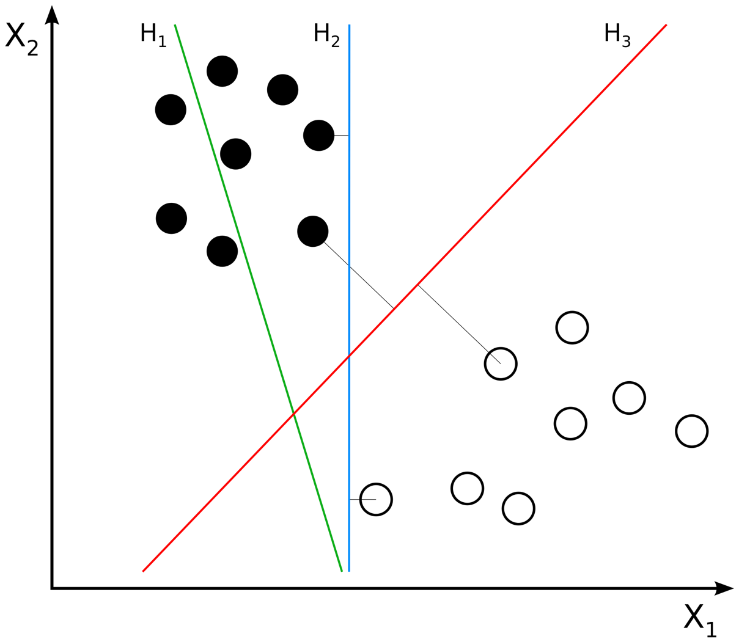
Figure 7.4: Clusters and hyperplanes. An SVM would identify H3 as the optimal hyperplane.

Hyperplane H1 (shown as a green line) does not divide the two classes (the black dots versus the white dots). Hyperplanes H2 (shown as a blue line) and H3 (shown as a red line) both divide the classes; however, only hyperplane H3 divides the classes by a maximal margin.

Let's suppose we are training an SVM as a people detector...

lock icon The rest of the chapter is locked
Visually different images
CONTINUE READING
83
Tech Concepts
36
Programming languages
73
Tech Tools
Icon Unlimited access to the largest independent learning library in tech of over 8,000 expert-authored tech books and videos.
Icon Innovative learning tools, including AI book assistants, code context explainers, and text-to-speech.
Icon 50+ new titles added per month and exclusive early access to books as they are being written.
Learning OpenCV 3 Computer Vision with Python (Update)
Register for a free Packt account to unlock a world of extra content!
A free Packt account unlocks extra newsletters, articles, discounted offers, and much more. Start advancing your knowledge today.
Unlock this book and the full library FREE for 7 days
Get unlimited access to 7000+ expert-authored eBooks and videos courses covering every tech area you can think of
Renews at ₹800/month. Cancel anytime
Modal Close icon
Modal Close icon