




















































Search icon CANCEL
Subscription
0
Cart icon
Your Cart (0 item)
Close icon
You have no products in your basket yet
Save more on your purchases! discount-offer-chevron-icon
Savings automatically calculated. No voucher code required.
Arrow left icon
Explore Products
Best Sellers
New Releases
Books
Videos
Audiobooks
Learning Hub
Newsletter Hub
Free Learning
Arrow right icon
timer SALE ENDS IN
0 Days
:
00 Hours
:
00 Minutes
:
00 Seconds
Arrow up icon
GO TO TOP
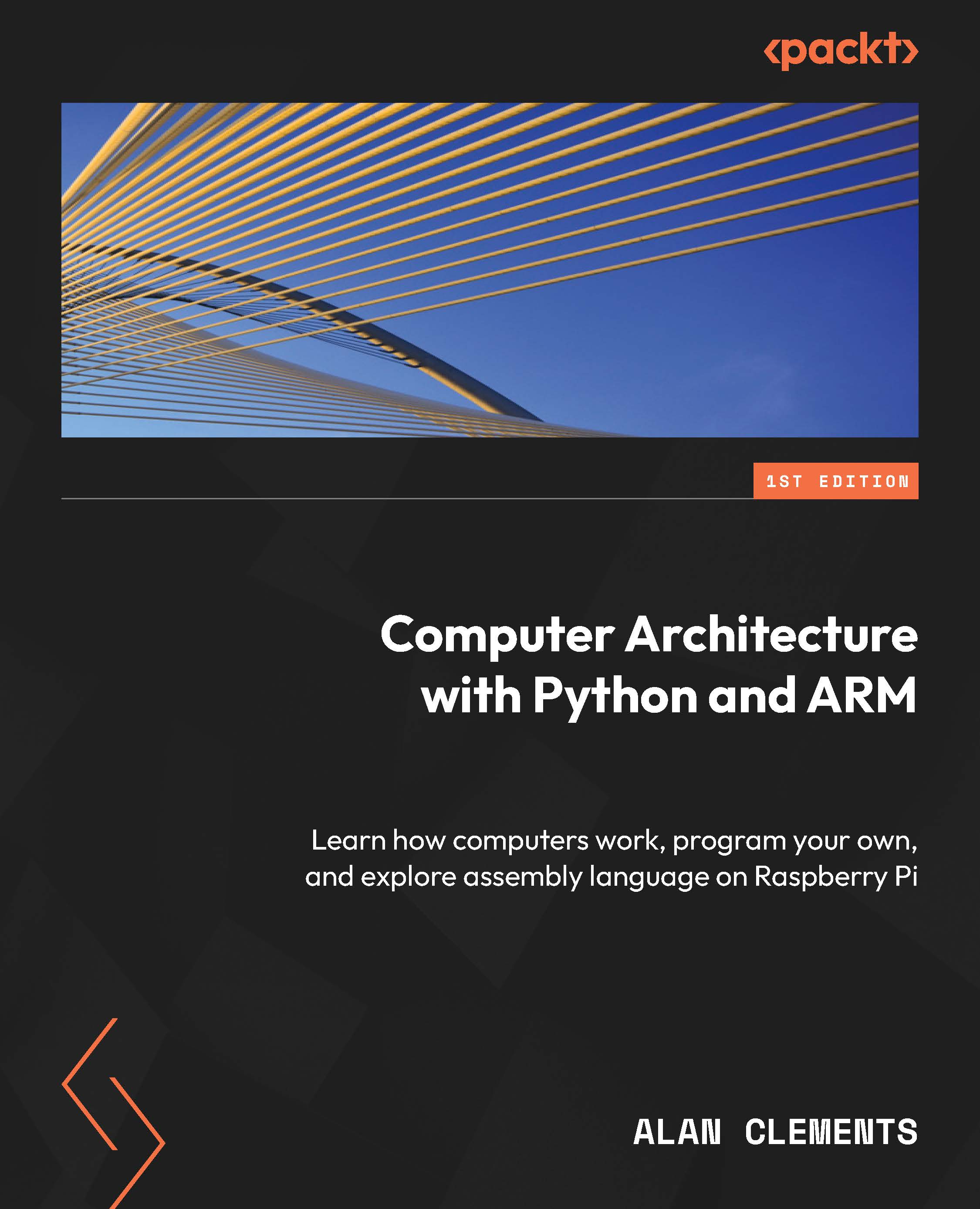
Computer Architecture with Python and ARM

You're reading from   Computer Architecture with Python and ARM Learn how computers work, program your own, and explore assembly language on Raspberry Pi

Arrow left icon
Product type Paperback
Published in Jul 2023
Publisher Packt
ISBN-13 9781837636679
Length 412 pages
Edition 1st Edition
Languages
Arrow right icon
Author (1):
Arrow left icon
 Clements Clements
Author Profile Icon Clements
Clements
Arrow right icon
View More author details
Toc

Table of Contents (18) Chapters Close

Preface 1. Part 1: Using Python to Simulate a Computer
2. Chapter 1: From Finite State Machines to Computers FREE CHAPTER 3. Chapter 2: High-Speed Introduction to Python 4. Chapter 3: Data Flow in a Computer 5. Chapter 4: Crafting an Interpreter – First Steps 6. Chapter 5: A Little More Python 7. Chapter 6: TC1 Assembler and Simulator Design 8. Chapter 7: Extending the TC1 9. Chapter 8: Simulators for Other Architectures 10. Part 2: Using Raspberry Pi to Study a Real Computer Architecture
11. Chapter 9: Raspberry Pi: An Introduction 12. Chapter 10: A Closer Look at the ARM 13. Chapter 11: ARM Addressing Modes 14. Chapter 12: Subroutines and the Stack 15. Index 16. Other Books You May Enjoy Appendices – Summary of Key Concepts

Summary

In this key chapter, we introduced the von Neumann computer with its fetch-execute cycle, where an instruction is read from memory, decoded, and executed in a two-phase operation. It is precisely these actions that we will learn to simulate in later chapters in order to build a computer in software. We have looked at the flow of information as an instruction is executed. The model of the computer we introduced here is the traditional model and does not take into account current technology that executes multiple instructions in a pipeline.

We also looked at the instruction format and described how it has several fields – for example, the opcode that defines the operation and the data required by the operation (e.g., addresses, literals, and register numbers). You will eventually be able to design your own instructions (thereby defining the computer’s instruction set architecture) and create a computer that will execute these instructions.

While describing...

lock icon The rest of the chapter is locked
Visually different images
CONTINUE READING
83
Tech Concepts
36
Programming languages
73
Tech Tools
Icon Unlimited access to the largest independent learning library in tech of over 8,000 expert-authored tech books and videos.
Icon Innovative learning tools, including AI book assistants, code context explainers, and text-to-speech.
Icon 50+ new titles added per month and exclusive early access to books as they are being written.
Computer Architecture with Python and ARM
Register for a free Packt account to unlock a world of extra content!
A free Packt account unlocks extra newsletters, articles, discounted offers, and much more. Start advancing your knowledge today.
Unlock this book and the full library FREE for 7 days
Get unlimited access to 7000+ expert-authored eBooks and videos courses covering every tech area you can think of
Renews at €18.99/month. Cancel anytime
Modal Close icon
Modal Close icon
